after the champagne corks flew

If you heard champagne corks popping yesterday, around 4 p.m., it was us, celebrating the good results of my latest scan. We’d met with my specialist in North Vancouver and he was very clear in his assessment that the nodules under scrutiny are not metastases as first suspected. That scan, a little harrowing, was thorough. So we left his office and went into a bar nearby, ordering two small bottles (the single-size serving) of sparkling wine and to be honest, the bottles had screw tops, not corks. But it was lovely to touch glasses and breath huge sighs of relief.

There’s so much to do. My publisher and I are beginning the process of thinking about a cover image for Euclid’s Orchard., due out in September. I believe that the book will be designed by Setareh Ashrafologhalai, who also designed Patrin. I love her sense of space, her ideas for both cover and page, and look forward to seeing what she does with this collection of essays. I put the manuscript together in the fall, when I was recovering from double pneumonia and was undergoing all sorts of tests for other possible things. I knew it was important not to waste time so I set myself the task of finishing four essays in various stages of completion after Mona at Mother Tongue asked me for a nonfiction manuscript. One of the essays, the title piece, was ready, thanks to Josh MacIvor-Andersen who edited it for Rooted: The Best New Arboreal Nonfiction, available in April. But the others were scrappy, messy, shapeless. Many nights I got out of bed and came down to my desk to sit in the absolute quiet and puzzle away at what it was I wanted the essays to do. I wanted them to explore territory, to shine small lanterns onto dark pathways threading through the lost landscapes of my family’s history. They’re personal and sometimes I wondered — still wonder — at the value of writing that terrain into being. But I also believe that we do the work we’re called to do and that was the material agitating to be noticed and shaped.

Today is Virginia Woolf’s birthday. I began reading her in high school and I remember how much I loved her novels, Mrs. Dalloway in particular. There was everything in it. Later I discovered A Writer’s Diary and lost myself in it. Each generation has its Woolf biography, or two; and for mine, it was Quentin Bell’s. He was her nephew and his sense of her time, her relationships, her houses — so intimate, and beautifully circumspect at the same time. I’ve read later biographies, notably Hermione Lee’s, and other books about Woolf. But I like best her diaries, edited by Anne Olivier Bell, and her letters.

Whenever we go to London, we stay in Bloomsbury, where Woolf often lived, and we walk from the little flat we rent at Cartwright Gardens to Marchmont Street for coffee. I love the street, with its bookstores, small hardware shop with pots of flowers for local gardeners to buy, cafes, stream of people…I remember this bit from the diaries, when Woolf returned to Bloomsbury from Hogarth House:

Can I collect any first impressions? How Marchmont Street was like Paris… Oh the convenience of the place and the loveliness too… Why do I love it so much?

There’s a pub we pass on our way back to the flat from dinners or concerts or plays and in March, the evenings are often mild enough for people to take their drinks to the outside tables. Walking by late, there’s a hum of conversation as one passes and I think of her then, hearing the same sound, on the same street, the air just beginning to smell of green from the nearby St. George’s Gardens.

on marchmont street.jpg

I wonder what she would have made about our current world? She would have had no time for the machinations of a pompous self-aggrandizing man tweeting his tiny vicious thoughts, I feel quite sure. It was a man like that who led her to believe that the world was not worth living in, I think. Her own demons were the world’s demons. On her last birthday, two months before her suicide in March, 1941, she recorded this is her diary:

Its the cold hour, this, before the lights go up. A few snowdrops in the garden. Yes, I was thinking: we live without a future. Thats whats queer, with our noses pressed to a closed door. Now to write, with a new nib, to Enid Jones.

Herakleitos in the snow

fire.jpg

Ποταμοῖς τοῖς αὐτοῖς ἐμβαίνομέν τε καὶ οὐκ ἐμβαίνομεν, εἶμέν τε καὶ οὐκ εἶμεν.
“We both step and do not step in the same rivers. We are and are not.”

I was awake for a couple of hours in the night, working on one of the essays that forms the collection Euclid’s Orchard, due out from Mother Tongue Publishing in September 2017. (Contract signed and sent off!) The essay, “Fish Knife”, is about my late father. And it’s about me. Our relationship.It wasn’t entirely a happy one, though we loved each other.

In the kitchen, at 3:30 a.m., the fire was glowing. In my dark room, with the desk light angled over my work, I was filled with sorrow for that relationship. There’s a little epigraph for the piece:“How can you hide from what never goes away?” It’s Herakleitos, in Guy Davenport’s clean translation. I thought of Herakleitos a lot as I was working on this essay. Rivers, the unity of opposites (“The same road goes both up and down.”), fire, that most fundamental of elements. And my father, somehow in the room, as cranky as ever, and as curious.

This morning, the big fall of snow we had over the weekend is melting. The fire, “an everlasting fire, rhythmically dying and flaring up again,” is warming the house. And my father is no longer here.

Mendel’s tools

Many years ago, I wrote an essay called “The Tool Box”; it’s included in my book, Red Laredo Boots. In it, I looked at a box John’s grandfather had made in England for John’s father Ben when the family emigrated to Canada in 1953. John’s grandfather had been a cabinet maker and he filled the box with handtools, little tins of grease, and he’d even made a level; I think he imagined his gift to his son would be very useful for a life in a new country. The box became a catchall for the things a family accumulates and when I examined the tools within it, I realized that some of the chisels had been used to pry open paint cans. Was the level ever used? Probably not. I keep it on my desk now and take it in my hands from time to time for the comfort of its shape. We built our own house and I learned to use a big level when we were pouring footings and raising walls. It gives me pleasure to see that my desk is level — that means my readings all those years ago were accurate and that our building is sound.

level.jpg

I’m working on an essay now about Gregor Mendel, the Moravian-Silesian monk and gardener who is considered to be the father of modern genetics. This essay was actually born out of another, “Euclid’s Orchard”, a long sprawling piece about love, coyote music, quilts, mathematics, orchards, and genetics. And I couldn’t seem to knit the parts about genetics in neatly enough. So out they came and I’ve been working on them in a different essay. I realized that the thing that really interested me when I visited St. Thomas Monastery in Brno, in the Czech Republic, where Mendel was a member of the Augustinian order, was the case of his pruning tools.

mendels-tools

They are so elegant, with their brass and wooden fittings. And they were obviously cared for. They tell me something about the man who used them — his patience, his diligence. So I’m looking at them, letting them talk to me, and we’ll see what happens. I brought peas back from the little shop in the museum at the Abbey of St. Thomas and kept notes (careless haphazard notes) on growing them in my garden over four years. That will be part of the essay too.

Most of all, I’m hoping that some of Mendel’s patience and care rubs off on me. I think of our pruning tools — one broken saw and one usable one; four pairs of secateurs, one pair held together with black electrical tape and one pair (I’m sorry to admit) hanging out on the fence by the garden where I was using them yesterday to cut down the fennel. A machete we found in our woods, which had probably been left by a salal cutter decades ago. John takes much better care of them than I do. He almost always returns them to their hooks in the workshop. But I get sidetracked or forgetful and leave them out in the weather.

In the top left corner of the photograph of Mendel’s tools, you can see a whetstone. It’s never occurred to me that our pruning tools should be sharpened regularly. I’ve occasionally used a knife sharpener on the edge of one pair of secateurs. Mostly I just struggle when cutting a difficult branch. Is it too late for me to learn new habits? I hope not. I remember how my father kept his hunting knives well-sharpened. In “The Tool Box”, there’s a memory of the oil he used, “a delicious smelling oil that scented the whole basement….I remember sitting on the basement stairs, listening to the blades being ground across the stone, and breathing in the heady oil.” It makes me wonder why some things — hair colour, body shape — are inherited but not the useful things, like the need to keep tools clean and honed.

a Christmas card

This year’s Christmas card from our house to yours:

christmas cardNot an artist, I make a linocut every year and every year I look at it and think how I really ought to learn to use the tools and the materials properly. But the spiral is at least simple and echoes the year’s passage, the stones we saw at Almendres in Portugal last March, the stitching I am finishing up on the “Euclid’s Orchard” quilt, the logarithmic spiral (or Spira mirabilis) evident everywhere in nature, from the flight of hawks, the approach of insects towards light, the arms of galaxies, the patterns of cyclones, and the shells of molluscs. Here’s our message for the coming year, which we send with love, also a form of spiral:

message

“…the red lengths”

spiral

“I’ll use red thread for this quilt, small stitches to draw layer to layer, capillaries to help the blood of our relationship circulate through the images and actual fabric of my thinking. Red thread, long strands carried by the needles I will prepare, three at a time, to allow me to push and pull the red lengths in and out, to meditate between the past and present, to contemplate the future, to secure with tiny knots the end of each fragment of thought.” (from “Euclid’s Orchard”)

his beautiful head

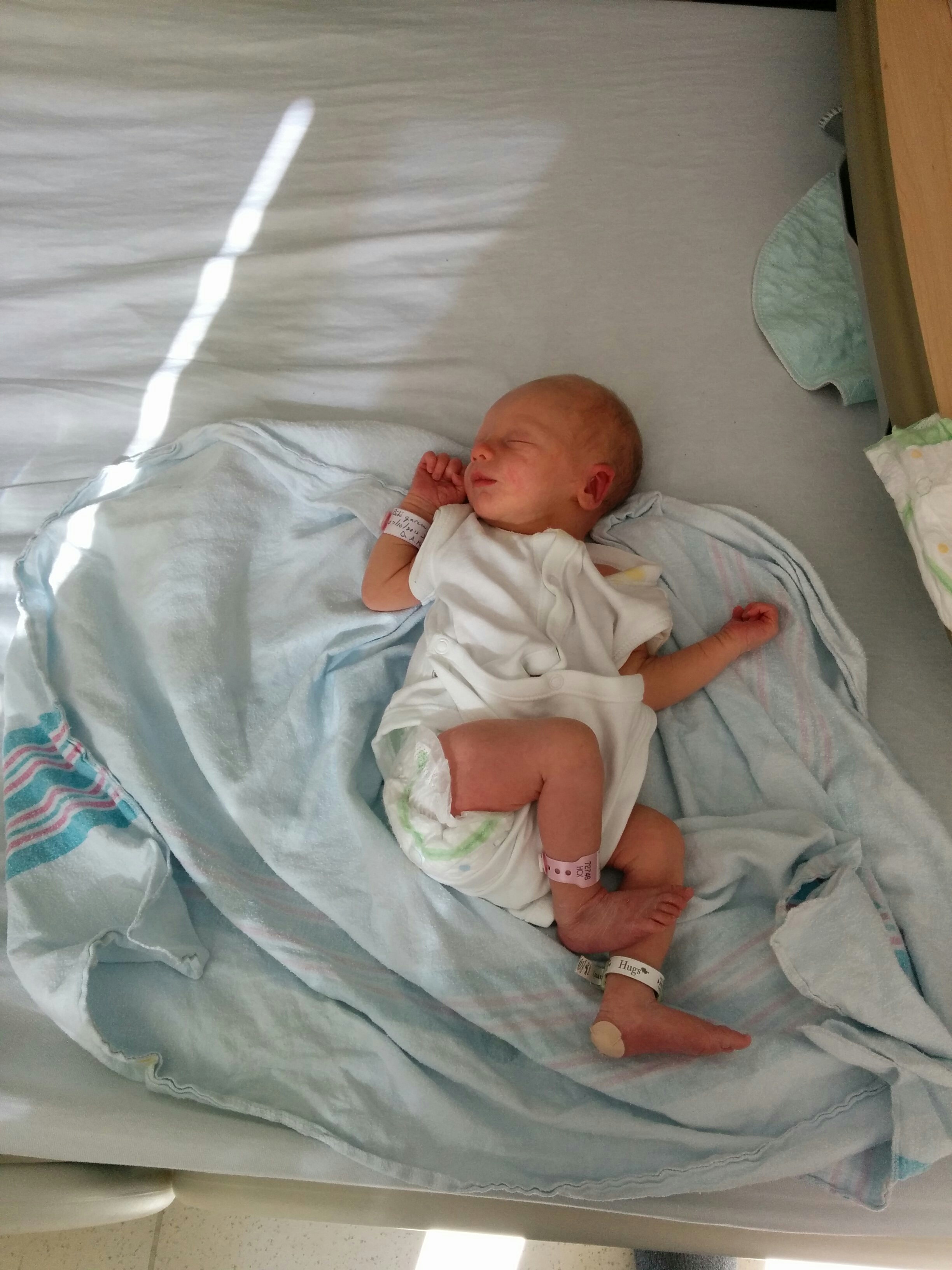
day 2For the last two days, I’ve been looking at photographs of my new grandson. In a week or so, John and I will travel to Ottawa to meet him, to hold him, to congratulate his parents. I think of how my own grandparents must’ve longed for such immediate gratification — I do have some photographs sent by my mother to my father’s parents (they were among the small leavings I took from my parents’ home after their deaths) and there are notes on the back to provide context: age of the children, the location of the photographs. Yesterday Forrest and Manon sent several images taken in the hospital and in response to my observation that Arthur’s hair seems dark, another photograph arrived to show the top of his beautiful head:

arthur's hairForrest’s hair was the colour of a peach when he was born. Soft faint strawberry-blond. And there wasn’t much of it. (Still isn’t! Though it’s more russety now…) So how fascinating that this little baby has what looks like red hair too! When Forrest was born, we tried to think of where the red hair came from. My father remembered one red-haired sister and also several sisters with blue eyes. They were half-sisters, sharing a mother — his mother. No one in my immediate family had red hair or blue eyes. In John’s family, his father had fair hair and blue eyes, as did his sister. (I say “did” for his sister because her hair darkened over the years, though her eyes are still blue!)

I tried to puzzle through the mysteries of genetics in my essay, “Euclid’s Orchard”, and re-reading it, I see that I was already wondering about this baby as soon as I knew he was in process! I was musing about what had happened with the peas I’d saved for three years from seed originally purchased at the Mendel Museum in Brno. The seeds were wrinkled and they produced strong vines with white blooms. For two years the peas were wrinkled and then, last spring, this was what I found in the dried pods I’d saved for planting in 2015:

P1110847

from “Euclid’s Orchard”: In four generations, the Mendel peas have taken different directions, perhaps because of their proximity to the Mammoth Melting Sugars or maybe because mysterious calculations under their own particular skins. I’ve planted them and await their appearance with all the anticipation of awaiting the birth of a child. Which we are also anticipating, in October. A second grandchild; the first being Kelly Samra, born on July 17, 2014, to her mathematician father, Brendan, and her physicist mother, Cristen. She is beautiful, with clear pink skin, blue eyes, and not enough hair to determine its colour. She is lanky like her mother and father—and shares her mother’s blue eyes, which are also her uncle and aunt’s blue eyes from our side of the family, and from her great-grandfather Ben Pass. And who will the new baby be? She or he has a red-haired father, with blue eyes—my older son—and a dark-haired dark-eyed mother. The maternal grandparents have lived for many generations on either side of the Ottawa River, in Quebec and Ontario, and there is an Algonquin great-great-grandmother in the not so distant past.


the stray, its second crop

strays

I wrote about the stray apple in my essay “Euclid’s Orchard” and yesterday John picked its small crop because there’s a bear around right now (yesterday it broke a large limb of the huge crabapple tree) and we don’t want it climbing onto our deck to get at the apples. And I wish I could say the apples taste good. They don’t. But they are beautiful (and kind of miraculous) and maybe that’s enough.

And now a stray. Just beyond the sliding doors that lead from our kitchen to the sundeck, coming up from rocky ground, is a small tree that has revealed itself to be an apple. Not a Pacific crabapple—our native Malus (or sometimes Pyrus) fusca—which is what I thought it was when I finally recognized its leaves and bark. I left it to grow up beyond the pink rambling rose tangled among the deck railings so we could enjoy its blossoms in spring. Last year it had fruit, and they weren’t crabs but fairly large green apples: there were four of them and when it seemed they might be ripe, when they came easily off the branch when twisted a little, I picked one to try it. Not delicious, not even remotely. I think now of Euclid: “The whole is greater than the part.” A tree’s beauty is more than the taste of its fruit. But the question of course is how the tree got there. I know that apples don’t come true from seed. Blossom from a Merton Beauty, say, is pollinated by an insect bearing reciprocal pollen from another apple—here, it would be a crabapple—and although the resulting apples would be true to their tree, their seeds would be the children of the Merton Beauty and the crabapple. One in ten thousand of those seeds might produce something worth eating. Who are the parents of this stray apple tree? It started growing before the Merton Beauty began its small production of fruit. Did this tree sprout from a seed spit over the side of the deck or excreted by birds or even seeds from the compost into which I regularly deposited cores and peelings from apples given us by friends in autumn? Belle of Boskoops from Joe and Solveigh for instance which make delectable fall desserts and cook up into beautiful chutney. Or else a seed from the few rotten apples from the bottom of a box bought from the Hilltop Farm in Spences Bridge, their flavour so intense you could taste dry air, the Thompson River, the minerals drawn up from the soil, faintly redolent of Artemesia frigida. This stray is all the more wonderful for its mysterious provenance, its unknown parents, and its uncertain future, for it grows out of a rock cleft, on a dry western slope.

distil

distilʹ, v.i. & t. (-ll-). Trickle down; come or give forth in drops, exude; turn to vapour by heat, condense by cold, & recollect (liquid); extract essence of (plant etc., or fig. Doctrine etc.); drive (volatile constituent) off or out by heat; make (whisky, essence) by distillation; undergo distillation. So ̴ lAʹTION n., ̴ lʹatORY a. [ME, f. OF distiller, L DI1(stillare drop)

I use my dictionary all the time, my 1964 fifth edition of the Concise Oxford Dictionary. I bought it to celebrate my new vocation as a university student in the fall of 1973. Maybe even the last day of August (though I know of course that there are still three weeks of summer left), as I nervously checked my textbook lists, my binders, the tires of my bicycle (for I cycled to the University of Victoria from Royal Oak in those days, up Quadra to McKenzie and along McKenzie to the campus). There were still a few places on McKenzie where I could stop to visit with horses in those years. Hard to believe now.

So this morning, looking at the pantry shelves, at the preserving I did this weekend, I thought of the word “distil”. Yesterday 4 pounds of tomatillos were distilled into 6 jars of salsa verde. That pile of tomatillos, the onions peeled and quartered, the pile of cilantro, the elegant long peppers from the planter on the upper deck, and a handful of fierce little peppers from my friend June — the heaps of vegetables reduced to a few jars of salsa. But what salsa! It tastes delicious and when I open a jar in winter, when I poach eggs (duck eggs if I’m lucky) in it and savour each aromatic mouthful on a corn tortilla, I’ll remember the paradox of the plenty cooked down into essence.

That was the second batch of salsa verde. And there are many jars of pickled beans, another distillation: tender beans, fresh dill snipped from its pot, garlic from the ropes of it still hanging in the woodshed, some salt, some vinegar, a handful of mustard seed, a small chili pepper tucked into each jar. There are jars of blackberry jam, gooseberry jam, jelly made with Himrod grapes given us by Harold Rhenisch and flavoured with rosemary and lime zest. Still to come: spicy red pepper jelly (a family favourite with lamb), maybe rosehip jelly (because otherwise the squirrels station themselves by my second-story bedroom window and throw the hips to the ground below; they’ve been throwing fir cones to the ground for a few weeks now, hitting the plywood covering the kindling pile so that we wake close to dawn to the sound of shots. What was that? What was that? And then sink back, realizing it’s the squirrels. Again.) The deer have already eaten all the low-growing crabapples but there are plenty in another tree for bears to return to, as they do every fall, and they’re welcome to the scabby fruit, though I hate it when they tear a branch in their eagerness to pick every apple.

quartet

Reading my dictionary this morning, I thought how glad I am to have a few old skills. Food preserving, quilting (for there is one in the works for an event later this fall), even decoding a word and its origins in a 1964 edition of OED. We have two sets of the dictionary in its larger incarnation, in two volumes. Well, no. We have three sets. We have one set of the Compact Edition of the Oxford English Dictionary, a gift to John from me about 15 years ago, bought at Macleod’s Books in Vancouver, missing its case but a treasure. And then we received the Shorter Oxford English Dictionary in two volumes as an incentive for (re)joining the Folio Society. When it arrived, we realized it was missing a section of pages or had been misbound somehow. (When I look at it now, I see only that there are some pages repeated, out of sequence, and I don’t use it enough to be familiar with its tricks.) The Folio Society cheerfully sent another set. I don’t imagine there are huge numbers of people wanting a dictionary in two volumes, for which a magnifying glass at the very least is required. (I’ve given up on those and bought reading glasses.) But it’s good to have these books for when you do need an authoritative source and online dictionaries are not that, or not to me anyway. In some ways our world is moving away from such notions — of ultimate authority, linguistic, orthographic, or otherwise —  but although communities use language and keep it lively and generative, they don’t always keep its long history in their memories. I’d been thinking of distillation as essence, as something (like 4 pounds of tomatillos) reduced to its essential flavour. But that’s process, really, and there’s so much more at play (and at work) in the word itself and its origins. And one word leads to another, either through its own relationships or simply by those around it on the page. The word before “distil” in my Concise Oxford English Dictionary is “distichous”, a word I’ve never seen before. And what does it mean? “Having fruit etc. arranged in two vertical lines on opposite sides of stem.” Yet it’s a form of phyllotaxis, which I’ve recently read a fair bit about (so maybe I just kind of skimmed over “distichous” if it appeared) for the long essay I wrote, “Euclid’s Orchard”.

Phyllotaxis is the term used for the study of the order of the position of leaves on a stem, how the spiral arrangement allows for optimum exposure to sunlight. I think of my children, my brothers, our parents and grandparents and all the generations of the spiral arranged on our own family tree. We are a case study in phyllotaxis, all of us absorbing the light, all of us contributing (“The whole is greater than the part”), even in death, to the ongoing life and vitality of the tree. Though by now, who knows its genus, its specific name.

We have a fire this morning, the first in months, the sweet smell of burning fir taking the damp out of the air, calling me to note the change in weather, season, to celebrate plentitude and to remember the beautiful utility of my small desk dictionary.

“…a coyote is singing a long low passage.”

Last night I woke around 3:00 to hear coyotes singing in the woods. Or the orchard. Hard to tell in moonlight the location of music, particularly coyote music, which is cast to the air in a kind of magic. I thought of my essay, “Euclid’s Orchard”, which also hears the music and tries to make sense of it. Not only its location but its meaning, over time.

From “Euclid’s Orchard”:

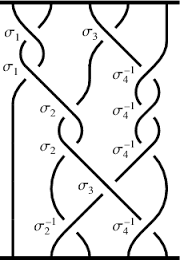
Braid groups, harmonic analysis: The whole is greater than the part. (5th axiom of Euclid)

braid groupsA mid-summer evening, clear moonlight. Down in the orchard, the coyotes have gone under the fence with their young. How many? I’ve seen one, heard several others. I’ve imagined them on the soft grass, tumbling like my children used to play, rolling down the slope over tiny sweet wild strawberries, over the heart-shaped violet leaves, the deep pockets of moss, while around them snakes hid under the lupines. But now in the quiet, I am shaken out of my dreaming because a coyote is singing a long low passage. A lump forms in my throat as I look out into the night, the sky dusty with stars, a three-quarter moon hanging so perfect over the hidden lake that I think of a stage-set, an arranged scene created by strings and wishful thinking. A jagged line of dark horizon and the vertical trees, the line of them rising, then descending as the bar changes, a page of music, the arpeggiated chords, the implied bassline. A pause, a comma of silence. Another coyote joins in, then at least two more. It’s a part-song, a madrigal. Each voice is on pitch but one is low, another high, and several braid themselves in and around the melody line.

See, see, mine own sweet jewel,
See what I have here for my darling:
A robin-redbreast and a starling.
These I give both, in hope to move thee–
And yet thou say’st I do not love thee.

What feast have the parents provided—a flying squirrel, a clutch of frogs, robin nestlings fallen from a tree, a cat from the summer neighbours sound asleep in their beds? See what I have here for my darling—I hear the riso in the father’s line, his extravagant vibrato; and then the sospiroin hope to move thee, as the mother nudges the twitching body towards her eager pups. For she knows, oh, she knows, that by summer’s end, her young will have gone their own way, far from the natal den in the woods just south of the orchard, forgetting the braided perfection of the family body and its unravelling, the strands unplucked and loose, and yet thou say’st I do not love thee.

sleeping house, the last morning

For a week, our house has been full. Three children, their partners, a baby. Some mornings I woke, excited, and wondered why, having forgotten in my sleep that they were all here. And then joy, a universe restored, even temporarily, to its old form. Well, new-old, because who would have imagined the small children who grew up here would become such capable purposeful adults? Not me, not when I remember the diapers, the kitchen floor strewn with toys, the clamour for favourite meals, a swim, the old stories at bedtime. But wait — some things haven’t changed!

I finished a long essay this spring, one I’ve had in mind for some time, and I know I’ve written of it here. It’s called “Euclid’s Orchard” and it’s about math, love, horticulture, quilting, coyotes, and the patterns that unite all of these. Here’s the last section, an offering as I listen to Brendan, Cristen, and Kelly getting ready to leave in less than an hour:

I tried hard to understand the Joy of Mathematics and realized that I couldn’t, except in the broadest possible way. That at the heart of it is an attempt to relate concepts that might not readily suggest themselves to be connected. Number theory and harmonic analysis, for example. And I can only think of those by relating them to the figurative language I learned as a student of literature. Language departing from its logical usage to urge the reader to emotional and intellectual discovery. On that mid-summer night, listening to coyotes sing madrigals in our abandoned orchard, I should have remembered Theseus in A Midsummer Night’s Dream:

The poet’s eye, in a fine frenzy rolling,
Doth glance from heaven to earth, from earth to heaven;
And, as imagination bodies forth,
The forms of things unknown, the poet’s pen
Turns them to shapes, and gives to airy nothing
A local habitation and a name. (V. i. 12-17)

They were our names, our bodies under the heavens, all of us singing together in different voices to tell the story of our orchard, our time here in this place we have inhabited since – for John and me – 1981, and the only way to shape the story is through connotation, not ordinary discourse, though I praise the literal, the specific, but by reaching up into the starlight to parse what lies behind it. A mathematician might see the strong-weak duality this way:
weak duality
I’ve tried to puzzle through equations: the arrows, the lines and diacritics, the glyphs, the beautiful characters that look like Greek to me. Oh, wait, they are Greek, though not used to shape the yearnings of Sappho or the grand battles of the Iliad, but something else: a notation, a way of assigning symbolic value to constants, function, variables. A way of talking about equalities between variables. It’s the chicken and egg argument written in the ancient markings of Simonides in wax. Would math work in Chinese characters or the syllabics of the far north? Would flowers still smell sweet if their seed patterns were random? Was a baby ever born without the blue eyes or sturdy legs of a potato-farming ancestor near the Carpathian mountains? Would it matter?

Inside I am stitching a spiral into the layers of the orchard I have pieced together, a snail shell curled into itself. That’s what I’ll see when I’ve finished. I begin the spiral at its very heart, keeping my course as even as I can as it opens out and widens. Not the complicated pathways of the sunflower, some turning left, some right, so that an optimal number of seeds are packed in uniformly, or Romanesco broccoli, its arcs within radi resulting in something so intricately beautiful I wonder how anyone could cut into it to eat it. On windowsills, pinecones. The plump Ponderosas, brought home from the Nicola Valley, and a few long monticolas. They’re dry, open, but at the base, where their stalk connected them to their trees, two spirals are still visible, like a relaxed embrace, lovers asleep. My spirals are simple, my hands sewing to follow a path from its knotted source, around and around, until I’ve learned that my pleasure comes from the journey itself, a needle leading me outward, towards completion. A quilt elegant and sturdy, a sequence emptied of its numbers.

And listen: the coyotes are singing, the deep voice of the father, the rather more shrill voice of the mother – anxious that all her offspring eat well and learn to hunt, to care for their safety in the forest beyond the orchard – and the lilting joyous youngsters unaware that a life is anything other than the moment in moonlight, fresh meat in their stomachs, the old trees with a few apples and pears too small and green for any living thing to be interested in this early in the season.