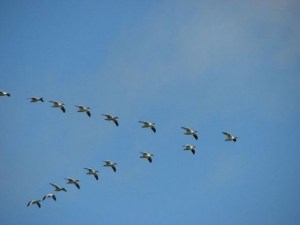
One autumn evening, under brilliant stars, a white coyote crossed the highway as we drove home from Oyster Bay. Its eyes glowed, and its ears were beautifully shaped, like receptors— every sound of the night entering them: owls, mice skittering under dry grass, a raccoon leading her kits to eat apples in moonlight, even the skeins of snow geese heading south in the darkness, muttering and calling, their navigational system a form of quantum entanglement.
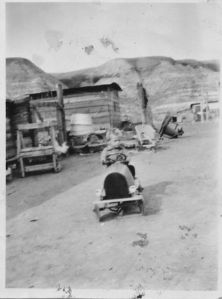
It’s a strange experience to be pursuing the sad origins of my father’s family at the same time that my immediate family is growing and flourishing. In Edmonton, on the same greyscale film as these old photographs, oddly enough, I viewed the ultrasound of Cristen and Brendan’s baby, due in September. I saw the baby’s hand, the baby’s face. And last year, in late February, as John and I visited Amsterdam to attend a wedding, a call came to our hotel from our older son Forrest and his wife Manon to tell us that they were expecting their first baby. Moments later, an ultrasound of beautiful Arthur arrived on my small Samsung tablet. I hold all of these in my mind and my heart’s archive, these grey approximations of the lives I cherish, even the ones so far away in time, that I will never know exactly where the boy who rode that little car lived, or where the family gathered in front of a weathered house dispersed to after the funeral. And did that boy’s grandparents, my great-grandparents, back in the small house in the valley below the Mionsi forest, ever see a photograph of him? Ever learn his name? They never saw their daughter Anna again.
A time of birthdays. It’s Arthur’s today — the boy in the passage above, from Euclid’s Orchard, who appeared first to us in an ultrasound image in an Amsterdam hotel, is two. He sings, he loves his weekend breakfast at Bobby’s Table in Ottawa, and this morning he was celebrated in that restaurant with his own pancake.
Via Skype, we watched him open the package of gifts we sent: a book, a pirate flag, a pirate ship puzzle, and other small things (we also sent him a wooden balance bike in summer so he could use it before the winter weather arrived). I think he liked the little soft globe, the earth writ hand-sized, best. That’s always the way with little kids. They like the wrapping paper (Arthur was drawing on the brown paper I’d wrapped the box in before his dad wondered if he’d like to do the puzzle), the tiny presents —a wee plastic aquarium you put water in and the fish grow!; but of course the adults tend to think the bigger the better.
Arthur’s cousin Henry turned one exactly a month ago. And the great-grandfather of both these boys would have been 91 in a few weeks. He is the boy in the little car in that bleak farmyard in the photo above. His is the shadow I live inside, mostly gladly, a shadow left by poverty and complicated history. He would have been good to these little boys, showed them how to use a fishing rod, and maybe even taught them Morse code. I cast my own shadow too, the one my oldest grandchild noticed in May as we were walking on the street in front of her house in Edmonton. Sometimes it dragged behind us, sometimes alongside us, a grey approximation of how we are connected across time.
…crowd in Ganges, on Salt Spring Island, we took refuge in Mouat’s Store. Located in the heart of the village, Mouat’s has been serving customers since 1907. When I was a child, camping at St. Mary’s Lake with my family, I used to love going to the store with my father. He’d been looking for a lure, a hook, a new reel of fishing line. Or a part for a pot — he was nothing if not resourceful. He’d spend hours in hardware stores, looking (it seemed) at each nut and bolt, each small hook, determined to find its weak point or flaw. If he found none, he’d buy it, taking money out of a worn brown wallet. If we were lucky, we got a quarter. There was always something in Mouat’s to spend money on. Or dream of buying.
I never would have had enough money to buy a music box. But yesterday I did and so when I spotted this beautiful tin box with a little handle and painted with Jemima Puddleduck, Peter Rabbit, and that rogue Pigling Bland, I knew I had to have it. When you turn the handle, it plays Für Elise in a hesitating way. I love it. At first I thought I was buying for a grandchild but no. It’s for that little girl who wanted to play piano, who wanted something to transport her occasionally far from the world she knew.
We were on Salt Spring for an event at the library. I was to read with Sarah De Leeuw and we were going to talk a bit about the essay—I’ve just published Euclid’s Orchard and Sarah’s Where it Hurts came out in spring from NeWest Press. But then Sarah wasn’t able to come and so Mona Fertig and my husband John read a little from Sarah’s work. Then I read passages and answered a few questions and we drove back to Peter and Mona’s in a drizzle of rain. We had drinks with an old friend Diana Hayes and her Pete and slept in a room overlooking the ocean, window open to the rain. Driving down to Fulford Harbour to take the ferry back to Vancouver Island, I felt (rather than thought) the beginning of a, well, a long essay, maybe even a book about the old coast. The coast I knew as a girl and still find traces of, on Salt Spring, on Vancouver Island, on the shore of Okeover Inlet or at Earls Cove, at Egmont, in places where the wood is weathered, the boats are useful, and people still know where they are. They’re not busy plotting for bridges from one island to another, for fancy forms of governance, for a billion dollar highway to blast its way from Squamish to Gibsons. They aren’t interested in sidewalks in rural fishing villages or buried power lines (because that’s how it’s done in Montreal). A bucket of clams is a dinner, a sockeye salmon a feast.
This morning we ate slivers of the most beautiful smoked salmon as we talked and then Mona poured tiny glasses of crabapple liqueur she’d made last year. I thought of Crete when I lived there and how sometimes the father of the man I was in love with poured Metaxa from a bottle he kept on his boat and we toasted the morning and our collective health. His son, who owned a taverna, took home a string of fish to gut and fillet for the evening crowd. I thought of my old friend Charles Lillard and his lines from “Closing Down Kah Shakes Creek”:
This is the old west where a secret cove with an old house is called history, a raven cackling on a limb, mythology…
Where a music box playing Für Elise summons it all back. For now. Until I can write it all down.
I’ve always loved the idea of gifts and reciprocity. The circular pattern of that process. What you give, you receive. This time of year I fill our pantry shelves with preserves, more than we can ever use. But when we are invited to dinner with friends, we take wine, yes, and often a jar of jam or pickled beans or a herbal jelly. I remember the time I spent living on Crete in the 1970s and how I would accompany my love interest of the time, Agamemnon (yes, that was his name!), to dinners with friends of his family. At the door we would be greeted with a small tray holding a glass of water and a jar of quince or cherry preserves. A long spoon. We would take a spoon of the preserve, called “spoon-sweets”, followed by a drink of water. Sometimes a tiny cup of coffee. This practice was part of an ancient code called Xenia. The guest was treated well in part because he or she might be a god or goddess in disguise. And if that didn’t prove to be the case? Well, no matter. The host had done the right thing. And a guest treated well was unlikely to behave badly.
“When the gift moves in a circle its motion is beyond the control of the personal ego, and so each bearer must be a part of the group and each donation is an act of social faith.”– Lewis Hyde, from The Gift: Imagination and the Erotic Life of Property
When people come to us, they bring flowers or books or wine; I feed them; John keeps our glasses replenished; they tell us stories and we share our own. Sometimes they leave with a bag of kale or a rooted cutting of wisteria or scented geranium. It’s the world I want to live in so I do my part.
Someone who does not know the Tigris River exists
brings the caliph who lives near the river
a jar of fresh water. The caliph accepts, thanks him,
and gives in return a jar filled with gold coins.
— Rumi, from “The Gift of Water”, trans. Coleman Barks
Someone once said as she arrived for dinner and put a jar of beautiful raspberry jam on the counter, “It’s like bringing coals to Newcastle.” But it wasn’t. Not at all. We grow wonderful raspberries but I never make jam of them. I don’t know why, quite. It seems there are always other things happening when the raspberries (cherished, for sure, but also called “the frigging raspberries” late in their season when they have to be picked, yet again, almost always by John, and arranged on trays for the freezer. In peak season, there’s a bucket a day….), anyway, when the raspberries are ripe so I never make jam of them. And hot buttered toast, with raspberry jam, in January? Oh, man.
So this isn’t entirely about jam. It’s about exchange. John printed these keepsakes on our Chandler and Price platen press to give out at my book launch and yes, we did that. Or Bev Shaw did. She owns Talewind Books and is the gracious bookseller at so many literary events on our coast. (Those who attend the Festival of the Written Arts in Sechelt will recognize her name!) She is a true friend to writers and readers. We have copies of the keepsake left. I’ll take some to Munro’s in Victoria for the reading I’m doing there on October 4th with Bill Gaston. But in the meantime, send me a photo or maybe just a confirmation that you’ve bought a copy of Euclid’s Orchard (my contact info is in the menu on the right-hand side of my home page) and I’ll mail you a copy of this lovely little letterpress keepsake. I can’t offer you a spoon of jam at the door and a glass of our delicious well water, not unless you visit us here, but I can offer something else. And I’m very happy to do that.
So, Euclid’s Orchard is well and truly launched.Maybe it began to feel like it was actually in the world when I saw the sign in Talewind Books earlier in the week,
and certainly when my publisher Mona Fertig and her husband arrived for lunch yesterday on their way back from Savary Island,
and, well, the day before that, when I baked the desserts that were waiting to be packed up for transport down to Sechelt.
Two apple galettes (“One apple tree remains under my care. It’s a Merton Beauty, bought as a tiny plant at a produce store in Sechelt.”), a peach and blueberry galette (“…that road led back to the foot of Poignant Mountain, forgotten and then found, lard pails stained by blueberries…”), and a dense chocolate torte that uses 2 Tbsp. of flour so it’s easy to make it gluten-free with rice flour for those who don’t eat wheat. A round of Brie, a jar of last year’s pepper jelly, fierce with Vietnamese peppers, and a few Merton Beauties to have with the cheese.
The Sechelt Library opened its doors, set up chairs, long tables for those desserts, tea and coffee, and lots of posters of Euclid’s Orchard‘s vivid cover. I wondered to Margaret Hodgins (the Chief Librarian) if anyone would actually come but by the time she introduced me, people were spilling out of the doors. It was so wonderful to talk about my book and read passages to people I’ve known forever and new faces too. To talk about how math came late to me, after a visit to Brendan when he was at the Mathematical Sciences Research Institute above Berkeley in 2013—he’d told us that he and Cristen were expecting a baby and I saw for the first time how we move forward in time, how we anticipate the future and how the past is hovering still, as potent as anything, that we are everywhere and nowhere simultaneously, and that Brendan knew equations that might help me to know this more deeply. To know him more deeply, as a man, as a father. And it was the Sechelt Library that had the copy of Joy of Math dvds that I brought home and diligently watched on my computer screen, understanding about 30% of the material but realizing how beautiful the structures are. (At least one person came to me afterwards to say that he was going to have a look at the Joy of Math. T. Kishkan, math recruiter?) I’d asked for a screen to have behind me as I read and on it a series of images passed quietly, some of them photographs from the book, and others of those strange presences who hovered as I was writing the essays: my grandmother and her first husband in the early days of their marriage; my grandfather’s sisters (I think they must be); the dusty streets of Drumheller, circa 1913, when my grandmother arrived with her 5 children after a long ocean voyage; an ultrasound of a beloved grandchild; my mother in a garden as a small girl; a funeral gathering by the house my father grew up in, though three years before he was born. I felt them in the room as I felt them last fall.
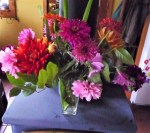
Anyway, it was wonderful, all of it. Some brought flowers.
After the reading, Bev Shaw sold books and tucked a copy of the little keepsake John printed into them. (It helps to have a husband who is a letterpress printer, among his other accomplishments.)
People ate and talked and I thought how the whole evening was a gift. A year ago, I wasn’t sure how the future would unfold because of what tests and scans had revealed. That’s all in the past now, part of the never-ending story that I am constantly listening to, trying to tell.
The other night I heard the most unearthly sound as I worked at my desk, window open. It was actually more like early morning—I woke at 3 and couldn’t get back to sleep so I came down to see if I could find my way into an essay-in-progress. The sound was close, just to the south of the house, the area where the coyotes den, though we haven’t seen them much this year. Not owls, not drunks on the lake below. John was upstairs and later I asked, Did you hear that cry? and he replied, Yes, just as he dropping back to sleep.
This morning we went early for our swim and the man who caretakes the small regional district park on Ruby Lake was there, raking the sand and picking up litter. He told us he’d seen a cougar crossing the highway below our place yesterday morning. As I swam lengths in the green water, I realized that it must have been a cougar we’d heard, a female in heat. There’s a moment in the title essay of Euclid’s Orchard where I recall an earlier moment when a sound woke us, though we were in a tent that time:
I don’t remember when coyotes arrived at the north end of the Sechelt Peninsula where we built our house in the early 1980s. There were coyotes in Vancouver, certainly, but not on our part of the coast. People said that a healthy cougar population kept them away. And in those years, we heard regular reports of cougars passing through schoolyards, hovering on the beaches, prowling the hiking trails along the spine of the peninsula. We heard one once when we were living in a tent with our first baby, building during the day and collapsing onto the foam mattress within the canvas walls at night. We heard it scream— yes, it was blood-curdling—and our dog, Friday, a big English sheepdog cross who slept under the tarp by the entrance to the tent, began to dig under the plywood platform we’d built so that the tent would be off the damp ground; she wanted the safety of the small space between earth and plywood. Now I know the cougar was probably a female in estrus, alerting males to her availability. But in the darkness, it was as wild a sound as I’ve ever heard.
There are a lot of deer around now. In the years I’ve lived here, I remember the cycles of deer and bears. Some years there would be many, others when you’d hardly see an animal. This year there are lots of bears too and I hope there will be a good return of coho in local streams to give them a big protein meal to sustain them over winter. A cougar moving through this territory is a healthy thing, I think. And that sound in the night? A privilege to hear it.
Today I’m expecting my new book to arrive. It’s my thirteenth book and I should be blasé about it but I have to confess that this never gets old—the anticipation, the greediness to simply hold the book in my hands. To read what I wrote in a form that is not a computer screen or pages from my printer. Will the cover really look as lovely as I hope it will? Did I leave anyone out in the acknowledgements? Did I miss any major spelling errors? (I have the excellent Mother Tongue team behind me…)
A year ago this week, John and I went to Vancouver for a couple of reasons. He was scheduled for a biopsy and we were meeting Forrest, Manon, and Arthur at a hotel near the airport; their flight was going to be late and because we had to be in town the day before, we booked a room at the hotel where they’d be staying so we could bring them back home with us the next day. John had already had a biopsy a few years earlier and thought this one would be like that one—a little uncomfortable but not so big a deal. Somehow the fasting was more difficult this time around and by the time we drove down the Coast, took the ferry across Howe Sound, made our way over to the hospital, and waited, waited, for the procedure, he was pretty woozy and depleted. It didn’t seem like the time to tell him that I could barely breathe.
After a belated breakfast, we went to Richmond to the hotel and had a long nap, followed by dinner nearby. If I sat up straight, it was better. Lying down was painful. I quietly wondered if it was something to do with my heart. Or what? But then a text came to say that our young’uns were enroute to the hotel and there we were in the parking lot as the shuttle pulled in, hugging them, helping them up to their room with all the stuff you need when you travel with a baby. (Arthur was not yet a year old.) Though I have to say they travel quite light. And we have a big basket of cloth diapers, covers, shelves of clothing bought at thrift stores, in varying sizes because there are three grandchildren. We have a crib, a highchair, toys, and books.
And then it was morning and we were in our car heading home, Arthur in the car seat we’d recently bought. We were driving home, singing to the baby (though I had a hard time catching my breath), and stopping here and there for snacks, a bit of a break.
That night, just as we were getting ready for bed, I told John I thought he better take me to Emergency in Sechelt, a 45 minute drive from us. I couldn’t breathe and the pain in my chest was phenomenal. He was feeling a little grim himself but raced us down the Coast and the rest is the story of the year between then and now. Double pneumonia, which shouldn’t have been such a big deal—antibiotics worked quickly and well—but the first chest x-ray was disturbing apparently, full of weird stuff, and a second was scheduled for two weeks later.
But before the second x-ray, somehow the week of my family’s visit was memorable. Angelica came for part of it and everyone helped to make beautiful meals. After a day or two of the antibiotics, my breathing improved and the pain went away. We went up to the Laughing Oyster restaurant one day for lunch (it took the whole day because there was the ferry between Earls Cove and Saltery Bay, the long drive to Desolation Sound…) and it was wonderful to sit by the weathered wooden rails and look out to Okeover Inlet, drinking lovely cool white wine (I’m not one of those people who eschews wine while on medication…), watching seals in the water below us.
The second x-ray led to a CAT scan 6 weeks later, then a second hurriedly arranged (I was driving home from the first scan as the radiologist was frantically trying to call me) because that one showed not only a pulmonary embolism but also strange shadowy areas in my lungs which were thought to be metastases. There were tests, more tests, blood thinners to keep more clots from forming (and not rat poison but something new and very expensive that made me grateful again for Tommy Douglas and our health system), doppler scans of my legs, a visit to a specialist who showed me images of my lungs that were like maps of deep water, with areas I thought resembled amoebas. No, not amoebas, he assured me very formally. But maybe metastases. He used a pointer to describe the margins. He spoke of biopsies, gold standards of treatment, and so forth. He also scheduled a PET scan at the Cancer Clinic. He hoped this could happen before Christmas but it was possible I’d have to wait until shortly after.
So that was the fall. John’s biopsy results were negative, a huge relief, but the poor man was so worried about me that other issues developed. I insisted he swim to relieve some of the stress and he went off three mornings a week to our local pool (where our children learned to swim three decades ago). And what did I do? I wrote most of a book. In late summer, around the time that I was developing double pneumonia (though I’m not implying the two are linked!), Mona Fertig of Mother Tongue Publishing wondered if I might have a non-fiction manuscript she could consider for fall of 2017. I didn’t think I did. I’d written a long essay called “Euclid’s Orchard” and I had two other short essays in something like final draft form. Masses of notes, masses of fragments, all of which I hoped to eventually turn into essays or maybe even something longer, of a piece. These had to do with research I was doing into my family’s history in Canada. In the spring of 2016, John and I were in Alberta and I spent a little time at the Archives in Edmonton, thinking I’d find one thing and instead discovering a whole chapter of my grandmother’s early years in Drumheller that I hadn’t known and I suspect my father hadn’t known either. We drove down to Drumheller that spring, hoping to find out more. And it might sound strange to say this but there were ghosts everywhere, some of them mine.
In the nights while John slept, I came down to my desk and turned on the little lamp to make a small light to work by and I wrote about three quarters of the work in the manuscript that I did send Mona in late November and that she liked enough to say, Let’s do it! It wasn’t in finished shape in the fall and winter but I felt that I needed to do what was required to make it as good as I was able to. I didn’t know if I’d have more time, more seasons, and there was no one else who cared enough about the material to do anything with it. Maybe “care” is the wrong word. My brothers care and my children care but somehow I felt that I was called to do the work. I saw my ancestors everywhere in the winter. Looking out to the patio, they were just leaving, wispy in the cold air. Before sleep, they were around my bed, holding the edges of the sheet. I felt their hands on my shoulders. I felt them in me. I can’t say I regret the strangeness of that time, the uncertainty. I learned things. I was given things. I was welcomed into the odd embrace of people dead a hundred years. They spoke to me, though I couldn’t understand their language; and they sang to me. In the darkness, I might have felt alone but thanks to my ghosts, I was never so surrounded by love and continuity. This is true for my living family as well.
I wrote about the post-Christmas PET scan here and was relieved a few weeks later to learn that there was no sign of cancer after all. A final scan in June was also negative. My specialist says he doesn’t need to see me again. A happy ending certainly, though there are still mysteries: if not metastases, then what? And the embolism? Who knows. I joined John at the pool three mornings a week and all summer we’ve been going down to Ruby Lake around 8:30 and swimming for half an hour. Some mornings there are kingfishers. Always crows. Some mornings there are bear tracks in the damp sand. Ghosts there too but more familiar ones. My children from infancy to adulthood, and their children. When Forrest, Manon, and Arthur were here last month, they came down to the lake with us and I loved hearing their voices as I swam back and forth in the green water under the old cedars.
Someone recently said to me, “I didn’t think you’d have another book out so soon.” Well, no. I didn’t either. But sometimes the stars conspire, they spark and set off fierce events in our lives, and we respond. I felt like a door opened. What was beyond was a little frightening but also mysterious and beautiful. Some days I still feel as I felt on the winter day when John and I listened to Christy Moore singing an arrangement of the Yeats poem, “The Song of Wandering Aengus”.
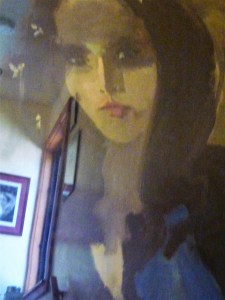
We held each other and wept, for the uncertainty of our future, and for everything we loved, and when the song finished, I went downstairs, looking up to an old portrait of me, painted when I was 22, another of the ghosts who gave me comfort on those dark nights. Who is still alive to me. (I couldn’t photograph her well because she’s in a stairwell and so you see everything else reflected in the glass but maybe that’s appropriate.)
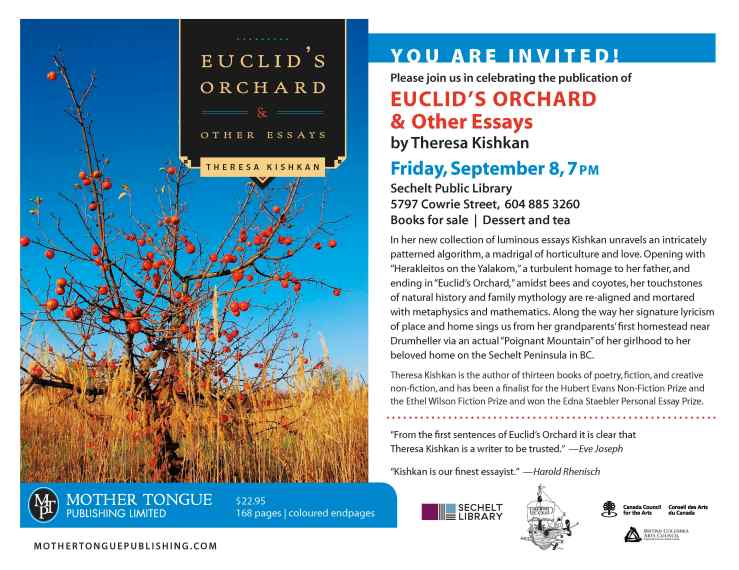
Now that the launch date has been set for Euclid’s Orchard—September 8th, 7:00 p.m., at the Sechelt Public Library (desserts to follow reading!)—my husband John has just printed a little keepsake to hand out to those who buy books that evening (book sales courtesy of Bev Shaw at Talewind Books). If you think you recognize the spiral image, it’s because it’s the same one we used for one of our Christmas cards a few years ago. a linocut, created by me. I’m not an artist, obviously, but Euclid’s Orchard, particularly the title essay, has spirals (some of them featuring the golden or logarithmic spiral, though this isn’t one of those), so it seemed a good graphic element for this keepsake. Two runs through the press (the big Chandler & Price) because it’s two colours. For years I’d look out the blue-framed window at the north end of the kitchen and see him out in the print shop, leaning over the press or the table where newly-printed pages were drying and so it was nice to pause there again and see him. Because all the doors and windows are open, I could even hear the thumping of the press working away—it’s treadle-driven— and I thought of it as a pulse. A heart-beat, a printer placing paper against the friskets on the bed, bringing the inked type-filled chase down to the bed so that the type could meet the paper and impress itself into the fibers.
Does it feel a little like we’re coming to the end of summer? I know there are weeks of it left but the weather has changed, the smoke’s gone, and there’s a cool thread running through the warm air. This coming weekend is the Pender Harbour Chamber Music Festival, something I’ve been involved with off and on for 13 seasons. It’s going to be a good one. We’re sold out and the excitement is high. Tonight is a dinner to welcome the musicians (who arrive early for rehearsals) and to thank their host families. I’ve made an apple galette and have picked a handful of nasturtiums to garnish it. The programme is spectacular this year, with many Canadian composers woven into each concert. The Harbour’s own mezzo-soprano, Rose-Ellen Nichols, is singing “Ships of the Night” from the Tobin Stokes opera Pauline; Rose-Ellen premiered the role with Vancouver City Opera and I’m looking forward to hearing her again. She’s part of our Rising Tide initiative where we invite young performers for an afternoon concert and it’s free (though with limited seating so only the first hundred people will be able to sit in the performance space, though others can sit on the grass outside).
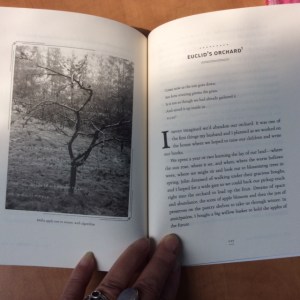
Yesterday my publisher Mona Fertig sent me photographs of the approval copy of Euclid’s Orchard. (It had just arrived at her house on Salt Spring Island and she knew I’d like to see how beautifully it turned out. The physical book, I mean.) And oh how lovely! The cover’s sky is particularly gorgeous, given our own grey haze, the result of fires burning all over British Columbia.
But it was the inner spread she also sent, the opening page of the title essay and the image I chose to take the reader into its world, that I am so happy with. It’s a Melba apple tree, in winter, in the orchard we planted so joyfully (and with a lot of hard work) back in the 1980s and then finally abandoned, with sorrow, a few years ago. The essay explores this and it also explores my attempt to decode some of the mathematical ideas so integral to my son Brendan’s life, both in his childhood and now as a math professor in Alberta. I wanted an image that was somehow proximate, that referenced history, pattern-making, botany, the relationships between quilting and Euclidean geometry, and the ghosts who hover in our lives—our younger selves, our ancestors, the disembodied voices of coyotes in the night, even Euclid of Alexandria himself, with his Elements and his proofs. Brendan was good-natured about helping me with so many things while I was writing this essay and his patience continued as I co-opted him to produce a Euclidian algorithm in various forms in the hope that one of them could be layered with the Melba apple tree in winter. Designer Setareh Ashrafologhalai worked her magic and voila!
Old moss and lichen, bare boughs, and the technique for finding the greatest common divisor of two integers. Magic.
I hope anyone on the Sechelt Peninsula will join me and Mother Tongue Publishing for this event! I look forward to seeing you there! More events to follow — see my News and Events page for details.






 ...Theresa Kishkan