“On hair falling down in curls.”

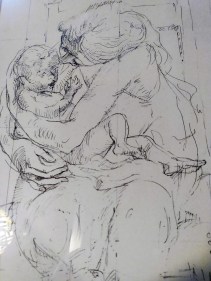
This morning, coming into my study, I stopped by the door to look at the drawing hanging on the wall. How many times do I come into this room and never notice it? Hundreds of times. Thousands. But this morning I noticed. Last year, over the Christmas holiday, I was writing a long essay in which this drawing has a little cameo. I was writing an essay about the artist who drew it–me–and how his life and my life entwined for a few years. By the time he drew this, we were “friends”, or at least that’s what I thought. But writing the essay had me re-reading a stack of old letters he’d written to me and I realized he never gave up his obsessive hope that I would realize I should make my life with him.

“On hair falling down in curls.”

Section 389 of Leonardo Da Vinci’s Notebook.

On hair falling down in curls:
Observe the motion of the surface of the water which resembles that of hair, and has two motions, of which one goes on with the flow of the surface, the other forms the lines of the eddies; thus the water forms eddying whirlpools one part of which are due to the impetus of the principal current and the other to the incidental motion and return flow.

He drew me once with my third child. He drew on rough paper that began to deteriorate almost at once. He made a copy and brought it when he came for a visit. It’s on the wall outside my study and I see it every time I come in to work at my desk. When he brought it I almost forgot the difficult weeks, the letters, the pressure, the insistent pronouncements of love. Look at my strong arms, the drapery of my clothes, the soft curl of my hair down my back, like water in motion. Look at my hands.

drawing3

I almost forgot.

Hundreds of time a year I pass the drawing. Hundreds of times I come down the stairs from my bedroom to encounter a portrait of myself hanging in the stairwell, myself at 23. The essay began as a conversation with that younger self. I finished it last March and it sits in various forms–paper, pdf, etc.–in my study. It would be difficult to publish it, for some legal reasons, for reasons of length (34,000 words) and subject matter (the male gaze, how it insinuates itself into a life, and how difficult it is to look away), and maybe most of all for personal reasons that involve my own sense of trespass. (It’s complicated.) Writing the essay was troubling and also cathartic.

As the old year fades away in grey light, I am sitting at my desk and thinking, taking stock of the past 12 months: what was accomplished, what was lost, what gave me joy, what didn’t. I wrote this essay, I worked on a novel, Easthope, set near me on the Sechelt Peninsula, I spent time with my family, with a few good friends. I swam in the Pacific Ocean in January on a trip to Baja and I swam daily, from the first of May until mid-October, in the lake near my home. As the old year fades, the lines of the drawing fade a little too. It’s behind glass. When I swim, my hair is water in motion and the years flow around me like water. There was so much I forgot until I wrote it down.

the summer plates are put away

summer plate

The last guests of summer have just headed down the driveway on their way to the ferry, then Edmonton. In July, two groups visited. In August, family arrived on the 5th and they left two weeks later, another group arriving a day later, and then another overlapping for a week, and staying until this morning. School starts on Tuesday so that’s their signal to head home. The washing machine is whirring with towels and sheets. I put the summer plates into the cupboard, the stack of 15 ready for next summer. We set them on the table for every meal, along with the silver we use for larger groups because there’s lots of it and why wouldn’t you use the best cutlery for your family?

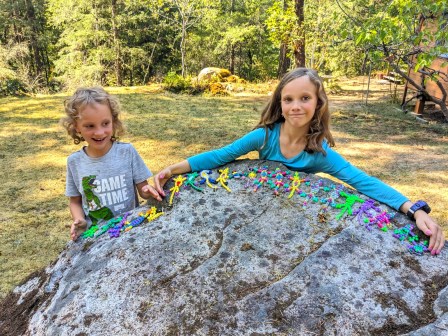
It was a summer of daily swims (and those will continue for me into October when I’ll reluctantly begin my pool swims 4 mornings a week), large meals–prawns, halibut, salmon, platters of lamb kebabs, garden salad, and last night the traditional send-off meal for Brendan and Cristen: prime rib with Yorkshire pudding, roast potatoes with rosemary, and nectarine upside-down cake with homemade strawberry ice-cream–outings to Francis Point where the kids explored tide-pools and saw a pod of orcas passing, visits to the thrift stores by everyone who came this summer, family dinners at the Backeddy Pub where I walked grandchildren down to look at the boats and seastars on the rocks while we waited for our food to arrive. We had our archery lessons from Grandpa John, the Gatineau kids hung their drawings outside in a grand gallery, they hung their painted halibut on a piece of driftwood from the pergola over the outside table, and the Victoria and Edmonton girls organized many plays on the mossy area they called Big Rock Field. Aunty Angie showed the kids how to make beaded lizards and that was the craft of summer, 20 or more tucked into the car this morning to drive to Edmonton.

lizards

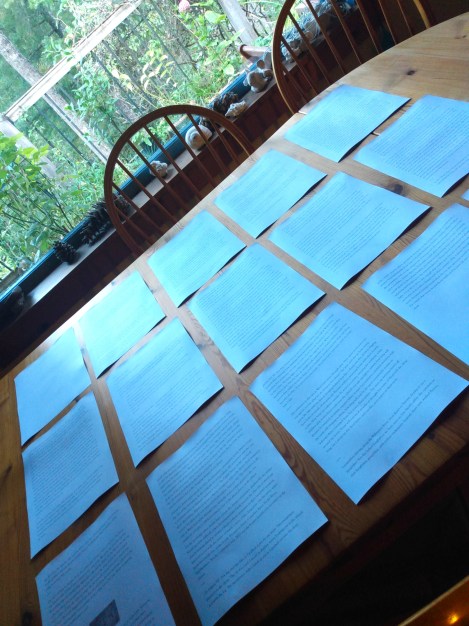
Somehow in the midst of the wild rumpus that is family life, I wrote the first draft of an essay. It’s 4000 words at present but I think it will be longer once I’ve figured out the gaps. It’s something that kept me up at night, working at my desk in a dark sleeping house, trying to find a way to tease out strands of a very complicated tangle of thinking: the war in Ukraine, the morning kingfishers at my swimming hole, the horror I feel at the local signs of climate change, and the the Cave of the Swimmers at Wadi Sura in the Egyptian Sahara (which sort of straddles two of the other strands, swimming and climatic shift). I printed out the draft and set it up at the dining table (which of course won’t be used for a bit) in order to see how the fragments cohere, or don’t. This will be an essay that I physically cut and paste to find the best arrangement of its parts. Sometimes I write like this, though not always, and I love the physicality of “editing” with scissors and tape.

fragments

So the summer plates are put away. The seasonal shift is in the air. The Steller’s jays have become accustomed to more seeds than usual because the children loved to feed them and 3 are haunting the posts on the deck, calling loudly, one with a peculiar whistle I’ve heard this summer for the first time. A bucket of crabapples waits for me to figure out what to do with it, a basket holding a quilt in progress will come out to the kitchen and another basket of fabric asks for something to be done with it (blues, of course), and I’m thinking of a quilt to remind me of 4 months of daily swims under a sky that was almost always clear.

“When is the burden of the gods lighter than air?” (Camille Paglia)

the line

In October, I began an essay about exploring something that was part of my life when I was 23. It involved paintings and archives. I had in mind an essay, perhaps one that would eventually lead me to others, and eventually a collection. I wrote two in the past year or so, in and around the work of getting Blue Portugal & Other Essays ready for publication. Readers of my essays will know how much I love the form, its capaciousness, its agreeable nature. I am also writing a novel but some days it goes quiet. To be honest, it goes quiet for weeks, as I think about where to go next with its narrative and characters. I like this rhythm. An essay, then immersive time in and around the water with Easthope, the novel.

What happened with the essay I began in October is that it grew. Yes, the essay is a capacious form but sometimes at some point it doesn’t want to carry the materials you need to put in it. So then I started to think of the work-in-progress as something else: a memoir. There were indications it was headed that way and one of those was a quilt I pieced together last April, one inspired by the memory and experience of framing the walls for our kitchen 42 years ago. It began as one or two panels but then it grew as I realized I needed more space to build the elements in harmony with each other. The quilt references the vertical framing timbers and the horizontal top and bottom plates, the lintels over the window openings. Our building process went something like this: John framed the walls on the 16×24 foot platform of what would be our kitchen; I’d nail down the plywood; then we’d both raise the wall and I’d hold it in place while he nailed down the bottom plates and tied the corners together (not with string but with nails).

clothesline

I’m quilting that now, drawing the 3 layers together with blue sashiko thread, sewing spirals that spin out into the space of the quilt. (You can see some of the work in the image at the top of this post.) While I’ve been quilting, I’ve been thinking about this essay-on-its-way-to-memoir, thinking and feeling my way through the territory I’ve needed to explore. It hasn’t been easy. It’s been quite painful actually. At the centre is a relationship, one I thought I understood, but from which I’d been sort of hiding. There were things I didn’t want to admit. That’s why it became longer and more complicated. All along, I’d told myself one story and it turns out there were many.And yesterday? I think I finished a first draft.

It’s very much a first draft. It’s full of notes to self, saying, Find out about this. Or, See if you can locate an image of this painting. There are sections that use some other texts in a conversational way, for example Freud’s “A Disturbance of Memory on the Acropolis”, and maybe I’ll put these to work in a more formal way. But it’s nearly 30,000 words, too long for an essay (and with the revisions I’ve planned, I know it will become longer), and worth working on some more to get things right. Every morning since October, even during the two weeks we were in Baja, I woke up excited about it. I worked on it daily, even in Mexico, though sometimes I didn’t do much but jot scribbles into my notebook in La Paz because my laptop was back in Cerritos. When I swam in the pools in Cerritos and La Paz, when I swam in the Pender Harbour pool, I was working out what to do next. And sewing led me to the memory of the extraordinary Karyatids holding up the entablature of the south porch of the Erechtheion on the Acropolis, women who have been in the back of my consciousness, who were at the heart of my strength as I helped raise the walls of our kitchen, holding them in place.

Mornings, I still pause by the poet with flowers in her hair. What do you have to tell me?

But the woman took off the great lid of the jar with her hands and scattered all these and her thought caused sorrow and mischief to men. Only Hope remained there in an unbreakable home within under the rim of the great jar, and did not fly out at the door…(Hesiod)

Pandora, the holder of the pithis, was herself a gift. Her name tells us that: Πανδώρα, the all-gifted, giver of all, though it’s hard to think of the contents of her vessel as welcome. So many in this story have died. So many I no longer know. The Karyatids once held phiales in one of their hands, shallow vessels for drinking or gifts, or for pouring libations for others. They held the weight of the entablature on their bodies, their hair arranged to detract from the strain on their necks. Can you imagine such strength, such purpose?

“The body of thought to carry the spirit of the thing.” (Anne Boyer)

rusknyk

Four days after John’s surgery at UBC Hospital, I was in the UBC bookstore, looking for something to read. I’d finished the two New Yorkers I brought with me and then I finished Ben Lerner’s Topeka (a wonderful novel) and my nights alone in a suite near the hospital were pretty much sleepless. I knew Anne Boyer’s poetry and I receive her Mirabilary (“love letters about thinking”) via email and I know I read somewhere (though I can’t find the source now) that she thinks that women are finding new forms for their work that sort of elide genres. So when I saw The Undying: Pain, Vulnerability, Medicine, Art, Time, Dreams, Data, Exhaustion, Cancer, and Care on the table, I bought it. I’d read the section that appeared in the New Yorker last year and I knew it was about her experience with an aggressive form of triple-negative breast cancer. In some ways it might not have been the best choice for a woman to read in the night, alone, as she waited for her husband to recover enough from a double hip surgery, with complications, to bring him home again, but in so many ways it was perfect company.

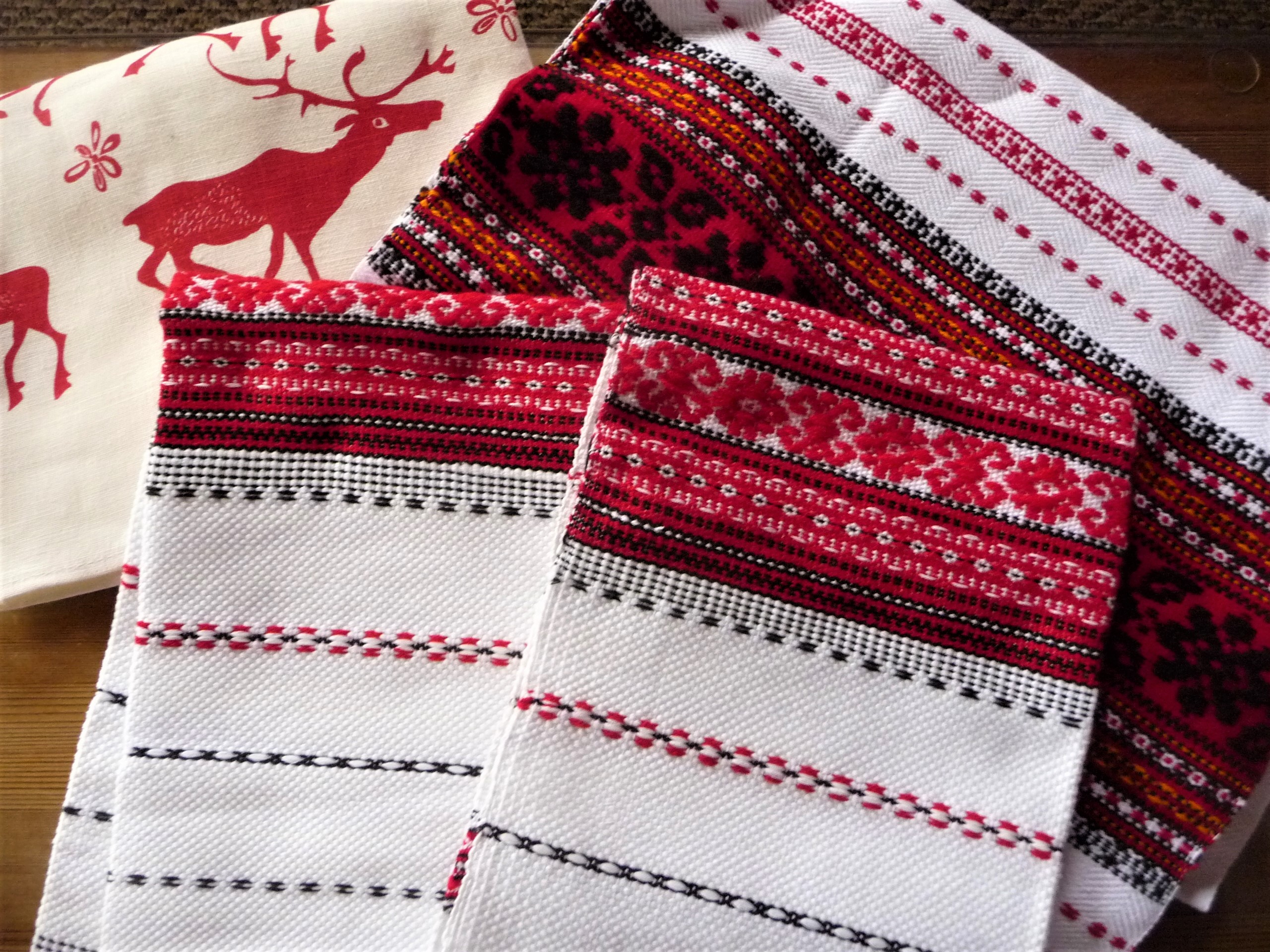
I’ve long believed that essays are an ideal form for me, though if your own view of the essay as formal, adhering to the rules we learned in school, paying strict attention to opening paragraphs, thesis, grammar, punctuation, syntax, and (when required) citing source material, then I’m not your writer. I think of the form as endlessly open and capacious, willing to accept experiments, bars of music, instructions for grafting, soup recipes, the history of Ukrainian embroidery, the life cycle of a blue mussel, meditations on mortality, dissertations on historical events, dream diaries, and colour wheels. Anything else? Whatever a writer needs.

What I try to do in my writing is that if I perceive my own weakness or my own occluded vision or some moment in which I am not up to the task of discerning some truth or seeking an idea, I just include that in the writing. I just include in the writing an admission of what I can’t do. I don’t ever want to be a writer whose writing presumes to have all the answers or to speak authoritatively on anything. (interview in The Believer)

Reading The Undying, which is a book-length essay of deep and thoughtful dimensions, was richly satisfying, although sad enough that I found myself weeping as I turned its pages in the narrow circle of light from my reading lamp. It’s a brave book. To track the course of your cancer treatment as you worry about income, the little hoard of paid sick days running out like sand through an hourglass, the loss of your fingernails, your hair, the potential damage–cognitive, physical– from Adriamycin, a chemical administered by nurses in hazmat suits, well, I was stunned by Boyer’s focus and range of scholarship. Her guides, John Donne, Audre Lorde, Aelius Aristides, her friends (the ones who haven’t abandoned her).

Although I finished the book a few days ago, I’ve been keeping it on my desk. There’s so much to learn from it. From the writing, clean and radiant; from the structure of the essay itself, resembling from time to time a section of one of the great epic poems, where the hero(ine) descends to the underworld and faces what is to be found there and returns, forever changed; and from the inclusion of so many sources that I want to follow up with. As someone who has a collection of essays currently under consideration and for whom the best way to cite source material has been (in the past) problematic–I’m not a scholar and have found that using formal citation styles to be awkward–I was excited to see how Anne Boyer has solved that problem for herself: a simplified Notes at the end of the book as well as a good bibliography. I’m glad to have a precedent for this way of citing quoted material and that this book won the 2020 Pulitzer Prize for General Nonfiction makes it a very good precedent indeed.

I loved what she says in The Believer interview (cited above) about the novel she is currently working on. This is so congenial to me. Sometimes when the material I have at hand leads me into fictional territory, I wonder if I have the right grammar for it. I do my best. But honestly? “The body of thought to carry the spirit of the thing.” Oh yes.

That’s what I’m learning about, going deeper and containing more. You have to think about the tissue between things. Like the way people move through space. In novels, which never happens anywhere else, somebody has to move from one room to another room. So there’s all these prepositions, extra conjunctions, dialogue. Dealing with all these parts, tissue, ligaments, as opposed to poetry’s beautiful condensation of experience, or the essay’s allowance of the body of thought to carry the spirit of the thing.

redux: “Who’s there?”

Note: this post is from February, 2019. I describe the process of writing “A Dark Path”, an essay subsequently published in Brick 104. Sometimes essays begin in thin air, a voice in the darkness calling out.

___________________________________________

pelvis

Something happened the other day and I want to write about it while it’s still fresh and lively in my thinking. I got up in the night (after midnight as Wednesday eased into Thursday) to sit at my desk and ponder the beginnings of an essay to accompany the dark path quilt I was sewing. I know this might not make sense to people who do one of these things or the other but not both. Each discipline requires a different set of skills, a different kind of focus. Still, working on the two things in tandem has become a way for me to explore the process of making something and thinking deeply about the way it connects to ideas, dreams, visual signals, metaphors. My essay “Euclid’s Orchard” traced the making of a quilt of the same name. It followed my attempts to learn something of mathematical language and pattern in order to understand my son Brendan and his life-long calling. (He is a professor of mathematics at the University of Alberta and when I look back at his childhood, I see that he was always pursuing patterns and numbers. Though when I asked him once if he always thought about numbers as a child, he said, “That’s the way you’d describe it but it was more about relationships, patterns, equations.” “Even then?” “Yes, even then.”) Another essay, “An Autobiography of Stars”, documents the making of a starry quilt for my daughter who was still a teenager. I wanted to give her the heavens and all they contained. Not all my essays have matching quilts but they almost have some sort of puzzle at their heart. Something I need to figure out.

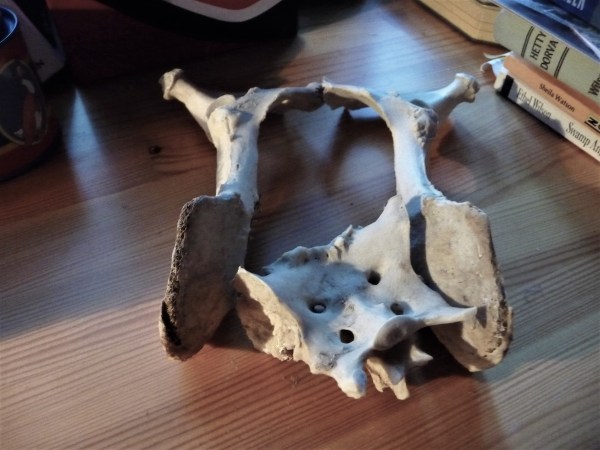
So as Wednesday became Thursday, I was at my desk, the space lit by a small lamp, and I was looking at the beginning of the dark path essay. To the right of my computer is the pelvis of a long-dead dog. While I was sitting there, I remembered something that happened to me when I was 14, an accident with my horse. I heard (if you can believe me) the voices of the two soldiers in the opening scene of Hamlet:

Bernardo: Who’s there?
Francisco: Nay, answer me. Stand and unfold yourself.

I shivered a little in the night, in the small space of my study under its Giotto ceiling, and I began to write. An hour later, maybe two, I went back to bed. Then in the morning I returned to my desk and finished what turned out to be a complicated and (to me) fascinating nexus.

What I wrote wasn’t what I thought I’d write. When I began the essay to accompany the quilt, I imagined it would describe the process of choosing scraps of fabric and laying them out in a pleasing pattern. Yes, there’s some of that in the essay. I thought I’d describe how much John and I are enjoying reading the Inferno of Dante each evening by the fire. Yup, that too. But I also found myself drawing together pelvises, fractures, the fear of losing myself in the process of aging, various paths I’ve made and taken in my life so far, and oh, some other strands of loose thread into a crooked but interesting seam. It took me almost all of Thursday to finish the first draft and a good part of Friday (yesterday) to fix some weak areas and to tighten the structure. (Those seams! The connective tissue!)

Sometimes you just have to write. You can’t wait for the right moment because when exactly will that be? You need to pay attention to your own fears (Who’s there?) and walk into the night to meet them. You hope the path you’re following is not too broken and rough. You hope your footing is at least adequate, in the darkness, in the grass that has grown up over the path you made with rocks to lead you out to the outhouse when you first lived here, your baby (not the mathematician but the one who became a historian) sleeping in the unfinished house.

“…time is your material.”

yellow

In the night I had to stop myself from getting up to come down to work on my current essay “blueprint”. thinking that it was high time I had a proper sleep. I didn’t go back to sleep right away but listened to the mouse that was making tiny sounds in the sunroom just off my bedroom and to the sleeping sounds of the cat (who brought the mouse in to show us the previous night and then dropped it in his excitement). I thought about the essay with a deep curiosity for where it might take me, and how. I know some things about it, of course, but I don’t know how they will come together. Because it’s partly a piecing together of how the plans for our house were imagined and made, I’ve made a little set of questions for John to answer, as he drew the plans. I’m not sure I remember exactly how I did the plans, he said yesterday as we sat by the fire after lunch. That’s ok, I assured him. Your not remembering is important too. He thought he’d done a lot of drafts on lined yellow paper and I’m hoping those turn up somewhere.

Our life here was never really planned. We met, married, wondered where we might live. There was a lovely old rented house but it was falling down around us and the owner had plans. We looked briefly at houses in Vancouver and realized it would be huge debt and we didn’t really want to live there anyway. We bought this land, thinking we’d camp on it, maybe forever. And then we realized that we could build something. And one thing led to another.

We had a baby and I enrolled in the MFA program at UBC. It didn’t work for me for a lot of reasons. I’d thought I could get that degree and perhaps teach. But that didn’t happen. I love Ann Hamilton‘s essay, “Making Not Knowing”, for its wise musings about how artists find their way into their true work:

You may set out for New York, but you may find yourself, as I did, in Ohio. You may set out to make a sculpture and find that time is your material.

I thought I’d teach, and write poetry. Instead, I helped to build a house and wrote prose. I’m still writing prose and although I sometimes miss the brief quick heat of writing a poem, I’ve learned that prose, particularly the essay, has a wide and generous capacity to hold everything you ever wanted it to. Everything you ever needed it to. Like the expandable string bags I first saw in France, pulled from a pocket in a market and filled with cheese, a head of chicory, a little pot of stoneground mustard, a baton or two, some butter wrapped in greaseproof paper, a melon, a bottle of wine, an essay will gladly perform the same function.

It’s important to me right now to think about my work and why it matters to me. I spent many years just finding time to write and now I have all the time in the world, though maybe not enough of it. I feel both urgency and patience. In a way it’s a perfect combination. I know what I want to do won’t go away if I let myself stay in bed rather than coming downstairs in the dark to write a page by lamplight. I used to think I wasn’t a real writer because I didn’t make outlines and didn’t work in a particular way. I’ve seen the photographs of sticky notes on bulletin boards and I know that it must provide terrific guidance for some writers but it’s not my process and I’m relieved to acknowledge to myself that I don’t have to do it that way. It’s a good thing I never taught writing, apart from a few workshops here and there, because I don’t have a system to pass along.

Imagine those bags, though. You hold one, wondering what you will choose at the market under the bright umbrellas. You didn’t make a list. But following your nose, you find the heaps of freshly-picked basil, a tumble of tomatoes so ripe you can imagine their juices puddling on the cutting board, little rounds of cheeses wrapped in vine leaves, spices from North Africa, brown eggs laid that morning, a tablecloth of brilliant yellow cotton printed with irises, branches of blossoming thyme that have brought bees from the hillsides with them, and somehow, somehow it all fits in your string bag.

But not knowing, waiting and finding—though they may happen accidentally—aren’t accidents. They involve work and research. Not knowing isn’t ignorance. (Fear springs from ignorance.) Not knowing is a permissive and rigourous willingness to trust, leaving knowing in suspension, trusting in possibility without result, regarding as possible all manner of response.


“Who’s there?”

pelvis

Something happened the other day and I want to write about it while it’s still fresh and lively in my thinking. I got up in the night (after midnight as Wednesday eased into Thursday) to sit at my desk and ponder the beginnings of an essay to accompany the dark path quilt I was sewing. I know this might not make sense to people who do one of these things or the other but not both. Each discipline requires a different set of skills, a different kind of focus. Still, working on the two things in tandem has become a way for me to explore the process of making something and thinking deeply about the way it connects to ideas, dreams, visual signals, metaphors. My essay “Euclid’s Orchard” traced the making of a quilt of the same name. It followed my attempts to learn something of mathematical language and pattern in order to understand my son Brendan and his life-long calling. (He is a professor of mathematics at the University of Alberta and when I look back at his childhood, I see that he was always pursuing patterns and numbers. Though when I asked him once if he always thought about numbers as a child, he said, “That’s the way you’d describe it but it was more about relationships, patterns, equations.” “Even then?” “Yes, even then.”) Another essay, “An Autobiography of Stars”, documents the making of a starry quilt for my daughter who was still a teenager. I wanted to give her the heavens and all they contained. Not all my essays have matching quilts but they almost have some sort of puzzle at their heart. Something I need to figure out.

So as Wednesday became Thursday, I was at my desk, the space lit by a small lamp, and I was looking at the beginning of the dark path essay. To the right of my computer is the pelvis of a long-dead dog. While I was sitting there, I remembered something that happened to me when I was 14, an accident with my horse. I heard (if you can believe me) the voices of the two soldiers in the opening scene of Hamlet:

Bernardo: Who’s there?

Francisco: Nay, answer me. Stand and unfold yourself.

I shivered a little in the night, in the small space of my study under its Giotto ceiling, and I began to write. An hour later, maybe two, I went back to bed. Then in the morning I returned to my desk and finished what turned out to be a complicated and (to me) fascinating nexus.

What I wrote wasn’t what I thought I’d write. When I began the essay to accompany the quilt, I imagined it would describe the process of choosing scraps of fabric and laying them out in a pleasing pattern. Yes, there’s some of that in the essay. I thought I’d describe how much John and I are enjoying reading the Inferno of Dante each evening by the fire. Yup, that too. But I also found myself drawing together pelvises, fractures, the fear of losing myself in the process of aging, various paths I’ve made and taken in my life so far, and oh, some other strands of loose thread into a crooked but interesting seam. It took me almost all of Thursday to finish the first draft and a good part of Friday (yesterday) to fix some weak areas and to tighten the structure. (Those seams! The connective tissue!)

Sometimes you just have to write. You can’t wait for the right moment because when exactly will that be? You need to pay attention to your own fears (Who’s there?) and walk into the night to meet them. You hope the path you’re following is not too broken and rough. You hope your footing is at least adequate, in the darkness, in the grass that has grown up over the path you made with rocks to lead you out to the outhouse when you first lived here, your baby (not the mathematician but the one who became a historian) sleeping in the unfinished house.

“every force evolves a form”

laid out

The great thing about swimming is its capacity for meditative thinking. Not always. But sometimes, when I have something to figure out, and if I’m breathing steadily as I swim up and down the local pool, I can find my way down into the idea I’m puzzling through.  I’m going to write about it here because I know how often I read about writers and their work patterns and my own never seems to be anything like that. I’ve asked myself many times if I might in fact be a fraud, that maybe I’m not really a writer at all. But this time I actually had an insight about something and I worked out a solution that I think is pretty interesting.

Over the weekend I completed a first draft of an essay on rivers and venous systems. I was trying to understand how our veins work and how things can go wrong with them. Obviously my medical background is zero. But I also realized at recent medical appointments that there are gaps in the way doctors and other medical practitioners view (and tend to pathologize) anomalies in the human body. My essay remembers particular rivers and their origins, situating me (and my family, if required) on or in different rivers. The rivers move over and around obstacles, their water levels change, they form oxbows and meanders. I try to imagine the notion of braided rivers, channels that split off from one another for various reasons (bank erosion being one) and then rejoin each other again. And there are many correspondences with our venous system. I loved writing the first draft and now the challenge is to take the sections, written as they occurred, and make a coherence of the whole thing. The beginning is still the beginning and the end is still the end but the 12 sections in between needed some organizing.

I had in mind moving the material around on the page a little, as one would do with the sections of a poem, using the space of the page as a compositional field. Can you do this with an essay that is essentially written as straight prose? Well, maybe you can. In the pool, I remembered a little passage in one section of the essay that uses an encounter with a physiotherapist last week who was helping me to strengthen one leg.

My physiotherapist tells me that the ligaments, bones, and cartilage exist in a relationship. He braids his fingers together to show me. Then he turns them askew, like my own braided hair after I’ve slept on for a night or two, and he says our work will be to re-align the workings of my right leg. He doesn’t think it’s simply arthritis though he’s breezily convinced that everyone over 50 has some degree of it in his or her joints. He speaks of trauma, of injury. A bump or a fall or a turn too far.

So what would happen, I wondered, if I tried justifying the margins of certain sections to the right-hand side of the page rather than the left. Would you still be able to read the prose easily but might you also be able to understand how the sections are like the rivers splitting and rejoining one another, the bones and ligaments trying to do the same? Would you? Hmmm. I kept swimming up and down the pool, doing my slow kilometer, and trying to “see” the prose sections as visual correlatives of my body and the rivers I love. I know this could work with huge sheets of paper and letterpress printing, I know that space would not be an issue. But on an 8 1/2 x 11 inch page, what then?

I’ve been trying various things in my word-processing program (which isn’t Word but LibreOffice, close to Word but not exactly the same) and I’ve been cutting and taping pages to try to see which sections might look best meshing or braiding together (only at the bottom or top of a page, I guess, because otherwise there won’t be room for the actual text). And trying to remind myself that this is writing first and graphic representation second. That meaning ought to come first. But maybe there’s also room for what Guy Davenport, via Mother Ann Lee, so beautifully recognized: that “every force evolves a form.” That meaning is, in a way, a realization of aesthetic form.

one section

Ok, back to it. I can’t wait to fiddle some more.

in the mail

postcard

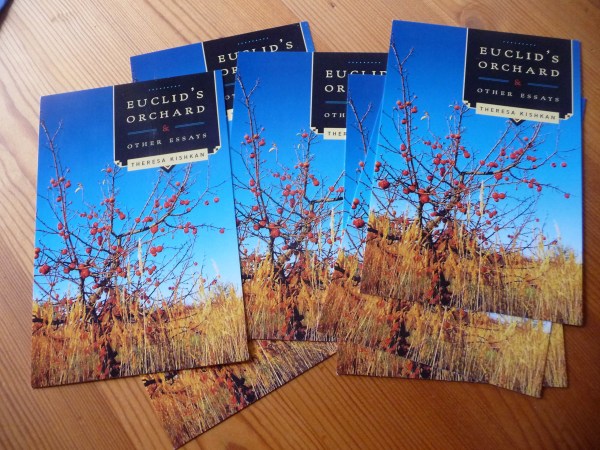
In today’s mail, the most beautiful postcards for Euclid’s Orchard. I’ll be taking them to Word on the Lake later this month. If you’d like me to mail one to you—and who doesn’t like mail?—send me an email with your address! I sent back the edited manuscript today so we’re one step closer. How would that be expressed in mathematical terms? I have no idea.

to try

to try.jpg

A few posts ago, I wrote about my difficulty in finding the right form for one of the essays in Euclid’s Orchard. My original thinking about the material I’ve been exploring—some of it archival, some of it personal memory, some of it meditation on time and family history—was that I wanted it to reflect the voices I’d heard speaking to me on a little road trip to Drumheller last spring in search of my grandmother’s first home in Canada. At the time I mused that I’d like to write the piece as a libretto. I know very little about the formal requirements of such writing but never mind. That’s what I hoped I could do!

What I wrote instead was something kind of flat and untidy. The material was there, oh yes, and I think it’s intriguing in its own right but I was disappointed in myself for not trying a little harder to give the piece an original shape and to find a way to represent those voices. Part of the pleasure of working with an editor is that you can often have a second chance, with a very capable eye and mind to guide you. I’ve had Pearl Luke. I know that there are elements to what’s become “Polychoral: A Badlands Antiphon in 25 Sections” that Pearl thinks are perhaps excessive but she’s been so encouraging and challenging. A dream of an editor.

What is an essay anyway? There are many ways to think about the form. I like part of the Oxford definition:

Origin

Late 15th century (as a verb in the sense ‘test the quality of’): alteration of assay, by association with Old French essayer, based on late Latin exagium ‘weighing’, from the base of exigere ‘ascertain, weigh’; the noun (late 16th century) is from Old French essai ‘trial’.

“Test the quality of.” Isn’t that wonderful? The quality of the writer and the relationship to the material as much as anything. I’ve never used a template for my work. For a while I kept hearing about something called a hermit crab essay, using one kind of thing inhabiting the shell or form or container of another species — for protection? For what, exactly? I’m not sure. Maybe to test the quality of its shape and original intention? But I can’t imagine setting out to write one. In French, “essayer” means to try, to attempt. I like the suggestion of almost preordained imperfection. Yes, we try. We attempt. And the pleasure, the value (if you like), is in that work. We weigh. We try.

So I didn’t write a libretto. I did look at a number of libretti (and the term itself is a diminutive of the Italian word for “book”) and quietly gave up that idea. But something stuck. The memory of my grandmother saying her rosary, the music of the Latin mass I attended once or twice with my father in childhood, the calls and responses of Byzantine chant, the strophic odes so characteristic of ancient Greek tragedy — and there was my essay. There’s no formal musical structure but there’s a weighing, yes, of musical form, a careful listening to the language of old letters and legal descriptions, and an attempt to contain all this in a series of lyrical sections that call to one another and listen for an answer. No other essay I’ve written has given me so much difficulty and perhaps none has given me so much pleasure.