a publishing history, with asides (third instalment)

21st century, second decade

Sandcut Beach

My parents died at the beginning of the second decade of the new century, a year apart to the day. Several close friends died. My sons married their sweethearts. (My daughter married hers a few weeks ago!) Every day held sorrow and joy. And also a sense of possibilities for my long-held interest in my family’s history. After my father’s death, I took home the small hoard of papers and photographs he’d kept to himself. I don’t know exactly why he was reluctant to share the materials, or to pursue answers to questions–the ones I had and surely ones he had too? And a year later, after my mother’s death, I felt the uneasy sense that I was now the family matriarch, the one responsible for keeping the lines of kinship clear. They were not clear. There were half-stories, careless genealogies. In retrospect, I see that much of the research and writing I did during this decade was in service to these histories.

I’ve always loved the literary novella. Without ever really intending to, I’ve built up a nice collection and have read many more, via library or generous friends. Inishbream was a sort of accidental novella, beginning as it did as a linked group of prose poems, eventually drawn out and given a structure. I loved the possibilities of the form, how it could hold so much in such a hermetic shape. A year or two after The Age of Water Lilies was published, I was invited to a book club to talk with members who’d just read it. I always enjoy these occasions. During our time together, one woman asked what happened to Grace after the novel ended. Good question. Grace was born to a single mother in the spring of 1915. She is sort of tangential to the narrative. But the more I thought about her, the more I wondered too. I began to write Winter Wren to find out. I think I knew from the beginning that the book would be a novella. I put Grace in a cabin I’d always thought I’d like to live in, a cabin I first saw as a teenager, on a beach west of Sooke, B.C. (It’s the one above the waterfall in the photograph at the beginning of this post.) She was in her late 50s, an artist trying to paint the view at dusk. I wanted to write about the 1970s—the novella takes place in 1974, an interesting time for ceramics in B.C. (Grace’s love interest is a potter in the tradition of those who studied with Bernard Leach in Cornwall and then returned to Canada), for museums where the salvage paradigm was part of the ethos, and perhaps the last possible time for Grace to meet one of the late 19th c-early 20th c artifact collectors.

winter wren

But you know already what I’m going to say: I sent Winter Wren to dozens of publishers and all of them rejected it. To make a long story short, my dear friend Anik See was visiting enroute from Dawson City to the Netherlands and we shared similar stories about novellas we’d written. We decided to begin a micropress to showcase the form and we decided to begin with mine. Our rationale was this: if our endeavour didn’t work, then I would be disappointed, sure, but at least it would only be me and not someone else. I could shake it off, poof, and move on. (Ha!) Anik designed the book, I photographed a pottery dish with a length of scouring rush (it figures in the book), and we found a really good printer in Victoria. And you know, we sold our first print run of 250 copies within weeks and we reprinted. I still get orders for it. We went on to publish 4 more novellas and we are very proud of Fish Gotta Swim Editions. Our latest is Anik’s Cabin Fever.

I’ve been to the small Vancouver Island beach near Jordan River where Theresa Kishkan’s novella Winter Wren (Fish Gotta Swim Editions) is set; I’ve seen the waterfall that tumbles over sandstone onto the shingle just below, and the solitary cabin facing south and west, surrounded by salal. Winter Wren tells one possible story from the many that cabin could tell. (Michael Hayward, Geist)

After I finished writing Winter Wren, I wrote another novella, Patrin, and it was published (beautifully) by Mona Fertig’s Mother Tongue Publishing in 2015 and then in French by Marchand de Feuilles in 2018. I also wrote a long essay, “Euclid’s Orchard”, about quilting, mathematics, coyote music, apple trees, and love; and when Mona showed interest in publishing a collection of my essays, I gathered together a group. Eulid’s Orchard & Other Essays was published in 2017 and was shortlisted for the Hubert Evans Award.

Each image is a perfect crystallization of a detail, gesturing toward a truth much larger than the tiny pinpoint of its composition. Near Victoria, she recounts an exquisite memory of “an abandoned house completely knitted into place by honeysuckle and roses” (p. 101). Near Drumheller, she sings the prairie: “turn, turn, bend the song to the roadside plants … free verse composed of craneflies, dragonflies, bluebottles, broad-bodies leaf beetles, greasewood and cocklebur” (p. 61). And near her home, she concludes with the cries of coyotes: “lilting joyous youngsters unaware that a life is anything other than the moment in the moonlight, fresh meat in their stomachs, the old trees with a few apples and pears too small and green for any living things to be interested in this early in the season” (p. 155). (Catriona Sandilands, The British Columbia Review)

An aside: Mona Fertig and her Mother Tongue Publishing enterprise deserve gratitude from writers everywhere for the beauty of the books and the huge effort Mona put into designing them, editing them, bringing them into the world with sparkling wine and flowers, arranging public events for the writers, and being the kind of publisher writers dream of. I’d have published with her forever and was sad when she announced her retirement but also glad for her because she’s been able to return to her own writing projects. She did everything that bigger publishers did and she did it with joy. (She’s the one on the left, with the big smile.)

at-the-book-prizes

Novellas, novellas. I wrote The Weight of the Heart as a way to lament the gaps in my own education in the 1970s when the instructor of my Canadian literature course told me not to bother writing about Sheila Watson and Ethel Wilson, saying they were minor, and the former was barely coherent. I wanted to celebrate these two literary cartographers of our province and to highlight the importance of their work. I also wanted to spend time, real time and imaginatively, in the Thompson Canyon and the dry Interior of B.C. Palimpsest Press published The Weight of the Heart in the spring of 2020, just as most publishers and some writers were required to pivot to a virtual presence because of the pandemic. I wish I’d been better at this, though we still had such a slow internet connection—we live in a rural area– that even if I had been able to Zoom more effectively, our bandwidth wouldn’t have allowed me to participate much. (We were able to upgrade a bit later.)

The Weight of the Heart also finds in Wilson’s and Watson’s writing an experimental style and a mode of consolation. Like Wilson’s independent protagonists, the narrator discovers her autonomy and grit in the landscape she travels. Watson’s spectral figures and interest in sacred rituals resound in the symbolic scenes of almost drowning in which the narrator is saved by her brother’s mysterious presence and in Kishkan’s invocation of Egyptian burial rites as a refrain throughout. Most obviously, the double hook of Watson’s title recurs in the dualities throughout the novel—in the two rivers, in twin foals (the colt unfortunately lost in birth) by a mare named Angel, and most clearly in the two siblings who are bound together in a landscape where life and death regularly meet. So, Kishkan and her narrator know where to look in Canadian fiction for a view of the British Columbian landscape that reveals these striking oppositions and their consoling unions. A unique and compelling creation in its own right, Kishkan’s poetic exploration of grief lives up to its literary precursors. (Kait Pinder, the Malahat Review)

I wrote another novella in this decade, begun perhaps in the middle, put aside, but finished in 2020, during the long lonely weeks of the pandemic when I was missing my family and wondering if we would ever get together again for our summer meals, swims, and talks late into the night by a campfire. I used Virginia Woolf’s Mrs. Dalloway as a template, following the main character through a day of preparations for a party. There are shadows and owl voices in the woods and an unexpected guest coming up the driveway at dusk, carrying a knife. I tried to find ways to present the material innovatively, with sections of call and response, lists, and the music of an oud. I called it The Occasions. I don’t know if it will ever be published.

Another aside: I am lucky in life and love if not in publishing. And I wonder how many writers have a husband who is also a letterpress printer and who offers to make keepsakes to celebrate new books? For the past ten years or so, John has printed beautiful objects, some of them embellished by me, to give away at book launches and to provide local book stores with so they can tuck a keepsake into the books of mine that they sell. I have a few remaining of some of these and if you want to order a book from me, I can include one for you.

keepsakes remaining

At the beginning of this instalment, I wrote that I was trying to untangle the knots of family history and genealogy. Some of this work resulted in essays in Euclid’s Orchard but I wasn’t finished and kept on writing. I’d also had a health issue in 2016 that resulted in many tests, half-diagnoses, fearful assessments (though it all worked out well), and I also wrote about those things against the backdrop of all I loved: my family, the rivers of this province, textile work (which is always a way of meditating for me, sewing myself in and out of mysteries, riddles), the countries my grandparents left for new lives in Canada, and more. These became Blue Portugal & Other Essays, published with care and generosity by the University of Alberta Press in 2022. It received SUCH good reviews.

In Blue Portugal the essays’ themes are allowed to slip their boundaries; a topic addressed in one essay recurs in later essays, a recognition, perhaps, that thoughts and interests develop over time, shifting slightly as they are put in the company of other thoughts, are seen from different perspectives. The essays in Blue Portugal seem to talk to each other; they interlace in interesting and thought-provoking ways. The book is a fine example of the personal essay at its best. (Michael Hayward, The British Columbia Review)

It was a book that others noticed, gifted to friends, and reading it now, I am sort of surprised that I was led into some of the essays so mysteriously. A voice in the night, murmuring, The river door. Whose voice? I only know I took it to heart.

To those of us who’ve been following Theresa Kishkan on her blog for many years, the preoccupations of her latest book, the collection Blue Portugal & Other Essays, will be familiar, the quilts, the homesteads, the memories, the blue. But it’s the stunning craftsmanship of the book, the fascinating threads that weave the pieces together and also recur throughout the text, that make this book such a pleasure to discover. How quilting squares are analogous to the rectangles from which, one by one, Kishkan and her husband literally constructed their home on BC’s Sechelt Peninsula, and the blueprints, and the blues of dye, and of veins, and of rivers, and of how one thing turns into another—how? How does a body get old? How do children grow? How does a family tree sprout so many new branches? And from where did it all begin, Kishkan going back to seek her parents’ nebulous roots in the Czech Republic and Ukraine, in a 1917 map of lots in Drumheller, AB, in everything that was lost in the Spanish Flu, and how we’re connected to everything our ancestors lived through. (Kerry Clare, picklemethis.com)

And now? Now? 4 years into the 3rd decade of the century, I’ve completed another collection of essays. The centrepiece is a long postmortem and reassessment of a relationship I had with a painter when I was 23 years old. My walls are hung with some of his paintings, portraits of me among them, and I attempt to reclaim the gaze by entering into a daily conversation with one particular portrait hung in a stairwell; she is one of the first things I see each morning as I come down to the kitchen. There are other essays in the collection that meditate on war, climate change, injury and recovery, swimming and Herakleitos, and the nature of love. I’ve begun the long process of trying to find a publisher (my last publisher wasn’t interested, feeling perhaps that the collection is too personal and potentially risky in terms of sexual politics). As I write, it’s been rejected by 4 publishers and is currently awaiting decisions by 6 more. I’m also about halfway through writing a novel set in a small fishing village called Easthope and in the city of Lviv, in western Ukraine. I began the novel 4 years ago, just home from a trip to Ukraine, and set it aside to complete editorial work on Blue Portugal. And then the Russians invaded Ukraine and I couldn’t imagine ever writing about Lviv. But I decided that I’d stay with my original intention and setting— 2015—and write to set down what I love about both places.

And now in a hurry just
pack, always, each day,
and go breathless, go to Lvov,
after all it exists, quiet and pure as
as a peach. It is everywhere.

–Adam Zagajewski, trans. Renata Gorezynski. The poet used a variant for his native city which has known many administrations since it was first established in the 5th century and is currently known as Lviv

It may seem that I am a bit cranky about publishing in the 21st century but I have to say that it’s always the end point in writing for me. I began to write with the sense that the process was complete when the piece found a place in the larger world. I don’t begin a work with any idea of what might happen when I’ve finished, though. Not yet. I live in the language, the world of the writing, and when I come up for air, it’s then that I realize that I have no idea if the work will ever find a readership. I am too many things that are not what the current world wants or needs. Who wants to read about a fishing village or a party under fairy lights in a garden on the edge of the world or eye injury or indigo dye or the musings of an aging grandmother? A woman married for 45 years. I know some people do but maybe not enough of them. Enough of you, I mean. But I have some years left and those will find me at my desk, finding a way to map out the terrain I dream about, yearn for, to find ways to knit together strands of music, roots of family trees, and real trees too, embellished with salmon bones, the beautiful holdfasts of bull kelp and bladderwrack (the tired images scorned by A.F. Moritz all those years ago). There’s a little quote from the writing of the early naturalist and advocate for wilderness, John Muir: “When we try to pick out anything by itself, we find it hitched to everything else in the Universe.” I keep this in my mind and heart as a mantra. I don’t know how this might be worked into a synopsis or query letter or proposal but it keeps me anchored, heldfast, to what I want to do in my life. Everything else is a bonus.

holdfast

winter gifts at High Ground

I know Christmas is more than a month away but if you’re thinking about gifts, we can make it simpler for you by offering some of our own books, limited edition chapbooks, and broadsheets printed on our late 19th c. Chandler & Price platen press for sale during the season.

mud bottom

For example, John’s Mud Bottom (details here) is $35. If you buy a set of the Companions Series Broadsheets (also here), a folio of 12 letter press broadsheets including poems by Gillian Wigmore, Russell Thornton, and Maleea Acker written in reponse to other poems printed enface, priced at $150, then we will include a copy of Mud Bottom for free with your order.

winter books

For a selection of our books, including my Euclid’s Orchard, Winter Wren, The Age of Water Lilies, Inishbream, Patrin, A Man in a Distant Field, and Red Laredo Boots, and John’s crawlspace (winner of the 2012 Dorothy Livesay Poetry Prize), Forecast (Selected Early Poems: 1970-1990), and This Was the River. the deal is this: buy one at cover price and receive a second book of your choice for 50% off. We’ll happily inscribe the books. Postage will be charged at cost.

If there are other books you’re interested in or you see something on the High Ground page (including chapbooks, individual broadsheets, including Michael Ondaatje’s “Breeze”), please ask us. And if you think that background scarf on which the books recline is as ravishing as I think it is, visit Caroline Jonas’s website. (I recently ordered the scarf as an early Christmas gift from my husband because he won’t be able to shop this year!)

Redux: “Don’t fear the voices.”

Note: 5 years ago last night I launched my novella Patrin at the Arts Centre in Sechelt. It was a wonderful evening, I remember, and I see from this post that I was also working on the essays that became Euclid’s Orchard. Today, five years later, I’ve finished another collection of essays, Blue Portugal, and a novella (maybe one that will rest in a drawer until, well, I die), but I’m nudging myself towards beginning another work of fiction, with a lot of my own family history in it. Imagined history, I guess, inspired by a photograph, what it suggests and what it hides. To see this sentence in the post that follows—”So a story, a fragment, and as mine as anything ever is.”—makes me realize I am such a predictable person….

Second note, September 21: John just read this and said, I don’t understand this opening paragraph. You left out Winter Wren and The Weight of the Heart! And yikes, I didn’t leave them out exactly; I’d already written Winter Wren in 2015 and it was published in 2016. Yes, I did publish a novella in June, The Weight of the Heart and should have included it but I was thinking of the writing that is immediately inspired by my family history, turning and braiding the strands of that with fictional elements.

************************************

Tonight is the launch for my novella Patrin. In the way that one does, I’m anticipating questions (not necessarily tonight but in the next while as friends and strangers read this book that takes place partly in the city of my birth and partly in the country of my grandmother’s birth) about the intersection of fact and fiction. Sometimes I write what I call fiction and sometimes I write what is presented as non-fiction. Each is embellished with elements of the other. How could it be otherwise? I think of myself as a writer first,  a citizen of language, and sometimes the world is so rich and dense with materials, with possibilities, that I feel dizzy with it. Joyous with it. And sometimes burdened by it.

For the past few years I’ve been working intermittently on pieces which hover between essays and stories. Some are just fragments of dialogue, overheard. Some are lists of findings, catalogues of family details. Some are sustained narratives. One is a wild patchwork of math and botany, genetics and animal behavior. I haven’t worried about the final organization of this material. Yet. But I know that at some point I’ll have to decide what it is.

I’ve been rereading Alice Munro’s The View From Castle Rock. It’s one of my favourites of all her books, though I have to say that on any random day, my favourite might be another book entirely. Maybe I mean that it’s the book that puzzles me and enchants me, in equal measure. Some of it seems to be pure memoir. Sometimes Munro takes a single fragment of factual material and meditates upon it, asking questions of it, giving it a life beyond its immediate presence. She writes, in her Foreward, about the genesis of the book. She tells us that she had been looking at family accounts, letters, recollections:

I put all this material together over the years, and almost without my noticing what was happening, it began to shape itself, here and there, into something like stories. Some characters gave themselves to me in their own words, others rose out of their situations. Their words and my words, a curious re-creation of lives, in a given setting that was as truthful as our notion of the past can every be.

During these years I was also writing a special set of stories. These stories were not included in the books of fiction I put together, at regular intervals. Why not? I felt they didn’t belong. They were not memoirs but they were closer to my own life than the other stories I had written, even in the first person. In other first-person stories I had drawn on personal material, but then I did anything I wanted with this material. Because the chief thing I was doing was making a story. In the stories I hadn’t collected I was not doing exactly that. I doing something closer to what a memoir does — exploring a life, my own life, but not in an austere or rigorously factual way. I put myself in the centre and wrote about that self, as searchingly as I could. But the figures around this self took on their own life and colour and did things they had not done in reality. They joined the Salvation Army, they revealed that they had once lived in Chicago.

I don’t know that any of those surrounding my particular self joined the Salvation Army but there are some individuals and occasions I don’t know enough about and perhaps never will. And maybe it’s time to explore the possibilities of those instead of waiting, waiting, waiting to find out the actual facts which I suspect will never be revealed. The land my grandmother bought near Grays Harbor, Washington, for instance — how did an immigrant woman living in Drumheller, a widow (I think) at that point, with at least 7 children, buy land in Aberdeen? My father told my son that she discovered the property was worthless and she took a shotgun with her to confront the man who sold it to her. Did she get her money back? My father said she shot fish to feed her children. Grays Harbor is a bay composed of many estuaries — the Hoquiam River, the Humptulips River, the Chehalis, all of them salmon-bearing rivers. In those years — this would have been the early 1920s at the latest — I imagine the salmon-runs were the old legendary runs, so many fish you could cross the river by stepping on a living bridge. I can smell those fish, can see that woman with her shotgun and her children. So a story, a fragment, and as mine as anything ever is.

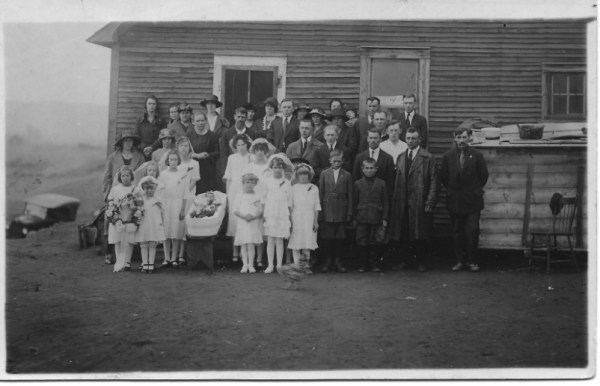
Releasing one book to the world creates such space for the imagination. I have been sorting (in the most chaotic way) some of the material I have in my study and I keep hearing quiet voices. In Patrin, there’s a poem by the wonderful Czech poet Jan Skacel; its opening line is “Don’t fear the voices.” Patrin Szkandery takes the poem and its advice to heart. And maybe it’s time I did too. I look at this photograph, for instance — a baby who would have been my aunt if she’d lived. Julia Kishkan. She died before my father was born and I know almost nothing about her death. This photograph is anything but empty though. Her older (half) sisters, the curtain, the window, the cloth under the casket, and all those brothers and sisters who aren’t in the photograph. Julia’s parents, my grandparents, whom I barely knew but whose lives deserve my attention, now if ever there was a time. “Don’t fear the voices, there’s a lot of them.”

julia

“the house shelters day-dreaming”

grandma's house and fields

In a dreamy moment yesterday, I found this photograph of my grandmother’s house online. She came from a village in the Beskydy Mountains, in what’s now the Czech Republic. In 2012, I was lucky enough to see her house, in snow, when a friend took John and I to her village, Horni Lomna. I wrote about that visit here. Hers is the house at the back of the photo, the one at the foot of the hills. That looks like an orchard behind the house, doesn’t it? A few years ago a kind woman in Horni Lomna sent me other photographs of the house and the garden directly behind it. She told me that she thinks the house is only used in summer and it’s owned by several people, one of whom has my grandmother’s mother’s surname, the surname I gave my character Patrin in my novella of the same name. Unfortunately those photographs and the other information the kind woman sent were filed on my old computer, the one that died suddenly. Some stuff was stored on Google Drive but not that. (Oh, the lessons we learn.)

I’ve been looking at this photograph, thinking about it and a girl growing up in it. My grandmother had two sisters whose names are recorded in Horni Lomna’s town hall and I suspect she also had a brother, the man with her original surname who showed up as one of the residents in the squatters’ community my grandmother lived in when she first came to Canada in 1913, the subject of “West of the 4th Meridian: A Libretto for Migrating Voices” in my last book, Euclid’s Orchard. That man, Josef Klus, arrived in Canada a month or so after my grandmother and on the ship’s manifest, in the category detailing reason for travel, it’s noted that he was joining his sister in Drumheller. Josef died in the Spanish flu epidemic, the one that also took my grandmother’s first husband.

So this photograph is compelling to me for all it says and doesn’t say. The landscape is so verdant. An orchard. Sheep probably. Pigs. She left that place for this one:

julia's funeral

This is 1923, the funeral of Julia, the first child of my grandmother’s second marriage. (There were 8 living children from her first marriage as well as a daughter who died in infancy, of diphtheria.) I have no idea if this house still exists. I’ve tried to find out the history of her houses in Drumheller—the one listed as a “shack” in the materials related to the squatters’ community she settled in with her first husband (and 5 children, 4 more quickly arriving); the one that replaced another (the shack?) that burned to the ground. And this is the last house she owned in Alberta, the house my grandfather build in the 1940s. It’s the subject of something I’m working on now. My father inherited this house and sold it after my grandmother’s death. I have one or two memories of staying here, not in this house specifically, but in a smaller house on the same property (I believe it was a house my grandfather bought from the Prins family and had moved to this property either before he built this one or just after.)

house

What does a house contain, what memories does it hold? Gaston Bachelard tells us what a house allows us: “I should say: the house shelters day-dreaming, the house protects the dreamer, the house allows one to dream in peace.” But are we also contained in its continued space, the corner of a street in Beverly, Alberta, near a park where children play, as we played, on the long summer days? And is my grandmother still a shadow among those trees in Horni Lomna or remembered in the small panes of glass gazing out towards the road?


novellas for a rainy day

rainy day friends

It’s raining, a lovely soft sound on the roof. A perfect day to curl up with a novella, or three. In that spirit, I’m offering my three novellas—Inishbream, Patrin, and Winter Wren—for $45. (That’s a paltry $15 per title! But I’m only offering them as a trio.) I’ll ship for free in Canada. Other places? We can talk!

On my Books page, you can read about the individual titles. And here’s a little sample of rainy writing from each of them:

Listen. There were weeks when the sun refused us. At first I thought I could never live in such a place, but then I learned the sweetness of the Irish mist, how it enveloped you and numbed you to any real action or consequence. And you wandered in it, your hair jewelled, and you let yourself drift in great imaginings, where the ruined castle on the coast was made whole and you lived there, where the beached hooker* was yours and you mended it.

—from Inishbream (Goose Lane Editions, 2001)

My grandmother told me once that her father had worn a cloak, a loden cloak, given him by a man who’d bought some of the copper pots. It repelled both wind and rain. Sometimes he’d open it to allow two or three of his children to shelter within, she said. We sat under trees while the rain poured down, and it was our own tent, warmed by our father’s body.

—from Patrin (Mother Tongue Publishing, 2015)

Where am I, where am I? Again, she woke and tried to orient herself in the new room. Curtains, no—the fogginess was because it was raining outside and she couldn’t see farther than the window. Her room was a cube of wood and glass. In the bed she had been born in, she leaned forward and watched drops of water slowly find their way down the glass to the sill. The trees dripped. The cabin was cold and she put off the moment when she would push away the eiderdown and rush to the woodstove to start the morning’s fire.

Winter Wren (Fish Gotta Swim Editions, 2016)

*The Galway hooker (Irish: húicéir) is a traditional fishing boat used in Galway Bay off the west coast of Ireland.

Courtepointe, on Mona’s counter

courtepointe

Very excited to receive this photograph of the French translation of PatrinCourtepointe—newly arrived in my (English-language) publisher Mona Fertig’s kitchen! The whole experience, from the interest shown by Mélanie Vincelette at Marchand de Feuilles, to a wonderful photography session with Alexandra Bolduc, has been lovely. I look forward to reading my novella in Annie Pronovost’s translation! And of course we toasted this new book just now but I wish we’d had some of the Czech wine Patrin (and her creator) love: Veltlínské Zelené.

“the house hidden in dense fog”

beginning

The fog that hangs in the air these December days seems fitting, somehow. Everything is muted and quiet. And how beautiful to see a light in a window, a candle. Our fall was filled with unexpected events, changes. A small medical procedure for John gone rogue and that led to a surgery a month later. Which meant cancelling our plans to fly to Ottawa for a week. He’s feeling much better though and stronger every day so on Wednesday we went to Vancouver to see the Arts Club production of Onegin. It was truly wonderful, transporting in the way that good theatre can be. We saw a matinee and afterwards planned to have dinner at our hotel, also on Granville Island. Wandering back from a shopping expedition to buy indigo at Maiwa, I passed the Liberty Distillery and looked in its windows to see a lovely room lit by small fairy lights. I brought John back so we could have a cocktail in that room with its long antique bar. We are not much for cocktails. We like wine, beer when the moment is right, a dram of good single-malt sometimes, but cocktails, gin particularly, have always struck me as mother’s ruin. The delicious taste of botanicals can seduce one (me, anyway) into thinking I’m drinking something harmless, benign! But I had a gorgeous concoction of pink gin flavoured with rose-petals and rosehips and John had something with vodka, I think, well-fortified with ginger. I was offered a choice of tonics and I asked for the regular one, not wanting anything to detract from the rose-petals and hips; but what would the elderflower tonic have tasted like? We’ll have to return to Liberty Distillery to find out.

I spent the next morning with a young photographer, Alexandra Bolduc. The Montreal publisher bringing out a French language edition of Patrin in 2018 wanted a current photograph of me for the press’s website. (This is Marchand de Feuilles.) And somehow the fog, the bare trees, the glimpses of water seemed right for my book and its atmospheres.

This morning it’s still foggy and somehow a little sombre. Like so many other people I know, I’m finding the current political climate, the global one made loud and ugly by that vulgar and dangerous president to the south, anyway, I’m finding it troubling beyond words. I’ve been sending letters to our Provincial Government, asking them to suspend work on the Site C Dam on the Peace River. I dream of flattened landscapes, of fire, of violence. And yet Christmas approaches. Ours will be quiet. Angelica is coming for a few days and I think I will roast a duck this year for the three of us. (Turkey is great when you want lots of leftovers but do we?) I made gingerbread boys* to include in the parcels that have already been mailed to Edmonton and Ottawa. I am thinking about fruitcake, the white chocolate one I make with tawny fruits and rum. There are a couple of parties in the next week and it will be good to hear the old songs, eat some festive food. I brought a bottle of Liberty Distillery gin home with me and who knows, maybe one of those cocktails will occasionally replace the customary glass of wine by the fire before it’s time to cook dinner.

And in the meantime, I’ve begun quilting the big length of rough linen dyed in October. I didn’t even wonder about what to do with it, simply begin stitching a spiral. It’s a way of thinking for me, thinking with my hands, finding a way to make sense of things. Holding the weight of a quilt-in-process on my lap, finding the best way to hold its layers together for warmth and beauty, the house hidden in dense fog, its lights glowing.

*I have tried for gender diversity with the gingerbread shapes. I bought a girl cutter, for instance, but somehow the dough doesn’t like to be cut with that one. I can’t get the dough to let go of the metal. An angel? Same thing. So boys it is, with Smartie buttons and dragée eyes. And also coyotes howling at the moon, fish, stars, lobsters (though those shapes are also difficult to use), pigs, trees, stars…


the murmur of voices in cold air

near stump lake
It’s always interesting to me that new friends can be made in one’s later years and that you find yourself wondering why it took so long to meet these people. In truth, I knew of Robin and Jillian Ridington before I ever met them. They are distinguished anthropologists, the authors of books that form an important part of the canon of North American ethnographic studies. On my desk I keep a copy of Where Happiness Dwells: A History of the Dane-zaa First Nations , an extraordinary gathering of stories told to them by elders living in the Peace River area, a place where they’ve done fieldwork (and made friends) for decades. I also loved When You Sing It Now, Just Like New: First Nations Poetics, Voices and Representations.  (Lincoln: University of Nebraska Press, 2006).
We met at the Pender Harbour Chamber Music Festival. I’ve been involved with the Festival as an organizer and writer since the first year—2005—and Jillian and Robin have been supporters since that first summer. I thought Robin in particular looked familiar but it wasn’t until later, after I’d taken a break from the Festival for a few years and then returned, that we became friends. One of the highlights of the summer is joining them for dinner on their Nordic Tug—they come to Pender Harbour by boat, often from their haven on Retreat Island, near Galiano Island. Robin grills steaks over the most ingenious barbecue at the stern of the boat (where there’s also a mangle for washing clothing; they spend a lot of time exploring coastal inlets and islands, living aboard for weeks on end). The tug drifts in slow circles on its anchor and we talk, drink red wine, eat until it’s time for Robin to take us back by Zodiac to the dock at Whiskey Slough. The old harbour is there as we talk—the net sheds, small houses with weathered boards, a few boats I remember from the days when we bought our halibut and salmon as the fishermen returned each year—though the new harbour continues to grow those huge houses and fences and yachts capable of taking out docks as they turn.
So friends, with whom we began a conversation years ago and we pick up where it left off whenever we meet. When we were in Victoria for a reading at Munro’s Books in October, we stayed with the Ridingtons for two nights (before heading over to the Surf Motel). We had delicious meals at their table and a wonderful evening of pupus (the Ridingtons spend winters on Maui where they immerse themselves in high Hawaiian music and culture and I love that they use Hawaiian words so naturally at home, including this word for appetizers!) and wine with John Schreiber and Marne St. Claire. I gave them a copy of Euclid’s Orchard as a gift. And this morning Robin returned the gift with this beautiful review: https://sites.google.com/site/plumeofcockatoopress/books-read-2017
Perhaps because her son Brendan is a mathematician, she used the matrix of Euclidean geometry as a way of interpreting the web of cultural and natural influences surrounding their lives.  She even attempts to learn something of mathematics, enough at least, to inform and organize and understand her experiences on their land.  As with everything Kishkan has written, these essays are beautiful, personal, and at the same time universal in their scope.  They are to be read, contemplated and then returned to after some dreamtime assimilation.
Jillian reviewed Winter Wren (and by inference, Patrin) in the summer 2017 issue of Herizons. The review isn’t available to read online but here’s a link to the issue in the event you might want to order it. (I read Herizon at the library and it’s terrific.)
http://www.herizons.ca/node/602  Jillian is intelligent and perceptive; here’s the first paragraph of her review:

BC writer Theresa Kishkan has been writing compelling fiction and poetry for many years. Recently, she has embraced the novella as her chosen form. A novella “retains something of the unity of impression that is a hallmark of the short story, but it also contains more highly developed characterization and more luxuriant description.1” In other words, it’s a perfect form for women writers who have a story to tell, but lack the time or desire to write an extensive novel — or simply find their material more suited to the shorter form.  For me, the novella a perfect form – long enough to fully develop characters and plot, but short enough to be read in the snatches of time I usually find available. Kishkan’s first novella, Patrin, published by Mother Tongue Press in 2015, tells of a woman’s search to find her Roma foremothers, using clues sewn into a quilt left to her by her grandmother. It is a tale of renewed roots and reclaimed skills. Her latest work, Winter Wren, is the first publication from Fish Gotta Swim Editions, a new company founded by Theresa and her friend Anik See, which will specialize in novellas.  And these two books are little gems – brilliant and reflective.

How do people find one another? How in this world of billions of people do we find the ones that we can share conversations of poetry and dreamers and music, of our families, of the old coast we all love and remember, the politics we deplore, the books we are reading (and writing)? We do, though. When we were in Victoria, Robin played a soundscape recorded by Howard Broomfield in Doig River—children singing, stories shared, dogs barking, the murmur of voices in cold air, by fires so near you could smell the smoke. I’ve dreamed of those voices, preserved on tape and in memory, and it’s what I’ve always wanted. Continuity, true place, true words.

it’s a (cover) wrap!

I’m really thrilled with Setareh Ashrafologhalai’s cover design for my forthcoming collection of essays, Euclid’s Orchard. Mona Fertig at Mother Tongue Publishing is a pleasure to work with. Small but vital! And she pays attention to important details, using excellent graphic designers for the books she publishes. One thing I love about this cover is that the title caps are from the late Jim Rimmer’s font, Amethyst. Jim was devoted to fine book design and his fonts are very durable and elegant.  And Setareh’s work is always so fresh and beautiful. She designed my novella, Patrin, and the pages are as lovely as the cover. I can’t wait to see what she does with Euclid’s pages!

Euclid's Orchard_cover Final.jpg

Three Friends of Winter: a novella sale

450px-three_friends_of_winter_by_zhao_mengjian

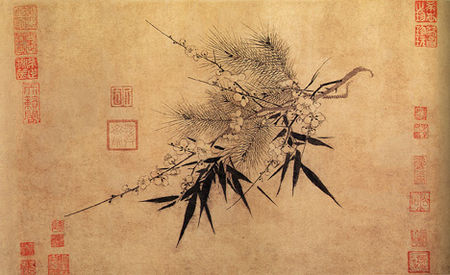
The Three Friends of Winter refer to the pine, plum, and bamboo. The origin of this term is found as early as “The Record of the Five-Cloud Plum Cottage” from The Clear Mountain Collection of literary writings by Lin Ching-hsi (1241-1310, a Sung dynasty loyalist): “For his residence, earth was piled to form a hill and a hundred plum trees, which along with lofty pines and tall bamboo comprise the friends of winter, were planted.”

Years ago, I saw a planting of the Three Friends of Winter in the Dr. Sun Yat-Sen Classical Chinese Garden in Vancouver. And I thought, what a lovely idea — a companion planting of things that thrive in winter! They symbolize steadfastness, perseverance, and resilience. A little like the novella? In honour of the Three Friends of Winter, I’d like to offer my three novellas — Inishbream, Patrin, and Winter Wren — for the winter-friendly price of $45. For the three of them. (See my Contact page for my email address.) And I will ship them for free. Think of them as hardy green trees (and doesn’t the scouring rush on Winter Wren look like bamboo?), flourishing in snow and wind, eager to find their way to you.

three-friends-of-winter