a publishing history, with asides (third instalment)

21st century, second decade

Sandcut Beach

My parents died at the beginning of the second decade of the new century, a year apart to the day. Several close friends died. My sons married their sweethearts. (My daughter married hers a few weeks ago!) Every day held sorrow and joy. And also a sense of possibilities for my long-held interest in my family’s history. After my father’s death, I took home the small hoard of papers and photographs he’d kept to himself. I don’t know exactly why he was reluctant to share the materials, or to pursue answers to questions–the ones I had and surely ones he had too? And a year later, after my mother’s death, I felt the uneasy sense that I was now the family matriarch, the one responsible for keeping the lines of kinship clear. They were not clear. There were half-stories, careless genealogies. In retrospect, I see that much of the research and writing I did during this decade was in service to these histories.

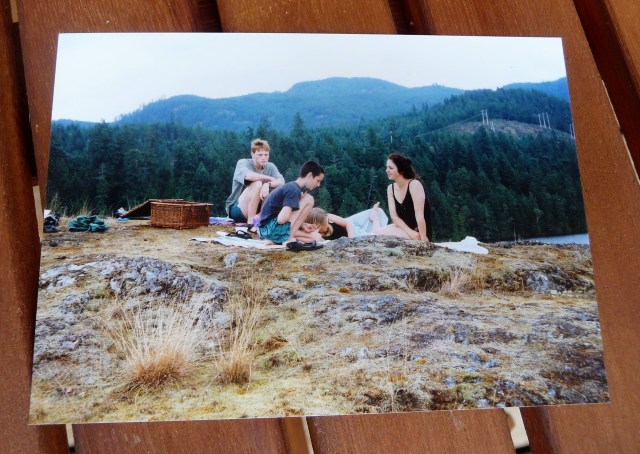
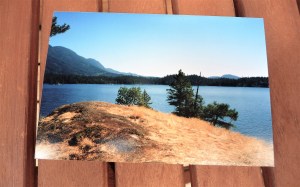
I’ve always loved the literary novella. Without ever really intending to, I’ve built up a nice collection and have read many more, via library or generous friends. Inishbream was a sort of accidental novella, beginning as it did as a linked group of prose poems, eventually drawn out and given a structure. I loved the possibilities of the form, how it could hold so much in such a hermetic shape. A year or two after The Age of Water Lilies was published, I was invited to a book club to talk with members who’d just read it. I always enjoy these occasions. During our time together, one woman asked what happened to Grace after the novel ended. Good question. Grace was born to a single mother in the spring of 1915. She is sort of tangential to the narrative. But the more I thought about her, the more I wondered too. I began to write Winter Wren to find out. I think I knew from the beginning that the book would be a novella. I put Grace in a cabin I’d always thought I’d like to live in, a cabin I first saw as a teenager, on a beach west of Sooke, B.C. (It’s the one above the waterfall in the photograph at the beginning of this post.) She was in her late 50s, an artist trying to paint the view at dusk. I wanted to write about the 1970s—the novella takes place in 1974, an interesting time for ceramics in B.C. (Grace’s love interest is a potter in the tradition of those who studied with Bernard Leach in Cornwall and then returned to Canada), for museums where the salvage paradigm was part of the ethos, and perhaps the last possible time for Grace to meet one of the late 19th c-early 20th c artifact collectors.

winter wren

But you know already what I’m going to say: I sent Winter Wren to dozens of publishers and all of them rejected it. To make a long story short, my dear friend Anik See was visiting enroute from Dawson City to the Netherlands and we shared similar stories about novellas we’d written. We decided to begin a micropress to showcase the form and we decided to begin with mine. Our rationale was this: if our endeavour didn’t work, then I would be disappointed, sure, but at least it would only be me and not someone else. I could shake it off, poof, and move on. (Ha!) Anik designed the book, I photographed a pottery dish with a length of scouring rush (it figures in the book), and we found a really good printer in Victoria. And you know, we sold our first print run of 250 copies within weeks and we reprinted. I still get orders for it. We went on to publish 4 more novellas and we are very proud of Fish Gotta Swim Editions. Our latest is Anik’s Cabin Fever.

I’ve been to the small Vancouver Island beach near Jordan River where Theresa Kishkan’s novella Winter Wren (Fish Gotta Swim Editions) is set; I’ve seen the waterfall that tumbles over sandstone onto the shingle just below, and the solitary cabin facing south and west, surrounded by salal. Winter Wren tells one possible story from the many that cabin could tell. (Michael Hayward, Geist)

After I finished writing Winter Wren, I wrote another novella, Patrin, and it was published (beautifully) by Mona Fertig’s Mother Tongue Publishing in 2015 and then in French by Marchand de Feuilles in 2018. I also wrote a long essay, “Euclid’s Orchard”, about quilting, mathematics, coyote music, apple trees, and love; and when Mona showed interest in publishing a collection of my essays, I gathered together a group. Eulid’s Orchard & Other Essays was published in 2017 and was shortlisted for the Hubert Evans Award.

Each image is a perfect crystallization of a detail, gesturing toward a truth much larger than the tiny pinpoint of its composition. Near Victoria, she recounts an exquisite memory of “an abandoned house completely knitted into place by honeysuckle and roses” (p. 101). Near Drumheller, she sings the prairie: “turn, turn, bend the song to the roadside plants … free verse composed of craneflies, dragonflies, bluebottles, broad-bodies leaf beetles, greasewood and cocklebur” (p. 61). And near her home, she concludes with the cries of coyotes: “lilting joyous youngsters unaware that a life is anything other than the moment in the moonlight, fresh meat in their stomachs, the old trees with a few apples and pears too small and green for any living things to be interested in this early in the season” (p. 155). (Catriona Sandilands, The British Columbia Review)

An aside: Mona Fertig and her Mother Tongue Publishing enterprise deserve gratitude from writers everywhere for the beauty of the books and the huge effort Mona put into designing them, editing them, bringing them into the world with sparkling wine and flowers, arranging public events for the writers, and being the kind of publisher writers dream of. I’d have published with her forever and was sad when she announced her retirement but also glad for her because she’s been able to return to her own writing projects. She did everything that bigger publishers did and she did it with joy. (She’s the one on the left, with the big smile.)

at-the-book-prizes

Novellas, novellas. I wrote The Weight of the Heart as a way to lament the gaps in my own education in the 1970s when the instructor of my Canadian literature course told me not to bother writing about Sheila Watson and Ethel Wilson, saying they were minor, and the former was barely coherent. I wanted to celebrate these two literary cartographers of our province and to highlight the importance of their work. I also wanted to spend time, real time and imaginatively, in the Thompson Canyon and the dry Interior of B.C. Palimpsest Press published The Weight of the Heart in the spring of 2020, just as most publishers and some writers were required to pivot to a virtual presence because of the pandemic. I wish I’d been better at this, though we still had such a slow internet connection—we live in a rural area– that even if I had been able to Zoom more effectively, our bandwidth wouldn’t have allowed me to participate much. (We were able to upgrade a bit later.)

The Weight of the Heart also finds in Wilson’s and Watson’s writing an experimental style and a mode of consolation. Like Wilson’s independent protagonists, the narrator discovers her autonomy and grit in the landscape she travels. Watson’s spectral figures and interest in sacred rituals resound in the symbolic scenes of almost drowning in which the narrator is saved by her brother’s mysterious presence and in Kishkan’s invocation of Egyptian burial rites as a refrain throughout. Most obviously, the double hook of Watson’s title recurs in the dualities throughout the novel—in the two rivers, in twin foals (the colt unfortunately lost in birth) by a mare named Angel, and most clearly in the two siblings who are bound together in a landscape where life and death regularly meet. So, Kishkan and her narrator know where to look in Canadian fiction for a view of the British Columbian landscape that reveals these striking oppositions and their consoling unions. A unique and compelling creation in its own right, Kishkan’s poetic exploration of grief lives up to its literary precursors. (Kait Pinder, the Malahat Review)

I wrote another novella in this decade, begun perhaps in the middle, put aside, but finished in 2020, during the long lonely weeks of the pandemic when I was missing my family and wondering if we would ever get together again for our summer meals, swims, and talks late into the night by a campfire. I used Virginia Woolf’s Mrs. Dalloway as a template, following the main character through a day of preparations for a party. There are shadows and owl voices in the woods and an unexpected guest coming up the driveway at dusk, carrying a knife. I tried to find ways to present the material innovatively, with sections of call and response, lists, and the music of an oud. I called it The Occasions. I don’t know if it will ever be published.

Another aside: I am lucky in life and love if not in publishing. And I wonder how many writers have a husband who is also a letterpress printer and who offers to make keepsakes to celebrate new books? For the past ten years or so, John has printed beautiful objects, some of them embellished by me, to give away at book launches and to provide local book stores with so they can tuck a keepsake into the books of mine that they sell. I have a few remaining of some of these and if you want to order a book from me, I can include one for you.

keepsakes remaining

At the beginning of this instalment, I wrote that I was trying to untangle the knots of family history and genealogy. Some of this work resulted in essays in Euclid’s Orchard but I wasn’t finished and kept on writing. I’d also had a health issue in 2016 that resulted in many tests, half-diagnoses, fearful assessments (though it all worked out well), and I also wrote about those things against the backdrop of all I loved: my family, the rivers of this province, textile work (which is always a way of meditating for me, sewing myself in and out of mysteries, riddles), the countries my grandparents left for new lives in Canada, and more. These became Blue Portugal & Other Essays, published with care and generosity by the University of Alberta Press in 2022. It received SUCH good reviews.

In Blue Portugal the essays’ themes are allowed to slip their boundaries; a topic addressed in one essay recurs in later essays, a recognition, perhaps, that thoughts and interests develop over time, shifting slightly as they are put in the company of other thoughts, are seen from different perspectives. The essays in Blue Portugal seem to talk to each other; they interlace in interesting and thought-provoking ways. The book is a fine example of the personal essay at its best. (Michael Hayward, The British Columbia Review)

It was a book that others noticed, gifted to friends, and reading it now, I am sort of surprised that I was led into some of the essays so mysteriously. A voice in the night, murmuring, The river door. Whose voice? I only know I took it to heart.

To those of us who’ve been following Theresa Kishkan on her blog for many years, the preoccupations of her latest book, the collection Blue Portugal & Other Essays, will be familiar, the quilts, the homesteads, the memories, the blue. But it’s the stunning craftsmanship of the book, the fascinating threads that weave the pieces together and also recur throughout the text, that make this book such a pleasure to discover. How quilting squares are analogous to the rectangles from which, one by one, Kishkan and her husband literally constructed their home on BC’s Sechelt Peninsula, and the blueprints, and the blues of dye, and of veins, and of rivers, and of how one thing turns into another—how? How does a body get old? How do children grow? How does a family tree sprout so many new branches? And from where did it all begin, Kishkan going back to seek her parents’ nebulous roots in the Czech Republic and Ukraine, in a 1917 map of lots in Drumheller, AB, in everything that was lost in the Spanish Flu, and how we’re connected to everything our ancestors lived through. (Kerry Clare, picklemethis.com)

And now? Now? 4 years into the 3rd decade of the century, I’ve completed another collection of essays. The centrepiece is a long postmortem and reassessment of a relationship I had with a painter when I was 23 years old. My walls are hung with some of his paintings, portraits of me among them, and I attempt to reclaim the gaze by entering into a daily conversation with one particular portrait hung in a stairwell; she is one of the first things I see each morning as I come down to the kitchen. There are other essays in the collection that meditate on war, climate change, injury and recovery, swimming and Herakleitos, and the nature of love. I’ve begun the long process of trying to find a publisher (my last publisher wasn’t interested, feeling perhaps that the collection is too personal and potentially risky in terms of sexual politics). As I write, it’s been rejected by 4 publishers and is currently awaiting decisions by 6 more. I’m also about halfway through writing a novel set in a small fishing village called Easthope and in the city of Lviv, in western Ukraine. I began the novel 4 years ago, just home from a trip to Ukraine, and set it aside to complete editorial work on Blue Portugal. And then the Russians invaded Ukraine and I couldn’t imagine ever writing about Lviv. But I decided that I’d stay with my original intention and setting— 2015—and write to set down what I love about both places.

And now in a hurry just
pack, always, each day,
and go breathless, go to Lvov,
after all it exists, quiet and pure as
as a peach. It is everywhere.

–Adam Zagajewski, trans. Renata Gorezynski. The poet used a variant for his native city which has known many administrations since it was first established in the 5th century and is currently known as Lviv

It may seem that I am a bit cranky about publishing in the 21st century but I have to say that it’s always the end point in writing for me. I began to write with the sense that the process was complete when the piece found a place in the larger world. I don’t begin a work with any idea of what might happen when I’ve finished, though. Not yet. I live in the language, the world of the writing, and when I come up for air, it’s then that I realize that I have no idea if the work will ever find a readership. I am too many things that are not what the current world wants or needs. Who wants to read about a fishing village or a party under fairy lights in a garden on the edge of the world or eye injury or indigo dye or the musings of an aging grandmother? A woman married for 45 years. I know some people do but maybe not enough of them. Enough of you, I mean. But I have some years left and those will find me at my desk, finding a way to map out the terrain I dream about, yearn for, to find ways to knit together strands of music, roots of family trees, and real trees too, embellished with salmon bones, the beautiful holdfasts of bull kelp and bladderwrack (the tired images scorned by A.F. Moritz all those years ago). There’s a little quote from the writing of the early naturalist and advocate for wilderness, John Muir: “When we try to pick out anything by itself, we find it hitched to everything else in the Universe.” I keep this in my mind and heart as a mantra. I don’t know how this might be worked into a synopsis or query letter or proposal but it keeps me anchored, heldfast, to what I want to do in my life. Everything else is a bonus.

holdfast

“my mind becomes one with all this” (Liu Tsung-Yuan)

jp-tk

I’ve been working on the final edits of an essay which will appear in a forthcoming anthology, Sharp Notions: Essays on the Stitching Life, due in fall from Arsenal Pulp. My contribution is about John’s bilateral hip replacement surgery in the fall of 2020 and the unexpected injury he suffered during that surgery. It’s about caring for him during a difficult period and how I worked on two quilts to keep my mind quiet. I was afraid. There were other medical issues at the time and our house in the woods felt very far from the services we needed. Because of COVID and because we were advised to consider John immunocompromised, we were not seeing other people at that time. I sewed and John healed and then I wrote about how the two processes were intimately connected, the threads overlapping and entwined. (In an older time, his incisions would have been sewn up after the surgery but now most surgeons use staples!)

Reading the essay as I worked on the rough spots, I realized it was about marriage as much as anything else. As well as anything else. When John was in UBC hospital, recovering from the surgery, we celebrated our 41st wedding anniversary. I bought pastries at a little bakery near where I was staying and took them to his room with a copy of Written in Exile: The Poetry of Liu Tsung-Yuan, translated by Red Pine (the pen-name of Bill Porter). We ate the pastries and read poems to each other, looking out towards the North Shore mountains.

Sewing, poetry, pastries…these have been constants of our lives together, it seems. We met at a poetry reading in 1979, we’ve worked as poets (though my writing trail veered off that course about 30 years ago), I began making quilts 35 years ago and the results are on every bed in our house, and we’ve always loved good pastries. When we stayed in Paris in 2009, in a tiny garret flat in the Marais, we went daily to a patisserie nearby and bought delicious treats to bring back to have with coffee. There were something like 94 stairs to our flat so walking up and down three or four times a day wore off the calories. We didn’t celebrate a wedding anniversary on that trip but a year or two later we were in Vienna on October 20th and we found a wonderful restaurant where we had a memorable meal. We chose the restaurant because it was a little low building and because there was a tidy stack of firewood by the door so we knew there would be a fireplace within. There was, and the food was wonderful. Tyrolean food, the owner told us, and he kept bringing little tastes of this and that, including duck and apple mousse in a tiny shell of choux pastry to taste while we were waiting for our soup and a schnapps flavoured with larch (for me) and pine (for John) to have with dessert.

Today isn’t our wedding anniversary but it’s the 44th anniversary of our meeting, which has always felt more important than the date we actually formalized our relationship. On the night we met, I was wearing a deep red dress I wish I still had. I was wearing mulberry tights. It doesn’t seem like 44 years ago. Everything feels like it was, oh, a month or so ago. A month or so ago I was waiting for our first baby to be born. A month or so ago I was sewing curtains for rooms for our children, red and blue cotton with white elephants marching from left to right. I was planting tomato seeds in little pots to arrange by the woodstove for warmth while the seeds germinated. I was writing my first essay. John was finishing a book of poems. We were listening to Dire Straits for the first time. We were walking down the driveway with one child, then two, then three, with one dog after another, until there were none. We were standing by the front door as grandchildren arrived and left. I was sitting in the rocking chair by the fire finishing a quilt. Starting another. Van Morrison was singing, I’m gonna walk down the street until I see my shining light. Our parents were getting older and older and then they were gone. Friends too. And how did this happen? We got older too.

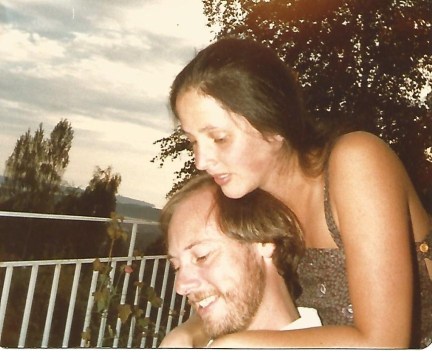
A photograph is a story. It’s the whole story. In the one I’ve used here, we are young, there’s a baby on its way, we have slept on the land we live on now, we are learning where the best views of the mountain are, where the deer bed down for the night, where we want our house to be. We have made the first ring of stones for fire. We are drinking the water from the lake we love. Almost certainly the first dog of our shared lives was curled up at our feet.

Last night we drove out to the Backeddy Pub in Egmont for supper. The chef made elk ragu over soft potato gnocchi. We sat by the window and looked across the inlet to two frail lights on the other side. This is a life, two people at a table, the tide high, the waiter pouring a little more wine before the drive home on a narrow twisting road. I’m going to go slow, said John, because the line on the middle of the road has faded completely. A little snow fell.

Sandbars free of overnight clouds
village walls lit by the morning sun
a pristine pond encircled by trees
last night’s rain scattered by the wind
happy having nothing to do
my mind becomes one with all this
–Liu Tsung-Yuan, translated by Red Pine

redux: what does a carrier bag hold?

Note: this was from December 1, 2014. Yet it’s still true, still ongoing. I did finish both the essay and the quilt. The essay was published first in Rooted: The Best New Arboreal Nonfiction, edited by Josh MacIvor-Andersen, and then it became the title essay of a collection of my work, published by Mother Tongue Publishing. The quilt went to Forrest and Manon for their March birthdays. And it’s all happening again—essays in progress, quilts inspired by them, and my bedrock belief that it’s part of a continuum.

__________________________________________________

For the past month or so, I’ve been trying to work on a long essay, “Euclid’s Orchard”, which is loosely about mathematics, wine, love, horticulture, and genetics. It’s a hodgepodge, yes, but I know that there’s also a coherence there, a pattern, and I’m a little at a loss right now to see it. (I’ve also begun a novella which is taking my attention, though not all of it.) The essay has a quilt to accompany it; the quilt is a textural meditation on the mathematics in the essay and the essay also details the making of the quilt. The individual parts of the quilt are all designed and made and now I need to piece it together, to find a pattern for the individual squares (though in fact they’re rectangles!) to echo the elements in the essay. This is where I’m puzzled and can’t see or think my way through it.

I don’t like being idle. And I think best when I have some sort of hand work to do. I am a terrible knitter but sometimes I knit just to feel the accumulation of yarn making itself into a scarf or a blanket, a kind of magic emerging from the needles. And my quilting skills are only a little better but I love to see the possibilities of colour, harmonies, even narratives in fabric and to find ways to work with those. My brain is not logical and I can’t follow directions so the quilts I’ve made over the years (more than 25 — years and quilts) are very much my own. And they’re explorations.

Maybe they’re also carrier bags. Years ago I visited a class of students studying my novel, Sisters of Grass, and when I met their instructor before the class, he told me that he thought of my work in the tradition of Ursula LeGuin’s “The Carrier Bag Theory of Fiction”, from her essay collection, Dancing at the Edge of the World. As it turned out, I’d brought along a basket of objects central to the novel — a sampler, some Ponderosa pine cones, photographs taken by the ethnographer James Teit — so I noticed the instructor (a very congenial man) smiling as I unpacked my basket, reading a little from my novel, and passing around objects for interested students to look at.

If it is a human thing to do to put something you want, because it’s useful, edible, or beautiful, into a bag, or a basket, or a bit of rolled bark or leaf, or a net woven of your own hair, or what have you, and then take it home with you, home being another, larger kind of pouch or bag, a container for people, and later on you take it out and eat it or share it or store it up for winter in a solider container or put it in the medicine bundle or the shrine or the museum, the holy place, the area that contains what is sacred, and then next day you probably do much the same again-if to do that is human, if that’s what it takes, then I am a human being after all.

A carrier bag holds more than food, of course. It holds anything you want it to and sometimes it holds ideas, simple ones and more adventurous ones. It holds scraps of fabric and pine needles for baskets and memories of campfires and the sweet scent of a baby sleeping.

This weekend I had such an urge to make something, my hands yearning for work. But I’m still weighing and pondering the final pattern of “Euclid’s Orchard” and wasn’t able to take that any further. I went into the trunk holding my stash of fabrics and pulled out a whole passle of scraps, bits and pieces left from other quilts but too pretty to throw away. There wasn’t enough to anything big or elaborate so I decided to cut what I had into five-inch squares and find a pleasing way to piece them together. It took two mornings to cut out all the squares — 168 of them — and then an afternoon and a morning to get to the point I’m at now: ten courses of the eventual fourteen pieced together. The cottons have no relationship other than the one I’ve imposed on them. Some of them are French prints, some scraps from intricate quilts I’ve made in the past, and some of the fabric comes from an unfinished dress begun by a friend and passed along to me because she thought I’d like the print and might want to cut up some of the usable areas.

This morning, as I sewed lengths of squares together, I found myself thinking about “Euclid’s Orchard” and I think I might be ready to work on the essay again.  Something about the quiet labour of fitting pieces together, aligning their edges, trying to make the seams even, looking for a way to highlight a colour — the punch of yellow in this simple patchwork quilt has me remembering the sunlight on the orchard that is central to the essay…

If you haven’t got something to put it in, food will escape you–even something as uncombative and unresourceful as an oat. You put as many as you can into your stomach while they are handy, that being the primary container; but what about tomorrow morning when you wake up and it’s cold and raining and wouldn’t it be good to have just a few handfuls of oats to chew on and give little Oom to make her shut up, but how do you get more than one stomachful and one handful home? So you get up and go to the damned soggy oat patch in the rain, and wouldn’t it be a good thing if you had something to put Baby Oo Oo in so that you could pick the oats with both hands? A leaf a gourd a shell a net a bag a sling a sack a bottle a pot a box a container. A holder. A recipient.

And wouldn’t it be wonderful to have a bright quilt to keep away winter’s chill? Blues, yellows, and a long diagonal of red, bright as berries and necessary as blood.

P1100972

redux: old postcards from Ruby Lake

In anticipation of a family visit later this month, I’m reposting this, from 2017. Some things change and some things never change. Thank goodness.

________________________________________

We’ve lived near Ruby Lake since 1980. Well, that’s not quite right. We bought our property in 1980, began building our house in 1981, when Forrest was two weeks old (we lived in a tent while building…), and moved in on John’s birthday in 1982, just a month before Brendan was born. But I have to say the property and the lake have been our home territory since we first came to camp on a little bluff on Ruby Lake while looking at land with a real estate agent in early 1980, just a few months after we got married.

I loved swimming in the lake. The water is clean, though some summers the duck itch is irritating. So are the big boats, though the ones with (is it?) open-exhaust systems are not permitted; not permitted, but no one enforces it. And so young men (they are almost always young men) like to tear around the lake, pulling each other on skis and innertubes. The lake doesn’t have a lot of public access so the areas that are accessible are often very busy now. It didn’t used to be that way. When we first came to swim in Ruby Lake, there was a rough track down to the shore at the place where the Regional District has now made a family-friendly park. You walked through hardhack and ocean spray and entered the water amid drifts of wild mint.

To get around the busy nature of the park, where we often couldn’t find a space for our family, we’d take picnics out to one of the small islands in the boat we bought with an income tax return when the kids were small. I wrote about those picnics in “Love Song”, included in Mother Tongue Publishing’s The Summer Book:

Out in the boat with a picnic to eat on the island in the lake, the island we call White Pine for the little grove on its high point, or else “Going to Greece” for the scent of yarrow and dry grass. I spread out a bamboo mat on the spine of hill and brush ants from my legs while one child dives from the rocks and another swims underwater. The third is learning to start the boat motor, pulling the cord and adjusting the choke.

This morning I was looking for old photographs and came across a few that brought those summers vividly to mind:

postcard 2.jpg

You could sit on that grassy spine of the island and the world was as you wanted it.

postcard 1

There are manzanitas growing near the water and some scrubby pines on the rise and in spring, chocolate lilies and death camas. The scent of yarrow. Snakes, turtles.

For the past few summers, I haven’t done much swimming. By the time the sun is high and it’s hot, the lake is so busy. The prospect of finding a place among the others on the shore is daunting. John goes every day, late afternoon, and has a favourite place away from the beach. He swims off some rocks. But I like to ease into the water (I never learned to dive) and I’d rather stay home.

But last week I thought, Why not swim early? And why not? All winter we swam in the local pool, in part to deal with some side-effects of the health crisis I faced last fall (autoimmune stuff going on in one knee), and I loved being in the water again. Loved the buoyancy, the lightness of being, the opportunity for long meditative thinking as I swam lengths in the warm water. So after the first round of watering, after the tomato plants have been given their drink, and the roses too, we head down to the park. No more hardhack right at the shore. No more mint. But also a kind of blessed quiet. No self-respecting jet-boater is up before 9.  We enter the green water and listen to crows overhead. This morning there were a few people camping in the parking lot. A motorhome. A van. A small pick-up truck with a tent in the back. Two motorcycles with a pup tent between them. As we walked down to the beach, a guy was standing by the water. His entire body was tattooed. He told us how beautiful the lake was, that he was going to go swimming, and that he and his partner had arrived too late for the campsite at Klein Lake so they came back to the park and put their tent up by their bikes. I knew John was remembering his own first glimpse of Ruby Lake, in the early 1970s, with a girlfriend— they also arrived on motorbikes after dark and camped in a clearing off the highway. When they woke the next morning, they saw the lake below them. He never forgot its beauty. That’s why we’re here.

In a few weeks, some of the kids (and one grandson) will arrive for a week. They spend as much time in the water as they can. There will be towels everywhere, and the smell of wet hair. I can’t wait.

How long can a girl dive before her father accords her a perfect score, how many times can a boy circumnavigate the island with the throttle on low? Another practises the dead man’s float. Three years, or six. Drift on a raft under the low-growing spirea and bog laurel, count turtles on logs, crush a few leaves of wild mint in your hands while the years accumulate. Nine years, or twelve. ( from “Love Song”)

postcard 3.jpg

“One apple tree remains under my care.”

merton beauty

One apple tree remains under my care. It’s a Merton Beauty, bought as a tiny plant at a produce store in Sechelt. An organic gardener had grafted interesting varieties to dwarf rootstock, and I chose one almost at random. Merton Beauty is a cross between Ellison’s Orange and Cox’s Orange Pippin. For years, ours sat sort of sullenly in a little circle of stones near the garden shed, caged in chicken wire. I’d water it, give it the occasional mulch of compost and drink of fish emulsion. A few frail blossoms, an inch or two of new growth. Then it produced some fruit that was delicious. The information I’ve read about this variety stresses the aromatic flavor of the apples—their spicy taste, redolent of pears, cinnamon, aniseed. I can’t say I noticed those particular notes, but the skins were pretty, russeted at the shoulders, and the flesh was crisp, with a true flavor of apple. Not the empty watery taste of many supermarket apples, sprayed, waxed, gassed, and stored for months.

–from Euclid’s Orchard

redux: “I have always taken the compass as a thing to be held.”

5A

Note: This post is from March, 2014. I was thinking my way into a novella and I was reading, in some cases re-reading, the novels (and novellas) of Ethel Wilson and Sheila Watson. They are the muses of the novella I eventually wrote, The Marriage of Rivers, and I am so delighted to tell you that Palimpsest Press will publish it next spring (2020). The contract has been signed, sealed, and delivered! This press, like Mother Tongue Publishing, is devoted to “…poetry, fiction, and select nonfiction titles that deal with poetics, the writing life, aesthetics, cultural criticism, and literary biography.” And their books are objects of beauty in themselves.

_________________________________________________________

I’ve never been to Dog Creek though I’ve thought of it many times as we’ve driven Highway 97 from Cache Creek north. In 1934 (one account says 1935) the young Sheila Doherty went to teach school in Dog Creek, then (as now) a remote community on the west side of the Fraser River. She lived in Dog Creek for two years and wrote of this time in her first novel, Deep Hollow Creek, though it was published much later in her life, after she’d achieved a kind of fame after the publication of her second novel, The Double Hook, in 1959. By then she’d married Wilfred Watson and taken his surname.

I read The Double Hook as many of us did, as an undergraduate (in the last century), and it changed the way I thought about novels. Its language, both lean and mythic, led the reader into a hermetic world from which one emerged, dazed and somehow enlightened. Its structure was (is) perfectly balanced between darkness and illumination, between violence and redemption. As Sheila Watson wrote in The Double Hook, “…when you fish for the glory you catch the darkness too.”

But it was many years later before I found Deep Hollow Creek — and no surprise there because it wasn’t published until 1992. I read it later in the 1990s, a chance discovery on the shelves of the Sechelt Public Library. It’s a brief perfect book. 111 pages in the New Canadian Library edition I bought at Russell Books in early March. I’d call it a novella, that enigmatic form beloved by maybe too few of us these days (or so the publishing world would have us believe. We can’t market them, they say. We can’t sell them!). Every word counts in Deep Hollow Creek and there are just enough of them for the young school teacher Stella to enter the place  that is Dog Creek and tangle herself in the dense stories of the few who live there.  “If I hadn’t come here, I doubt whether I should ever have seen through the shroud of printers’ ink, through to the embalmed silence. The word is a flame burning in a dark glass.”

Deep Hollow Creek anticipates The Double Hook but to my mind it’s more satisfying. This is personal, of course. I think both books are works of sheer genius but somehow the symbolism of The Double Hook is used with a lighter hand in the earlier book. The place — Dog Creek — seems first of all to be a real place. Stella unravels the water-rights, the systems of hay crops, the genealogies of horses and dogs, the bitter disputes between families. And it all rings so true, even those grouse among the jack-pines: “…red-eyed, speckle-coated fool-hens…unconcerned, waiting for their necks to be wrung without the trouble of a shot.”

I am trying to find a way to write lean essential stories myself and it’s a gift to have this book to serve as a talisman, a compass. “I have always taken the compass as a thing to be held. Yet the hand falters measuring the fleeting body of flame.”

twirling

dad on bike.jpg

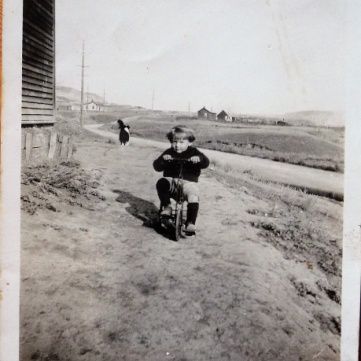
My father, on his small tricycle, c. 1929, his dog watching the road. I think of him often, particularly when I see photographs of my grandchildren. How certain gestures, features, remain over time, in the intricate mathematics of inheritance.

I consider the ghost of a child’s hand in an ultrasound image, another of a baby’s spine,my father on a tricycle,in a little metal car, grey, grey, the propped coffin on a bench in 1923, on the stair by a house I am uncertain is the one my father spent his
childhood in or an earlier one that burned. Is it the house built by Joseph Yopek or a later house?

—from “West of the 4th Meridian: A Libretto for Migrating Voices”, published in Euclid’s Orchard, Mother Tongue Publishing, 2019

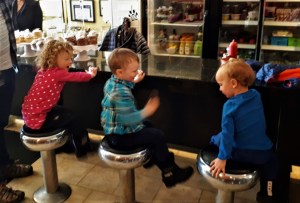
This morning, 3 of my grandchildren in a cafe in Ottawa (the 4th still too small to sit on a stool unassisted). They remind me of their own fathers (my sons) and they remind me of my brothers as children, twirling on stools in cafes as we drove across Canada to Halifax, and back. Twirling and twirling until, dizzy with movement, they’d fall or be forcibly removed from the stool, and scolded.

at Bobby's Table

the night wild with their song

crossing over

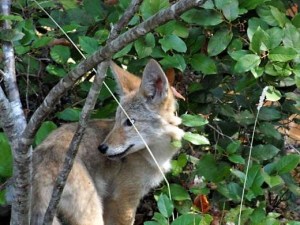
Last night I was awake again and from my warm place in the bed, I heard the coyotes. They were far away but one of them (the male, I think) was howling and one of them (the female) was yipping. Yesterday, on our walk down the driveway (we can’t drive up in this snow so leave the car by the highway), we saw the whole story of how the coyotes had spent their morning. It had snowed overnight so we knew the tracks were fresh. They’d been up near the house (which explains why the cat was skittish). One of them stopped to pee. Above is where they were ambling down the driveway, their tracks crossing. Sometimes you could tell that one was following almost in the other’s footprints. Sometimes they walked on separate sides of the driveway. By the time they reached the old orchard, they were walking side by side.

lives

They are presences in our lives and even in our sleep. And in my memory, as I think of the years that we’ve heard them, seen them, the night wild with their song.

And listen: the coyotes are singing, the deep voice of the father,the rather more shrill voice of the mother—anxious that all her offspring eat well and learn to hunt, to care for their safety in the forest beyond the orchard—and the lilting joyous youngsters unaware that a life is anything other than the moment in moonlight, fresh meat in their stomachs, the old trees with a few apples and pears too small and green for any living thing o be interested in this early in the season.

—from “Euclid’s Orchard”, published in Euclid’s Orchard & Other Essays, Mother Tongue Publishing, 2017.


It’s all in the song.

pup

Last night, we’d just fallen asleep when the room was filled with noise. Coyote noise. I think it was the estrus call of the female and it went on and on. Then was answered. Most years we hear the courtship music of the coyotes and later in the season, we’ll hear the resulting family song.

Coyotes weren’t around when we first moved to the north end of the Sechelt Peninsula in the early 1980s. By the 1990s, they were on the lower end, then people were reporting them in Halfmoon Bay, and by 2005, we were seeing them regularly. We think of them as part of the landscape and it’s surprising to remember that they haven’t always been here. Or at least not in our time. In Mammals of British Columbia (Eder and Pattie), there’s an interesting note that David Thompson wrote regularly about fox and wolf sightings as he traveled west but he didn’t mention coyotes. They’re certainly thriving now, in cities as well as wilderness.

They arrived on our land around the time our children had moved away. I’ve thought about this a lot. How we’ve heard their courtship, seen the young pups, heard the family singing in late summer, and then in winter watched the parents crossing the old clearing where our orchard used to be. When I see them, I think of my family, its long residency among these trees. I wonder if the coyotes think of their own grown offspring.

I wrote about coyotes and family and mathematics in an essay, “Euclid’s Orchard”. It became the title of a book of essays released in 2017 by the wonderful Mother Tongue Publishing.

One day a single light brown coyote came out of the woods and walked by my window. It had all the time in the world. It passed the wing of rooms where my children grew up. It passed the windows they looked out at night, first thing in the morning, drawing their curtains to let sunlight in or the grey light of winter, in excitement, lonely or sleepless, in good health and bad, dazzled with new love or sorrow, at the lack of it, on the eve of their birthdays, new ventures, on the eve of leaving home. I went to the back of the house to see where the animal was headed, but it did what coyotes do, a trick I wish I could also learn. It dematerialized. Vanished into thin air.

Mostly coyotes are monogamous. Their life span is 10-14 years. I don’t know how likely it is that the pair we heard last night is the original pair. But perhaps one of the offspring and its mate, drawn to the old territory?

So it happens again. Courtship, mating, birth, nurture. It’s all in the song. In August, in moonlight, we’ll hear it again, will recognize in the beautiful harmonies something of our own deep story.

Braid groups, harmonic analysis: The whole is greater than the part. Euclid’s 5th Axiom

A midsummer evening, clear moonlight. Down in the orchard, the coyotes have gone under the fence with their young. How many? I’ve seen one, heard several others. I’ve imagined them on the soft grass, tumbling like my children used to play, rolling down the slope over tiny sweet wild strawberries, over the heart-shaped violet leaves, the deep pockets of moss, while around them snakes hid under the lupines. But now in the quiet, I am shaken out of my dreaming because a coyote is singing a long, low passage. A lump forms in my throat as I look out into the night, the sky dusty with stars, a three-quarter moon hanging so perfect over the hidden lake that I think of a stage set, an arranged scene created by strings and wishful thinking. A jagged line of dark horizon and the vertical trees, the line of them rising, then descending as the bar changes, a page of music, the arpeggiated chords, the implied bass line. A pause, a comma of silence. Another coyote joins in, then at least two more. It’s a part-song, a madrigal. Each voice is on pitch, but one is low, another high, and several braid themselves in and around the melody line.

winter dreaming at the end of the old year

crossing the bridge

Last night I dreamed so vividly of a place my family lived in the 1950s, at the foot of Poignant Mountain, and a drive across the Fraser River to Mission City. I dreamed and woke and couldn’t believe how the years had passed.

All the mystery of waiting at the river for the bridge to come down, the dark water, the glowing of the beehive burners, the anticipation of an egg salad sandwich and a chocolate milkshake. A crossing I loved. From Matsqui to Mission, from our side of the river to the other. And returning, driving home over the bridge again, from the shadow of the mountains to the open prairie, along Riverside Road, past Miss Kemprud’s where we went for ice-cream during Sunday drives, past the school my younger brother attended, past the hall where, at the age of five, I’d been in a fashion show—I modelled a tartan skirt and short-sleeved sweater from Eaton’s, which I hated and which my mother bought for me afterwards—along Harris Road, then Glenmore, house lights golden in the black fields, turning right on Townshipline Road until we reached our own driveway, the quiet barn with its sleeping cows, and the sound of frogs loud in the slough. I’ve turned a dream into a memory. But in fact both are the same.

Across dark water, I went from childhood to adolescence. The house at the end of the row by the radio base was not the house we returned to from Mission City in the dream that was also a memory. It was a white house on a farm on a long road, but that road led back to the foot of Poignant Mountain, forgotten and then found, lard pails stained by blueberries and abandoned on the verge, a small girl huddled in the cool bunker where the milk waited to be collected and where I wait now with her for the end of the world.

— from “Poignant Mountain”, Euclid’s Orchard, published by Mother Tongue Publishing, 2017.