5 pounds: a late divination

a writer's diary

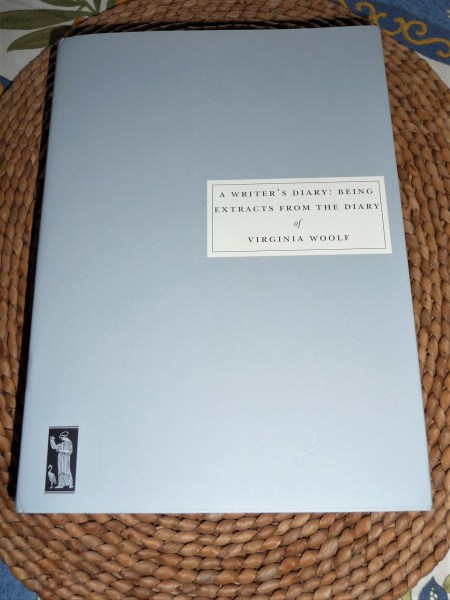
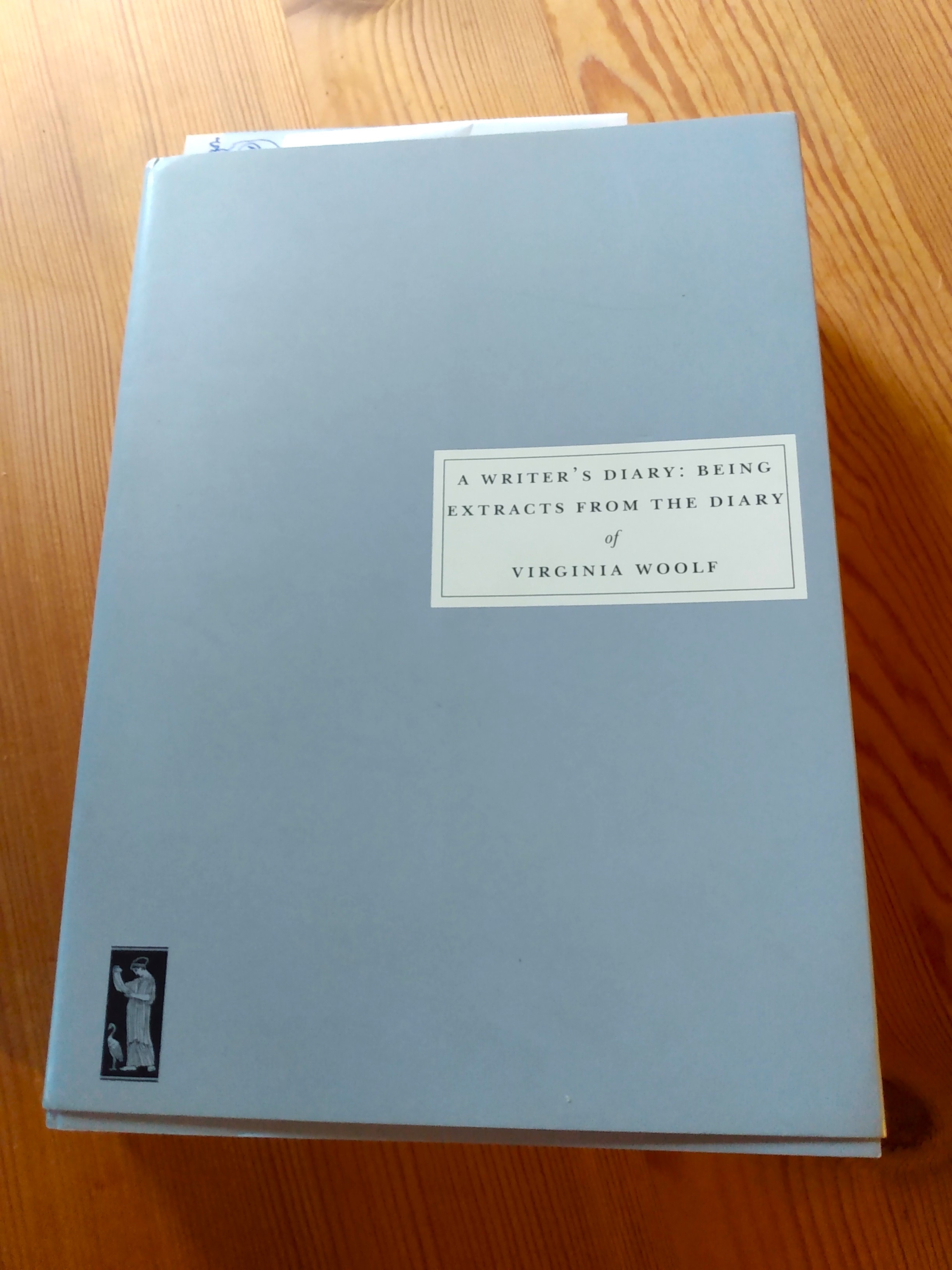
I keep Virginia Woolf’s A Writer’s Diary on my desk. Many mornings I look through its pages to see what she was thinking in 1921 or 1925 or even as late as March, 1941, with her own death just weeks away. She has been my writing companion since I first read The Waves in 1972 or 3. I’ve written before that a kind friend who was both a librarian and a bookseller once gave me a first edition of this book, with cover design by Vanessa Bell, and I treasured it. I lent it to a promising student in a course I once taught in Victoria in 1978 and then I never saw her, or the book, again. But never mind. This Persephone Books edition has endpapers based on that cover design and it serves me well. Some mornings I use it as a kind of divination. What advice will Virginia have for me, what will I learn about both writing and about faith, about confidence, about perseverance?

This morning, as she was finishing The Waves, in late December, 1930:

What it wants is presumably unity; but it is I think rather good (I am talking to myself over the fire about The Waves). Suppose I could run all the scenes together more?–by rhythm chiefly. So as to avoid those cuts; so as to make the blood run like a torrent from end to end–I don’t want the waste that the breaks give; I want to avoid chapters;that indeed is my achievement, if any, here: a saturated, unchopped completeness; changes of scene, of mind, of person, done without spilling a drop. Now if it could be worked over with heat and currency, that’s all it wants.

Yesterday and the day before I printed out hard copies of all the writing I’ve done in the past 4 years: a novel, a novella (sort of my own Mrs. Dalloway, a day in the life of a woman planning a party), one very long essay (35,000 words), and 6 shorter essays. I put them all in an accordion file folder and then, as I was about to tuck the folder away, I thought, Wow, this is quite heavy. So I weighed it. 5 pounds. 5 pounds of writing from the past 4 years. To be honest, the novella was begun earlier but then put aside, and for a lot of reasons that made sense (and still make sense), it was the perfect thing to work on in those early lonely days of the pandemic when my thoughts regularly turned to the cherished past. This work is very much mine. And that poses something of a dilemma because it seems that none of it is particularly publishable. One of the essays appeared in a literary magazine and another was part of an anthology. But the other work: I have a list in a notebook of publishers sent to, of silences and rejections, and it has grown to a rather shocking length. Which tells me something, if I am paying attention. In late October, on a train from Bordeaux to Paris, I took advantage of the free WiFi to send queries to those who hadn’t responded. And it was a little surreal to read replies coming in as we passed fields shorn of their crops and chateaux on distant hills. No, and no, and no.

So on a shelf near my desk, an accordion folder with 5 pounds of text. And a new essay well-underway, one that tries to wrangle some feelings into order, what it was like to finally encounter the animals I first learned about when I was 19 (nearly 50 years ago), on a mild morning in October at Font-de-Gaume in the Vézère valley in France. In a book I’m reading, The First Signs, paleo-anthropologist Genevieve von Petzinger talks about the period when our early ancestors became us. When they used signs and made images that were sophisticated records and responses to the world. And when we entered Font-de-Gaume on that morning, I think I knew I’d found my own people. I stood in the dark, looking at the drawing of a male reindeer bending forward and licking the forehead of a smaller reindeer, probably a female. There is tenderness in this moment, and also such artistic skill. The stag’s tongue is engraved. I am writing about that moment. I am writing something that will probably join the other pages in a file folder on a low shelf, a note on its flap: Unpublished work. But maybe what happens after is irrelevant. I wrote the story of a woman planning a party, I wrote about the strange legacy I carry of having been the subject of an artist’s obsession, I wrote about stitching a life back together after a surgical misadventure, about swimming and the origins of string, about kingfishers and Russian atrocities in Ukraine, about a family rupture that made me see the past 40 years in a very different light, a dim sad one, and in every sentence I wrote there was love.

John took this photograph of the entrance to Font-de-Gaume. It’s an opening, a door into the dark. But I found such beauty there and a kind of deep solace. This morning, reading divination in the words of Virginia Woolf, this is what I have.

entrance

“Relish the Monday and the Tuesday” (Virginia Woolf)

the square

I’ve written about Virginia Woolf a fair bit on this site. She was one of the first writers I came to as a girl, not even really a young woman, not yet, and recognized in her something of a kindred spirit. I loved her use of language, of structure, of attention. Would she have recognized any of these things in me? Not then. Probably not even now. But for more than 50 years I’ve read her regularly, I keep her A Writer’s Diary on my desk and use it almost as a form of divination. What was she thinking around this time of year in 1930 when she was writing The Waves?

How to end, save by a tremendous discussion, in which every life shall have its voice–a mosaic–I do not know. The difficulty is that it is all at high pressure. I have not yet mastered the speaking voice. Yet I think something is there; and I propose to go on pegging it down, arduously, and then re-write, reading much of it aloud, like poetry. It will bear expansion.

What was she thinking in 1940, the war filling the airwaves? (She thought about it a lot. But she also tried to preserve her own sanity.)

Relish the Monday and the Tuesday, and don’t take on the guilt of selfishness feeling: for in God’s name I’ve done my share, with pen and talk, for the human race. I mean young writers can stand on their own feet. Yes, I deserve a spring…

What was she thinking, just before her suicide by drowning, by forcing a large stone into her coat pocket and walking into the River Ouse 83 years ago today, what was she thinking 20 days earlier, when her life must have felt like something she could leave behind with a letter (“You’re in your body like a plant is solid in the ground,/Yet you’re the wind. You’re the diver’s clothes/lying empty on the beach.” –Rumi).

I intend no introspection. I mark Henry James’ sentence: observe perpetually. Observe the oncome of age. Observe greed. Observe my own despondency. By that means it becomes serviceable. Or so I hope. I insist upon spending this time to the best advantage.

In London in late February, I walked over to Mecklenburgh Square where Virginia and Leonard lived briefly and ran the Hogarth Press before German bombs destroyed the house. A few years ago I read Francesca Wade’s Square Haunting, a history of the square and five women who called it home: Dorothy Sayers, the poet HD, Eileen Power, classicist Jane Harrison, and Virginia Woolf. It was a wet day and I could only peer through a hedge at the garden in the middle of the square, locked to the public. I’d left John in St. George’s Garden, among the newly flowering trees and birdsong. I thought of how traces are left, and not left, houses are bombed, and how we are both remembered and forgotten. The world hasn’t improved. At least Virginia Woolf was spared what was to come. We on the other hand are both burdened and spared.

This morning, after my swim, I was sitting on a bench outside, waiting for John and all around me the robins were singing. I waited all winter for this song, the long syllabic whistles over in the maples near the creek. On dark days in January, I thought of it, the way it almost drowns out every other bird in the area, except for the piercing note of the varied thrush. I even checked to see what Woolf was thinking in the months before her death.

It’s the cold hour, this: before the lights go up. A few snowdrops in the garden. Yes, I was thinking: we live without a future. That’s what’s queer: with our noses pressed to a closed door.

Or our ears longing, near an open window.

Note: the passages of VW are from A Writer’s Diary: Being Extracts from the Diary (Persephone Books, 2017). The passage of Rumi was translated by Coleman Barks.

redux: “all the lives we ever lived”

Note: two years ago I finished The Weight of the Heart, published in late spring of this year. How wise Virginia Woolf was in her advice: “So long as you write what you wish to write, that is all that matters; and whether it matters for ages or only for hours, nobody can say.”

light1

And all the lives we ever lived and all the lives to be are full of trees
and changing leaves.” — Virginia Woolf, To the Lighthouse

Yesterday I surprised myself and finished the novella I’ve been working on. I knew I was somewhere near the conclusion but as I didn’t know what would ultimately happen, I didn’t see the end coming until I was actually there. (When I say I “finished”, what I mean is that I completed a first draft. The next step is to print it out because I can never do a substantial edit before I see what the work looks like as a physical text. Some people can scroll through pages on a screen and understand where they are in the work as a whole and how each chapter (or section, in my case) relates to the others. But I can’t. I like to sit with an actual draft and a pen and scribble on paper as I read.) I’ve noted before that this is probably a novella that will not be published. It’s a strange sort of meta thing. The narrator is writing a thesis on the work of Sheila Watson and Ethel Wilson and she frequently refers to their writing. She is notating a map with places and moments in their fiction and the reader imagines a map with actual passages from various books. A scholar writing a thesis wouldn’t have to worry (I don’t think) about securing permission to use the quoted material because it’s considered fair use for critical purposes. But as this is a work of fiction, the situation is a bit more complicated. And potentially prohibitively expensive. That’s what I mean by “meta”. Or maybe I don’t. This novella is a strange sort of hybrid. And I loved every minute of its creation.

Last week I met with the Special Collections librarian and archivist at the University of Victoria about papers (mine, and John’s) and they showed me one of the Margaret Peterson works held by the Legacy Gallery at UVic. It’s a huge tempera on panel and when I saw it, I thought two things. One is that Margaret Peterson belongs in this novella and so now she’s there. (There’s that meta idea again: in my own life, I met her and her husband Howard O’Hagan once. The narrator of the novella is, in a way, the person I would have been if I’d pursued a degree in Canadian Literature instead of becoming a writer.) The other is that the painting would make a perfect cover image.

At this point in my life, I am grateful to be able to sit at my desk and construct a work in which worlds are superimposed on one another, the real and the imagined. Grateful to spend time in the grace and beauty of language and rivers, bluebunch wheatgrass and Ponderosa pines. Where coyotes appear out of folds in the hills and history glosses the landscape like a weathered homestead where someone still makes a daily fire and tends to the animals.

So long as you write what you wish to write, that is all that matters; and whether it matters for ages or only for hours, nobody can say.” — Virginia Woolf, A Room of One’s Own

light3

Do tables remember the weight of platters and flowers?

your table is ready

After a grey morning, a swim in water at least two degrees cooler than last week, an unsettling encounter with the corpse of a shrew on the deck by my bedroom, I thought it might be time for a little divination, via A Writer’s Diary. I have the lovely Persephone Books edition, with Vanessa Bell’s endpapers, and this morning I looked at September 7th, 1924, as Virginia Woolf was working on the final pages of Mrs. Dalloway.

There I am now–at last at the party, which is to begin in the kitchen, and climb slowly upstairs. It is to be a most complicated, spirited, solid piece, knitting together everything and ending on three notes, at different stages of the staircase, each saying something to sum up Clarissa. Who shall say these things?

I’ve been thinking of parties lately. Will we have them again? Will friends drive up our gravel driveway, parking in the rough area we call Wood Lane, by the little vernal pool where flag irises grow and where the elk stand up to their knees in early summer, eating the green tops? Will we push tables together and drape them with cloth, setting them with plates and silver—our family silver combined with the junk store collection we bought in Falkland some years ago, along with a silver candelabra out of an Ian Tyson song:

Does the wind still blow In New Mexico?
Do the silver candelabras yet shine?
Is Kathrine still queen of El Paso?
Never to be yours, never to be mine.
Out of reach like the pale moon that shines,
On the road to Las Cruces.

I think it was 2014 that we drove on the high desert near Las Cruces and I kept singing the song, watching for cattle and cowboys and hoping to return to a landscape so deeply storied that I wanted to spend more time listening and taking the side-roads into dry arroyos:

The line of desire, seven strands of barbed wire,
Will hold back the on rushing tide.
Many dreams have been brought to the border…


We ate tacos in small towns and slept in an old hotel in Las Vegas, not the city of lights and casinos, but a wonderful little city,  with leafy trees, saddle shops, and young men and women walking around the park across from our room. For dinner there was trout with pinon nuts and cold beer. Will we do that again?
 
Writing is a solace. I was at my desk in the night, trying to find my way into something new. I made notes and sat with my chin in my hands while the moon approached full in the tangle of firs. The corn, barley, and fruit moon, the moon of the hungry ghosts. Mine aren’t hungry, exactly, but they’re wondering if we will ever polish every wine glass we own and fill the galvanized tub with ice. If we will slip our feet out of summer sandals and dance on the grass. If, if, if. When I wrote the final scene of my Virginia Woolf inspired novella in March, just a day after our local pool closed, the same day we drove to Egmont for supper at the Backeddy Pub and realized it would be the last meal out for…well, we didn’t know for how long, when I wrote that scene (to wrangle this sentence back into its fenced enclosure), a meal to celebrate finishing, even though it was in the shadow of something scary and unknown, I somehow thought there might be a party this summer. We had some of our family here and that was lovely but we didn’t have a party. Do tables remember the weight of platters and flowers, do the owls wonder where everyone has gone? Why the firepit is cold, the little lights unlit?
 

Someone has brought out the old jar I filled with dragonfly lights and they flicker from the nest of ferns where the jar is nestled. Nick is a little drunk and his eyes are shining as he looks into mine. Listen, Alice, it’s the Old Country Fairytale. Let’s just dance and forget that a former friend came up our driveway with a knife. It’s hidden away now and she’s talking to Alex. There is a brief passage, near the end of the Fairytale, when Tom’s cello sobs with a low vibrato. We stop dancing and just hold each other, on the edge of the darkness. Tea-lights in their mason jars are golden, some glittering in a small firework of burning wax as they gutter out. The scent of burning cedar is intoxicating. I love watching the children around the fire, the girls dancing behind those in chairs, and the boys leaning on skinny legs to angle their marshmallow sticks over the glowing coals.

the scent of apples

merton beauties

Some mornings, I use Virginia Woolf’s diaries as a form of divination. I’ve been reading her since I was 16 (that’s nearly 50 years!) and I return to her diaries over and over for a glimpse of her mind at work. Some mornings, I dip in to see what she was thinking around this time of year. I suspect I’ve posted this before but here’s what she was writing in late August, 1930, about The Waves, perhaps my favourite of her books.

The Waves is I think resolving itself (I am at page 100) into a series of dramatic soliloquies. The thing is to keep them running homogeneously in and out, in the rhythm of the waves. Can they be read consecutively? I know nothing about that. I think this is the greatest opportunity I have yet been able to give myself; therefore I suppose the most complete failure. Yet I respect myself for writing this book—yes—even though it exhibits my congenital faults.

At the beginning of the pandemic, I finished writing a novella loosely based on Mrs. Dalloway. I loved working on it, creating an ideal day (which of course contained a lot of history) in the life of the narrator Alice and her family, who are gathered for a party. It will be a final party for reasons known only to Alice and her husband Nick. It’s every party we’ve ever had in high summer, the table laid with the best crockery and silver, wine chilling in the big galvanized wash tub, salmon on the barbecue, jugs of flowers at every turn, someone whipping cream for the blackberry pies, and….see what happened there? I gave away the story’s source. And that might be the problem with this particular novella. Too much of us, not enough fiction. Though there is certainly fiction in it. The house has more bedrooms than ours, the family has one more child than we do (and the children are composites, they’re not equivalents), and when the former friend comes up the driveway carrying a knife, well, maybe she’s fictional too.

Right now it feels like something to tuck away in a drawer, maybe forever. Some of the people I was commemorating in the novella are dead and some aren’t. Some never existed in the first place. But given what’s happened with the world and how we don’t know how our lives will unfold in the mysterious future that we hope is still possible, I’m very happy to have written it. There are soliloquies in it, cello solos, a series of calls and responses. The writing of it felt very much like an opportunity and yes, a failure in some ways. I’d hoped for more originality, more depth to the actual work. I had so much to say and I wonder why I didn’t manage to say it all.

In the meantime, summer is almost over. This morning, walking into the lake for our swim, we noticed bear tracks in the sand. I’d better pick the apples when we get back, John said, and he did. Exactly 60 pounds of Merton Beauties, from a small tree he thinned by a third when the little apples were forming. Whatever else the unfolding future holds, there will be pies and crumbles and French apple cake flavoured with rum. In the Before Times, these would have been desserts for parties, served on the plates John’s family brought from England in 1953, with the little silver dessert forks. People would laugh and eat and not mind how close they were sitting to their neighbour. We’d hug (hug!) at the end of the evening and walk our guests to their cars under stars so beautiful I’d dream of them.

Yet I respect myself for writing this book—yes—even though it exhibits my congenital faults.

90 years ago, Virginia Woolf was finishing a book and I think of her so often, her troubled and radiant life. I’m sitting at my desk, with the scent of apples finding their way to me, grateful to have opened her diary for this message about doing what we need to do.

quotidian

blue cups

Shall I now continue this soliloquy, or shall I imagine an audience, which will make me describe…We had tea from bright blue cups under the pink light of the giant hollyhock. We were all a little drugged with the country; a little bucolic I thought. It was lovely enough—made me envious of the country peace; the trees all standing securely—why did my eye catch the trees? The look of things has a great power over me. Even now, I have to watch the rooks beating up against the wind, which is high, and still I say to myself instinctively “What’s the phrase for that?”…
–from A Writer’s Diary, Saturday, August 12th, 1928

It’s always that, isn’t it? The phrase. And the dailiness of life. Today John is putting new glass into an old window, a blue-framed window from a derelict summerhouse in the yard of the house where we lived in North Vancouver before we came to live here. The summerhouse and big house were demolished after we left and we were given permission to take windows and other bits and pieces. The windows are at least a hundred years old and every few years some of them require work. Not usually new glass but new putty, areas of dry-rot scraped out, the frames repainted with the blue I chose 37 years ago at a paint store on Lonsdale Avenue (a sort of Wedgwood blue; I’ve never seen any reason to change it). The windows have old hardware that creaks a little as you wind the windows open and some of the panes are old warbly glass that make you woozy when you look through them.

As for me, I will making pies to freeze for the winter, using Merton Beauty apples and either blackberries or blueberries. I’ll freeze them unbaked but maybe I’ll make a small one for us. Maybe we’ll have a slice with cups of tea from those bright blue cups.

And I’ll continue to work at my desk, finishing up some small edits of an essay coming out in Brick later in the fall, finding my way into The Occasions, and changing into my bathing suit once it warms up enough for a swim. The light has changed. It has the faint golden promise of fall in it. This morning I looked out at the dog rose surrounding my bedroom window and noticed that the hips are red. What’s the phrase for this little hinge in the year, not yet autumn but creaking a little on summer’s axis, asking us to prepare, to replace old glass, to fill the freezer with the season’s abundance, to take the time to look at the trees.

reading Virginia Woolf on a grey Saturday morning in August

a writer's diary

Last night I had to force myself to stay in bed when I woke after midnight, wondering about the work I have in progress. The night is often such a wide and generous space for thinking and writing but I forced myself to stay in bed because I have a bit of a cold, a rough throat, and two weeks from today I will be in Kyiv and want to be healthy for that. Instead of getting up and coming down to my desk, I thought about the way the story I am writing is unfolding. It’s not as I imagined it. I thought it would be more of a piece somehow. Instead, there are sections told in the first person, there are sections that are simply calls and responses, there are overheard conversations, and there are lists. This may change of course. Right now I’m trying not to second-guess myself but simply to write. Later I can figure out if there’s a better way to arrange the sections, to tell the story and all its backstories. Its understories. At the chamber music festival last weekend, I was particularly intrigued by Timothy Corlis’s “Raven and the First Men”, a tone poem based on the Bill Reid sculpture of the same name. It’s a series of brief movements. The composer writes that, “The shortest movements titled “Bird Sanctuary I-III” are like the post-and-beam structure of the piece.” And yes, they served as structural shelters almost, where we could sit and hear rain, the waves, the sound of birds. In my work-in-progress, I think the equivalent structural element is the table. If it is to work as I hope it does, then linear time won’t be as important as what happens around it. Yes, the story will move forward but it will also linger around the table, hover over place-settings, ask a person to lean to their companion and ask for something to be passed. Meanwhile, the sun sets, the moon rises, and (this is becoming an ominous note in the story), the owls begin to call.

Speaking of companions, it is lovely to have A Writer’s Diary at hand. When I opened it this morning, to August 20th, 1930, I find this:

The Waves is I think resolving itself (I am at page 100) into a series of dramatic soliloquies. The thing is to keep them running homogeneously in and out, in the rhythm of the waves. Can they be read consecutively? I know nothing about that. I think this is the greatest opportunity I have yet been able to give myself; therefore I suppose the most complete failure. Yet I respect myself for writing this book—yes—even though it exhibits my congenital faults.

It gives me solace to read Virginia Woolf’s thoughts on her work. Lately I’ve heard young writers talk about their frustration with the “industry” they find themselves in and I’m glad to remember that it doesn’t need to be that. It can be that, of course, if people choose that. Lord knows there’s little enough money in the way I’ve chosen to do things! But for a little while yet, there’s room for other books and writers in the cultural conversation. We don’t need to write for markets, we don’t need to be guided by trends and fashions. Of course we probably won’t find ourselves popular fixtures on the reading circuits, on the bestseller lists, or in demand in a host of other ways. There’s still a place, a quiet place, for the books that don’t aspire to Big.

“The walks in the field are corridors…”

your table is ready

When I was about 21 and figuring out how to be a writer, I sometimes helped at an antiquarian bookstore on Fort Street in Victoria. I liked being there. There were old Persian carpets on the floor and shelves filled with treasures. The owner, who was a friend, gave me books instead of money and that was perfect. Once he presented me (there is no other word) with a copy of a first UK edition (though possibly not a first printing) of Virginia Woolf’s A Writer’s Diary, with a cover design by Vanessa Bell. He made a little speech about her being a good model for me as a young writer and that he knew I would love the book. He’d enclosed a sweet card that I used as a bookmark, and yes, I did love the book. A year or two later I was teaching a writing course at the Y, the one across from Christ Church Cathedral, and I loaned books to the students in that way you do when you are very trusting. I think every book came back except A Writer’s Diary. I’ve borrowed it from the library many times but for some reason I’ve never replaced it. Well, let’s be honest. That particular volume, given in those circumstances, couldn’t be replaced.

A week or two ago, I needed the book. I’m writing a novella (I think it will be a novella, though there’s a chance it might be longer…) that takes as its template Mrs. Dalloway. An anticipated party, the preparations, and of course the flowers. The party in my book will be site-specific and the site is here, though the characters are not us and the house is a bit bigger (to accommodate all the guests who are arriving by ferry, car, plane) and there is even a little guest house, a tiny house on wheels, and that is something I’d love to have here but I don’t think we will take on the work at this point in our lives. My book will be called The Occasions. Even during the busy whirl of the past month, with visiting children and their children, with visiting musicians for the Pender Harbour Chamber Music Festival, I was awake many nights working at my desk. I didn’t want to lose momentum. I wanted the guidance of someone who knew how a book can take over both the waking life and the dreaming one.

I ordered a copy of A Writer’s Diary, the very elegant Persephone edition, and it arrived in today’s mail. I’m so happy to see that the end papers are based on the original Vanessa Bell cover! I opened to August, 1924, when I knew Virginia Woolf was working on Mrs. Dalloway.

For I see that Mrs. Dalloway is going to stretch beyond October. In my forecasts I always forget some most important intervening scenes: I think I can go straight at the grand party and so end; forgetting Septimus, which is a very intense and ticklish business, and jumping Peter Walsh eating his dinner, which may be some obstacle too. But I like going from one lighted room to another, such is my brain to me; lighted rooms; and the walks in the fields are corridors; and now today I’m lying thinking.

Mine is a tale in which I know the place and thought I knew how the events would unfold but something dark is happening and I think I wanted to know that it didn’t need to take over my life. Someone isn’t invited to the party for a whole lot of complicated reasons and she has begun to haunt the proceedings. I’m not quite sure what to do about it. About her. In the meantime, the narrator is surrounded by loved ones, the flowers arranged in big jugs for the long table that is being set with French cloths on the grass by the vegetable garden, and someone is tuning her oud. Yes, her oud. I know nothing about these beautiful pear-shaped instruments but a woman has brought it out to the big rock to the south of the house and I can see the rosettes on its soundboard from where I sit. Or at least I’d be able to see them if she really existed and if an oud was truly being tuned for the party. The walks in the fields are corridors, Virginia wrote, and I am walking them, walking them, listening to music.

“Let me then…”

rivers

“Let me then, like a child advancing with bare feet into a cold river, descend again into that stream.” (from ‘A Sketch of the Past’, Virginia Woolf)

Yesterday, using the new printer that arrived on Friday (old one, perfectly serviceable, would no longer talk to the aging computer it was linked to and of course there are no longer drivers available, etc.), I printed the first full draft of Blue Portugal & Other Essays, a collection I’ve been working on for the past two years. In fact, it’s not quite finished. There’s a place holder, a title, for the final essay: “Museum of the Multitude Village”. This last essay I hope to write after a trip to my grandfather’s village in Bukovina in September. In trying to locate more Kishkans in that area, I discovered a museum in a neighbouring village, founded by one Vasily Kishkan, described as a writer and teacher.

museum

This collection surprises me and it doesn’t. I wanted to pursue some threads and I did that. I also found myself revisiting landscapes with new information, trying to make sense of what I already knew, or thought I knew. If I was trying to write a book to fit the current market, I’d be very disappointed now because this isn’t that kind of book. I have my touchstones for what I do and thank goodness they are always close at hand. Last night I was re-reading Virginia Woolf: An Inner Life, by Julia Briggs, a book in which the author explores Woolf’s life through her writing, including diaries, letters, and unpublished work. She invites the reader to follow Woolf as she writes, edits, faces both uncertainty and the true possibilities of her work. Last night I was particularly interested in the chapter on the writing of Roger Fry’s biography, a book she began with hope and excitement and concluded with something like despair as the machinery of war sounded everywhere around her (the book was published in 1940). As solace, she wrote some autobiographical sketches, including “A Sketch of the Past”, the most beautiful essay about her childhood at Talland House in St. Ives. I remember walking to the road above Talland House on a trip to England in 2005, entranced by its views and garden. Could I hear voices from where I stood on the road? Coming from the trees? Maybe.

Yesterday, with my newly printed manuscript in hand, I sat outside with my red pen. I’ve already edited most of the essays but one I finished recently, “Mapping, an Unknown Place”, was still pretty rough. I didn’t realize how rough until I had the actual pages in hand. I’m still that old 20th century writer, the one who needs to see the pages following one another in actual time and space, not on a screen. So I scribbled and made notes to myself and spent time at my computer entering the changes.

pages

And realized this morning that I was writing to my father. The essay tries to find him (again) in the place where he was a child. I’ve gone there before but this time I had more information, as though that would allow me to be closer to him. Did it? I don’t know. But it made me feel remorse for how our relationship left too much unsaid. On this day, of all days, I want to give myself a second chance with him and one of the opportunities that writing gives us is just that. Let me then, Virginia Woolf said, descend again into that stream. And oh, yes, that’s what I hope for.

The map I have been trying to draw eludes me. I look and look again. Was it here the washtubs were stored, in full view of the singular hill, was that the river beyond the cottonwoods, the road with its little haze of dust? Yearning is a cloudy overlay. As much as I want to see the thing clear and definite, the land, the house, the road leading to town, and away to the places my father walked, looking for bones, I am lost in the contours of paper and dirt. My thumb rasps old paper. Wandering down the gravel road alongside the barren ground with its tufts of tough grass, broken bottles at the edge, a few brave grasshoppers clicking, I keep my face averted from the truck with the Canadians Against the Temporary Foreign Workers Program sign painted across its side. I will it away. Away. On the map I can’t draw or annotate but keep clear in my imagination, I can find the exact location where my Canadian family (all foreign workers, domestic, miners, subsistence farmers) began. The cone-shaped hill holds more than its layers of mudstone, sandstone, shales, and seams of dark coal. Within the hill, the fossilized bodies of dinosaurs large and small, later mammals, reptiles, fish, trees as unlikely as giant redwoods and mulberries in that dry land. On its steep slope, my father lingers. My finger traces the road, the place where Michichi Creek enters the Red Deer River, its elbows of ice and the pike and walleye resting in the shadows. I smell the mineral scent of the waters, far off rain in the clouds. My father is riding towards me, hell-bent for town. He is 3 years old. He is 13. He a man bent by the news that his brother died. I open my arms to him, full of questions, full of love.

late swimmer

“The lake of my mind, unbroken by oars…” (Virginia Woolf, from The Waves)

lake2 (1)

I learned to swim at the age of 6 and as a child, I lived for water. Summers in lakes, the ocean, the shallows of Englishman River where my family camped. Lived for the clarity of immersion, the moment when you release your attachment to ground and push off into water. Later, as a teenager, I used to ride my horse to Island View Beach on the Saanich Peninsula. I’d take off his saddle and ride him into the water. Sometimes I thought we could push right on to James Island. He loved the chuck as much as I did.

But for years I didn’t swim much. The lake near us where we took our children daily in summer is lovely but the little wild beach became tame and the local regional district trucked in sand, expanded the parking lot, and it was harder and harder for me to want to join my husband on his daily swim in late afternoon. I didn’t like the changes. I missed parting the hardhack and mint to enter the water, missed finding a clump of grass or a warm rock to sit on after a swim. When my children came home in summer, they headed down to the lake each day, sometimes twice, and while I didn’t join them very often (except when we took our little boat out to one of the islands for a picnic), I felt that the planets were all properly aligned when I saw the towels draped on railings and smelled the wild scent of the lake on their skin when they hugged me.

But then I had some health issues that prevented me from taking my regular walk and I missed the exercise. I’d already sent John to the local pool–this was November of 2016– because I knew he was worried and I wanted him to channel the stress into something relaxing. I didn’t want to swim in the pool for some of the same reasons I gave up the lake. I don’t like crowds. But then I did join him, in January of 2017, and discovered there are seldom crowds at the Pender Harbour pool in winter. I swam 3 times a week, a kilometer each time, and found myself more and more attached to the experience. A few people would ask me, How much do you do?, meaning, how far, how long, and when I told them 50 lengths, they were impressed. Imagine! I liked the sense of myself as a swimmer. My mum loved to swim and one of my favourite photographs of her was taken by my dad on Gonzales Beach in Victoria where they rented a little house and learned to be parents.

mum on gonzales beach

Once I’d become habituated to regular swimming, I wanted to go the lake again. But not in late afternoon when the beach area is filled with people and reckless young men who bring their jet skis to the shore and others who ignore the signs saying No Boats and tie theirs up to branches of cedar. Well, what about mornings, said John. What an idea. So we began to go down around 8:00 or 8:30 when no one was there except the friendly man hired by the regional district to collect garbage and clean the outhouse and rake the sand. I don’t have a device to tell me how far I swim but I think it’s about 3/4 of a km. And we go almost every day in summer.

This morning was so lovely. It’s not sunny, except in fits and starts. But the water was so green and clear, the air clean, the cedars laden with cones, and not a single boat on the lake. A cutthroat trout jumped 3 times right in front of us and swallows dipped over the surface of the water, probably feeding on the same hatch as the trout. Later in summer, we’ll see tracks in the sand when we come down — deer, even a bear last year, wanting what we want: solitude, the old sense of the lake before the crowds, its cool welcoming licks against the shore.

lake2 (2).jpg