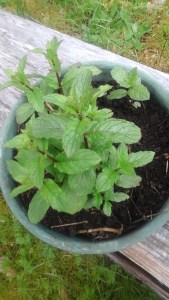
“the long roots of her mother’s mint”

great grandmother's mint

First thing tomorrow, we’re heading off into the wild blue yonder. First stop: Word on the Lake in Salmon Arm for a weekend of readings, workshops, and editorial sessions with aspiring writers. From there, to Edmonton where most of our tribe (we’ll miss Angelica!) is gathering for a week-long building project at Brendan and Cristen’s house. The lumber’s been delivered, the sand for settling foundations, John has filled the trunk of our car with tools (because most mathematicians don’t have power saws, assorted levels, a plumb-bob, crow-bars for prying an old porch off the side of a house, and various other implements collected and used in the long process of building a home here on the Sechelt peninsula). Forrest, Manon, and Arthur are coming from Ottawa so it will be a week of animated conversation, many bottles of wine (we’re bringing some of those too), and, for some, mojitos. I think of cocktails as Mother’s Ruin (it doesn’t take much) so won’t partake* but my contribution will be 2 pots of mint. As I’ve weeded this spring, I’ve kept the volunteer mint to take to Edmonton. Some of it already travelled to Ottawa and is part of a garden there where a small boy will be told one day, “Your grandma brought this and guess where it came from originally?” John’s mother used to visit and in the trunk (or boot, as she called it) would be many cuttings and roots of plants from her garden. I’ve written about this in “Ballast”, one of the essays in Euclid’s Orchard.

She carried rooted shoots of the original family wisteria in turn from her mother’s garden in Suffolk, wrapped in damp paper in her suitcase after one of her annual summer visits to her mum. Have you anything to declare, I imagine her being asked, and like me (who carries acorns and interesting cones and seeds from everywhere I visit), she took a deep breath, keeping inside every important reason for children to continue their parents’ gardens, and said no. In her suitcase, the long roots of her mother’s mint, the perennial geraniums.

And it will be a week of little trips too to places that speak to me — to us — of our family connections. Two springs ago, John, Brendan, baby Kelly, and I drove out to the Ukrainian Cultural Heritage Village, east of Edmonton. I don’t know many details about my grandfather’s life in Bukovyna but somehow seeing the Nazar Yurko house gave me some insights into the domestic culture of his village (Ivankivtsi).

house

We’re planning to drive out the open-air museum again this trip, with all the grandchildren strapped into their car-seats. They’ll see the house with its adjacent garden, where I remember drifts of ferny dill that the young woman weeding told me self-sowed everywhere. (I wanted to lift a little clump and tuck it into my pack. Maybe this time I’ll be bolder.) They’ll see the church
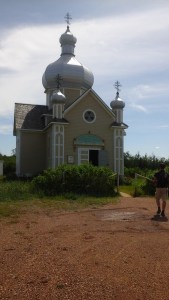
church at Ukrainian Village Museum

and I’ll show them a photograph of the church in their great-great-grandfather’s village and they might hear the echoes that I hear when I enter these buildings.

church in my grandfather's village

And then their fathers can muddle the mint that came from their great-great-grandmother’s English garden (via their great-grandmother, and then their grandmother) and make a jug of mojitos. So the world is remembered, mint and rum and the bells of old churches.

*I mean cocktails, not wine. I’ll drink more than my share of the Wild Goose Pinot Gris but mixed drinks catch up on me sooner than I’d care to admit.

for my mum, Shirley MacDonald Kishkan, 1926-2010

tokens2.jpg

From “Tokens”, an essay included in Euclid’s Orchard, forthcoming from Mother Tongue Publishing, 2017.

What do I do with a bottle of fifty-year-old perfume? I am 57 myself. It’s not something I’d wear. I discovered Chanel 19 in 1972 and never have found any reason to change. I don’t even know if this bottle is still viable. Does perfume turn to vinegar, as an opened bottle wine will if not used within a reasonable time? When I sniff the bottle cap, I say that I smell my mother but how can that be? She wore perfume so seldom — ¼ of a bottle over 48 years. Maybe she knew she would never have another bottle of French perfume, maybe she wanted to ration it to keep the memory of my father’s return fresh. What I am smelling is the way I would like to remember her, in a rustling cocktail dress one or two evenings only, her feet wiggling into pretty shoes, checking her seams in the bedroom mirror, her eyes bright with anticipation of dancing! Not the old disappointments, a daughter who didn’t visit often enough, the house sold, her husband dead, the days growing shorter and shorter as the year approached the longest night, the bottle of French perfume forgotten in the camphorwood chest, among the gloves and her one cashmere sweater, an old silk square from Zanzibar folded neatly on the bottom.

in the mail

postcard

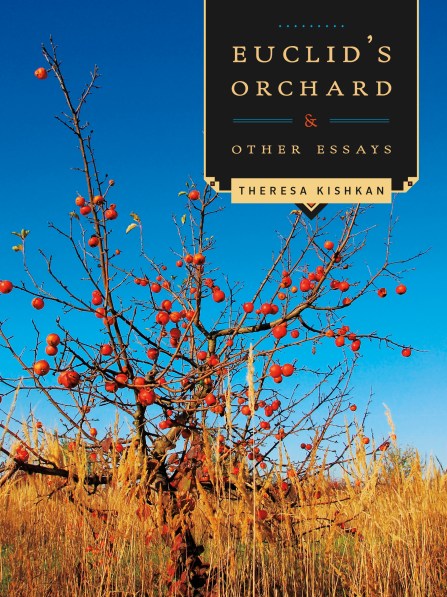
In today’s mail, the most beautiful postcards for Euclid’s Orchard. I’ll be taking them to Word on the Lake later this month. If you’d like me to mail one to you—and who doesn’t like mail?—send me an email with your address! I sent back the edited manuscript today so we’re one step closer. How would that be expressed in mathematical terms? I have no idea.

“the heavy blossoms of fruit trees in May”

Euclid's Orchard_cover Final.jpg

From my forthcoming book, Euclid’s Orchard (Mother Tongue Publishing, September, 2017).

Twelve quilt blocks wait for me to find an ideal pattern for them. I arrange them on Moravian blueprint, somehow expecting to see logic at work. Do I begin with the first idea I had—the representation of Euclids orchard, the set of line segments like a trellis to hold the heavy blossoms of fruit trees in May? Or do I find a way to let the blocks tell a story all their own, dense with figurative language? Does it matter?

to try

to try.jpg

A few posts ago, I wrote about my difficulty in finding the right form for one of the essays in Euclid’s Orchard. My original thinking about the material I’ve been exploring—some of it archival, some of it personal memory, some of it meditation on time and family history—was that I wanted it to reflect the voices I’d heard speaking to me on a little road trip to Drumheller last spring in search of my grandmother’s first home in Canada. At the time I mused that I’d like to write the piece as a libretto. I know very little about the formal requirements of such writing but never mind. That’s what I hoped I could do!

What I wrote instead was something kind of flat and untidy. The material was there, oh yes, and I think it’s intriguing in its own right but I was disappointed in myself for not trying a little harder to give the piece an original shape and to find a way to represent those voices. Part of the pleasure of working with an editor is that you can often have a second chance, with a very capable eye and mind to guide you. I’ve had Pearl Luke. I know that there are elements to what’s become “Polychoral: A Badlands Antiphon in 25 Sections” that Pearl thinks are perhaps excessive but she’s been so encouraging and challenging. A dream of an editor.

What is an essay anyway? There are many ways to think about the form. I like part of the Oxford definition:

Origin

Late 15th century (as a verb in the sense ‘test the quality of’): alteration of assay, by association with Old French essayer, based on late Latin exagium ‘weighing’, from the base of exigere ‘ascertain, weigh’; the noun (late 16th century) is from Old French essai ‘trial’.

“Test the quality of.” Isn’t that wonderful? The quality of the writer and the relationship to the material as much as anything. I’ve never used a template for my work. For a while I kept hearing about something called a hermit crab essay, using one kind of thing inhabiting the shell or form or container of another species — for protection? For what, exactly? I’m not sure. Maybe to test the quality of its shape and original intention? But I can’t imagine setting out to write one. In French, “essayer” means to try, to attempt. I like the suggestion of almost preordained imperfection. Yes, we try. We attempt. And the pleasure, the value (if you like), is in that work. We weigh. We try.

So I didn’t write a libretto. I did look at a number of libretti (and the term itself is a diminutive of the Italian word for “book”) and quietly gave up that idea. But something stuck. The memory of my grandmother saying her rosary, the music of the Latin mass I attended once or twice with my father in childhood, the calls and responses of Byzantine chant, the strophic odes so characteristic of ancient Greek tragedy — and there was my essay. There’s no formal musical structure but there’s a weighing, yes, of musical form, a careful listening to the language of old letters and legal descriptions, and an attempt to contain all this in a series of lyrical sections that call to one another and listen for an answer. No other essay I’ve written has given me so much difficulty and perhaps none has given me so much pleasure.

the springtime lamb

Today, on my shelves, a book of poetry by Annie Dillard. Tickets for a Prayer Wheel. This is a season I celebrate — not for any religious reason but because moment by moment, the earth is coming alive. In “Feast Days”, Dillard takes us through a strange arrangement of Christian holidays. And I’ve remembered the conclusion since I first bought this book as a student in 1974:

God send us the spring lamb
minted and tied in thyme
and call us home, and bid us eat
and praise your name.

The names I praised were those of my family. All morning I worked on an essay for Euclid’s Orchard, one that explores my deep past in the Drumheller valley. So those names. The Yopeks, the Kishkans, poor Joseph Klus who died in a dugout house on the banks of the Red Deer River, of Spanish flu. Calls or texts came from my children. I’d sent my sons their childhood paper mache eggs, filled with little chocolate treats and toys for their children, my grandbabies. I wondered if they’d remember their eggs and oh, yes. They did.

In the afternoon, I worked in the garden where spring has eased itself into every bed — Spring Tonic, where I grow salad greens; Long Eye, where garlic is planted and kale is volunteering; Wave, where the peas have yet to sprout against their fence and, fearful that slugs will nip off the new sprouts, I scattered crushed oyster shells (from my birthday oysters) over the length of the furrows. I planted ten hills of French Fingerling potatoes in Old Deck and weeded mint volunteers from Thin Deck to pot up to take to Edmonton in May when we will all gather (except Angie, alas) to build a deck and porch for Brendan and Cristen and where I know the young’uns will want mojitos come 5’o’clock. (John and I would rather have a glass of wine. Call us stuffy.)

The spring lamb made an appearance on the Easter table, tied not with thyme, but stuffed with garlic and rosemary. A pan of Greek potatoes, lemony, and fragrant with olive oil from Crete. Eggplant with garden dill and chives in yoghourt. Salad of feta, tomatoes, and Kalamata olives. And for dessert? A galette with last year’s gooseberries and this year’s rhubarb. The most beautiful Desert Hills Syrah.

Today I’ve been naming
the plants of the southern forest:
arrowwood, witherod,
hobblebush, nannyberry
and the loblolly, longleaf
and shortleaf pine.

No, I’ve been looking at the pink new growth on the huckleberries, cerise salmonberry blossoms, Douglas fir, watching two sapsuckers chase one another up and down the trunk of a small cascara, and brushed a bumblebee from my shoulder as I put away the shovel. And thinking of my grandchildren, opening the eggs their fathers loved 30 years ago, on the table that still looks west. And misses them.

easter galette

the world comes in

window

This morning I’ve been working on the edits for my forthcoming book, Euclid’s Orchard. I have the most perceptive editor in Pearl Luke and her notes challenge me to go a little deeper, to clarify, to find the best words. My eyes are a bit strained by the effort of looking at the screen, contemplating commas. But just now I walked out of my study and saw the glass piece we gave to each other for Christmas, made by our friend June Malaka. It’s hanging in a south-facing window and all winter I loved how the light came through the orbs of different glass. Winter light, sombre and diffuse. But today, there’s spring light and a budding lilac behind it.

The world comes in. It comes to a woman sitting at her desk, it finds its way into her writing, her heart. It reminds her of everything she’s looked at and remembered.

One day a single light brown coyote came out of the woods and walked by my window. It had all the time in the world. It passed the wing of rooms where my children grew up. It passed the windows they looked out at night, first thing in the morning, drawing their curtains to let sunlight in or the grey light of winter, in excitement, lonely or sleepless, in good health and bad, dazzled with new love or sorrow, at the lack of it, on the eve of their birthdays, new ventures, on the eve of leaving home. I went to the back of the house to see where the animal was headed but it did what coyotes do, a trick I wish I could also learn. It dematerialized. Vanished into thin air.

–from “Euclid’s Orchard”, title essay of forthcoming book.

it’s a (cover) wrap!

I’m really thrilled with Setareh Ashrafologhalai’s cover design for my forthcoming collection of essays, Euclid’s Orchard. Mona Fertig at Mother Tongue Publishing is a pleasure to work with. Small but vital! And she pays attention to important details, using excellent graphic designers for the books she publishes. One thing I love about this cover is that the title caps are from the late Jim Rimmer’s font, Amethyst. Jim was devoted to fine book design and his fonts are very durable and elegant.  And Setareh’s work is always so fresh and beautiful. She designed my novella, Patrin, and the pages are as lovely as the cover. I can’t wait to see what she does with Euclid’s pages!

Euclid's Orchard_cover Final.jpg

“all those waters changing as we changed…”

I had a difficult relationship with my father. I loved him and I believe he loved me. But we couldn’t talk to one another easily. He found me remote, as I found him. He taught me some important things, though, and I miss him. (He died in 2009.) I talk to him more and more, to try to limn the dimensions of our relationship — I always thought it kind of one-dimensional but realize now it was complicated and even nuanced. In my forthcoming book, Euclid’ Orchard, there is an essay about this: “Herakleitos on the Yalakom”. In the essay I talk to my father in a way we were never able to talk in the years I lived with my parents, and afterwards, when he and my mother visited us here. I tell him how I wish things had been different. It might be too bitter. But it’s honest, if that matters.

The old-fashioned knots you’d tied long ago wouldn’t loosen enough to let you take ease in a chair on the deck of a cabin. And by then the fish knife had gone to my son. Herakleitos on the Yalakom River, on the Cowichan, on the far-seeing MacKenzie where you were young, the Red Deer, all those waters changing as we changed—and were ever the same. There were roads that led to them, and away.

I think about my father a lot now that I see my sons immersed in fatherhood. They are tender and loving with their children.

pass-boys-and-their-babies

My father was born in 1926 to very poor immigrant parents. His father was a coal miner and he was illiterate. No bedtime stories. My father grew up not knowing anything about his parents’ parents, their extended families. I explore this in other essays in the collection, trying to map his emotional geography, which is now my geography, my maps scribbled with the cryptic markings of love and loneliness. Of regret and sorrow.

We spent the weekend in Vancouver, with our son Brendan, daughter-in-law Cristen, and their two young children. Our daughter — Kelly’s cherished Aunty Angie (“My Auntie Angie.”) — joined us for part of the time. We ate great meals and laughed a lot and had some outings that I know will be happy memories for Kelly. (Blue frogs at the Aquarium! Big fish! The soft pink feet on the ducks in the tropical conservatory…) Kelly has plans for May when we will visit her family in Edmonton and she is thrilled that her Auntie Manon, Uncle Forrest, and cousin Arthur will be there at the same time. (We are all going to build a new porch for Brendan and Cristen’s house.) She is very excited at the prospect of sharing the double stroller with Arthur. And of throwing stones into Mill Creek with him. By then Henry might be able to throw a stone too. Over the weekend, he was happy to lie on the floor with his Grandpa John, pushing toys back and forth.

grandpa-john-and-henry

The road that leads to Edmonton from the west coast is one my family drove many summers to visit our grandparents who lived in Beverly, in a small plain house on a quiet street near the river. It was a river my father remembered in his later years — the smell of poplars coming into leaf, its dangers at spring melt. And the Red Deer, that flowed past his family’s first home in Drumheller. All the rivers of our shared geography, unchanged, and constantly changing. Although my father never read Herakleitos, I found him in Guy Davenport’s elegant translation. I found him over and over, changed and unchanged. “The river we stepped into is not the river in which we stand.” It never was. But where else can I look?

in pieces

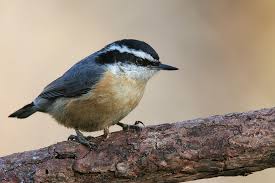
This morning there’s a red-breasted nuthatch hanging out with the chickadees. I thought I saw a more elegant small body on the wisteria and sure enough, a nuthatch with its elegant eyeliner was perched on a long lateral branch.

nuthatch

I call the chickadees “the sillies” because they come to the window over the kitchen sink if their feeder is empty; they jump around on the narrow sill. They know the food comes from that direction and I like the reminder. They’re a constant. Winters, summers. Last summer a pair nested in one of the cedar boxes John built for violet-green swallows. We watched them dart in and out and just by chance John was standing by the big window facing the arbutus tree where the box is and saw the moment — it happened within five minutes! — when all six nestlings left home. Each one peered out the opening, cheered on by the others who were waiting in the nearby mountain ash. It took courage to try their wings for the first time, to alight on a branch of ash and find their balance. Here’s the last one, a bit more reluctant that the others.

next.JPG

This morning I’m trying to find a way to finish an essay for my forthcoming collection, Euclid’s Orchard. I thought I had all the preliminary work done — five essays drafted and ready for an editor’s eye. But then my publisher suggested I might want to add one more. And I do have one in pieces. Literally. I’ve been looking at it and wondering how to knit the sections together, to find a way to provide a seam. But this morning I think I might leave it in pieces. There’s a logic for this. They are all discrete elements and the way they’re connected is through memory. The online Oxford Dictionary defines “essay” this way”:

Late 15th century (as a verb in the sense ‘test the quality of’): alteration of assay, by association with Old French essayer, based on late Latin exagium ‘weighing’, from the base of exigere ‘ascertain, weigh’; the noun (late 16th century) is from Old French essai ‘trial’.

So let this one be that. An attempt, a trial. It’s certainly a kind of weighing. Its title? Well, right now it’s “Ballast”.

This is the second day of our Midwinter Chamber Music Weekend in Pender Harbour. The summer Chamber Music Festival I’m involved with has created this weekend for those of us who love intimate chamber concerts whatever the season. Violinist Corey Cerovsek, cellist Adrian Brendel, and pianist Michelle Mares treated us to a beautiful concert yesterday, including the ravishing César Franck Violin Sonata in A Major and the Beethoven “Archduke” Piano Trio. Today? Ravel, Chopin, and Johannes Brahms (the Trio No.2 in C Major). Can’t wait.