a wild orchestration

coyote.jpg

On a walk up the Malaspina trail yesterday, coyote scats everywhere, full of hair and new grass. This is a sign of spring as much as daffodils and salmonberry blossoms (though yesterday we didn’t see a single one). Last week, an ambulance sounded its siren as it came down the long hill near us, on its way to an emergency in Egmont or Earls Cove. And as soon as the siren stopped, we heard the pair of coyotes denning just to the south of our house sing their own version of the siren’s song, two voices rising and falling, in a complex and beautiful harmony. In the title essay of my book Euclid’s Orchard, there are coyotes singing and they might even be the same animals as the ones last week. I’ve always loved the continuities, the cycles.

We knew about the coyotes because they left scats on our driveway, in the hollows of moss in the orchard, on the nearby trails we hiked regularly, and even along the highway we walked to collect our mail at the community boxes about half a mile away. Every time we walked, we saw the scats. If we were on a trail, the scats were in the middle. The animals wanted anyone using the trail to know they’d been there. On the edges of the highway—a sign that the animals had mastered the knowledge of traffic—the piles were right on the human-worn margins.

And they were—are—fascinating. Coyotes are omnivores. They eat rodents, frogs and other amphibians (but not toads because their skins are bitter), reptiles, fish, crustaceans, birds, larger mammals that they can either kill or scavenge, grass (which helps them to digest fur and bones, I’ve read, and which also serves to scour parasites from their intestines), birdseed, and all kinds of fruit and vegetables.Once we watched a young pup hold salal branches down with its foot so it could reach the ripening berries, plucking them delicately one at a time. We’ve noticed more fur and bones in spring, when rodent populations are highest. And sometimes the scats seem to be composed entirely of grass. Once, the head and neck of a garter snake, scales still intact. Bloody flesh gives them a darker color. Fruit— crabapples, wild cherries, even elderberries–give them bulk. Seeds and fur make them grey. And if they’re lucky enough to find a source of dry dog or cat food, the scats resemble those of canines.

Even though they were mostly invisible, we knew they were around and felt lucky when we saw them. Luckier still when we heard them. We live far from the nearest village and can usually hear emergency vehicles coming from a distance. But if there are coyotes in the immediate vicinity, they begin to howl before we hear the sirens, and by the time the ambulance or police car is near our house, on its way to the ferry or to deal with a collision on the highway below us, there’s a cacophony of siren and coyote accompaniment. A wild orchestration for voices and synthesizer—longitudinal waves coming toward us, bending and refracting the long length of the highway. Sound nowhere and everywhere.
“…will the voices come to us again?”

euclid
Euclid’s arrival at Mona’s place

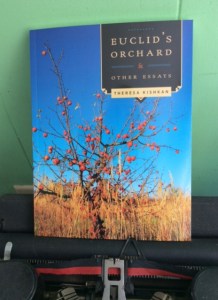
This morning the B.C. Book Prizes announced the 2018 shortlists and I am so thrilled to see Euclid’s Orchard nominated for the Hubert Evans Non-Fiction Prize.

Awarded to the author(s) of the best original work of literary non-fiction. Topics such as philosophy, politics, biography, history, belles lettres, etc. Quality of research and writing along with insight and originality are major considerations in the judging of this prize. (from the Book Prizes website)

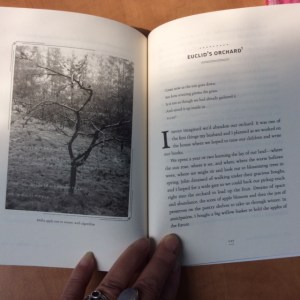
I’ve always admired Hubert Evans. When John and I first moved to the Sechelt Peninsula, Hubert was still alive, living at Roberts Creek. I met him once and told him how much I loved his Mist on the River and O Time In Your Flight. In the way that these things happen in small places, his granddaughter, a nurse at the hospital in Sechelt, helped to deliver my son Brendan. Brendan, for those of you who’ve read Euclid’s Orchard, is the mathematician who inspired the title essay. When my publisher Mona Fertig and I were making decisions on images for the book, I had to call on Brendan several times to help with something I had in mind: a photograph of a tree in our old orchard with Euclid’s algorithm hanging over it like mist. Another layer of meaning. I remember my relief when Mona sent a photograph of the spread for that essay, relief that both Brendan’s work and the wonderful eye of designer Setareh Ashrafologhalai helped to bring my vision alive.

page

My other children are in these pages too. Son Forrest, a historian, helped with the work of decoding a whole complicated knot of information about a squatters’ community in Drumheller in the early 20th century, the first place my grandmother lived when she came to Canada. My daughter Angelica is always the first person I ask about classical texts (she has an M.A. in Greek and Roman Studies and can read Latin with an impressive fluency). And my husband John, well, he makes so much of what I do possible. The beautiful young women who are the mothers of my grandchildren are also in these pages, entering the family story with grace and humour.

I dedicated Euclid’s Orchard to those grandchildren and my late parents. They bracket my specific time on earth and the stories in my book are theirs. Ours. No one knows when they might need to know something and when I was undergoing medical tests in the fall of 2016, I needed to know how the pieces of particular family stories fit together, both within our own ecology and also the larger picture. How a squatters’ community on the banks of the Red Deer River echoed much of the immigrant experience, the languages of loss and grief and deprivation. How a child dazzled by patterns and numbers might grow up in a family of dreamers and poets and how a mother might try to parse the meaning of those patterns late in life. How letters might be written to the dead.

Migratory, like monarchs, we find our own urgent way to a place where the sun and earth greet us, give us rest.We find our place among wild plants on a roadside, we hear beetles and the lazy drone of bees. If we sit on the grass and let the dry wind ruffle our hair, will the voices come to us again? — from “West of the 4th Meridian: A Libretto for Migrating Voices”

the season is late

by the door

I don’t keep really careful or accurate weather records but I do remember that the earliest I’ve seen salmonberry blossoms is February 6. (That was in 2005.) I’ve been watching for them this year but haven’t yet seen a single one. I’ve just come in from a little walk around the trees and garden and it looks like winter. There was even a tiny bit of ice on the bathtub pool where the tree frogs lay their eggs. On Saturday I was digging in the vegetable garden and I heard a tree frog chirping somewhere nearby. It’s too early, I told it. Stay hidden. The snow is still low on the mountain.

But on Saturday when I forked over the compost, there were nests of worms quite close to the surface:

compost

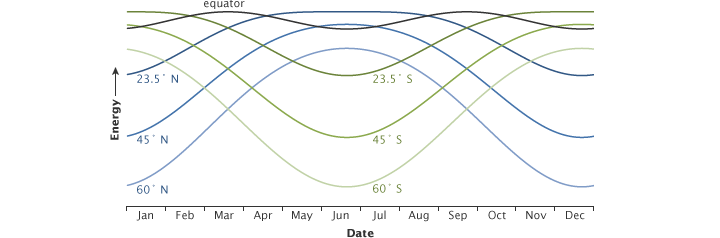
Last week’s full moon is sometimes called the Full Worm Moon and when I was digging the beds I call Wave and Long Eye, the fork unearthed huge worms, doing their work in the cold soil.  So the season is late but there are signs of spring. The 50 daffodils I planted with my granddaughter in November are all up and looking happy in their nests of moss. The fennel is green and feathery. Garlic looks strong. A couple of tiny plants of corn salad. Even a small digging of last year’s red potatoes in Long Eye (and those volunteers to begin with). One morning we’ll wake and the sun will be climbing in a blue sky and we’ll know that the season has truly turned. I found this little chart to show how there is less energy coming from the sun in the form of electromagnetic radiation impinging on the land during winter.

H9bPc

Like rivers? Or tides?

But I also like winter for the time inside, for writing (I completed two long essays during the dark season and am moving towards finishing a novella that has been patiently waiting for attention). The stacks of books at the top of the stairs, waiting to be shelved (oh, such optimism), the nearly-completed indigo quilt, tell me I’ve spent the hours productively.

And good things have happened. Are happening. A new grandchild begun, a trip to Ukraine in September dreamed about and in the planning stages. A box of Courtepointes opened in great excitement (and followed by a terrific review in Le Devoir). A wonderful and generous review of Euclid’s Orchard in the Ormsby Review (the online review section of B.C. BookWorld): https://bcbooklook.com/2018/02/27/the-trees-we-cant-see/

This morning our young cat Winter jumped onto my stomach before 6:30, encouraged by the light to ask for his breakfast. So he knows something is in the air. It might be time to check on the salmonberries again. Just in case.

long eye


coyote time

morning-visitor

Just now John called me to the kitchen because he was watching two coyotes trot through what used to be our orchard. They were moving along the perimeter, between open ground and the forest. Our cat, Winter, has been very skittish lately, wanting to go out and then wanting back in again very quickly so I’ve half-expected to hear coyotes in the night. For many years, we’ve heard them in the woods to the south of our house, a mating pair, and we’ve seen the offspring from time to time, including the pup in the image above a few years ago. The pair we just saw might be the constant couple or else a new pair but this is obviously part of their territory because I sometimes see one or more passing my study window. I’m here now, with a camera ready.

Here’s a passage from the title essay of my collection, Euclid’s Orchard:

At my desk, I look up to see two large brindled coyotes lope out of the bush and across the grass in front of my study. In the past, I’ve heard coyotes in the woods just south of our house and suspect there’s a den there used year after year. Once, reading in bed late at night, my husband and I heard a pair mating— the rhythmic grunts and growls, the high-pitched squeals, a passionate duet, tempo changing until all we could hear was an urgent expressive finale, and then silence. Though running, these two also seemed at ease in their surroundings, coming out of the woods where there’s a rough game trail used by deer and elk, and crossing the grass as though they’d done it many times before, on their way to the orchard. I called my husband to see, but by the time we opened the back door, they’d disappeared.

“Boy and baby only. Fair. Grey blue.”

I’ve recently finished reading Lorri Neilsen Glenn’s Following the River: Traces of Red River Women in which she travels both physically and imaginatively through the country where her great-grandmother Catherine lived and died. Rupert’s Land, Selkirk, Norway House, Warren’s Landing—all these places hold traces of the family story. I won’t tell it here. But it’s worth reading, both for the elusive strands that have been painstakingly recovered, in part or in whole, and woven into something both practical (because we need these records of our ancestors to help us understand our own place in the world) and beautiful, and for the deep sense of the land and what it remembers (those traces). Abandoned graveyards, modest monuments to lost or murdered young women, foundations of buildings long fallen to earth. There’s poetry here, there’s prayer, there’s the simple naming of names in all their possible variants, from both English and the different dialects of Cree that shaped Lorri’s family.

My family history began on a different continent. But there were many moments when I saw in Lorri’s book something of my own attempts to parse the language of old documents and photographs, some of this in a language as difficult to shape in my mouth as Cree was for Lorri. Sometimes what I tried to read wasn’t language at all but images. It was often strange and frustrating but then there’d be a moment when I understood what I was seeing. Lorri realizes that a photograph of her great-grandmother with her husband and children was taken after Catherine’s death and that Catherine’s head has been imposed upon another woman’s body for the sake of the photograph. Thinking about Catherine’s daughter, Lorri’s own grandmother, she wonders, “What must it have been like to stand behind someone else’s body wearing your mother’s clothes, holding still until the exposure was complete, feeling such profound absence?”

I had such a moment with my musings about family photographs and I remembered writing about it on this blog. Here is a post from July, 2011, as I was finalizing the proofs of my book, Mnemonic: A Book of Trees.

 The Moirs Happiness Package


In my forthcoming book, Mnemonic: A Book of Trees, there’s an essay about my father and his father. I don’t know much about my paternal grandfather and in this piece, I try to puzzle through the mysteries of family connection, try to find traces of my grandfather through the small clues in my father’s stories, the tiny hoard of memories. At one point, I was thinking about two photographs in the basement of my parents’ home in Victoria. This is what I wrote about one of those photographs:

“In the second photograph, my father stands in his white shirt, short pants, dark stockings, and boots on a rattan chair. Someone has told him to stand still, because there is nothing natural about his pose. But — and here’s the bizarre thing — hovering in the air, as though balanced on the arm of the chair, is the swaddled form of his sister Julia, who died three years before he was born. This is the late 1920s, before Photoshop — before any of the techniques we are now so accustomed to using. I know that photographers could manipulate images even in the nineteenth century (I think of Hannah Maynard in Victoria with her trick portraits and artistic interpretations). But this is clearly the work of someone who didn’t have much skill at all. The half of the photograph in which baby Julia has been inserted is blurry.

That only this one photograph survives suggests that although money was probably in short supply, my grandparents wanted a record of the two children they had conceived together. Perhaps they were more sentimental than I’ve been led to believe, because what other reason would result in an image of a baby being inserted into the photograph of her brother-to-be, at least five years after her death? Julia was nearly three when she died, and yet the photograph is of an infant, wrapped in a blanket, wearing a hat against the cold.

Photographs are intriguing but ultimately unsatisfying. I’ve tried to read these ones for hidden narratives of love and family connection and perhaps I’ve interpreted them completely incorrectly. Still, sometimes photographs with their cryptic stories and forgotten conclusions are all we have.”

I wrote the essay as my father was dying and since then my mother has died as well. I brought home that photograph (a grainy image clumsily cut to fit in a wooden frame) and many boxes of family papers which I’ve been slow to sort. Every time I open a box, the smell of the past – dust, old cigarette smoke, the sadness of missed or lost connections – overpowers me and I close it again, thinking that the time will come when I’m more resilient or at least able to look at the materials without crying.

The day before yesterday, I opened one of the boxes, determined to put together some photographs for a family project. The problem is, nothing is sorted or organized, so in some ways, I’ve no idea where to look. There are some albums, yes, but then there are also envelopes with bank statements, stray photographs caught between them, or my high school report cards shoved into folders with baby pictures, drawings, my grandmother’s naturalization papers from 1937, etc. Where to begin?

I began with the Moirs Happiness Package, a chocolate box with a bluebird on it, and the slogan, “There’s happiness in every box.” Inside, a small collection of  photographs, all of them bent and foxed, and all of them as astonishing to me as anything I’ve ever seen. My father was the only surviving child of his mother’s second marriage. The first child of that union was Julia. She died of diphtheria, I believe, and is buried in Drumheller, Alberta, where the family lived. There are two photographs of Julia’s funeral. One shows a group of solemn people in front on a bleak house, the men and women dressed in dark suits, the girls (some of them must be the daughters of my grandmother’s first marriage) in white dresses and veils. A small white casket is set on a wooden bench. The second photograph is taken inside. The casket is on a table covered with a starched white cloth and is flanked by two girls in white. A child’s face can be seen surrounded by flowers: Julia.

There are two other photographs, too, which I realized were the ones which had been brought together to create the large image of my father and his sister. What’s amazing is that there are notes on the back of them, obviously the work of the person charged with “regrouping”. Notes about tint and placement. “Boy and baby only. Fair. Grey blue.”


There’s so much I don’t know. I want to find out more about my grandmother, a woman who was born in Horni Lomna, in what was then Czechoslovakia, in 1881 and who left, with her first husband, Joseph Yopek, in 1913. He died of flu in 1918 and she was left with 8 children. She married my grandfather a year or two later (I should know when and will try to find out), giving birth to Julia, and to my father, in 1926.

Our recent house-guests from the Czech Republic, Petr and Lenka, showed me pictures of Horni Lomna. It’s a small village in Moravia, nestled in the Beskydy Mountains. When John and I return to the Czech Republic next February, I intend to go to my grandmother’s birthplace and see if anything remains – a name in a cemetery, in a parish record, perhaps.

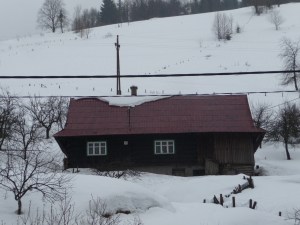
And a coda to that post. I did go to my grandmother’s birthplace and although I couldn’t enter the graveyard because of snow several feet deep, I did walk down a road by the Lomna River to stand in the snow and look at the house where she was raised, where she lived with her parents and her five children while her first husband went to Canada to make a home for them to come to the next year (1913). What happened then is the subject of a long essay in my most recent book, Euclid’s Orchard. And yes, it involves photographs, old documents, reading a landscape as foreign to me as the languages my grandparents spoke.

horni-lomne-26

shades of blue

greens

Two days into the New Year and I’m sitting at my desk looking out at a cold world. There’s a little wicker birdhouse hanging just beyond my window and this time last winter I saw 6 winter wrens enter, one after another, at dusk. They are not particularly sociable birds but need each other when the temperatures drop. And how lucky I was to be watching at as they found their way into the collective warmth of the birdhouse.

The other night at our New Years dinner, one friend said that he looked forward to the mornings when he’ll wake in excitement at the prospect of spending a day in his garden. He has a beautiful garden, full of flowers, vegetables, productive fruit trees, and even a beach of oysters from the days when his wife’s family operated an oyster business on the property. That night it seemed that spring was not too far away though this morning I’m planning and plotting my own garden—imaginatively, of course, because it’s too cold to actually work out there—and it’s hard to believe that the tools will ever find their way into that frozen soil. I was scrolling through some photographs and saw the one I’ve posted here, taken (I think) two years ago. I love the mornings of knowing these greens are waiting, the tendrils of beans needing to be coaxed to their sticks, the damp frogs surprised from their hiding places. The first dandelion pizza, the first salad of miners lettuce and new kale.

A new year should also be about writing but I’m having a crisis of confidence. When I look at the work I have in progress, it seems very small and, well, personal. This time last year I was working on the revisions of the essays in Euclid’s Orchard. I found this passage in a blog post written in January, 2017, just after I’d had the PET scan that determined the strange growths in my lungs were not metastases. I was remembering (in this post) the months in the fall of 2016 when I wrote the essays in a heat of fear and mystery and love.

Many nights I got out of bed and came down to my desk to sit in the absolute quiet and puzzle away at what it was I wanted the essays to do. I wanted them to explore territory, to shine small lanterns onto dark pathways threading through the lost landscapes of my family’s history. They’re personal and sometimes I wondered — still wonder — at the value of writing that terrain into being. But I also believe that we do the work we’re called to do and that was the material agitating to be noticed and shaped.

Is it enough to do this kind of work? I’m not sure. I read a comment about Euclid’s Orchard on goodreads.com in which a reader expresses her disappointment in the book. Too personal. Not universal enough. It’s something to think about, take to heart.

In the meantime, I’ll work on the blue quilt, think about the garden, muse about the ultrasound image we were sent this morning of our 4th grandchild, due in summer. So many wonderful things to look forward to, to complete, though quietly, not with summer’s exuberance. And the year has only begun. The colour of winter is not green, not right now, but blue, so many shades of blue—the rich indigo of my linen quilt, the greyblue of the ultrasound, the underside of snow, the Steller’s jay squawking for seeds from the fir by the clothesline. I thought of a poem by Robert Francis, “Winter Blues”, and it was my mood exactly:

Winter uses all the blues there are.
One shade of blue for water, one for ice,
Another blue for shadows over snow.
The clear or cloudy sky uses blue twice-
Both different blues.

winter work

winter work

It’s cold out and the fire is warm, the coffee dark and strong. I’m thinking about the past year, how it was filled with strange medical adventures, a few wonderful road trips (Waterton Lakes before the fire with its hills covered in arrow-leaved balsamroot, bluebirds on the fence-posts, bighorn sheep watching us eat breakfast at the Prince of Wales Hotel), time with friends and family. Oh, and a book, Euclid’s Orchard. I suspect I may have posted this passage before but I’m doing this exact thing today and everything that has ever happened seems to happen again. Or at least that’s what I want to believe.

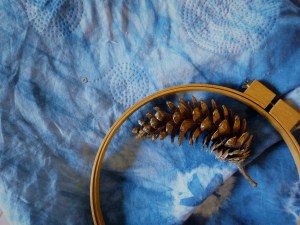
Inside I am stitching a spiral into the layers of the orchard I have pieced together, a snail shell curled into itself. That’s what I’ll see when I’ve finished. I begin the spiral at its very heart, keeping my course as even as I can as it opens out and widens. Not the complicated pathways of the sunflower, some turning left, some right, so that an optimal number of seeds are packed in uniformly, or Romanesco broccoli, its arcs within radii resulting in something so intricately beautiful I wonder how anyone could cut into it to eat it. On windowsills, pinecones. The plump Ponderosas, brought home from the Nicola Valley, and a few long Monticolas. They’re dry, open, but at the base, where their stalk connected them to their trees, two spirals are still visible, like a relaxed embrace, lovers asleep. My spirals are simple, my hands sewing to follow a path from its knotted source, around and around, until I’ve learned that my pleasure comes from the journey itself, a needle leading me outward, towards completion. A quilt elegant and sturdy, a sequence emptied of its numbers.

— from Euclid’s Orchard, Mother Tongue Publishing, 2017

a chest, unlocked


trunk

I still have the carved chest. For years my mother stored all her sweaters in it, and they had the distinctive smell of camphorwood. There was a shallow inner box that sat on a ridge around the top. She kept small containers with various pieces of jewellery on the shelf, and gloves. I keep my sweaters in the chest, and the linen tablecloths that have come from John’s mother (embroidered with brilliant flowers by his grandmother in Suffolk),as well as several from the Goodwill on Pembina Highway in Winnipeg, bought while I killed time between readings on a book tour in 2001. I keep my pashminas there too, a kaleidoscope of them, many of them gifts from my children. Everything that comes from the chest carries the smell of my childhood, sharp and arboreal. — from “Tokens”, Euclid’s Orchard, Mother Tongue Publishing, 2017.

Sometimes the scent is all it takes and there I am, back in my mother’s bedroom, watching her dab on a tiny drop of My Sin as she got ready to go out with my father. I would have been 6 or 7, and the chest was new, brought home by my father from a long naval trip to the Far East. (I wrote about the trip and the chest in my last book, Euclid’s Orchard.) I’ve been tidying my study, trying to find room for all the papers I prepared for an anticipated visit from librarians interested in acquiring my archive, then delayed. So the papers are organized in boxes and laundry baskets and there’s nowhere else to store them. Given my magpie nature and my tendency to just pile stuff up (“I’ll deal with it later.”), it was hard to find my way to my desk. I have the habit of clearing my desk and as much of the study as I can when I’m trying to find my way into regular writing again and so this weekend I cleared and dusted and moved stuff around. It’s hard to actually get rid of any of it. The big rocks from various riverbeds and beaches. The spruce and pine cones from trees on several continents, including a tree in front of my grandmother’s house in Horni Lomna, in the Czech Republic. My beloved dog Lily’s pelvis! A small level made by John’s paternal grandfather of oak and brass for a tool box he’d put together for John’s father when the family emigrated to Canada in 1953. Worry dolls. Books, books, books. A scanner I was keeping even though I couldn’t download drivers for my current computer but then yesterday, on a whim, I tried again, and voila!

I found room for a small set of bookshelves I built in grade 12 and put all my field-guides and plant books and bird books and that meant moving the chest to another location. I polished it with wood-cleaner and then opened it. Her scent, in a way; at least, her scent in the years she wore Pringle sweaters and gloves stored in the chest, and very occasionally dabbed on My Sin (though the bottle is 3/4 full so she couldn’t have used it very often). At the bottom of the chest was a bag with fabric in it.

two silks

The plain one is actually a very vivid cherry raw silk from Italy, though I bought it in Ottawa, from Woven Streams (actually in Gatineau; I crossed the river to find the shop). The other fabric is Atlas ikat silk brought as a gift by my brother when he worked in Xinjiang Uyghur Autonomous Region. The silk is made from the silk produced by Atlas moths, huge and beautiful creatures; and the fabric is used to make clothing for Uyghur women. I look at these two lengths and imagine something really luxurious—I don’t know, an opera cloak? A rustling skirt? But I can’t sew well enough for anything so lovely and the fabric sits in the chest where it smells of camphorwood and Pringle sweaters and maybe just faintly of My Sin.

Years ago, I read Penelope Lively’s wonderful memoir, A House Unlocked, about her family’s ancestral home in Somerset and thought what a good way to record a family’s history: through its domestic context, its gardens, its implements. For my parents’ home, this would have meant the Melmac plates, the china vase in the shape of a bible with a homily on it, a plaster-of-paris picture of a lighthouse, a lamp on the television in the shape of two ducks flying with a candy dish as its base. We were not a grand family. And after my parents died, I found silver-plated cutlery, including very beautiful salad servers still in their original package, and linen napkins, all wedding gifts, never ever used but saved for an occasion that didn’t happen. What would that have been, I wonder? I use silver for family meals and the linen napkins that are now stained a little but I think of that as a patina, part of the experience and pleasure of use.

On each recovery of Golsoncott, each return to the place now safely stashed in the mind, intact and inviolate, I review the familiar landscape of the house. A left turn out of the vestibule, past the gong stand—the cloakroom door now facing me and, behind that, the red-tiled floor, the wall of pegs slung with old raincoats, riding macs, gardening aprons, sou’westers, my aunt’s hunting bowlers, the rack of walking sticks, the dog leads, everything tinged pink with Somerset earth…Here in the dining room my grandmother played Rachmaninoff and Tchaikovsky 78s that clicked and clumped from within her adventurous purchase of a radiogram. Here Rachel worked at wood engravings at the fireside. Here, each evening, I laid the table for dinner, abiding by an inexorable formula—the correct selection of implements and impedimenta from the sideboard and the silver cupboard. — from A House Unlocked

I thought of my childhood as without ceremony and ritual (there was no “inexorable formula” for setting the table with the Melmac plates and the glasses—former Cheez Whiz jars, printed with pheasants and ducks), yet when I look at the camphorwood chest, I remember the dusky scented room with my mother stepping into her high-heeled shoes, draping a chiffon scarf around her neck before reaching for her muskrat fur jacket. I remember tracing my fingers across the surface of the chest, trying to read the story of the two men lifting their end of a sedan chair with a pagoda roof (in the photo above you can’t see the man at the back, holding up his end), the occupant just visible through a small opening. I imagined I was that occupant, perhaps being carried to the mountains, the scent of camphorwood heady in the air.

“a sequence emptied of its numbers…”

morning, looking west

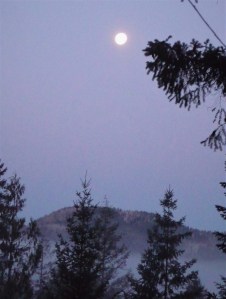
The fire’s made, the beautiful morning moon observed as it heads to the western horizon, and I’ve decided it’s a day to work on a quilt, to put the layers together with long temporary stitches and to figure out a way to quilt them so that the resulting cover is durable. I’m going to use some of last weekend’s indigo-dyed linen and either yellow cotton or deep red flannel for the backing. I bought some soft organic cotton batting for the warm middle layer.

Inside I am stitching a spiral into the layers of the orchard I have pieced together, a snail shell curled into itself. That’s what I’ll see when I’ve finished. I begin the spiral at its very heart, keeping my course as even as I can as it opens out and widens. Not the complicated pathways of the sunflower, some turning left, some right, so that an optimal number of seeds are packed in uniformly, or Romanesco broccoli, its arcs within radii resulting in something so intricately beautiful I wonder how anyone could cut into it to eat it.On windowsills,pinecones. The plump Ponderosas, brought home from the Nicola Valley, and a few long Monticolas. They’re dry, open, but at the base, where their stalk connected them to their trees, two spirals are still visible, like a relaxed embrace, lovers asleep. My spirals are simple, my hands sewing to follow a path from its knotted source, around and around, until I’ve learned that my pleasure comes from the journey itself,a needle leading me outward,towards completion. A quilt elegant and sturdy, a sequence emptied of its numbers.

—from Euclid’s Orchard (Mother Tongue Publishing, 2017)

a quilt, a pantry, a book

liberty


There was that gate, generously wide so we could bring in our truck with that big willow basket, for when the trees produced the harvests we thought might be possible. I filed recipes for apple preserves, for plum jams, for bottled cherries in exotic liqueurs. One year I scavenged enough pears to process in Mason jars, and we had pies of Transparent apples encased in buttery pastry. Some years this happened, that we managed to harvest enough for ourselves against the constant predations of bears.

—from Euclid’s Orchard (Mother Tongue Publishing, 2017)

The other day I had the pleasure of talking to a group of women in my community about my writing life (which is of course entwined with everything else I do). I talked about how I understand story and its importance to how we see ourselves in relation to others, how a woman gathers stories in her carrier bag (thank you, Urusla LeGuin!), and makes them into something useful. A quilt, a pantry, a book. In the face of everything else—toxic politics, the unnecessary divisions between the rich and the poor (the unnecessary presence of poverty at all on a planet with so much wealth and superfluous food), possible nuclear war, the lack of civility in our public discourse, all of it (and this list is just too depressing a thing to continue with on a Friday morning)—walking through a life gathering materials too useful to discard seems a small but hopeful act. As Ursula LeGuin calls it, a “human thing”.

If it is a human thing to do to put something you want, because it’s useful, edible, or beautiful, into a bag, or a basket, or a bit of rolled bark or leaf, or a net woven of your own hair, or what have you, and then take it home with you, home being another, larger kind of pouch or bag, a container for people, and then later you take it out and eat it or share it or store it up for winter in a solider container or put it in the medicine bundle or the shrine or the museum, the holy place, the area that contains what is sacred, and then next day you probably do much the same again–if to do that is human, if that’s what it takes, then I am a human being after all. Fully, freely, gladly, for the first time.

—from “The Carrier Bag Theory of Fiction”

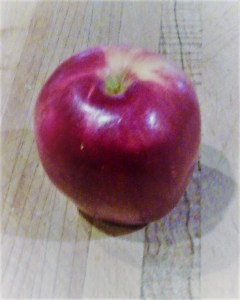
After my talk, I was given a small bag and in it: an apple. A Liberty apple from Karen Strong’s tree. And it was delicious.