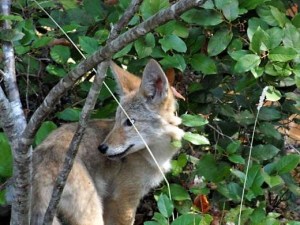
It’s all in the song.

pup

Last night, we’d just fallen asleep when the room was filled with noise. Coyote noise. I think it was the estrus call of the female and it went on and on. Then was answered. Most years we hear the courtship music of the coyotes and later in the season, we’ll hear the resulting family song.

Coyotes weren’t around when we first moved to the north end of the Sechelt Peninsula in the early 1980s. By the 1990s, they were on the lower end, then people were reporting them in Halfmoon Bay, and by 2005, we were seeing them regularly. We think of them as part of the landscape and it’s surprising to remember that they haven’t always been here. Or at least not in our time. In Mammals of British Columbia (Eder and Pattie), there’s an interesting note that David Thompson wrote regularly about fox and wolf sightings as he traveled west but he didn’t mention coyotes. They’re certainly thriving now, in cities as well as wilderness.

They arrived on our land around the time our children had moved away. I’ve thought about this a lot. How we’ve heard their courtship, seen the young pups, heard the family singing in late summer, and then in winter watched the parents crossing the old clearing where our orchard used to be. When I see them, I think of my family, its long residency among these trees. I wonder if the coyotes think of their own grown offspring.

I wrote about coyotes and family and mathematics in an essay, “Euclid’s Orchard”. It became the title of a book of essays released in 2017 by the wonderful Mother Tongue Publishing.

One day a single light brown coyote came out of the woods and walked by my window. It had all the time in the world. It passed the wing of rooms where my children grew up. It passed the windows they looked out at night, first thing in the morning, drawing their curtains to let sunlight in or the grey light of winter, in excitement, lonely or sleepless, in good health and bad, dazzled with new love or sorrow, at the lack of it, on the eve of their birthdays, new ventures, on the eve of leaving home. I went to the back of the house to see where the animal was headed, but it did what coyotes do, a trick I wish I could also learn. It dematerialized. Vanished into thin air.

Mostly coyotes are monogamous. Their life span is 10-14 years. I don’t know how likely it is that the pair we heard last night is the original pair. But perhaps one of the offspring and its mate, drawn to the old territory?

So it happens again. Courtship, mating, birth, nurture. It’s all in the song. In August, in moonlight, we’ll hear it again, will recognize in the beautiful harmonies something of our own deep story.

Braid groups, harmonic analysis: The whole is greater than the part. Euclid’s 5th Axiom

A midsummer evening, clear moonlight. Down in the orchard, the coyotes have gone under the fence with their young. How many? I’ve seen one, heard several others. I’ve imagined them on the soft grass, tumbling like my children used to play, rolling down the slope over tiny sweet wild strawberries, over the heart-shaped violet leaves, the deep pockets of moss, while around them snakes hid under the lupines. But now in the quiet, I am shaken out of my dreaming because a coyote is singing a long, low passage. A lump forms in my throat as I look out into the night, the sky dusty with stars, a three-quarter moon hanging so perfect over the hidden lake that I think of a stage set, an arranged scene created by strings and wishful thinking. A jagged line of dark horizon and the vertical trees, the line of them rising, then descending as the bar changes, a page of music, the arpeggiated chords, the implied bass line. A pause, a comma of silence. Another coyote joins in, then at least two more. It’s a part-song, a madrigal. Each voice is on pitch, but one is low, another high, and several braid themselves in and around the melody line.

redux: “with the days unspooling”

I was looking to see when our cat Winter came to live with us and discovered that two years ago, right around now, we were finding his tracks out in the light snow. No snow this morning, just a hard frost, and Winter is fast asleep on our bed.

_________________________________________

tracks

North America and Europe have been experiencing cold weather, colder than usual. We often have a few very cold days in mid-winter, some snow, but this year — and last, because we’re only just into 2017 — we’ve had a lot of snow and temperatures around minus 10. Last night it rained and everything is melting today. What I’ve enjoyed about the snow is seeing the tracks and realizing, again, how populated this area truly is. Deer tracks, elk, weasels winding up and down the driveway — and a cat. A wild cat. Not a bobcat (we have those too) but a black and white cat hovering around. Yesterday its tracks were so clear in the snow, wandering around under the bird feeder, the woodpile (where mice nestle in for the season), the compost box (where mice nest, too, for the warmth), and then darting under the old dog-house, uninhabited now but restored, just in case. I was surprised because there are coyotes around and a cat would make a good breakfast for a hungry canine. Especially in winter. I put a little dish of food out in a protected area and see this morning that it’s empty.

The other day we went for a walk around what we call the Sakinaw loop. Down our driveway to the highway, along for about a quarter of a kilometer to Sakinaw Lake Road, down that long hill to the lake and Haskins Creek where the coho spawn, and then along a trail that leads through the woods below our property, meeting our driveway again beyond the gate to our neighbour’s place. We were talking, talking, as we always do. It’s been a 38 year conversation at this point in our lives. I’ve just finished a book of essays and John is coming to the end of a collection of poems so we discussed what we hoped the work had done –in my case, to explore old ground in a new way; and in John’s, to complete a sequence long in the making, about animals. At the top of Sakinaw Lake Road, we noticed the coyote tracks, fresh, in the snow, two sets, one on either side of the road, leading down the hill that we were also walking (carefully) down. Sometimes one set of tracks would edge closer to the other set and at one point, there were signs of a skirmish or play in the deeper snow by the salmonberry bushes. You could see at another point that one animal had run for a bit. But mostly the pair was ambling, as we ambled. I expected the tracks to lead over to the creek where there might still be some carcasses to feed on. But no. They continued, as we continued, along the trail through the woods. Fresh scat. The bodies coming closer together as ours came closer together where the trail narrowed.

There’s lots of research that tells us coyotes practice social monogamy – they live together for long periods but might mate with others. But recent research suggests they also practice genetic monogramy. They only reproduce with each other. I don’t know if the tracks we were following belonged to the pair who mate each year, in late February, in the woods near us. We’ve heard them. (It’s something that I wrote about in my essay, “Euclid’s Orchard”, part of the book titled for that essay,  due out in September…) And one year one of their pups came most mornings for a week, in August, eating salal berries just below the deck where we were drinking coffee with one of our sons, watching as it explored, even entering the old dog-house to try out the space.

So I walked down the road with my life partner, talking, and just ahead of us on the trail, the coyotes were ambling too, either talking, or not, with the days unspooling ahead of them.

The creak of boots.
Rabbit tracks, deer tracks,
what do we know.
    --Gary Snyder

winter dreaming at the end of the old year

crossing the bridge

Last night I dreamed so vividly of a place my family lived in the 1950s, at the foot of Poignant Mountain, and a drive across the Fraser River to Mission City. I dreamed and woke and couldn’t believe how the years had passed.

All the mystery of waiting at the river for the bridge to come down, the dark water, the glowing of the beehive burners, the anticipation of an egg salad sandwich and a chocolate milkshake. A crossing I loved. From Matsqui to Mission, from our side of the river to the other. And returning, driving home over the bridge again, from the shadow of the mountains to the open prairie, along Riverside Road, past Miss Kemprud’s where we went for ice-cream during Sunday drives, past the school my younger brother attended, past the hall where, at the age of five, I’d been in a fashion show—I modelled a tartan skirt and short-sleeved sweater from Eaton’s, which I hated and which my mother bought for me afterwards—along Harris Road, then Glenmore, house lights golden in the black fields, turning right on Townshipline Road until we reached our own driveway, the quiet barn with its sleeping cows, and the sound of frogs loud in the slough. I’ve turned a dream into a memory. But in fact both are the same.

Across dark water, I went from childhood to adolescence. The house at the end of the row by the radio base was not the house we returned to from Mission City in the dream that was also a memory. It was a white house on a farm on a long road, but that road led back to the foot of Poignant Mountain, forgotten and then found, lard pails stained by blueberries and abandoned on the verge, a small girl huddled in the cool bunker where the milk waited to be collected and where I wait now with her for the end of the world.

— from “Poignant Mountain”, Euclid’s Orchard, published by Mother Tongue Publishing, 2017.

what the essay wants

essay bit

It wants space, it wants room, it wants to cry, to think aloud, to examine a plan showing subdivision of Lot C Block 6 Plan 2528 AR in Beverly Heights Annex and determine its relationship to where your grandparents built their house, it wants a recipe for your grandmother’s sweet plum pedaha, it wants to know the details of your mother’s birth and abandonment, it wants to include the spring song of the Swainson’s Thrush, the quick rustle of the winter wren in the underbrush just this morning, it wants to spread itself across the page like the clean hieroglyphics of crows on the beach of Cox Bay last month, it wants, it wants, it wants.

essay 2


“Something that happened a century ago, west of the 4th Meridian.”

julia's funeral

From Euclid’s Orchard, published last fall by Mother Tongue Publishing:

And did my grandmother ever tell us of her first husband and the shack he built for her on the banks of the Red Deer River, how he dug a garden in preparation, how he went under the earth for coal, some cold potatoes wrapped in clean cloth, or did this come from an aunt, looking back under poplars in a yard, thinking of the distance a family travels, by water, by rail. As far away as the Carpathian Mountains, so far that some of them die on the way to lives of their own? Two babies buried in the Drumheller cemetery, where we saw showy milkweed, heard the click of beetle wings, the small strophe of local music almost too faint to hear. And a husband, a brother, either sleeping in the mass flu grave or else somewhere forgotten,their own journey abandoned too soon.No,I don’t believe she told me.All of this I gleaned from a sentence here or there, a fragment of song, a remembered prayer on a string of beads. Something that happened a century ago, west of the 4th Meridian.

Migratory, like monarchs, we find our own urgent way to a place where the sun and earth greet us, give us rest. We find our place among wild plants on a roadside, we hear beetles and the lazy drone of bees. If we sit on the grass and let the dry wind ruffle our hair, will the voices come to us again?

“the house shelters day-dreaming”

grandma's house and fields

In a dreamy moment yesterday, I found this photograph of my grandmother’s house online. She came from a village in the Beskydy Mountains, in what’s now the Czech Republic. In 2012, I was lucky enough to see her house, in snow, when a friend took John and I to her village, Horni Lomna. I wrote about that visit here. Hers is the house at the back of the photo, the one at the foot of the hills. That looks like an orchard behind the house, doesn’t it? A few years ago a kind woman in Horni Lomna sent me other photographs of the house and the garden directly behind it. She told me that she thinks the house is only used in summer and it’s owned by several people, one of whom has my grandmother’s mother’s surname, the surname I gave my character Patrin in my novella of the same name. Unfortunately those photographs and the other information the kind woman sent were filed on my old computer, the one that died suddenly. Some stuff was stored on Google Drive but not that. (Oh, the lessons we learn.)

I’ve been looking at this photograph, thinking about it and a girl growing up in it. My grandmother had two sisters whose names are recorded in Horni Lomna’s town hall and I suspect she also had a brother, the man with her original surname who showed up as one of the residents in the squatters’ community my grandmother lived in when she first came to Canada in 1913, the subject of “West of the 4th Meridian: A Libretto for Migrating Voices” in my last book, Euclid’s Orchard. That man, Josef Klus, arrived in Canada a month or so after my grandmother and on the ship’s manifest, in the category detailing reason for travel, it’s noted that he was joining his sister in Drumheller. Josef died in the Spanish flu epidemic, the one that also took my grandmother’s first husband.

So this photograph is compelling to me for all it says and doesn’t say. The landscape is so verdant. An orchard. Sheep probably. Pigs. She left that place for this one:

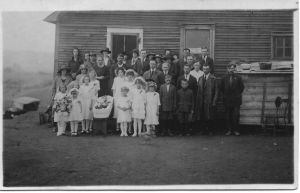
julia's funeral

This is 1923, the funeral of Julia, the first child of my grandmother’s second marriage. (There were 8 living children from her first marriage as well as a daughter who died in infancy, of diphtheria.) I have no idea if this house still exists. I’ve tried to find out the history of her houses in Drumheller—the one listed as a “shack” in the materials related to the squatters’ community she settled in with her first husband (and 5 children, 4 more quickly arriving); the one that replaced another (the shack?) that burned to the ground. And this is the last house she owned in Alberta, the house my grandfather build in the 1940s. It’s the subject of something I’m working on now. My father inherited this house and sold it after my grandmother’s death. I have one or two memories of staying here, not in this house specifically, but in a smaller house on the same property (I believe it was a house my grandfather bought from the Prins family and had moved to this property either before he built this one or just after.)

house

What does a house contain, what memories does it hold? Gaston Bachelard tells us what a house allows us: “I should say: the house shelters day-dreaming, the house protects the dreamer, the house allows one to dream in peace.” But are we also contained in its continued space, the corner of a street in Beverly, Alberta, near a park where children play, as we played, on the long summer days? And is my grandmother still a shadow among those trees in Horni Lomna or remembered in the small panes of glass gazing out towards the road?


another postcard, the stray apple, after weeks without rain

stray

I know that apples don’t come true from seed. Blossom from a Merton Beauty, say, is pollinated by an insect bearing reciprocal pollen from another apple—here,it would be a crabapple—and although the resulting apples would be true to their tree, their seeds would be the children of the Merton Beauty and the crabapple. One in ten thousand of those seeds might produce something worth eating. Who are the parents of this stray apple tree? It started growing before the Merton Beauty began its small production of fruit. Did this tree sprout from a seed spit over the side of the deck or excreted by birds or even seeds from the compost into which I regularly deposited cores and peelings from apples given us by friends in autumn? Belle of Boskoops from Joe and Solveigh, for instance, which make delectable fall desserts and cook up into beautiful chutney. Or else a seed from the few rotten apples from the bottom of a box bought from the Hilltop Farm in Spences Bridge, their flavor so intense you could taste dry air, the Thompson River, the minerals drawn up from the soil, faintly redolent of Artemesia frigida. This stray is all the more wonderful for its mysterious provenance, its unknown parents, and its uncertain future, for it grows out of a rock cleft, on a dry western slope.

—from Euclid’s Orchard, Mother Tongue Publishing, 2017.

a year later

what's new

This morning, because it’s cooler and I don’t have to rush out to water everything that droops, shrivels, or turns brown overnight, I was looking at posts from this time last year. In a way, my blog is my journal. Between it and my datebook, I am able to keep track of what happened when. On this day last year, my publisher Mona Fertig sent me two photographs of the advance proof copy of Euclid’s Orchard. I wrote about that here. As I’ve said before, it was a book I hadn’t expected to write. Or at least I hadn’t expected it to come together quite so quickly. I’m very glad it did. I’m very glad the reasons I wrote most of it—facing a potentially devastating health issue—have resolved themselves. The year leading up to Euclid’s Orchard‘s publication was filled with appointments and tests and the year leading away from it had some of those but also the relief that comes with knowing that the thing I dreaded was almost certainly not going to happen. At least not yet.

reading copy

It was a good year, this past one. My book took me to various places for readings and festivals. People wrote reviews and letters with such generosity. My book took me to the B.C. Book Prizes Gala because of its place on the Hubert Evans Award shortlist and that was fun. Some of the writing has led me to new work and for that I’m grateful. This is one of the best things about the essay form: it can be truly open-ended and you don’t have to think of it as “finished”.  It turns out “West of the 4th Meridian: A Libretto for Migrating Voices” was only the beginning of the stories I was listening to in the night as I came down to my desk to work during those weeks of waiting to learn if I had metastatic lung cancer. I’d sit in the dark with only the glow of my laptop light and the tiny desk lamp to one side and feel the presence of my father’s family around me. There is no logical way to explain this and I won’t but it was a source of comfort and now that I know a little more about them, I want to  explore their lives. In “West of the 4th Meridian”, there’s a line from Ovid’s Tristia, the letters he wrote in exile in Tomis: “I wish to be with you in any way possible.” To this end, I’m reading books about the Holodomor, about the politics of early 20th c. Ukraine, about the waves of emigrants who came to North America any way that they could. I want to find out who this woman was, the tiny image that was part of my grandfather’s archive. She is somehow familiar.

single woman

Time and the essay are related, I think. Spacious and widening, circling back on themselves when necessary, asking questions, pausing to listen to music, to take the air, remembering to keep the mind and the heart open to chance, to love, to the complexities of what a sentence can hold and also to what it can let go.

A coda to watering the Melba

In May, I wrote about our Ottawa family planting a Melba apple tree in their yard.

watering the melba

The entry ended this way:

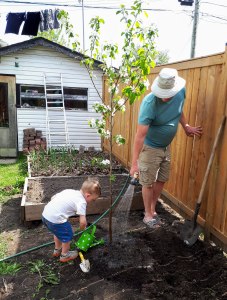
The younger man in the photograph is my grandson, who is two, the same age his father was when we brought home our Melba. In “Ballast”, in Euclid’s Orchard, I wrote, “I’m interested in how plants travel, how they are carried to new places, how they are botanical palimpsests, in a way. And how they hold stories,some plain and true, and some cryptic.” The first thing I thought of when I woke this morning was the Melba in Ottawa, newly planted, newly watered, with a young family to care for it (another grandson is anticipated in July) and to enjoy its beautiful fruit.

20180802_172335

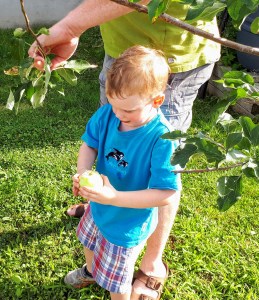
And now, in early August, some photos arrived of my grandson picking apples! His brother was born a month ago and the season is turning just a little—our heat wave has broken and the lake this morning was cooler than it’s been for weeks—so it’s a good time to eat apples from a tree planted in memory of an earlier tree, now gone. And good to sit at my desk and look at the image while my Edmonton grandchildren shout and play in the other rooms. They have been helping me water the tomatoes, the basil, the lilies on the upper deck, and later we’ll go out to see if the Merton Beauties are ripe enough to pick.


a river nearby

001

After a long day of medical adventures for my poor husband, it was a relief to sit on our deck under the vines and talk to our granddaughter Kelly, who turned 4 yesterday. “It’s my real birthday today,” she confided. Her party was last week so this was worth knowing: that you can celebrate twice (maybe more) but only one day is the actual day you become officially a year older.

Her birthday party included a bike parade, all the kids riding (or gliding, because her bike is a balance bike) with balloons and streamers on their handlebars. And there was also a treasure hunt. A neighbour told them that pirates had been known to come up the North Saskatchewan River to bury their treasure along Mill Creek Ravine, just a half a block from Kelly’s house. And you know how landscapes change over time, particular rivers and ravines. So there was a hunt for this treasure and sure enough, right under the porch of Kelly’s house—gold coins! And even better? There was chocolate inside.

I was not surprised to learn that pirates had been in the vicinity. It was foretold, after all, by the Arrogant Worms:

I hear in North Alberta there’s a band of buccaneers
They roam the Athabaska from Smith to Fort McKay

One of the photographs that arrived by email shows Henry on his bike in their backyard. We gave Kelly this bike for her second birthday. Now she’s moved up to a bigger size and it’s perfect for her brother.
010
Looking at him, I remembered one of the handful of photographs I have of my father as a child, also on a bike (well, a trike), and also near a river. The Red Deer, not the North Saskatchewan, but their body language is a shared language, across almost a century. My father looks like he would have been 3 or 4 in this photograph:
dad on bike.jpg

He’s wearing a sweater, which suggests this might be fall, his birthday, October, 1929? A boy who might also have dreamed of pirates, of treasure. I wrote about those photographs in Euclid’s Orchard:

I have a handful of photographs from the 1920s, taken on what I suspected was the land where Anna and Joseph settled and that my grandmother must have inherited after Joseph’s death during the 1918 Spanish flu epidemic. A funeral for Julia, the first child born to my grandmother and her second husband, my grandfather John Kishkan, in 1921 and dead of diphtheria in 1923. My father, Anthony Kishkan, known to his familiars as Tony, on a small trike in a rough yard with a dog. Another of my father in a little car with some wash tubs stacked behind him and bleak hills beyond those. I wondered if this was the land. Dry, dry, and a river nearby.

Sometimes people are too far away. You want to be part of the happy group eating cupcakes among children in a yard in Edmonton and you are instead driving down the highway to spend a day holding your husband’s hand as he is hooked to monitors (which showed that his heart is just fine so whatever else it might be, he has a strong heart). They are far away in time (your father on that bike, the dog barking at something arriving or departing behind him). And they are gone before you asked the questions you always meant to ask. But your father is also present in the body of that small boy on his bike. The half-smile, the collar turned up.