striated

dad in metal car

I’m at work on (yet) another essay about family history and am trying to puzzle through something that is both about place and about the public record. In Euclid’s Orchard, in an essay titled “West of the 4th Meridian: A Libretto for Migrating Voices”, I wrote about my discovery that the homestead I’d believed my grandmother’s first husband had taken out in the Drumheller area prior to her arrival in Canada in 1913 didn’t exist. Instead, she arrived to a squatters community.  In spring of 2016 I’d gone to the Provincial Archives in Edmonton to make a copy of a few documents I thought would help me to find the 1/4 section of land I’d always believed my grandmother’s first husband owned and was surprised to find instead the whole long file of maps, letters, petitions, directives, etc. On that day in 2016, I didn’t have time to do anything more than make one or two copies of pages I thought might be useful. Later, my son Forrest sent me a pdf of the microfilm detailing the difficulty the residents of the community had in petitioning the federal government for permission to buy the individual plots they’d settled on. Instead of a copy of the homestead grant and a map, I had 398 pages to decode and try to understand. I don’t believe that my grandmother and her first husband bought the plot they were living on when a portion of the land was subdivided in 1918. Their names don’t show up on the list of purchasers and anyway in 1918 that husband died in the Spanish flu epidemic and my grandmother had a new baby, her 9th, who was to die just a few months later.

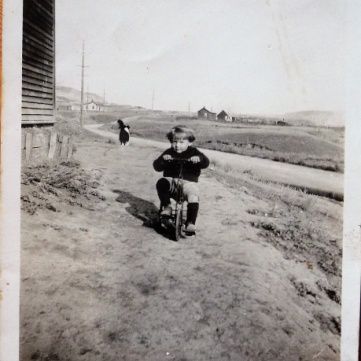
In 1920 my grandmother remarried. She married my grandfather John Kishkan. They show up on the 1921 Census (though I didn’t find them at first because my grandfather’s surname was misspelled) and again in 1926, living on the north side of the river, near the Midland Mine. I suspect my grandfather worked there. A few weeks ago in Drumheller, John and I took the two photographs we have of my father as a child and tried to find the location of the small farm he lived on by matching the hills in the photographs with the hills near Michichi Creek above the Dinosaur Trail, formerly Midland Road (the address given on the Census forms). That process is what I’m writing about now.

It gets complicated and in many ways it’s a useless exercise. What can I possibly learn by looking at striated hills and barren ground? Maybe something. I’ve discovered that the actual section of land where the squatters community was and where my grandparents had their farm is the same. The records are confusing. It was School Land. It was owned by someone called James Edward Trumble and maybe it was owned by someone else. Maybe my grandparents owned a little piece. Or maybe they rented a piece. I hope to figure it out.

On this map (which asks to be a quilt, doesn’t it?), you can see Range 20 on both sides of the Red Deer River.
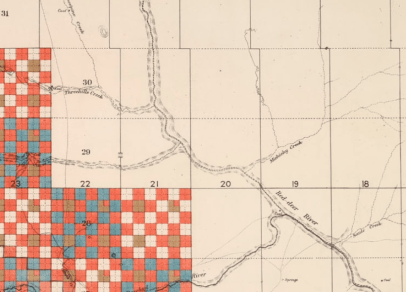
map of range 20.png

Imagine the small farm tucked against the flank of hill. Imagine waking to the striations, walking out to the morning in the shadow of those layers. My father once wrote a letter to me when I was living in Ireland, so it must have been 1978, and he mentioned he’d been to the funeral of his last living (half)brother, Paul Yopek. He’d driven to Drumheller after that funeral and wrote that he saw the hills where he’d walked as a boy but had never found anything worth keeping in his life. I thought he meant fossils but perhaps his comment was more ontological. Looking at the sedimentary layers exposed by weather, the mudstone, sandstone, the coal seams, and shale, all softly coloured and shimmering in the light, I wondered if they might take up a large space in the physical topography of a boy growing in their shadows. Paleontologists were at work in the 1930s when my father was a boy and perhaps he encountered one on his forays into the hills. Maybe he’d been asked to keep his eyes open and maybe he had and nothing ever showed up. The long rib of a creature as old as time. An ammonite. A nest of fossilized eggs. In his rough house, his mother made noodles, his father came home dark with coal dust.

          — from a work-in-progress

redux: the Passable Builders at work

Note: this was two years ago today. I’ve been out on my own deck, planting zinnia seeds and moving pots around, remembering the pleasure of watching my sons and their father work together, making jokes, adjourning for beer at the end of the day. And somehow during those days in Edmonton, inbetween walks with the children, making food with my daughters-in-law, driving out to the Ukrainian Village Museum,  I proof-read the final galleys of Euclid’s Orchard with those same men and their lives on almost every page.

********

One plan for our time in Edmonton, if weather and time conspired congenially, was to help Brendan and Cristen replace a rotting porch at the back of their house in Strathcona and to build a new free-standing deck under the leafy maples in one corner of their back yard. It’s the place where outdoor tables go for summer meals and so plans have passed back and forth between John and Brendan for a few months. Best size? Lumber dimensions? John loves a project like this. It’s been a long time since two neophytes (poets!) built a house on the Sechelt peninsula and though many projects have arisen since then—adding rooms to accommodate a growing family; replacing the original decks —I have to say that my husband loves construction. I told him once that I thought humans had vestigial building knowledge in their hands and when the need arose to call on that knowledge, it would be there. (I know you’re rolling your eyes!)

Forrest, Manon, and Arthur planned to spend a week in Edmonton too. Five of our days overlapped with theirs. (I just took them to the airport.) All week John and his sons measured wood, hammered joists, screwed down long lengths of lumber for the decking. They joked that they were the Passable Builders (their surname being Pass). This morning, after breakfast, I asked them to sit on the porch (which may or may not see railings and perhaps a bench or two):

passable builders, with foreman

The old porch is waiting to have its nails removed:

old porch.JPG

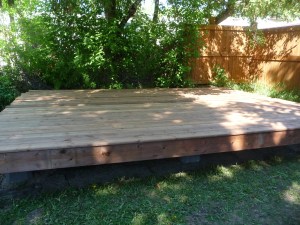
And here’s the deck where we’ll eat our dinner tonight (the remaining two Passable builders are out buying the last two pieces of lumber to finish it as well as stair materials):

deck under maple

While details were being weighed and pondered (“Measure twice, cut once.”), I looked over to see how weeds thrive in sunlight:

weed thrive in sunlight


a morning poppy, in memory of my mother

morning poppy

So now I have tokens, left in the event she should return to claim me, in all my imperfections—a child who burned recipes, who resisted sitting on her bed to share details of her life, a life I thought she’d disapprove of, but maybe I would have been surprised.Was I the fairest object of her love all those years when I felt myself homely, lonely, my face too dark, my legs too thick? Did her longing eyes seek me? Was my own birth wondrous to her. I doubt it. She was alone with two young sons, my father at sea, as he would be for so much of my childhood. I’ve searched for her mother, who never returned, who never claimed her in word or deed, but maybe I should have concentrated more on her. Her true heart, her own plain virtue.

At the Foundling Museum, a spyglass, a hairpin, the handle of a penknife. Padlocks, a tiny black hand pierced with a hole for a ribbon, a handful of coins, pierced, notched, worn thin by thumbs stroking, stroking, stored in the archives. I have My Sin, a tweed coat,a memory of Mrs. Nobody on her chair in the kitchen. I have a hole on my sleeve the shape of a heart but no scrap to match it with and the sound of a creek running underground on its way to the sea, with everything of my mother in it, and nothing. I have every regret for the way her life began, and ended, a motherless child, so far, so far from her home, no one looking for her in the listservs, among the dry records of Vital Statistics, no one, no one but me, my face against the glass case of all those unclaimed tokens, those stories begun perhaps in love and ending in sorrow.

–from “Tokens”, published in Euclid’s Orchard, Mother Tongue Publishing, 2017.

“One apple tree remains under my care.”

merton beauty

One apple tree remains under my care. It’s a Merton Beauty, bought as a tiny plant at a produce store in Sechelt. An organic gardener had grafted interesting varieties to dwarf rootstock, and I chose one almost at random. Merton Beauty is a cross between Ellison’s Orange and Cox’s Orange Pippin. For years, ours sat sort of sullenly in a little circle of stones near the garden shed, caged in chicken wire. I’d water it, give it the occasional mulch of compost and drink of fish emulsion. A few frail blossoms, an inch or two of new growth. Then it produced some fruit that was delicious. The information I’ve read about this variety stresses the aromatic flavor of the apples—their spicy taste, redolent of pears, cinnamon, aniseed. I can’t say I noticed those particular notes, but the skins were pretty, russeted at the shoulders, and the flesh was crisp, with a true flavor of apple. Not the empty watery taste of many supermarket apples, sprayed, waxed, gassed, and stored for months.

–from Euclid’s Orchard

redux: the springtime lamb

From Easter, 2017. Today? Not lamb but a ham, with potatoes in cream, and a salad with oranges and garden mint. There’s a tiny hummingbird perched on a rose cane outside my window and yes, the earth is coming alive, even if so many of its inhabitants are hungry or at war or struggling in one way or another.

_______________________________

Today, on my shelves, a book of poetry by Annie Dillard. Tickets for a Prayer Wheel. This is a season I celebrate — not for any religious reason but because moment by moment, the earth is coming alive. In “Feast Days”, Dillard takes us through a strange arrangement of Christian holidays. And I’ve remembered the conclusion since I first bought this book as a student in 1974:

God send us the spring lamb
minted and tied in thyme
and call us home, and bid us eat
and praise your name.

The names I praised were those of my family. All morning I worked on an essay for Euclid’s Orchard, one that explores my deep past in the Drumheller valley. So those names. The Yopeks, the Kishkans, poor Joseph Klus who died in a dugout house on the banks of the Red Deer River, of Spanish flu. Calls or texts came from my children. I’d sent my sons their childhood paper mache eggs, filled with little chocolate treats and toys for their children, my grandbabies. I wondered if they’d remember their eggs and oh, yes. They did.

In the afternoon, I worked in the garden where spring has eased itself into every bed — Spring Tonic, where I grow salad greens; Long Eye, where garlic is planted and kale is volunteering; Wave, where the peas have yet to sprout against their fence and, fearful that slugs will nip off the new sprouts, I scattered crushed oyster shells (from my birthday oysters) over the length of the furrows. I planted ten hills of French Fingerling potatoes in Old Deck and weeded mint volunteers from Thin Deck to pot up to take to Edmonton in May when we will all gather (except Angie, alas) to build a deck and porch for Brendan and Cristen and where I know the young’uns will want mojitos come 5’o’clock. (John and I would rather have a glass of wine. Call us stuffy.)

The spring lamb made an appearance on the Easter table, tied not with thyme, but stuffed with garlic and rosemary. A pan of Greek potatoes, lemony, and fragrant with olive oil from Crete. Eggplant with garden dill and chives in yoghourt. Salad of feta, tomatoes, and Kalamata olives. And for dessert? A galette with last year’s gooseberries and this year’s rhubarb. The most beautiful Desert Hills Syrah.

Today I’ve been naming
the plants of the southern forest:
arrowwood, witherod,
hobblebush, nannyberry
and the loblolly, longleaf
and shortleaf pine.

No, I’ve been looking at the pink new growth on the huckleberries, cerise salmonberry blossoms, Douglas fir, watching two sapsuckers chase one another up and down the trunk of a small cascara, and brushed a bumblebee from my shoulder as I put away the shovel. And thinking of my grandchildren, opening the eggs their fathers loved 30 years ago, on the table that still looks west. And misses them.

easter galette

essays in blue

an essay in blue

In the past year, I’ve written most of a collection of essays. This surprises me—and doesn’t. I knew I had threads I wanted to pursue, into a labyrinth of blue pigment, textiles, family history (again! or still?), and some other unknown and perhaps decorative elements. I had a title, Blue Portugal, and I knew that the title would help to determine something of the process of identifying likely threads.

And why the essay specifically for this work? Although I’ve written poetry in the far past and a version of fiction in the not-so-far past (and present), the essay form(s) somehow welcome(s) my own strange metabolic writing style and interests. You will find writers who will argue quite fiercely for what an essay is or isn’t. I’m more interested in what it can be. That its borders are notional. That it welcomes ideas, materials, figurative language, metrical incursions, and really almost anything that a writer cares to bring to it. I don’t mean that it is undisciplined as a form but that its disciplines are not (as they say) written in stone, though an essay would be very interested in learning about about glyphs and maybe the influence of the beautiful carved letters on Trajan’s column.

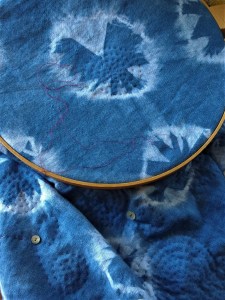
Last week I wrote an essay, over two mornings, called “Anatomy of a Button”. This one came out of the blue, literally, as I sewed buttons on an indigo quilt. And when I edited it several times and placed it in the draft manuscript of Blue Portugal, I saw that there are now 8 essays. I know I have one more (at least) to write but that one has to wait until after the middle of September when I’ll return from a trip to Ukraine to learn something about the country, and more specifically the village, my grandfather left in 1907. John and I had planned to go to Ukraine last September but an unexpected health issue arose instead. I’ve had a little literary windfall which means we can try again this fall. I’m in the process of organizing it now.

The 8 essays I’ve written are all different. They use language and even the white space of the page differently. Some of them sing. One of them uses a particular piece of music (Bach’s Partita for Violin No. 2 in D Minor) to investigate grief, the speaker of the essay taking on each of the dance moments of the Partita, sometimes gracefully, sometimes awkwardly, to move through space and time, noticing as she dances the strings of a violin bow, the bodies of those in the Cancer Institute as she waits for her own procedure, and the number of breaths a person takes in a life if you stop to do the math. Sometimes in these essays I stop to do the math (as I did in “Euclid’s Orchard”). Sometimes I tie cloth with hemp string and dip it repeatedly in indigo dye. Sometimes I visit rivers with my husband. I wonder about taking psychotropic drugs in order to recover the beauty of entoptic phenomenon experienced when my retinas were trying to detach in Edmonton in winter.

I think nothing gives me more pleasure than realizing that I have an essay to write. My pulse speeds up. Nothing else matters. I feel dazzled by and with language, pulled along in its flow and currents. This winter has been like that. So many nights I’ve come downstairs to work at my desk while the night breathes around me, essays in blue while owls called, coyotes mated, weasels raced through the eavestroughs. Having written these 8 essays, I kind of wonder what’s next. Imagine a single thread, dazzling in its colours and texture. Take it in your hand and wonder about it. Is it strong, is it tied securely to something as yet unknown, unseen? I don’t like confined space and if the thread leads down under the earth, I probably won’t follow. Not yet. But sometimes I dream of darkness, the comfort of it, and the fear. I’ll keep tugging, just a little, and maybe one day I’ll be brave enough to take the first step down.

cell by cell

afternoon deck

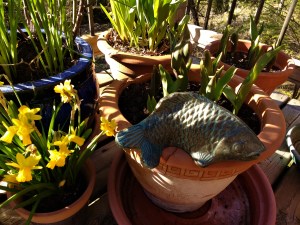
It felt like summer on this deck (with its bronze fish). Huge bees, bombus spp. of some sort (orange rumps…), going from flower to flower—crocus, daffodils, forsythia, low yellow primula. I planted out the seedlings of sugar peas I started indoors on March 16th. They were a foot tall and ready for their bed in Wave (the box where there’s a good screen of chicken wire for them to grow up against). I also transplanted some tiny kale seedlings, self-sown, in Long Eye. (My vegetable beds have names. What can I say.)

Over the past week I finished another of the essays for the collection I am calling Blue Portugal. The process of writing these essays feels a little like the fall of 2016, when I’d been tentatively diagnosed with something serious and I felt that I couldn’t waste time. I’d get up in the night and come down to my desk to work on the material that became Euclid’s Orchard. There was urgency in the work and also the daily rhythm of my life. I have no regrets, either for the sense that time was limited and I needed to use it well, and for the headlong energy I expended during that period. I felt lucky. I lived with someone I loved and who I knew would accompany me on any dark path that beckoned. I had a wonderful extended family. (Still have!) This work has that same urgency, though (as far as I know) I am strong and healthy. When I wake in the night, I have the sense that everything I know is connected, that I need to find way to stitch it all together like a useful and beautiful length of tapestry. Everything is connected, the flight of the bumblebees, the starlight, a pileated woodpecker just beyond my garden, drumming on a Douglas fir, the small blue scribble of my grandfather’s signature—he was learning to sign his name on a scrap of paper and mostly he gives up on the first syllable of his surname (my surname) but a single version is complete—the new chives so green and pungent in their pots on the deck.

The essay I just finished, “blueprints”, takes me back to house-building, the beginnings of our family, and then reaches back, back, to my grandparents’ years in Beverly, then a community outside Edmonton and now part of the city. It reaches back to the extraordinary photographer Anna Atkins, whose cyanotypes are botanical studies in blue and white. It ends with an informal picnic on the banks of the North Saskatchewan River as the ice breaks up, the ice I saw forming in late November as we drove across the Walterdale Bridge on our way to the Emergency ward of the Royal Alexandra Hospital because my retinas were trying to detach, the result of a hard fall on ice.

What I did today was shadowed by bees, their orange rumps glowing in sunlight. They entered the trumpets of daffodils, hovered over warm soil, paused from time to time on the sleeve of my flannel shirt.

We are bees,
and our body is a honeycomb.
We made
the body, cell by cell we made it.

—Rumi, translated by Robert Bly

twirling

dad on bike.jpg

My father, on his small tricycle, c. 1929, his dog watching the road. I think of him often, particularly when I see photographs of my grandchildren. How certain gestures, features, remain over time, in the intricate mathematics of inheritance.

I consider the ghost of a child’s hand in an ultrasound image, another of a baby’s spine,my father on a tricycle,in a little metal car, grey, grey, the propped coffin on a bench in 1923, on the stair by a house I am uncertain is the one my father spent his
childhood in or an earlier one that burned. Is it the house built by Joseph Yopek or a later house?

—from “West of the 4th Meridian: A Libretto for Migrating Voices”, published in Euclid’s Orchard, Mother Tongue Publishing, 2019

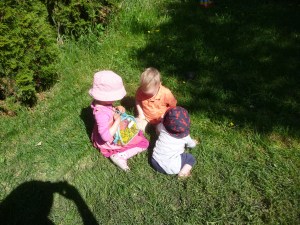
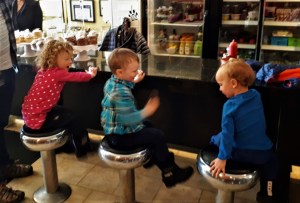
This morning, 3 of my grandchildren in a cafe in Ottawa (the 4th still too small to sit on a stool unassisted). They remind me of their own fathers (my sons) and they remind me of my brothers as children, twirling on stools in cafes as we drove across Canada to Halifax, and back. Twirling and twirling until, dizzy with movement, they’d fall or be forcibly removed from the stool, and scolded.

at Bobby's Table

the night wild with their song

crossing over

Last night I was awake again and from my warm place in the bed, I heard the coyotes. They were far away but one of them (the male, I think) was howling and one of them (the female) was yipping. Yesterday, on our walk down the driveway (we can’t drive up in this snow so leave the car by the highway), we saw the whole story of how the coyotes had spent their morning. It had snowed overnight so we knew the tracks were fresh. They’d been up near the house (which explains why the cat was skittish). One of them stopped to pee. Above is where they were ambling down the driveway, their tracks crossing. Sometimes you could tell that one was following almost in the other’s footprints. Sometimes they walked on separate sides of the driveway. By the time they reached the old orchard, they were walking side by side.

lives

They are presences in our lives and even in our sleep. And in my memory, as I think of the years that we’ve heard them, seen them, the night wild with their song.

And listen: the coyotes are singing, the deep voice of the father,the rather more shrill voice of the mother—anxious that all her offspring eat well and learn to hunt, to care for their safety in the forest beyond the orchard—and the lilting joyous youngsters unaware that a life is anything other than the moment in moonlight, fresh meat in their stomachs, the old trees with a few apples and pears too small and green for any living thing o be interested in this early in the season.

—from “Euclid’s Orchard”, published in Euclid’s Orchard & Other Essays, Mother Tongue Publishing, 2017.


“Who’s there?”

pelvis

Something happened the other day and I want to write about it while it’s still fresh and lively in my thinking. I got up in the night (after midnight as Wednesday eased into Thursday) to sit at my desk and ponder the beginnings of an essay to accompany the dark path quilt I was sewing. I know this might not make sense to people who do one of these things or the other but not both. Each discipline requires a different set of skills, a different kind of focus. Still, working on the two things in tandem has become a way for me to explore the process of making something and thinking deeply about the way it connects to ideas, dreams, visual signals, metaphors. My essay “Euclid’s Orchard” traced the making of a quilt of the same name. It followed my attempts to learn something of mathematical language and pattern in order to understand my son Brendan and his life-long calling. (He is a professor of mathematics at the University of Alberta and when I look back at his childhood, I see that he was always pursuing patterns and numbers. Though when I asked him once if he always thought about numbers as a child, he said, “That’s the way you’d describe it but it was more about relationships, patterns, equations.” “Even then?” “Yes, even then.”) Another essay, “An Autobiography of Stars”, documents the making of a starry quilt for my daughter who was still a teenager. I wanted to give her the heavens and all they contained. Not all my essays have matching quilts but they almost have some sort of puzzle at their heart. Something I need to figure out.

So as Wednesday became Thursday, I was at my desk, the space lit by a small lamp, and I was looking at the beginning of the dark path essay. To the right of my computer is the pelvis of a long-dead dog. While I was sitting there, I remembered something that happened to me when I was 14, an accident with my horse. I heard (if you can believe me) the voices of the two soldiers in the opening scene of Hamlet:

Bernardo: Who’s there?

Francisco: Nay, answer me. Stand and unfold yourself.

I shivered a little in the night, in the small space of my study under its Giotto ceiling, and I began to write. An hour later, maybe two, I went back to bed. Then in the morning I returned to my desk and finished what turned out to be a complicated and (to me) fascinating nexus.

What I wrote wasn’t what I thought I’d write. When I began the essay to accompany the quilt, I imagined it would describe the process of choosing scraps of fabric and laying them out in a pleasing pattern. Yes, there’s some of that in the essay. I thought I’d describe how much John and I are enjoying reading the Inferno of Dante each evening by the fire. Yup, that too. But I also found myself drawing together pelvises, fractures, the fear of losing myself in the process of aging, various paths I’ve made and taken in my life so far, and oh, some other strands of loose thread into a crooked but interesting seam. It took me almost all of Thursday to finish the first draft and a good part of Friday (yesterday) to fix some weak areas and to tighten the structure. (Those seams! The connective tissue!)

Sometimes you just have to write. You can’t wait for the right moment because when exactly will that be? You need to pay attention to your own fears (Who’s there?) and walk into the night to meet them. You hope the path you’re following is not too broken and rough. You hope your footing is at least adequate, in the darkness, in the grass that has grown up over the path you made with rocks to lead you out to the outhouse when you first lived here, your baby (not the mathematician but the one who became a historian) sleeping in the unfinished house.