icosahedron, bordered with cotton

While in Ottawa last week, I had a little peek at quilts in the curatorial wing of the Canadian Museum of History (formerly Museum of Civilization) in Gatineau — thank you, Forrest! — and my hands kept twitching. I wanted to make something! I wanted to work on my own quilt, which has been longer in the thinking stage than anything I’ve ever made. This is because of the long process of working out how to replicate the images I wanted to use. I’m much better at the doing than the planning. Strategies for this particular quilt have changed many times and so there hasn’t been much sewing — until yesterday, when I cut out and stitched the top and bottom borders on all the blocks. And this morning I’ve just finished the sides of the first block. It’s a model of Euclid’s icosahedron and I love how elegant it is. An icosahedron is a polyhedron with 20 equivalent equilateral triangle faces, 12 polyhedron vertices, and 30 polyhedron edges. In the Timaeus, Plato equated the polyhedra with elements and the icosahedron’s element is water. This block hasn’t been pressed so you can see the ruckles in this photograph. And the colours aren’t quite true. But I love the cotton, something from my quilter’s stash which I could never find the right use for, and I don’t have enough of it to line up the pattern at the corners perfectly. But every quilt is a a version of the Platonic ideal, I suppose, and maybe the next one will be better…

icosahedron block

waiting at home

Yesterday we returned home from a week in Ottawa, a week during which a deck was built, many walks were taken, large meals were indulged in, and some explorations were conducted at the Museum of Civilization. I kept seeing wildflowers I wasn’t familiar with (near Calabogie Lake), and trees. A pine with very long soft leaves. Oaks just coming into leaf, the leaves themselves almost frilly, with red margins. (I brought back an acorn and will try to grow one for myself.) On the Eagle Nest trail, there was a small toadlet and amazing views and I brought back memories of those stored in a safe place.

Coming up the driveway, we were so thrilled to see that the wisteria framing our patio (on a long cedar beam taken from a tree we took down years ago and had milled into lumber, a process described in Mnemonic: A Book of Trees) was in full bloom. When we left last week, it was in bud, the leaves opening but not yet fully out. Friend Jeffrey, who stayed here for a couple of nights while we were away, took this photograph:

wisteriaThere are two more of these beauties around the house and I took a root to Forrest and Manon for their garden. (John has already been booked for next spring to help them to build a pergola over one end of the new deck.) The wisterias came from John’s mother who brought them in turn from her mother’s garden in Felixstowe, along with mint, perennial geranium, honeysuckle, tucked into her suitcase after summer visits. I took kale to Ottawa and a tiny mountain ash; and I brought back violets, the ones growing like weeds in the grass and which I carefully dug up from the place where the deck was going to be built.

And it looks like one of my novellas has found a home. A publisher who is enthusiastic about the form has written to say she would love to publish Patrin in the spring of 2016! More on this as things develop but this news is too good to keep to myself!

imagine the days

Mid-way through our week in Ottawa. The days are filled with deck-building (Forrest and John) —

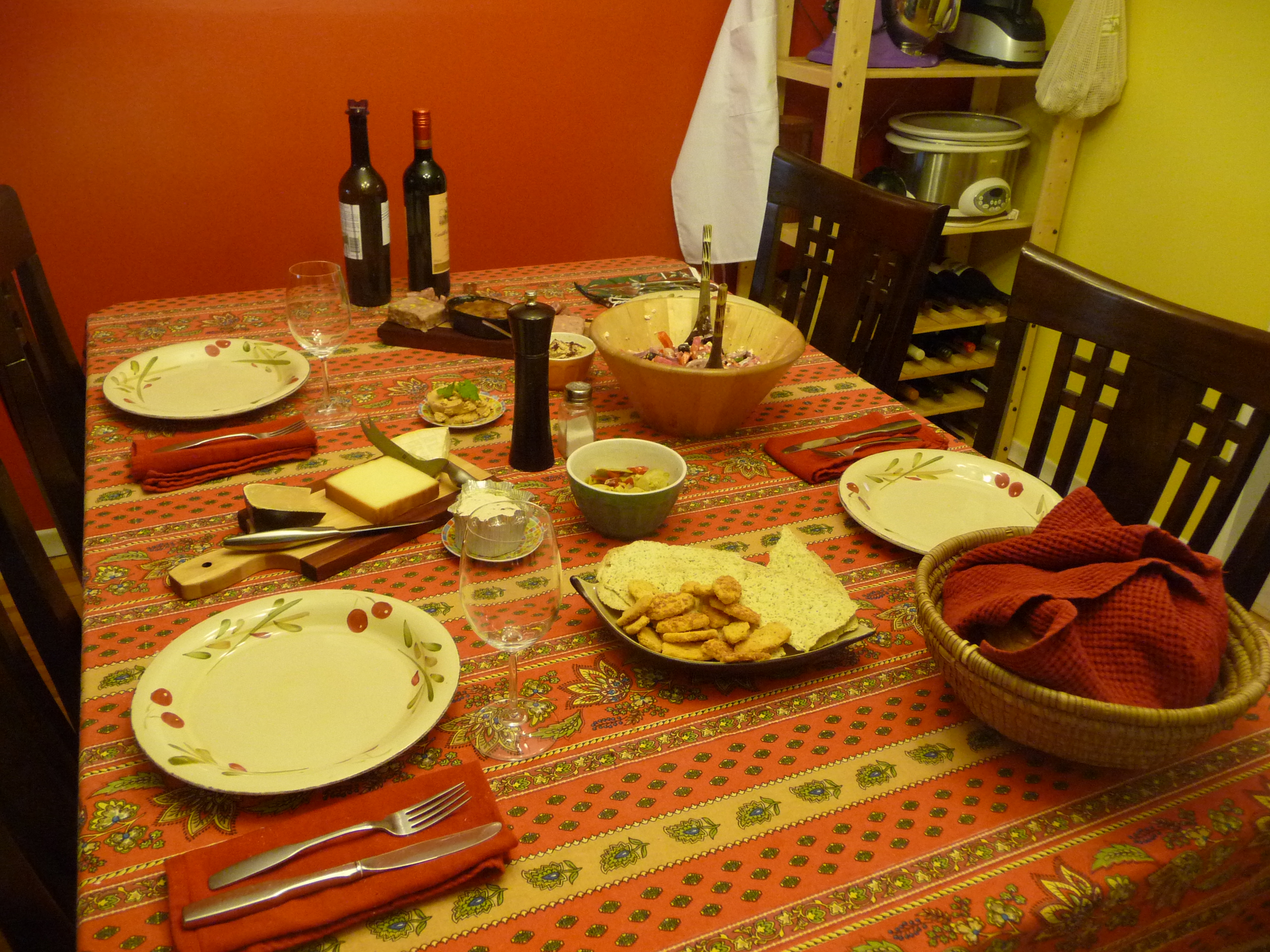
P1100129delicious meals courtesy of Forrest and Manon —

P1100125sitting in Pressed Cafe and listening to poetry (John, Pearl Pirie, and Catherine Brunet), a lunch with Andrea Cordonier (who came prepared to work on the deck but torrential rain meant we stayed inside and talked instead: a pleasure…), and walks through Richelieu Park where trilliums are blooming and some sort of native lily will be in a few weeks (a leaf not unlike the Erythronium oregonum so I’m wondering if these are trout lilies?). Vanier is a neighbourhood of great diversity — old houses and a butcher and porches meeting the streets and a little Mexican restaurant (Ola Cocina where we sat at a sidewalk table and ate duck tacos which were so wonderful). Across Beechwood is Rockcliffe, entirely different, but we went there, to Jacobsons, to buy divine cheese (La Sauvagine, a washed-rind cheese from Quebec which I could happily eat for the rest of my life) and an elk pate I bought just for revenge (see previous posts about elk eating my garlic during a period of garden reconstruction and ongoing consumption of our orchard).

And imagine violets in the grass like weeds (I have a little bag of them wrapped in paper towel to take home with me to try around our patio, the same bag that brought kale seedlings here the other day and which are happily tucked into the vegetable garden as I write…) and brilliant cardinals in the trees. Imagine every step you take in this house being observed by Matilda:

P1100119

And imagine a bedside table with two new gifts, from Forrest’s workplace (The Museum of Civilization or, no, it’s now the Canadian Museum of History): Sanatujut: Pride in Women’s Work (Copper and Caribou Inuit Clothing Traditions) and The Whaling Indians: Legendary Hunters.

heartsease

A day to think of mothers — mine, John’s, both dead — and to celebrate one’s own maternity. And I do. My children have been one of the greatest joys of my life. Sometimes I walk around and see this house and its garden as it was when my children were small. They were pretty much free-range. They had 8 acres of our woods and clearings to explore and then continued from there to the lakes, the mountain behind us, and now to Ottawa, Edmonton, and Victoria. Today I thought of them as I encountered snakes in the sunny grass, two tree frogs, and watched violet-green swallows swoop over the garden. These are constants, waited for every spring, and noted with such pleasure. (I know snakes don’t necessarily sound lovely but they are so useful and if you look at them carefully, you can see the beauty in their markings and the elegance in their movement.)

John’s mother brought a tiny crabapple, a seedling or sucker from her own tree, and now it is perhaps 25 feet high, and wide, welcoming — it’s humming with bees today and in the fall, a bear will come for its fruit.

P1100097A clump of sweet-scented white violet which has grown here since 1987 when Vi (short for Violet) Tyner left a bit of it on the seat of my car while I was shopping, its growing conditions noted in her spidery handwriting.

P1100100And remember Oberon, in A Midsummer Night’s Dream, asking Puck to bring him ““…a little western flower / Before milk-white, now purple with love’s wound / And maidens call it love-in-idleness.” (Act II, Scene 1.) That was the tri-coloured viola or heartsease and I love seeing it growing wild among the new grass:

P1100101In herbal lore, it is associated with happy memories summoned to ease the heartbreak of separation. No heartbreak here but a kind of thoughtfulness. Where have the years gone? Why did I keep hearing children at play in the woods while I planted savoy cabbages and weeded the salad patch?

notes from a work-in-progress

Anyone expecting to see regular updates on my Euclid’s Orchard quilt and essay must be thinking I am very lazy indeed. And in a way I am. It’s been a long process to figure out how to translate the material I am working on in the form of this essay to actual tangible quilt blocks. I’m not much a seamstress although I’ve been sewing since grade eight when we made aprons and jumpers in Home Economics. I was careless then, in a hurry to finish so I could have an actual made object in my hands, and I’m careless still. I’ve made more than 25 quilts and the sewing has never progressed to the point where anyone looking at them ever comments on the actual stitching. But never mind. I love the process and if you kind of squint when you look at one of my quilts, you might mistake it for something accomplished.

The problem with this quilt is that I am using images from textbooks, many of them graphic representations of particular mathematical theorems or ideas. I’d thought of simply trying to draw them onto white cotton and then embroidering them to highlight the parts that are relevant to the ideas I’m pursuing in my essay. But when I tried to do the drawings, they were lopsided and I knew that every step along the way would compound this problem. And let’s face it: a person who is careless at sewing isn’t going to be any better at embroidery.

I’ve seen quilts with computer-printed images on them so that seemed like a good solution. I thought I could design the blocks on my computer and then take the files somewhere to be printed. That didn’t work. The place I thought would do it, wouldn’t. So then I planned to print them myself, backing cotton with freezer paper which supposedly makes it possible to use it in a printer. But ours is a  a laser printer, a good one, and those won’t work. (They generate too much heat, apparently.) Finally, after some more weighing and pondering, I ordered an ink-jet printer (which seems like the height of self-indulgence) and bought four packages of specially prepared ink jet printable fabric.

Then I looked at my images again and they seemed awfully busy. I wanted one element to travel from one block to another, to provide continuity. But what could that be? Because this is an essay about mathematics and ideas but also about a real orchard, ours, which is fenced with chicken wire, and because one section of the essay is about bees and how they construct their honeycombs in hexagonal cells (which Pappus of Alexandria attributed to “a certain geometrical forethought”), I decided to use a simple model of those cells which echo the pattern of chicken wire. So here’s one block, just printed, the one I chose to accompany the section of the essay which meditates on inheritance. This uses a graphic representation of dominant and recessive phenotypes:


P1100087

Something else will happen to this block when the entire quilt top is completed — and so think of it  bordered with Moravian blueprint cotton, brought back from Brno two years ago, and maybe embellished with beads and gold thread among those cells. There will be 14 blocks altogether and I hope I have enough of the blueprint for the top. If not, there will have to be more improvisation…

 When I first began to work on this essay, I wrote this little aria, which I think I posted ages ago. But it’s still at the heart of this work I’m doing, so I will conclude with it.

Aria leading to summer

“Yes, but what can I say about the Parthenon – that my own ghost met me, the girl of 23, with all her life to come…” (Virginia Woolf, A Writer’s Diary, April 21, 1932) How I felt that as I looked at our photographs of White Pine Island – Brendan and Angie in their little bathing suits, Lily on a log, Forrest rowing the boat away from us, my parents smiling the summer of their 40th wedding anniversary. All the years of our family, the warm days, the smell of pine, the silken texture of dry grass flattened under our towels, taste of lemonade from the River Trails thermos jug, all of them collapsed into an hour, a moment, held in my hands, water falling through my fingers. How do I keep my memories intact, how apart from this, a brief time in the middle of the night, darkness pressed to the window by my desk, myself reflected in glass as I sit in my white nightgown, every cell in my body yearning for those I have loved, still love, though the only one left in the sleeping house is John. Whom I have loved, still love.

Emboldened by Virginia, I think of what I want to say, not what form it must take. There will moments when I embellish, or downright invent; there will be brief arias, phrases of poetry, the instructions for making a quilt, for working out the puzzle of Mendelian genetics.

the quiet world

Well, it’s quiet here — apart from roosters down by the lake — but not still. When you take the time to see what’s going on, it’s astonishing. We were just having coffee on the deck off our second-storey bedroom and we saw the mason bee we’d noticed yesterday. There’s a tiny hole in the siding and yesterday the bee was going in and out of it. Today it was just hovering around the entrance. When it left, and I looked closer, I saw that the hole has been filled in with mud. I got out the National Audubon Society Field Guide to Insects and Spiders to try to figure out what was going on. I learned that the female mason bee constructs small nest cells of clay which she provisions with pollen and nectar before laying a single egg. And then I read this, which is as much of a found poem as anything: “Some species include plant fragments in their nest construction. Others build inside empty snail-shells, and still others line each nest with snips of flower petals.”

mason bee nestThere are also a lot of mud-daubers around right now, looking for ideal locations for their nests. Here’s one building just outside the bathroom window:

mud dauberIn the notes on mud-daubers, I discover more interesting drama that happens without us even noticing:”Using its mandibles, female shapes small masses of moist mud into balls and makes joined tubular cells. Into each cell female stuffs 1 paralyzed spider, immobilized by venom, then lays 1 egg on spider and closes cell with mud.”

And speaking of drama (though in quite a minor key), I saw a snake yesterday rush up to an area below a little Japanese maple, its mouth stuffed full. It appeared agitated and after shoving its face into the moss, it lifted its head, mouth now empty, and began the process of trying to get its jaw back into position. (Garter snakes can unhinge their jaws while eating large prey.) Because I was there, it moved away a little and rested its head on a small stone, opening and closing its mouth, like a cat yawning. (I could see inside its mouth and it was red!) I poked around in the moss and saw that the thing it had been carrying was a huge slug. I thought I would help by tossing the slug to where the snake had by now eased its jaw back into place. But instead of taking the slug,  it returned to the moss and began to plunge its head down, looking for its dinner. Here’s the snake this morning, in the same area. I never knew they cached food.

snakeBecause we are anticipating our first grandchild in July, I said to John, “Won’t it be wonderful to show small children these things?” To which he rolled his eyes and made texting motions with his fingers. (We don’t own a cell phone which is why I have a huge reference library of field guides to use instead of looking up mason bee behaviour on a smart phone.) But honestly I can’t imagine a child not wanting to watch a snake dislocate its jaw and yawn like a cat or fail to be delighted at this tree frog taking the sun on a May morning:

tree frog

green pie

To keep up with the kale — which is last year’s planting and it’s wanting to bolt but this year’s seedlings aren’t quite big enough to begin cutting — I’ve been making green pie. Two big ones today, one to eat over the next few days and another for the freezer. Tomorrow I’ll make a couple more. When our plane landed in Vancouver last Tuesday, after 12 days in New Mexico and five in Edmonton, I thought how beautiful and lush everything was. Grass, trees, even sea itself as we drove home up the coast highway. And when we got to our place, it was the kale I saw first of all. I thought of the lines from the Odyssey, when Odysseus visits Phaiakia (and I think they are even better in the Fagles translation than the Fitzgerald which is the one I usually consult, mostly because it was the one my wonderful Classics professor Peter Smith taught to us in 1974):

And there by the last rows are beds of greens, 

bordered and plotted, greens of every kind, 

glistening fresh, year in, year out.”. (Book Seven, 129-31)

So kale and dandelion greens and blood-red sorrel, picked while still glistening with morning damp.

P1100056And they steamed down to this:

P1100061

I mixed them with chives, mint, and last year’s (frozen) dill, eggs, some delicious fresh feta, and arranged the greens over the filo, bringing out the Greek olive oil which had languished in a dark cupboard and looked like it should spend a little time outside first, reclining on the rosemary:

P1100066

And now the green pie is cooling on the worktable while we enjoy a glass of wine outside, in sunlight, with a few mezes — beet and toasted walnut spread on little rice crackers, some peas, a hummus made with roasted carrots and chickpeas.

P1100068After one of the wonderful extended catalogues for which the Odyssey is justly famous, listing those rows of greesn, figs, apples, and every other kind of fruit, the vines which would yield wine, all watered from a clear fountain, Homer ends the passage by saying, “These were the gifts of Heaven.” Who can argue?


at Francis Point

I thought we might have missed the wild lilies (Erythronium oregonum) at Francis Point. It’s become our habit to walk to see them over the Easter weekend and this Easter we were in Edmonton watching the magpies in the trees around Brendan and Cristen’s house. But we walked out this morning and were lucky to find a few lilies still in bloom.

P1100048

It’s a beautiful place to walk. You make your way above the rocks where at low tide the gulls can be seen feeding on starfish (I know, I know: they’re called sea stars now but old habits die hard…) and will look up with their thoats ridiculously distended. Sometimes there are seals or even sea lions passing though it’s more usual to see a boat — a pleasure craft, a fishing boat, or else this:

P1100053P1100054

This is a view across Georgia Strait to Texada Island. We’ve always called it Georgia Strait though there’s a movement to include it in a wider area which supporters want to term the Salish Sea. When I asked Kevin Paul, a poet and linguist  from the WSÃ ,NEC Nation on Saanich peninsula (the same area where I spent my teen years), what he thought of the idea, he laughed. He said Salish was a controversial term to say the least and that the body of water I was referring to had different names for different times of the year, used by different Nations, and that it also depended on what you were doing at the time.  But some things don’t change. The wind, the flowering arbutus, the gulls, the constancy of the wild lilies, the way the heart opens to all these things on a bright April morning.

“…the dream and the light softly fading”

Sometimes a song is all it takes. Sometimes it takes you there, to the moment when you drove down highway 518, through snow and deep forests, across the Mora Valley, through soft grasslands fringed with Ponderosa pines, piñons, those fragrant junipers, to the high desert where the unexpected was waiting: the beautiful plaza of Las Vegas. And it was all there, in Ian Tyson’s “Road to Las Cruces”:

On a high plateau out of Anton Chico

I see the dust of a herd coming through

The dream and the light softly fading

My horses will not stand

They wish to go with them

Riding for Alex Carone on the road to Las Vegas.

It’s a song I’ve loved for years though I never had a clue that it wasn’t Nevada he was singing about but that town a few hours from Albuquerque. And not too far from the Conchas-Pecos branch of the legendary Singleton Ranches where there is, indeed, an Alex Carone working as a manager.

In the second-hand stores near the plaza in Las Vegas, there were saddles, some of them broken-down and cracked, some of them in pretty good shape. I saw a bridle with silver conchas and many pairs of cowboy boots. There were paint ponies in a field on the way to Montezuma. You could smell history in the air, though maybe not everybody’s history. Not mine, I know, but that didn’t prevent the yearning.

Today I’m putting away my suitcase, the books I bought, and catching up with work at my desk. I took a moment to photograph the little Acoma rain pot that I bought from its maker, Emil Chino, at the Sky City Mesa. It stood out on the table he presided over — a few big ollas, some seed pots, and an assortment of the rain pots. I wish I could read the imagery a little more fluently but I remember Emil pointed out the rain, the clouds, some ears of corn. And for now, that will have to do.

P1100046

the smell of piñon smoke

In one of geographic shifts that we’ve become accustomed to, that we adapt to so easily it seems, I am watching snow fall outside Brendan and Cristen’s house in Edmonton and realizing it’s only about ten hours since I woke to the most beautiful moon over Albuquerque and watched the sun rise from the plane as we left New Mexico. Only twenty four hours since we ate lunch on the patio at Mas while the soft leaves of an olive tree planted within the patio area shook in the breeze and small sparrows waited for us to drop crumbs from the sesame lavash we’d ordered with our mezes.

Yesterday morning we left Las Vegas and stopped at Pecos National Landmark to walk and explore. It’s the site of a pueblo dating from 1100 A.D., a high place, with views down to the desert and to the mountains in every direction. Its population was 2000 or more and there are two mission churches, one built over another destroyed in the Pueblo revolt in 1680. People lived there until 1838 when the last occupants went to Jemez Pueblo to join relatives there. It’s a place you can easily understand the “why” of — why people chose its location, why it was settled for so long, and how it would live long in the memories of anyone who’d ever been there (us included, I suspect).

Here’s what you see, looking up to the pueblo site:

P1090984And here’s the light in one of the reconstructed kivas where we climbed down and understood why the Pueblo creation stories tell of people coming up from under the earth to live on its surface. (The kivas are still used for ceremonial purposes.)

P1090988Already I miss New Mexico’s red soil, the grey chamisa, the mule deer with their curious faces watching from the roadsides. I miss the juniper and piñon forests, particularly the ones on the road up through Madrid and Cerillos, the bluebirds at Bandelier, and the field of elk we saw on our drive to Cimarron the other morning. I loved our room at the Taos Inn where the smell of piñon smoke from the fireplace scented the room in the most seductive way so that I imagine now I can smell it in my clothing. (Wishful thinking…) I loved the friendly servers at La Boca in Santa Fe and the wonderful food they brought to the table and how the Spanish wine we ordered was perfect with the food. When I opened my suitcase in the pretty room Cristen and Brendan had ready for us, I smelled the chili powder from Chimayo and maybe, just maybe, that piñon smoke.