foundational

Yesterday I had a virtual visit to a class reading my novella, The Weight of the Heart. (Thank you, Richard Pickard!) In the course of the discussion, I found myself admitting that the 1970s had been foundational to me — as a writer, as a person figuring out how to live on this earth. I found out the things I wanted and I tried to build a life that would include them. I didn’t realize then how pottery was part of that, pots built by BC potters, using earth and pigment, but looking around my house this morning (begun not quite in the 1970s but close: we started building our house in 1981 after buying the land a year before and spending a year figuring out where we wanted the house and how we would proceed…), I can see the evidence.

This red raku tea bowl was made by Wayne Ngan in the early 1970s. My then-sister-in-law Rosemary Kent (herself a potter) owned a small art gallery in Bastion Square in Victoria. They often had pieces made by Wayne. He’d come to Victoria from his home on Hornby Island with new pots. I fell in love with this one but couldn’t begin to afford it (I was a university student) and Rosemary surprised me with it at Christmas. The glaze is heart-stoppingly beautiful.

This wide shallow bowl was also made by Wayne. I saw it at Rosemary’s gallery and realized that I could buy it with unexpected scholarship money, received after I’d already paid my tuition with earnings from my summer job at Butchart Gardens. You can’t really see it but there’s some blue in the slip used to create the design. We used to eat salad from this bowl regularly, particularly when friends came for dinner (it holds a lot of salad!) and I remember how surprised people were when the last helping of greens had been lifted from the bowl and we could see that engaging little face!

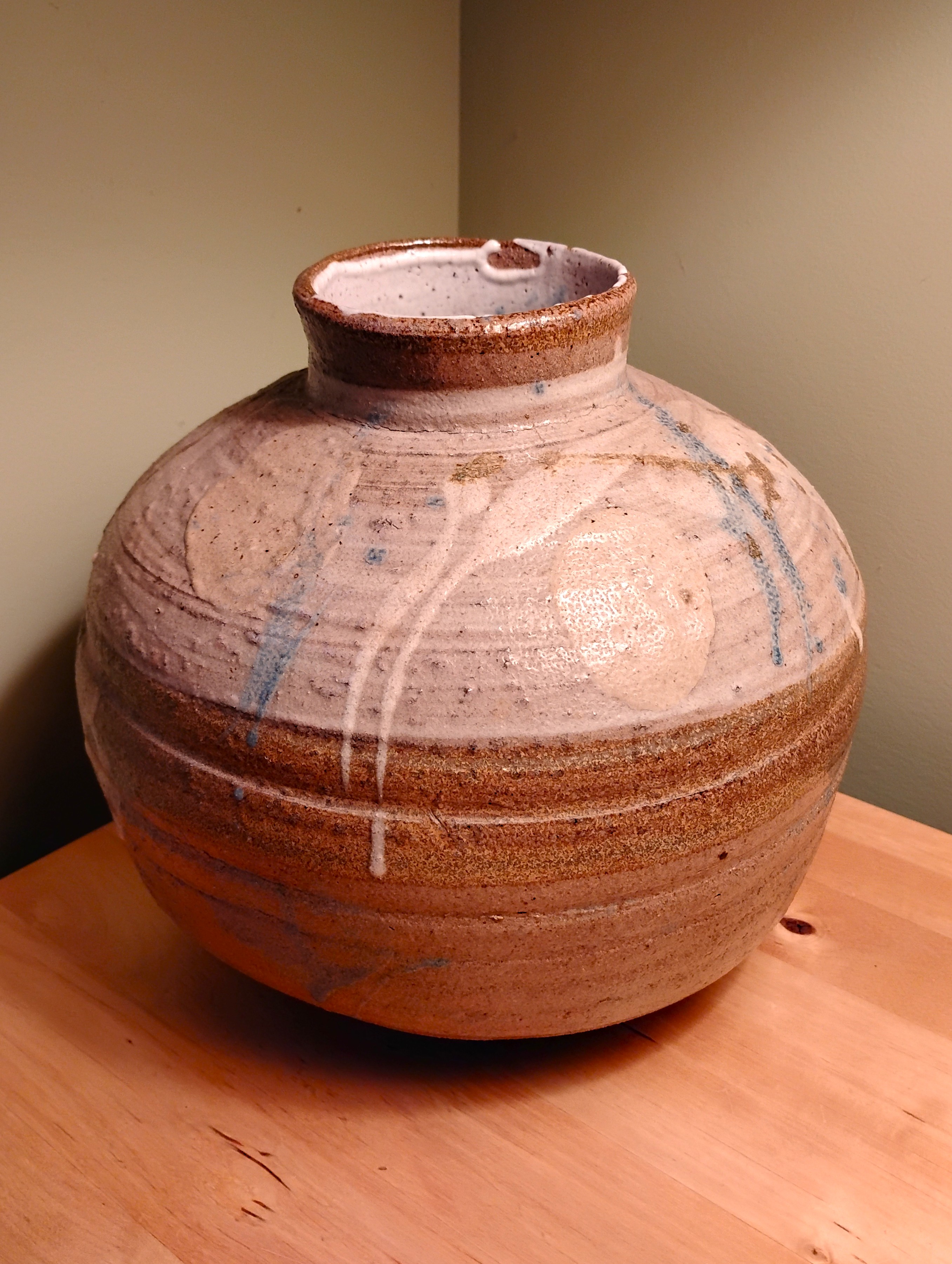
I am not entirely sure if this pot was made by Wayne Ngan. I bought it from a couple who’d set up a table at a huge swap meet at the site of the old Tillicum drive-in theatre (now the Tillicum Mall) in Victoria. They’d come from Hornby Island and were selling everything to spend a year in Europe. They had pots by various artists, including Gordon Hutchens, and they assured me that this large vessel was made by Wayne. It doesn’t have a seal so I can’t confirm it. But it’s heavy in the way so many pots were then and sometimes I put dried rushes or flowers in it. When I lifted it up to check once again for a seal, there was a stick of driftwood sticking out of, left over from wind-chimes I made a few summers ago with my grandchildren, also emblems of the 1970s!

These wind-chimes hang by our front door and a rose has sent out a tendril to join the music before winter. Sometimes I see Anna’s hummingbirds paused on it between sips from the feeder which hangs just to its right.

Sometimes I just take one of the pots in my hands and hold it. There’s life to them, life in their shapeliness, their inner space. In a wonderful interview with Spencer Bailey on the podcast Time Sensitive, the potter Edmund De Waal says this:

I think it’s completely my grounding, really, which is that the making of one vessel and then making another vessel, taking it off the wheel, making another one, has an extraordinary element of rhythm within it. But at the heart of the rhythm, of course, is this interior space of a vessel, which is a breath. And so, there’s an embodiment there. It’s almost a breathing into the vessel. I don’t want to sound like God or Prometheus, but, for me, a vessel, it’s a container of breath.

Surrounded by things made of earth, shaped by hands, I am in the foundational time again, the one I wrote about in my novella, Winter Wren. What mattered then matters now. The quiet of a west-facing house, the view at dusk, finding a way to live a life in which these things have a place, a place known and loved and cared for. I think it’s completely my grounding, really…Yes, and yes, and yes.

a publishing history, with asides (third instalment)

21st century, second decade

Sandcut Beach

My parents died at the beginning of the second decade of the new century, a year apart to the day. Several close friends died. My sons married their sweethearts. (My daughter married hers a few weeks ago!) Every day held sorrow and joy. And also a sense of possibilities for my long-held interest in my family’s history. After my father’s death, I took home the small hoard of papers and photographs he’d kept to himself. I don’t know exactly why he was reluctant to share the materials, or to pursue answers to questions–the ones I had and surely ones he had too? And a year later, after my mother’s death, I felt the uneasy sense that I was now the family matriarch, the one responsible for keeping the lines of kinship clear. They were not clear. There were half-stories, careless genealogies. In retrospect, I see that much of the research and writing I did during this decade was in service to these histories.

I’ve always loved the literary novella. Without ever really intending to, I’ve built up a nice collection and have read many more, via library or generous friends. Inishbream was a sort of accidental novella, beginning as it did as a linked group of prose poems, eventually drawn out and given a structure. I loved the possibilities of the form, how it could hold so much in such a hermetic shape. A year or two after The Age of Water Lilies was published, I was invited to a book club to talk with members who’d just read it. I always enjoy these occasions. During our time together, one woman asked what happened to Grace after the novel ended. Good question. Grace was born to a single mother in the spring of 1915. She is sort of tangential to the narrative. But the more I thought about her, the more I wondered too. I began to write Winter Wren to find out. I think I knew from the beginning that the book would be a novella. I put Grace in a cabin I’d always thought I’d like to live in, a cabin I first saw as a teenager, on a beach west of Sooke, B.C. (It’s the one above the waterfall in the photograph at the beginning of this post.) She was in her late 50s, an artist trying to paint the view at dusk. I wanted to write about the 1970s—the novella takes place in 1974, an interesting time for ceramics in B.C. (Grace’s love interest is a potter in the tradition of those who studied with Bernard Leach in Cornwall and then returned to Canada), for museums where the salvage paradigm was part of the ethos, and perhaps the last possible time for Grace to meet one of the late 19th c-early 20th c artifact collectors.

winter wren

But you know already what I’m going to say: I sent Winter Wren to dozens of publishers and all of them rejected it. To make a long story short, my dear friend Anik See was visiting enroute from Dawson City to the Netherlands and we shared similar stories about novellas we’d written. We decided to begin a micropress to showcase the form and we decided to begin with mine. Our rationale was this: if our endeavour didn’t work, then I would be disappointed, sure, but at least it would only be me and not someone else. I could shake it off, poof, and move on. (Ha!) Anik designed the book, I photographed a pottery dish with a length of scouring rush (it figures in the book), and we found a really good printer in Victoria. And you know, we sold our first print run of 250 copies within weeks and we reprinted. I still get orders for it. We went on to publish 4 more novellas and we are very proud of Fish Gotta Swim Editions. Our latest is Anik’s Cabin Fever.

I’ve been to the small Vancouver Island beach near Jordan River where Theresa Kishkan’s novella Winter Wren (Fish Gotta Swim Editions) is set; I’ve seen the waterfall that tumbles over sandstone onto the shingle just below, and the solitary cabin facing south and west, surrounded by salal. Winter Wren tells one possible story from the many that cabin could tell. (Michael Hayward, Geist)

After I finished writing Winter Wren, I wrote another novella, Patrin, and it was published (beautifully) by Mona Fertig’s Mother Tongue Publishing in 2015 and then in French by Marchand de Feuilles in 2018. I also wrote a long essay, “Euclid’s Orchard”, about quilting, mathematics, coyote music, apple trees, and love; and when Mona showed interest in publishing a collection of my essays, I gathered together a group. Eulid’s Orchard & Other Essays was published in 2017 and was shortlisted for the Hubert Evans Award.

Each image is a perfect crystallization of a detail, gesturing toward a truth much larger than the tiny pinpoint of its composition. Near Victoria, she recounts an exquisite memory of “an abandoned house completely knitted into place by honeysuckle and roses” (p. 101). Near Drumheller, she sings the prairie: “turn, turn, bend the song to the roadside plants … free verse composed of craneflies, dragonflies, bluebottles, broad-bodies leaf beetles, greasewood and cocklebur” (p. 61). And near her home, she concludes with the cries of coyotes: “lilting joyous youngsters unaware that a life is anything other than the moment in the moonlight, fresh meat in their stomachs, the old trees with a few apples and pears too small and green for any living things to be interested in this early in the season” (p. 155). (Catriona Sandilands, The British Columbia Review)

An aside: Mona Fertig and her Mother Tongue Publishing enterprise deserve gratitude from writers everywhere for the beauty of the books and the huge effort Mona put into designing them, editing them, bringing them into the world with sparkling wine and flowers, arranging public events for the writers, and being the kind of publisher writers dream of. I’d have published with her forever and was sad when she announced her retirement but also glad for her because she’s been able to return to her own writing projects. She did everything that bigger publishers did and she did it with joy. (She’s the one on the left, with the big smile.)

at-the-book-prizes

Novellas, novellas. I wrote The Weight of the Heart as a way to lament the gaps in my own education in the 1970s when the instructor of my Canadian literature course told me not to bother writing about Sheila Watson and Ethel Wilson, saying they were minor, and the former was barely coherent. I wanted to celebrate these two literary cartographers of our province and to highlight the importance of their work. I also wanted to spend time, real time and imaginatively, in the Thompson Canyon and the dry Interior of B.C. Palimpsest Press published The Weight of the Heart in the spring of 2020, just as most publishers and some writers were required to pivot to a virtual presence because of the pandemic. I wish I’d been better at this, though we still had such a slow internet connection—we live in a rural area– that even if I had been able to Zoom more effectively, our bandwidth wouldn’t have allowed me to participate much. (We were able to upgrade a bit later.)

The Weight of the Heart also finds in Wilson’s and Watson’s writing an experimental style and a mode of consolation. Like Wilson’s independent protagonists, the narrator discovers her autonomy and grit in the landscape she travels. Watson’s spectral figures and interest in sacred rituals resound in the symbolic scenes of almost drowning in which the narrator is saved by her brother’s mysterious presence and in Kishkan’s invocation of Egyptian burial rites as a refrain throughout. Most obviously, the double hook of Watson’s title recurs in the dualities throughout the novel—in the two rivers, in twin foals (the colt unfortunately lost in birth) by a mare named Angel, and most clearly in the two siblings who are bound together in a landscape where life and death regularly meet. So, Kishkan and her narrator know where to look in Canadian fiction for a view of the British Columbian landscape that reveals these striking oppositions and their consoling unions. A unique and compelling creation in its own right, Kishkan’s poetic exploration of grief lives up to its literary precursors. (Kait Pinder, the Malahat Review)

I wrote another novella in this decade, begun perhaps in the middle, put aside, but finished in 2020, during the long lonely weeks of the pandemic when I was missing my family and wondering if we would ever get together again for our summer meals, swims, and talks late into the night by a campfire. I used Virginia Woolf’s Mrs. Dalloway as a template, following the main character through a day of preparations for a party. There are shadows and owl voices in the woods and an unexpected guest coming up the driveway at dusk, carrying a knife. I tried to find ways to present the material innovatively, with sections of call and response, lists, and the music of an oud. I called it The Occasions. I don’t know if it will ever be published.

Another aside: I am lucky in life and love if not in publishing. And I wonder how many writers have a husband who is also a letterpress printer and who offers to make keepsakes to celebrate new books? For the past ten years or so, John has printed beautiful objects, some of them embellished by me, to give away at book launches and to provide local book stores with so they can tuck a keepsake into the books of mine that they sell. I have a few remaining of some of these and if you want to order a book from me, I can include one for you.

keepsakes remaining

At the beginning of this instalment, I wrote that I was trying to untangle the knots of family history and genealogy. Some of this work resulted in essays in Euclid’s Orchard but I wasn’t finished and kept on writing. I’d also had a health issue in 2016 that resulted in many tests, half-diagnoses, fearful assessments (though it all worked out well), and I also wrote about those things against the backdrop of all I loved: my family, the rivers of this province, textile work (which is always a way of meditating for me, sewing myself in and out of mysteries, riddles), the countries my grandparents left for new lives in Canada, and more. These became Blue Portugal & Other Essays, published with care and generosity by the University of Alberta Press in 2022. It received SUCH good reviews.

In Blue Portugal the essays’ themes are allowed to slip their boundaries; a topic addressed in one essay recurs in later essays, a recognition, perhaps, that thoughts and interests develop over time, shifting slightly as they are put in the company of other thoughts, are seen from different perspectives. The essays in Blue Portugal seem to talk to each other; they interlace in interesting and thought-provoking ways. The book is a fine example of the personal essay at its best. (Michael Hayward, The British Columbia Review)

It was a book that others noticed, gifted to friends, and reading it now, I am sort of surprised that I was led into some of the essays so mysteriously. A voice in the night, murmuring, The river door. Whose voice? I only know I took it to heart.

To those of us who’ve been following Theresa Kishkan on her blog for many years, the preoccupations of her latest book, the collection Blue Portugal & Other Essays, will be familiar, the quilts, the homesteads, the memories, the blue. But it’s the stunning craftsmanship of the book, the fascinating threads that weave the pieces together and also recur throughout the text, that make this book such a pleasure to discover. How quilting squares are analogous to the rectangles from which, one by one, Kishkan and her husband literally constructed their home on BC’s Sechelt Peninsula, and the blueprints, and the blues of dye, and of veins, and of rivers, and of how one thing turns into another—how? How does a body get old? How do children grow? How does a family tree sprout so many new branches? And from where did it all begin, Kishkan going back to seek her parents’ nebulous roots in the Czech Republic and Ukraine, in a 1917 map of lots in Drumheller, AB, in everything that was lost in the Spanish Flu, and how we’re connected to everything our ancestors lived through. (Kerry Clare, picklemethis.com)

And now? Now? 4 years into the 3rd decade of the century, I’ve completed another collection of essays. The centrepiece is a long postmortem and reassessment of a relationship I had with a painter when I was 23 years old. My walls are hung with some of his paintings, portraits of me among them, and I attempt to reclaim the gaze by entering into a daily conversation with one particular portrait hung in a stairwell; she is one of the first things I see each morning as I come down to the kitchen. There are other essays in the collection that meditate on war, climate change, injury and recovery, swimming and Herakleitos, and the nature of love. I’ve begun the long process of trying to find a publisher (my last publisher wasn’t interested, feeling perhaps that the collection is too personal and potentially risky in terms of sexual politics). As I write, it’s been rejected by 4 publishers and is currently awaiting decisions by 6 more. I’m also about halfway through writing a novel set in a small fishing village called Easthope and in the city of Lviv, in western Ukraine. I began the novel 4 years ago, just home from a trip to Ukraine, and set it aside to complete editorial work on Blue Portugal. And then the Russians invaded Ukraine and I couldn’t imagine ever writing about Lviv. But I decided that I’d stay with my original intention and setting— 2015—and write to set down what I love about both places.

And now in a hurry just
pack, always, each day,
and go breathless, go to Lvov,
after all it exists, quiet and pure as
as a peach. It is everywhere.

–Adam Zagajewski, trans. Renata Gorezynski. The poet used a variant for his native city which has known many administrations since it was first established in the 5th century and is currently known as Lviv

It may seem that I am a bit cranky about publishing in the 21st century but I have to say that it’s always the end point in writing for me. I began to write with the sense that the process was complete when the piece found a place in the larger world. I don’t begin a work with any idea of what might happen when I’ve finished, though. Not yet. I live in the language, the world of the writing, and when I come up for air, it’s then that I realize that I have no idea if the work will ever find a readership. I am too many things that are not what the current world wants or needs. Who wants to read about a fishing village or a party under fairy lights in a garden on the edge of the world or eye injury or indigo dye or the musings of an aging grandmother? A woman married for 45 years. I know some people do but maybe not enough of them. Enough of you, I mean. But I have some years left and those will find me at my desk, finding a way to map out the terrain I dream about, yearn for, to find ways to knit together strands of music, roots of family trees, and real trees too, embellished with salmon bones, the beautiful holdfasts of bull kelp and bladderwrack (the tired images scorned by A.F. Moritz all those years ago). There’s a little quote from the writing of the early naturalist and advocate for wilderness, John Muir: “When we try to pick out anything by itself, we find it hitched to everything else in the Universe.” I keep this in my mind and heart as a mantra. I don’t know how this might be worked into a synopsis or query letter or proposal but it keeps me anchored, heldfast, to what I want to do in my life. Everything else is a bonus.

holdfast

redux: “all the lives we ever lived”

Note: two years ago I finished The Weight of the Heart, published in late spring of this year. How wise Virginia Woolf was in her advice: “So long as you write what you wish to write, that is all that matters; and whether it matters for ages or only for hours, nobody can say.”

light1

And all the lives we ever lived and all the lives to be are full of trees
and changing leaves.” — Virginia Woolf, To the Lighthouse

Yesterday I surprised myself and finished the novella I’ve been working on. I knew I was somewhere near the conclusion but as I didn’t know what would ultimately happen, I didn’t see the end coming until I was actually there. (When I say I “finished”, what I mean is that I completed a first draft. The next step is to print it out because I can never do a substantial edit before I see what the work looks like as a physical text. Some people can scroll through pages on a screen and understand where they are in the work as a whole and how each chapter (or section, in my case) relates to the others. But I can’t. I like to sit with an actual draft and a pen and scribble on paper as I read.) I’ve noted before that this is probably a novella that will not be published. It’s a strange sort of meta thing. The narrator is writing a thesis on the work of Sheila Watson and Ethel Wilson and she frequently refers to their writing. She is notating a map with places and moments in their fiction and the reader imagines a map with actual passages from various books. A scholar writing a thesis wouldn’t have to worry (I don’t think) about securing permission to use the quoted material because it’s considered fair use for critical purposes. But as this is a work of fiction, the situation is a bit more complicated. And potentially prohibitively expensive. That’s what I mean by “meta”. Or maybe I don’t. This novella is a strange sort of hybrid. And I loved every minute of its creation.

Last week I met with the Special Collections librarian and archivist at the University of Victoria about papers (mine, and John’s) and they showed me one of the Margaret Peterson works held by the Legacy Gallery at UVic. It’s a huge tempera on panel and when I saw it, I thought two things. One is that Margaret Peterson belongs in this novella and so now she’s there. (There’s that meta idea again: in my own life, I met her and her husband Howard O’Hagan once. The narrator of the novella is, in a way, the person I would have been if I’d pursued a degree in Canadian Literature instead of becoming a writer.) The other is that the painting would make a perfect cover image.

At this point in my life, I am grateful to be able to sit at my desk and construct a work in which worlds are superimposed on one another, the real and the imagined. Grateful to spend time in the grace and beauty of language and rivers, bluebunch wheatgrass and Ponderosa pines. Where coyotes appear out of folds in the hills and history glosses the landscape like a weathered homestead where someone still makes a daily fire and tends to the animals.

So long as you write what you wish to write, that is all that matters; and whether it matters for ages or only for hours, nobody can say.” — Virginia Woolf, A Room of One’s Own

light3

“women who loved lakes”

lac le jeune

So to give Maggie the lake, with its rich presence, the birds, warm rocks, the pines, and even a gun, the Swamp Angel itself, to drop finally into the water, was to give a woman an everlasting place in the landscape. As horses ran through the grass of the Jocko Creek Ranch, the Two-Bit, and others unknown to me, women who loved lakes also unknown to me but Maggie’s was on any map if you knew the code. Knew the legend.

A month from today, I’ll be sitting on the shores of Lac Le Jeune, watching my grandchildren fish with their grandfather. I’ll be thinking about Ethel Wilson and her husband, one of them rowing, the other casting. I’ll be listening for loons and remembering a walk at one end of the lake in 2003 when I saw a wood duck jump down from a nesting box in a tree, followed the her ducklings, one two three. I’ll take a copy of my new book so that it too can know the lake it contains in its pages. Maybe I’ll even leave a copy on a bench.

evening reading

deep hollow creek

We began reading together in the evenings last winter, stopped for the summer, and then continued again this winter. Our first book together was Robert Pinsky’s translation of Dante’s Inferno. This winter we read Emily Wilson’s translation of the Odyssey, followed by Volume One of the Tales of Chekhov. Then Seeing Things, by Seamus Heaney, followed by Outside History by Eavan Boland. We pass the books back and forth, bringing to each our own reading styles, our own cadences. We talk a little about what we’re reading but mostly one of us reads, the other listens. I’ve grown to love this.

Two nights ago, the day after we finished Outside History, we were wondering what we’d read next. For some reason we were talking about my recently published novella, The Weight of the Heart, and I was explaining about the notes at the back, how I wanted to include reference to Sheila Watson’s Deep Hollow Creek, her first work of fiction, written about her first teaching job at Dog Creek in 1934 but not published until 1992*. I wanted to reference it because I think it is a small perfect gem but the protagonist of my book wouldn’t have known about it in 1976 or 1977 when she was searching for traces of the fiction of Ethel Wilson and Sheila Watson in the landscapes of British Columbia. Anyway, I was explaining this and then I asked John if he’d read it. No, he hadn’t. So let’s make that the book we read over the next few weeks. Sure, he said.

When you read aloud, you hear a text that you don’t necessarily find on the page. You hear what I think of as the undercurrents of the language. In this book, about a small community in the Cariboo, you hear the laconic voices of some of the characters (the dour hardscrabble farmers), the more voluble chatter of the woman who owns the store and who is so self-referential that I think I might have tuned her out when reading to myself (but it’s impossible to do that reading aloud!), and you also hear the heightened language framing the narrative. You realize just a few sentences in that it won’t be an ordinary story.

She had come into the valley to find life for herself. It is not difficult, she thought, to recall all the fine things which have been written about life. She could summon to witness Taylor’s rose, Browne’s frame, and Harvey’s microcosmic sun, the palpitating radiance of the life-streak seen with the naked eye in the egg of a barnyard fowl.

The shift between metaphysics and the quotidian detail of life in houses of rough boards, fenced by weathered poles, surrounded by trees filled with fool hens—this is characteristic of Watson’s work of course but reading aloud you are taken by how her language accommodates these shifts. It’s so exhilarating. Is this what it’s like, asked John, meaning all the gossip as the characters are introduced. Yes, I said, but of course there’s so much more. And there is! After a sad description of Rose Flower’s terrible bread (“cold and grey and sour”), which the narrator Stella realizes is Rose’s “peculiar emblem”, there is this paragraph:

Can the validity of this emblem—or of any other emblem—she wondered, be assessed. I see the hand, the compass, the dragon when the book falls open. The hand reaches over the ledge spilling one knows not what of essence or substance into the narrow cleft. Through Sassetta’s eyes or Edmund Spenser’s I see in the shadow of Limbo the red cross—and they see it because the light glances off and reflects from the fire which warms their shoulders as they work. I have always taken the compass as a thing to be held. Yet the hand falters measuring the fleeting body of flame.

The ledge of Stella’s window overlooks the narrow cleft where the house is built against a hill but somehow it is also an aperture. This is a book to take your time with and reading aloud will allow us to do just that.

The cover of this New Canadian Library edition features a painting of Lynn Valley, North Vancouver, by Frederick Varley. But it could have featured a painting by another member of the Group of Seven: A.Y. Jackson. In the 1950s, he stayed at the stopping house in Dog Creek, owned by the Place family, and painted what he saw around him. Hilary Place, grandson of the original Place of Dog Creek, wrote a book about his family and his community. Sheila Watson has a cameo in the book—as Sheila Doherty, she was his grade 8 teacher. On the cover of Dog Creek: A Place in the Cariboo is a beautiful view of the deep hollow threaded through by a blue creek, painted by A.Y. Jackson and given to his hosts.

*Deep Hollow Creek was nominated for the Governor General’s Award for Fiction that year but it didn’t win. The English Patient did…


“Like the symbol for infinity.”

In other Junes, we’ve taken road trips, driving through our favourite landscapes. Windows open, music, stops to look at wildflowers. I feel restless this morning, remembering, but somehow I don’t feel brave enough to leave home. Not yet.

Looking back, I remember the Bridesville-Rock Creek road, how we turned off Highway 3 in 2013 on our way to Grand Forks and meandered through soft grasslands, sweet-scented pines, bluebirds on the fenceposts, and everywhere sticky geranium, upland larkspur, old man’s whiskers. We stopped to watch yellow-headed blackbirds in a small marsh and when this ranch appeared in the distance, I lost my heart.

In my new novella, The Weight of the Heart, the main character encounters a couple who have a ranch near Lac Le Jeune. I had in mind a particular place, though in my imagination it’s further from the road than it is in real life. This part of it is what I remember very vividly:

jocko creek horses

And in my book? I think there’s an intimation that it doesn’t really exist, that perhaps Izzy dreamed it:

He turned his truck and went up over the hill and I followed, followed the road Maggie must have driven with Joey or the Gunnarsons. There were pines, more of the bull pines in the distance, and a shimmer of lakes just off the road. A few weather-beaten cabins back in the trees, some of them pole frames and shingles returning to earth as moss and needle duff. The very cabins were as trees in the forest. I followed, past the Jocko Creek Ranch, which surely Ethel Wilson would have known from her trips to Lac Le Jeune. And just beyond, the Two-Bit Ranch, where Pete and Alice raised cattle and Appaloosas. Their sign, marked with their brand, two circles, side by side, overlapping slightly, like the symbol for infinity, hung between two posts over the gate, which was anchored on either side by wooden wagon wheels.

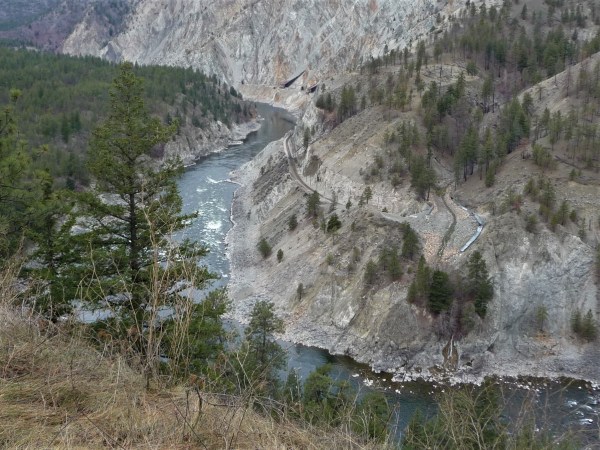
Like the symbol for infinity. This morning, that’s how these places feel to me. I haven’t been back to the Bridesville-Rock Creek Road since the serious fires of 2015 and 2017. If we could pack the car today and head out, Emmylou Harris on the stereo, is that where I’d want to go? Maybe not. I do know we’ve talked about our favourite stretch of Highway 99, between Lillooet and Pavilion, stopping at the Fountain Flat store to fill our coffee mugs, and stopping along the shoulder of the road to look down at the Fraser River below.

above the fraser

Instead, I’ll prepare copies of my book to send to my children and a few far-flung friends and put a few of the keepsakes John printed into envelopes for others who’ve bought The Weight of the Heart. (If you’ve bought a copy, let me know and I’ll send you a keepsake!) In other Junes, we’ve taken road trips. This year we shelter in place, our memories vivid with rivers, wildflowers on the Bridesville-Rock Creek Road, and the sound of yellow-headed blackbirds on a small hidden marsh. Like the symbol for infinity, they too are anchored, turning a little in the wind.

The Weight of the Heart

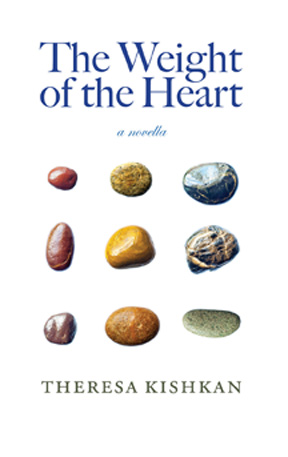
My novella, The Weight of the Heart, is now at the printer. It’s available for pre-order here. On the one hand, publishing a book in the midst of a lockdown due to a global pandemic is perhaps unfortunate; on the other hand, people are reading and why not this book? It will take you deep into the interior of Canada’s western province as well as to Sombrio where you will roast potatoes in the coals of a cedar fire and collect salt from exposed rock for the potatoes, you’ll eat oysters fresh from their shells, you will be in good company (a thoughtful young narrator, Isabel, and her muses Ethel Wilson and Sheila Watson. The painter Margaret Peterson has a cameo), and you’ll hear coyotes, watch bighorn sheep mate, and you’ll stop for ice-cream at the old Pavilion store before it burned. There’s a newborn Appaloosa filly to stroke and rattlesnakes to avoid. Isabel finds an old pair of cowboy boots at a thrift store in Kamloops and if you’re lucky, you might find a pair too.

Kishkan COVER 72dpi_RGB

I thought, our maps are so cursory. We know that the big cities matter because they have stars to prove it. And the big rivers? Thick blue lines across the landscape. Mountain ranges, the borders between provinces delineated in a kind of cartographic Morse code: dash, dot, long dash for countries. Huge expanses of blue sea. Great lakes. The colours of empire. But what do they tell us about what happened, or happens, in grassy kettle depressions where the flakes of old tools litter the earth and salmon leap in the river against the current? Where on the map’s contours is the place where a woman paused to consider the beauty of the morning? Where a tree noted for its long cones was cherished by a family dependent on seeds? A map carries nothing of the smell of autumn, what it feels like now to walk over and into the remnants of pithouses, right into the body of the memory. Where on the map is the site where two boys found a body and might have been changed forever by it?

The river lay still in the sunlight, its thousand pools and eddies alive under its silver skin.

The vessel that I thought of as a poem

portal

I was doing something upstairs, something that required no thinking on my part, when I suddenly said to myself, The vessel that I thought of as a poem wasn’t right any longer. I wrote it down on a scrap of paper and came downstairs to have my breakfast and a second cup of coffee by the fire. The phrase has been in my mind ever since.

After publishing a couple of books of poetry in the mid-1970s and writing a novella, Inishbream, in that decade (a novella that began its life as a series of brief sketches I hoped were prose poems but was convinced by a couple of friends needed connective tissue to link them, broaden their strokes), I pretty much stopped writing for a few years. I had a child, then a second, and then a third, in four years. My husband and I built a house. I began (but didn’t complete) a MFA. I always thought I’d return to poetry when I had time and inclination. I did write a few poems during those years, a very few, but I had the sense that I wasn’t doing what I needed to do with language, with narrative, with the lyric line. I couldn’t have told you what I did want to do because I didn’t know the possibilities. Other people wrote novels. Or they wrote books I was reading at the time – Pilgrim at Tinker Creek; The Horse of Selene; And Our Faces, My Heart, Brief as Photos; The Practice of the Wild; Wendell Berry’s essays about farming and ecology—that used space and ideas differently than I was used to seeing in poems or traditional prose forms. I couldn’t imagine a way in to this way of writing, not until we were camping in the Nicola Valley one summer in the late 1980s and (there is no other way to write this) the world opened itself to me in a way that I am only now beginning to understand. I heard voices in the grass, I walked among the little corral of graves at the Murray churchyard and felt the presences of the dead (though they weren’t mine), and everything around me shimmered with a golden light that felt almost divine. I kept making notes. Those notes became “Morning Glory”, my first attempt at what I now call an essay. An attempt. A weighing, a testing – both of physical matter and of the actual vessel that would hold what I wanted to say. It’s interesting to me now that I first published that essay in a chapbook that co-won the bpNichol Chapbook Award, an annual prize for the best poetry chapbook, in 1992.

The vessel that I thought of as a poem…It’s something I want to think about over the next while as I anticipate the final proof-reading of my forthcoming novella, The Weight of the Heart. The novella seems such a perfect form to hold certain things I want to do with language and with the possibilities of story. When I begin a piece of writing, I’m almost always trying and weighing and testing. Is this mine? Can it be? Is this voice my own? Sometimes there comes a moment when the material I have at hand, the places I want to inhabit, require embellishment or invention to an extent that I can no longer consider what I’m writing an essay. I think of essays as grounded in something like the truth, the actual. Occasionally I’ll imagine a detail a little frivolously, or collapse several years of experiences into a single one. In an essay in Red Laredo Boots, I did that. Two summers became one. The back and forth between the two felt awkward and I reasoned that it didn’t matter if I wrote about two summers as one. Does this kind of retooling or adjusting make a essay any less true? I don’t think so. It’s perhaps not entirely verifiable but I’m not aspiring to journalism.

But as I said, sometimes I need to expand what I need to write to include perspectives that are not my own, to allow a voice that maybe begins as mine to evolve into someone else’s voice. The protagonist of The Weight of the Heart shares some of my life experiences, she had some of the same professors at her university, she loves the landscapes and books I love. But her beloved brother drowns. My three brothers are very much alive. I do remember the moment when I knew I needed to turn what had begun as a meditation on the work of women whose books were rooted in British Columbia into fiction. I was thinking about my relationships with my brothers and how, when we were children, we were so close to one another. Our father was transferred every two years for part of my childhood and we’d arrive at a new city, knowing no one. We had each other, though. We were a unit. But of course that changed as we took different paths into the future. I saw a similar dynamic between my own children. Isabel in The Weight of the Heart is haunted by her brother, looking for traces of him in the last places she knew him. Her quest to find the loci of Swamp Angel and The Double Hook is also a quest to know the passage from her brother’s life to the afterlife. (I like that a locus in mathematics is the set of all points (usually forming a curve or surface) satisfying some condition.) The vessel for this book about kayaks and fishing dinghies and rafts made of driftwood logs is something most resembling a novella, though there are lyric passages, arias, that might stand on their own as prose poems.

And now in the night when I’m awake, there’s new material asking me to find a vessel for it. I think it’s an essay but it might be longer, a book-length work of lyric prose, an investigative treatise on disease and lost history, and a very personal exploration of my family’s early experiences in Canada. Those children who travelled with their parents from one city to another: they’re in it. So are what I think of as shadows, apparitions I catch a glimpse of hovering mostly just beyond my vision but sometimes allowing me close enough to touch them, their ancient hands.

The man who was my earliest mentor was disappointed when I stopped writing poetry. I took on that disappointment as my own for years. I was glad to be writing again, once my children were all in school and I had more time; but I wondered if I was doing the right work. As though I had a choice. To say no to those voices in the grass, the presences in the Murray churchyard, the meaning of pollen on our tent as we woke on those mornings on Nicola Lake to the sound of nutcrackers and magpies. Or to refuse what seemed possible after years of not being able to put one word after another until I had a sentence, a page. Or four.

In our house, we re-purpose things. Sheets became curtains for the guest room, a Greek olive oil tin holds a rosemary plant, scraps of fabric find their way into quilts, an old iron grate from the basement of the house we were living in when poetry left me has become the portal hanging out my study window. These days as I wait to welcome a new book into the world and think about the next one, I think of a book I’ve  written about before: Guy Davenport’s wonderful essay collection, Every Force Evolves a Form, the title bowing in homage to Shaker founder, Mother Ann Lee. The title essay, a gathering of birds, concludes this way:

The history of birds taken to be daimons traverses religions, folklore, and literature. In Europe it begins with the drawing of a bird mounted on a pole in Lascaux. In the New World we can trace it back to the Amerindian understanding of the meadowlark as a mediator between men and spirits of the air. Poe’s raven, Keats’ nightingale, Shelley’s skylark, Olson’s kingfisher, Whitman’s osprey thrush, and mocking-bird, Hopkins’ windhover are but modulations in a long tradition, a dance of forms to a perennial spiritual force.

I’d add Emily Dickinson’s lark (“Split the Lark, and you’ll find the Music”), who in fact prefaces this essay, and I’d say yes, to all the birds, their modulations, all the vessels, holding flowers or ashes, oil or water, powered by oars or wind, dense with potential.

“…the harmonic scales of a fenceline…”

jocko creek horses
“The foal was still damp from her mother’s tongue. I put my hand out and her soft nostrils rested briefly on my palm. Then she returned to sucking. Her eyes, when she paused to look at me, were deep pools. They had only known daylight for a few hours and I thought of her still curled up in her mother’s body while I’d slept the night before; she was curled up with her brother who didn’t even taste his mother’s milk. I thought of them asleep in their watery darkness while I swam in the river, wanting to let go of life to join my own lost brother. Touching the filly’s spine as her tail flickered, I was surprised to find myself wiping away tears.

Last night we arrived home from a few days in Ottawa, celebrating Christmas with our family there. I made stone soup with one little boy, read “The Wheels on the Bus” many times to the other. We ate large meals, we walked (slowly, because of Grandad’s hips) to the park, and we slept in a room completely filled with books. (The apple doesn’t fall far from the tree…) This morning I reviewed copy-edits of my novella The Weight of the Heart, due out in spring from Palimpsest Press. When I began to write this novella, the two small boys didn’t yet exist. Yet as I looked at the text this morning, I imagined them into the landscape their dad loved so well. One day we will go there with them and show them everything we love about the dry country in the interior of B.C.

at pavilion
“So we were taking that same route, but backwards; we were driving up Pavilion Mountain rather than down and we were heading north to Kelly Lake, then east to Clinton. But my body felt the road’s contours, the rich feathery growth of the pines, the tickle of those soft grasses. I could relate these things to a map but I didn’t use the map to see how to get from one place to another. I used it as a literary text of its own.”

Reading again of the main character Izzy as she searches for the places at the heart of The Double Hook, Swamp Angel, and Hetty Dorval, and as she tries to understand the final days of her brother’s life before he drowned in the Thompson River, I felt myself to be there, in autumn, among the sumac and dried rabbitbrush, the air pungent with sage, weathered wood and lyrical pines at every turn in the road. Writing a book is one thing. Editing it is another. This stage of fine-tuning the language is a gift on the last days of the old year.

above the fraser
“I wanted them to know that I’d found the contours of their language in hills, above rivers, in the shadowy reeds of a lake, the harmonic scales of a fenceline; I wanted them to know they have written books so beautiful that they’ve entered my body, have shaped the way I see the land.

“…stories belong on maps too…”

under the bridge

This morning I’m working on the (final) edits of my novella The Weight of the Heart, due out from Palimpsest Press in spring. It’s about several things, maybe even many, but at its heart is a young woman searching for the terroir of books she has loved: Ethel Wilson’s Swamp Angel and Hetty Dorval; Sheila Watson’s The Double Hook (and the rumour of Deep Hollow Creek, because my novella is set in the 1970s and DHC wasn’t published until 1992, though it was written before The Double Hook…). The young woman, who is Izzy, drives up the Fraser Canyon and over to Lac LeJeune and all the way to Dog Creek, and she marks a map—this is before gps, before Google—with textual notes. She is making a feminine (even feminist) cartography, though she wouldn’t have phrased it that way.

By association, stories belong on maps too, even the ones that were too quiet to be heard or else refuted the popular narratives. Stories have their own geography and need a scale bar that allows them to express location, relationships, emotions, weather effects on riverbanks, and the erosion of delicate landforms. Or they have their own gender and no one understands the legend.

When I was writing this novella, I didn’t think it would be published. Yet it will be, and I am so grateful. But more than that, I’m grateful to the women who wrote books that helped me to realize that our landscape has been lovingly commemorated by women who aren’t exactly household names in the great literary canon. I had the opportunity this time last year to remember one of them as part of CBC Radio’s The Backlist and with The Weight of the Heart, I have another opportunity to showcase their books.

The other week, on a little road trip, John and I stopped at Lytton to look at the Thompson River, greeny blue and somehow lithe, entering the brown Fraser River. The rabbitbrush had lost its yellow and gone to seed, sumac along the riverbank was brilliant red, and you could hear the thin voices of ospreys fishing. Always always always.