“one foot bare to the weather”

This morning I have been thinking of the soft landscape around my grandfather’s village in Ukraine and how my photographs from a 2019 visit helped me to write the Ukrainian sections of my novel, Easthope. In the novel, the main character visits a village very like my grandfather’s, though her family history is not mine, and what she discovers there, the long threads of connection, some snipped, some tangled and knotted, inspire her to paint her way into a greater understanding. Her name is Tessa (and if you’ve read my other novels, you might recognize her as the child in The Age of Water Lilies) and I’ve given her an adjacent life, if that makes sense. She and her husband live in a house on the Doriston Highway, the first house John and I looked at in 1979 when we were trying to work out a way to live here (though we didn’t quite know that then; we thought we could spend summers, maybe a week or two in other months of the year too). We didn’t buy that house but Tessa and Marsh inherited it. Fiction lets you do that. And so it goes. She paints. (I can’t.) Marsh has a refurbished Columbia River gillnetter. (I don’t.) Tessa’s Ukrainian relations are not mine.

My novel is out on submission and maybe one day it will be published. I keep opening the file to read particular passages, maybe just to make sure they’re still there. That Tessa is still there, making her art, in the house on the Doriston Highway, the one with a secret room off the studio, filled with….Oh, you’ll have to wait to find out.

As the date for the show at the Arts Centre approached, Tessa found herself painting daily. Not work she intended to include in the show—those choices had been made with Sandra and she was happy with the selection they’d decided on—but new work. The dream of the
Sovytsya River, her grandfather floating away. She’d painted Stepaniya brushing her hair, baby Olena tucked into a basket. Over them, silver fir and beech. She’d cut a scrap of pink wool and carefully edged it with satin ribbon and if you lifted the edge, you could see Olena’s smocked nightdress and a tiny stuffed duck she’d made of yellow felt. Her grandfather floated on his back, eyes closed, and ahead of him, in the undulating surface of the water, she made a little pocket. She thought about how to do this for days and opted for cotton and adhesive, painting the cotton the same colour as the river. Silk thread, green as waterweed, allowed you to open the pocket. Inside: a tiny photograph of her grandparents and their 9 children in front of their house in Drumheller, the dry hills behind them. A chicken strutted in front of them and a washtub hung on the outside wall of the house. She was also working on a big canvas of a lean-to in the woods beyond West Lake, a woodcutter’s axe propped on a stump. And she was making sketches for a diptych: on the left, a portrait of the boot Richard had found in the woods, battered, with copper nails holding what was left of a sole in place; on the right, a series of images of a man’s life, from birth, to migration across a wild sea, to the skid row of a big city, to a remote forest, and finally a death under the roots of a fallen fir, one foot shod in a leather boot (she would use leather embedded in impasto, with tiny copper furniture tacks tapped in), one foot bare to the weather.

a publishing history, with asides (third instalment)

21st century, second decade

Sandcut Beach

My parents died at the beginning of the second decade of the new century, a year apart to the day. Several close friends died. My sons married their sweethearts. (My daughter married hers a few weeks ago!) Every day held sorrow and joy. And also a sense of possibilities for my long-held interest in my family’s history. After my father’s death, I took home the small hoard of papers and photographs he’d kept to himself. I don’t know exactly why he was reluctant to share the materials, or to pursue answers to questions–the ones I had and surely ones he had too? And a year later, after my mother’s death, I felt the uneasy sense that I was now the family matriarch, the one responsible for keeping the lines of kinship clear. They were not clear. There were half-stories, careless genealogies. In retrospect, I see that much of the research and writing I did during this decade was in service to these histories.

I’ve always loved the literary novella. Without ever really intending to, I’ve built up a nice collection and have read many more, via library or generous friends. Inishbream was a sort of accidental novella, beginning as it did as a linked group of prose poems, eventually drawn out and given a structure. I loved the possibilities of the form, how it could hold so much in such a hermetic shape. A year or two after The Age of Water Lilies was published, I was invited to a book club to talk with members who’d just read it. I always enjoy these occasions. During our time together, one woman asked what happened to Grace after the novel ended. Good question. Grace was born to a single mother in the spring of 1915. She is sort of tangential to the narrative. But the more I thought about her, the more I wondered too. I began to write Winter Wren to find out. I think I knew from the beginning that the book would be a novella. I put Grace in a cabin I’d always thought I’d like to live in, a cabin I first saw as a teenager, on a beach west of Sooke, B.C. (It’s the one above the waterfall in the photograph at the beginning of this post.) She was in her late 50s, an artist trying to paint the view at dusk. I wanted to write about the 1970s—the novella takes place in 1974, an interesting time for ceramics in B.C. (Grace’s love interest is a potter in the tradition of those who studied with Bernard Leach in Cornwall and then returned to Canada), for museums where the salvage paradigm was part of the ethos, and perhaps the last possible time for Grace to meet one of the late 19th c-early 20th c artifact collectors.

winter wren

But you know already what I’m going to say: I sent Winter Wren to dozens of publishers and all of them rejected it. To make a long story short, my dear friend Anik See was visiting enroute from Dawson City to the Netherlands and we shared similar stories about novellas we’d written. We decided to begin a micropress to showcase the form and we decided to begin with mine. Our rationale was this: if our endeavour didn’t work, then I would be disappointed, sure, but at least it would only be me and not someone else. I could shake it off, poof, and move on. (Ha!) Anik designed the book, I photographed a pottery dish with a length of scouring rush (it figures in the book), and we found a really good printer in Victoria. And you know, we sold our first print run of 250 copies within weeks and we reprinted. I still get orders for it. We went on to publish 4 more novellas and we are very proud of Fish Gotta Swim Editions. Our latest is Anik’s Cabin Fever.

I’ve been to the small Vancouver Island beach near Jordan River where Theresa Kishkan’s novella Winter Wren (Fish Gotta Swim Editions) is set; I’ve seen the waterfall that tumbles over sandstone onto the shingle just below, and the solitary cabin facing south and west, surrounded by salal. Winter Wren tells one possible story from the many that cabin could tell. (Michael Hayward, Geist)

After I finished writing Winter Wren, I wrote another novella, Patrin, and it was published (beautifully) by Mona Fertig’s Mother Tongue Publishing in 2015 and then in French by Marchand de Feuilles in 2018. I also wrote a long essay, “Euclid’s Orchard”, about quilting, mathematics, coyote music, apple trees, and love; and when Mona showed interest in publishing a collection of my essays, I gathered together a group. Eulid’s Orchard & Other Essays was published in 2017 and was shortlisted for the Hubert Evans Award.

Each image is a perfect crystallization of a detail, gesturing toward a truth much larger than the tiny pinpoint of its composition. Near Victoria, she recounts an exquisite memory of “an abandoned house completely knitted into place by honeysuckle and roses” (p. 101). Near Drumheller, she sings the prairie: “turn, turn, bend the song to the roadside plants … free verse composed of craneflies, dragonflies, bluebottles, broad-bodies leaf beetles, greasewood and cocklebur” (p. 61). And near her home, she concludes with the cries of coyotes: “lilting joyous youngsters unaware that a life is anything other than the moment in the moonlight, fresh meat in their stomachs, the old trees with a few apples and pears too small and green for any living things to be interested in this early in the season” (p. 155). (Catriona Sandilands, The British Columbia Review)

An aside: Mona Fertig and her Mother Tongue Publishing enterprise deserve gratitude from writers everywhere for the beauty of the books and the huge effort Mona put into designing them, editing them, bringing them into the world with sparkling wine and flowers, arranging public events for the writers, and being the kind of publisher writers dream of. I’d have published with her forever and was sad when she announced her retirement but also glad for her because she’s been able to return to her own writing projects. She did everything that bigger publishers did and she did it with joy. (She’s the one on the left, with the big smile.)

at-the-book-prizes

Novellas, novellas. I wrote The Weight of the Heart as a way to lament the gaps in my own education in the 1970s when the instructor of my Canadian literature course told me not to bother writing about Sheila Watson and Ethel Wilson, saying they were minor, and the former was barely coherent. I wanted to celebrate these two literary cartographers of our province and to highlight the importance of their work. I also wanted to spend time, real time and imaginatively, in the Thompson Canyon and the dry Interior of B.C. Palimpsest Press published The Weight of the Heart in the spring of 2020, just as most publishers and some writers were required to pivot to a virtual presence because of the pandemic. I wish I’d been better at this, though we still had such a slow internet connection—we live in a rural area– that even if I had been able to Zoom more effectively, our bandwidth wouldn’t have allowed me to participate much. (We were able to upgrade a bit later.)

The Weight of the Heart also finds in Wilson’s and Watson’s writing an experimental style and a mode of consolation. Like Wilson’s independent protagonists, the narrator discovers her autonomy and grit in the landscape she travels. Watson’s spectral figures and interest in sacred rituals resound in the symbolic scenes of almost drowning in which the narrator is saved by her brother’s mysterious presence and in Kishkan’s invocation of Egyptian burial rites as a refrain throughout. Most obviously, the double hook of Watson’s title recurs in the dualities throughout the novel—in the two rivers, in twin foals (the colt unfortunately lost in birth) by a mare named Angel, and most clearly in the two siblings who are bound together in a landscape where life and death regularly meet. So, Kishkan and her narrator know where to look in Canadian fiction for a view of the British Columbian landscape that reveals these striking oppositions and their consoling unions. A unique and compelling creation in its own right, Kishkan’s poetic exploration of grief lives up to its literary precursors. (Kait Pinder, the Malahat Review)

I wrote another novella in this decade, begun perhaps in the middle, put aside, but finished in 2020, during the long lonely weeks of the pandemic when I was missing my family and wondering if we would ever get together again for our summer meals, swims, and talks late into the night by a campfire. I used Virginia Woolf’s Mrs. Dalloway as a template, following the main character through a day of preparations for a party. There are shadows and owl voices in the woods and an unexpected guest coming up the driveway at dusk, carrying a knife. I tried to find ways to present the material innovatively, with sections of call and response, lists, and the music of an oud. I called it The Occasions. I don’t know if it will ever be published.

Another aside: I am lucky in life and love if not in publishing. And I wonder how many writers have a husband who is also a letterpress printer and who offers to make keepsakes to celebrate new books? For the past ten years or so, John has printed beautiful objects, some of them embellished by me, to give away at book launches and to provide local book stores with so they can tuck a keepsake into the books of mine that they sell. I have a few remaining of some of these and if you want to order a book from me, I can include one for you.

keepsakes remaining

At the beginning of this instalment, I wrote that I was trying to untangle the knots of family history and genealogy. Some of this work resulted in essays in Euclid’s Orchard but I wasn’t finished and kept on writing. I’d also had a health issue in 2016 that resulted in many tests, half-diagnoses, fearful assessments (though it all worked out well), and I also wrote about those things against the backdrop of all I loved: my family, the rivers of this province, textile work (which is always a way of meditating for me, sewing myself in and out of mysteries, riddles), the countries my grandparents left for new lives in Canada, and more. These became Blue Portugal & Other Essays, published with care and generosity by the University of Alberta Press in 2022. It received SUCH good reviews.

In Blue Portugal the essays’ themes are allowed to slip their boundaries; a topic addressed in one essay recurs in later essays, a recognition, perhaps, that thoughts and interests develop over time, shifting slightly as they are put in the company of other thoughts, are seen from different perspectives. The essays in Blue Portugal seem to talk to each other; they interlace in interesting and thought-provoking ways. The book is a fine example of the personal essay at its best. (Michael Hayward, The British Columbia Review)

It was a book that others noticed, gifted to friends, and reading it now, I am sort of surprised that I was led into some of the essays so mysteriously. A voice in the night, murmuring, The river door. Whose voice? I only know I took it to heart.

To those of us who’ve been following Theresa Kishkan on her blog for many years, the preoccupations of her latest book, the collection Blue Portugal & Other Essays, will be familiar, the quilts, the homesteads, the memories, the blue. But it’s the stunning craftsmanship of the book, the fascinating threads that weave the pieces together and also recur throughout the text, that make this book such a pleasure to discover. How quilting squares are analogous to the rectangles from which, one by one, Kishkan and her husband literally constructed their home on BC’s Sechelt Peninsula, and the blueprints, and the blues of dye, and of veins, and of rivers, and of how one thing turns into another—how? How does a body get old? How do children grow? How does a family tree sprout so many new branches? And from where did it all begin, Kishkan going back to seek her parents’ nebulous roots in the Czech Republic and Ukraine, in a 1917 map of lots in Drumheller, AB, in everything that was lost in the Spanish Flu, and how we’re connected to everything our ancestors lived through. (Kerry Clare, picklemethis.com)

And now? Now? 4 years into the 3rd decade of the century, I’ve completed another collection of essays. The centrepiece is a long postmortem and reassessment of a relationship I had with a painter when I was 23 years old. My walls are hung with some of his paintings, portraits of me among them, and I attempt to reclaim the gaze by entering into a daily conversation with one particular portrait hung in a stairwell; she is one of the first things I see each morning as I come down to the kitchen. There are other essays in the collection that meditate on war, climate change, injury and recovery, swimming and Herakleitos, and the nature of love. I’ve begun the long process of trying to find a publisher (my last publisher wasn’t interested, feeling perhaps that the collection is too personal and potentially risky in terms of sexual politics). As I write, it’s been rejected by 4 publishers and is currently awaiting decisions by 6 more. I’m also about halfway through writing a novel set in a small fishing village called Easthope and in the city of Lviv, in western Ukraine. I began the novel 4 years ago, just home from a trip to Ukraine, and set it aside to complete editorial work on Blue Portugal. And then the Russians invaded Ukraine and I couldn’t imagine ever writing about Lviv. But I decided that I’d stay with my original intention and setting— 2015—and write to set down what I love about both places.

And now in a hurry just
pack, always, each day,
and go breathless, go to Lvov,
after all it exists, quiet and pure as
as a peach. It is everywhere.

–Adam Zagajewski, trans. Renata Gorezynski. The poet used a variant for his native city which has known many administrations since it was first established in the 5th century and is currently known as Lviv

It may seem that I am a bit cranky about publishing in the 21st century but I have to say that it’s always the end point in writing for me. I began to write with the sense that the process was complete when the piece found a place in the larger world. I don’t begin a work with any idea of what might happen when I’ve finished, though. Not yet. I live in the language, the world of the writing, and when I come up for air, it’s then that I realize that I have no idea if the work will ever find a readership. I am too many things that are not what the current world wants or needs. Who wants to read about a fishing village or a party under fairy lights in a garden on the edge of the world or eye injury or indigo dye or the musings of an aging grandmother? A woman married for 45 years. I know some people do but maybe not enough of them. Enough of you, I mean. But I have some years left and those will find me at my desk, finding a way to map out the terrain I dream about, yearn for, to find ways to knit together strands of music, roots of family trees, and real trees too, embellished with salmon bones, the beautiful holdfasts of bull kelp and bladderwrack (the tired images scorned by A.F. Moritz all those years ago). There’s a little quote from the writing of the early naturalist and advocate for wilderness, John Muir: “When we try to pick out anything by itself, we find it hitched to everything else in the Universe.” I keep this in my mind and heart as a mantra. I don’t know how this might be worked into a synopsis or query letter or proposal but it keeps me anchored, heldfast, to what I want to do in my life. Everything else is a bonus.

holdfast

winter gifts at High Ground

I know Christmas is more than a month away but if you’re thinking about gifts, we can make it simpler for you by offering some of our own books, limited edition chapbooks, and broadsheets printed on our late 19th c. Chandler & Price platen press for sale during the season.

mud bottom

For example, John’s Mud Bottom (details here) is $35. If you buy a set of the Companions Series Broadsheets (also here), a folio of 12 letter press broadsheets including poems by Gillian Wigmore, Russell Thornton, and Maleea Acker written in reponse to other poems printed enface, priced at $150, then we will include a copy of Mud Bottom for free with your order.

winter books

For a selection of our books, including my Euclid’s Orchard, Winter Wren, The Age of Water Lilies, Inishbream, Patrin, A Man in a Distant Field, and Red Laredo Boots, and John’s crawlspace (winner of the 2012 Dorothy Livesay Poetry Prize), Forecast (Selected Early Poems: 1970-1990), and This Was the River. the deal is this: buy one at cover price and receive a second book of your choice for 50% off. We’ll happily inscribe the books. Postage will be charged at cost.

If there are other books you’re interested in or you see something on the High Ground page (including chapbooks, individual broadsheets, including Michael Ondaatje’s “Breeze”), please ask us. And if you think that background scarf on which the books recline is as ravishing as I think it is, visit Caroline Jonas’s website. (I recently ordered the scarf as an early Christmas gift from my husband because he won’t be able to shop this year!)

“All these years later, Winter Wren is what happened.”

P1020930.JPG

She listened to the creek falling to the beach. She pulled off her sweater, threw it to the rocks. Her corduroy trousers. She left on her canvas sneakers. And darted under the shelf where the fossils slept in the wall of stone. With a little shriek, she stepped forward into the shower of cold water.

She turned so every part of her body met the water, thrusting her chest forward, her breasts stinging at the contact, her legs shuddering. The pool the water tumbled into came half-way up her calves, icy as glaciers. Freshets ran down her back and she could not feel her knees, her elbows.

And now it was dark, moonlight just beginning to glitter on the ocean. Gasping and coughing, she groped with icy hands for her clothing, wrapping her sweater around her shoulders and not bothering to put on her pants. Sneakers squelching, she climbed the bank and found her way back up to the cabin where her candle guttered in the night air. She could not stop shaking. Rubbing her body briskly with a towel and wrapping another around her dripping hair, she realized she had not felt so alive in months.

Any moment now, Winter Wren will be arriving from the printer. It’s the first offering from Fish Gotta Swim Editions and to say I’m excited and nervous about the whole enterprise is an understatement of enormous proportions. It’s a novella about a place — the cabin and the beach in the photograph above the extract from the book. And it’s about a character, Grace Oakden, who appears in an earlier book, The Age of Water Lilies. I visited a book club to talk about that novel and someone asked, What happened to Grace? I had no answer but it got me thinking. And wondering. Winter Wren is the result. In it is buried a meditation on the 19th c. photographers and artifact collectors (Charles Newcombe, et. al.) who plundered and celebrated and recorded the west coast. The issue is complicated and this novella understands that.

On my study wall is a framed series of nine photographs, illustrating the book’s mantra: Bring me the view at dusk. Nine panels for nine window frames. It was given me by my daughter for my 60th birthday.Every morning I study it while I’m waiting for my computer to boot up and every morning I hear the surf, the noisy creek falling over its shelf of sandstone, smell the kelp. When I wrote the book, I had a hard time leaving its world each day to return to the dailiness of my present life, a dailiness I love and that anchors me in a sturdy durable way. But some days I wonder what would have happened if I’d actually left a note on the door of the cabin you can see above the creek, asking if I could rent the place. That was 1974. All these years later, Winter Wren is what happened.

“A map of houses and days, of secrets and details noticed by a child fiercely in love with the pattern trees make with their shadows…”


We spent a few days in Victoria, visiting Angelica and Sahand, and it was (as usual) a time of great pleasure and wistful nostalgia. They live in the neighbourhood where I spent part of my childhood; in fact, they are a block away from my elementary school, the one in which I sat near a window and gazed out at Moss Rocks, thinking of the wildflowers on its sunny slopes, and wondering how many more hours I had to sit in the classroom before I could take the path over the rocks and home. We lived near the Ross Bay Cemetery. My mother would say to us on summer mornings, “Go play in the cemetery. I don’t want to see you until lunch.” I rode my bike down its quiet lanes and I had my favourite graves. Some of them were the graves of children; I cried by a small stone armchair with an empty pair of shoes, the grave of D.B. Campbell, who died in 1913 at 17 months of age, “a little hero”. I used to lie on the warm grass and listen to water. Impossible, my father said. But I knew I heard water. It wasn’t until about 2005 that I found out about the buried streams under the cemetery and in fact throughout Fairfield. I gave the experience of listening to water to Tessa, one of the main characters in my novel, The Age of Water Lilies. And like Tessa, I also played in the yard of Stewart Monumental Works where men engraved tombstones while children darted among the slabs of granite and marble and buried each other in the sand beneath a crawlspace under the building. “A map of houses and days, of secerets and details noticed by a child fiercely in love with the pattern trees make with their shadows in sunlight, of the softening touch of moss on an inscription set in motion in a box canyon where lovers lay in dry grass and dreamed of a future now collapsed by violence. Off the edges of the map, the world settles its story and what can anyone do but remember the route water takes through the decades on its singular journey to the sea.” And much earlier than any of this, the Lekwungen people used the creeks as transportation corridors through their territory. A place contains so many layers of history, so many occupations, so many stories. Sometimes, if the light is right and we are attentive enough, we can apprehend something of this richness. A house, a grave, a creek, a case of masks in the Royal British Columbia Museum with information about the Winter Ceremonials to remind us that our own experience is recent, that the ravens we hear in the yews at the cemetery are the descendents of those who inspired the Crooked Beak of Heaven.

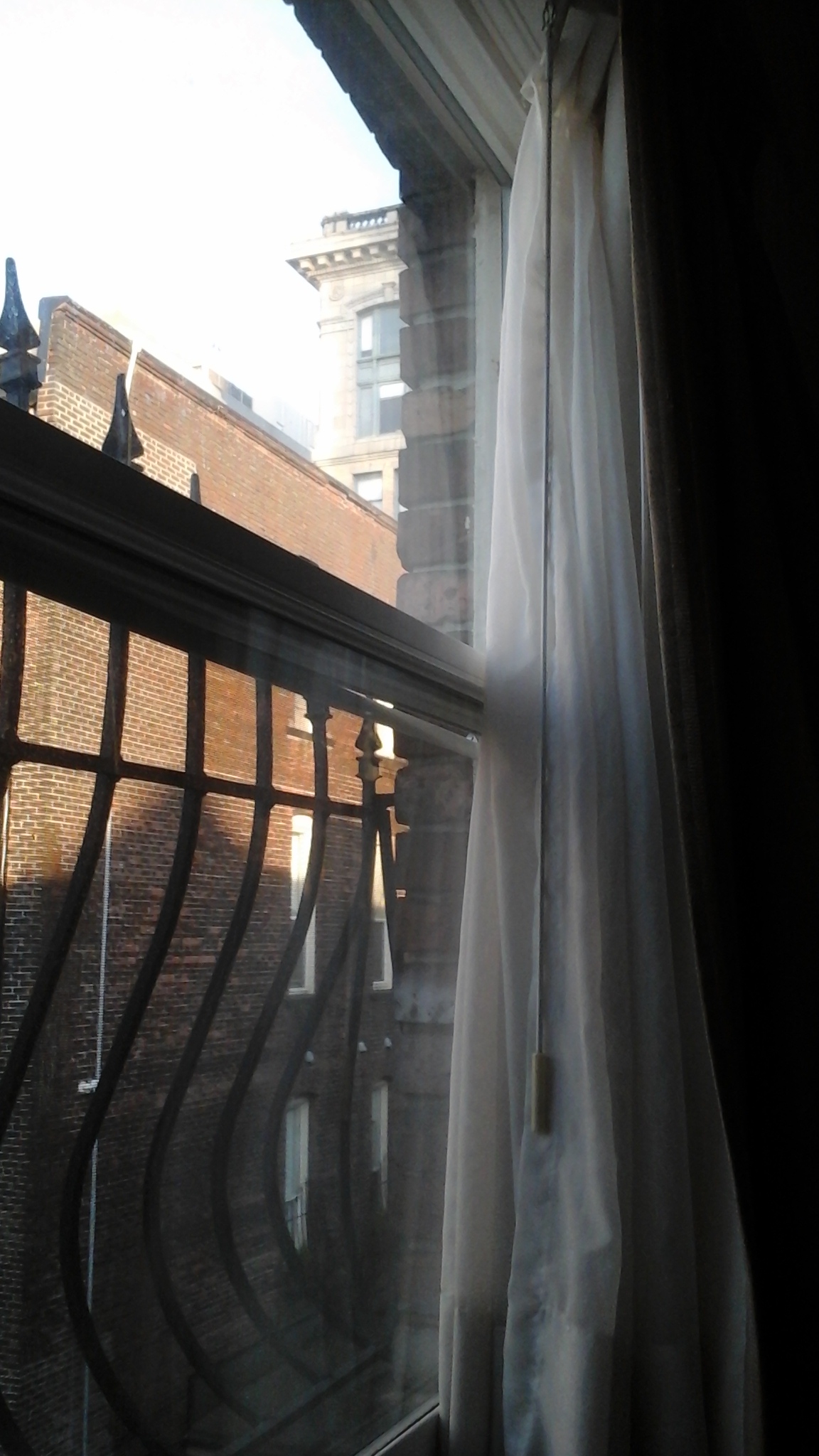
And then a night in Vancouver — John was reading at the Vancouver Public Library as part of the Vancouver Writers Festival Incite Series — where we stayed in our favourite hotel   (speaking of history): http://victorianhotel.ca/   It’s kind of quirky and the breakfast room is always in yet another stage of renovation but the rooms are comfortable and the rates are so reasonable, particularly for Vancouver. (And imagine, you get breakfast too: wonderful croissants and baguettes with fruit and coffee.) When you sit at the table in the window of your room in the morning, you have the sense that you are truly somewhere. Not just anywhere, but a place, a location, a building with echoes of its making in the brickwork around the windows, the little glimpses of other buildings around the corner:

from the Victorian Hotel

The hotel was built as a guesthouse in 1898 and occupies a corner in what might be termed a “transistional” neighbourhood. But on the other corner, Finch’s — the best sandwiches in the city: we had fresh baguette stuffed with sliced free-range eggs, butter lettuce, dijon and mayo, and thick slices of tomato. Nearby, Sikora’s, for cds (some of us will probably never learn to download music. I still don’t know what an ITune is). And around the corner, The Paper Hound, a marvellous independent bookstore.

Driving away from the Victorian, along Hastings yesterday, I saw the Marine Building ahead of us, cradled by a curved glass tower in morning sun. The new, the old. The Marine Building is one of the most beautiful structures in Vancouver. It was built in 1929-1930, with Art Deco carvings and plasterwork and a Mayan effect in its upper stories; at 21 floors, it was the signature skyscraper of its time. You might not notice it if you’re walking along Hastings or Pender, listening to your ITunes, but if you look up, there it is. Unforgettable.

marine building

we’re #28

I love the series of Literary Landmarks featured in B.C. BookWorld online. (http://bcbooklook.com/2015/12/02/john-pass-theresa-kishkan/) John and I are #28; our landmark is the corner of May Street and Memorial Crescent in Victoria, the locus for my novel The Age of Water Lilies and a place very dear to both of us. As new lovers we walked those enchanted streets and into the Ross Bay Cemetery which was where I played as a child, riding my bike up and down its quiet lanes and listening to the buried streams flowing under it to the Strait of Juan of Fuca.

And I love this photo of us, taken by my brother in early summer, 1980. What shows: our youth, our happiness. What doesn’t show: I was newly pregnant with our son Forrest, though I didn’t know it would be him. (I had the option of knowing the gender after an ultrasound but I thought I’d like to be surprised.)

Pass-John-Theresa-Kishkan-1980-300x246

the road from Lillooet to Kamloops, via Pavilion

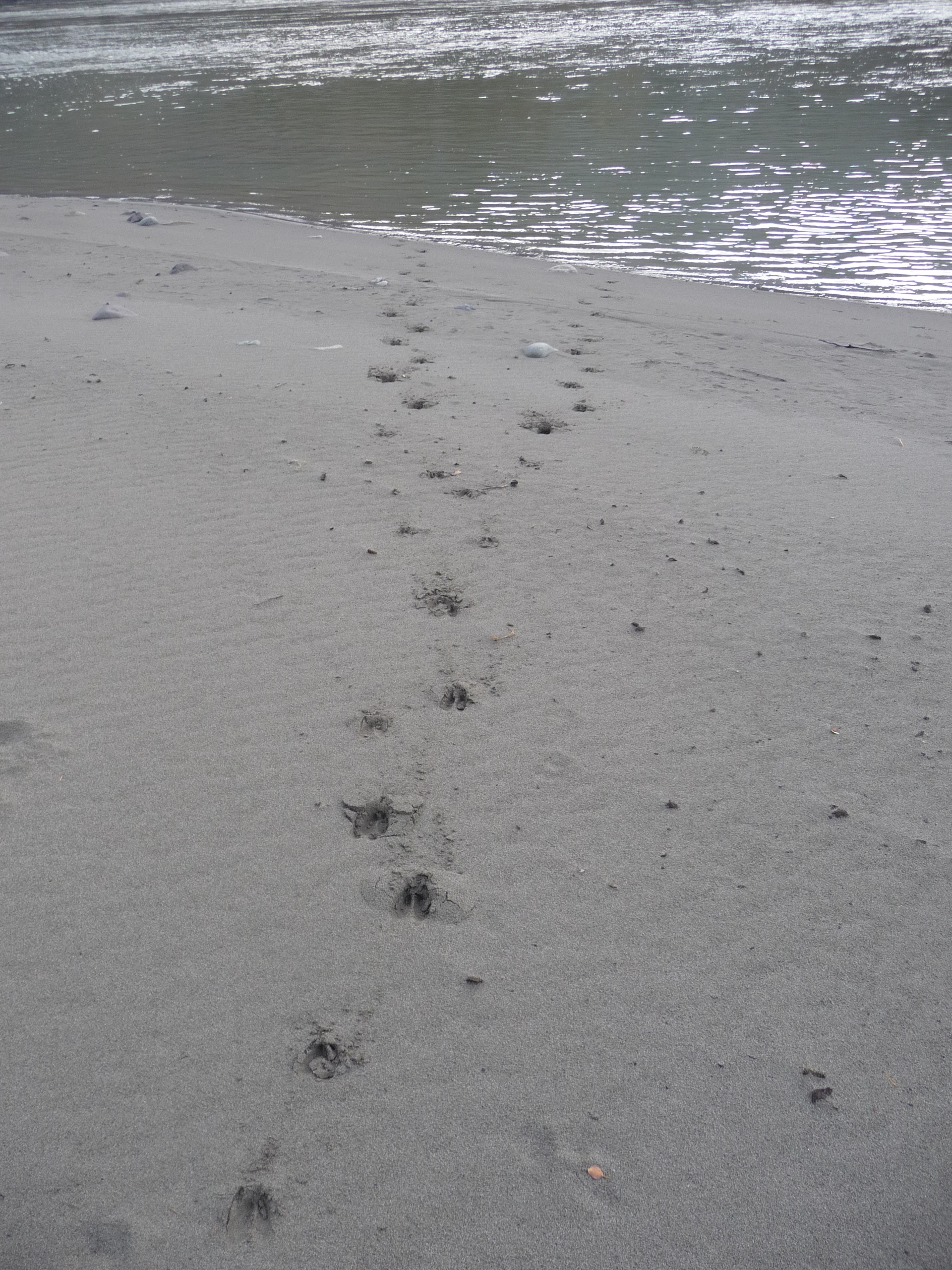
First, a walk below Lillooet along the Fraser River, a path we quickly realized was a bear’s daily route. Scat every ten feet or so, filled with pin cherry pits and rose-hips, one so utterly fresh it almost steamed. But no other sign of him. We were led to the edge of the river by deer tracks, made just a little earlier:

P1100697The pines had long needles (not always the case in dry country) so I decided to gather them at various points today and tomorrow to make a basket when we return. Readers of Mnemonic: A Book of Trees might remember my efforts a few years ago and my hands have the sense they’d like to try again.

“Take a bundle of three pine needles (or two bundles, says one book). So take your three, six, or even eight pine needles, and snip the sheath(s) off the end (or pinch off between your fingers). Make a little circle of one end with a tail of the sheath-end of the needles. Thread a length of raffia onto a wide-eyed tapestry needle and begin to wrap the circle, drawing the tapestry needle from back to front. Oh, I am all fingers, all thumbs! No dexterity at all. I study the diagram, wrap my circle, drop my pine needles, and unravel my raffia until it is impossible to work with. I begin again, burning that first attempt. Then the second.”

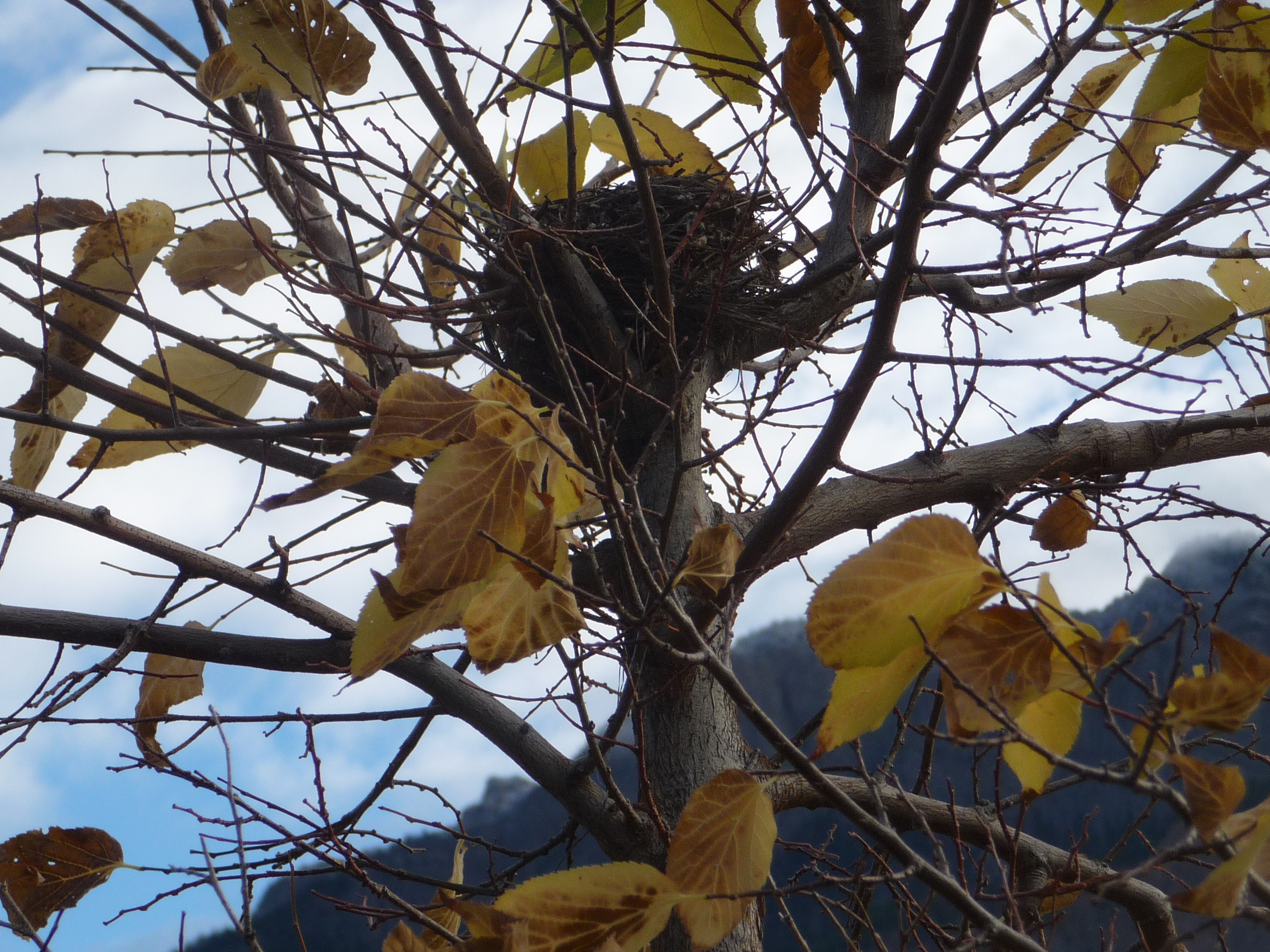
I loved the cactus gardens and the little nest in the top of a small tree:

P1100705

P1100715On the road through the Fountain Reserve, there were signs:

P1100721and when we reached Pavilion, we saw the sad evidence that the store had burned down: the remains of a beautiful stone fireplace and a two-storey chimney, metal flashing still intact. (Actually we knew this because we drove the road last in 2009 but I’d forgotten. The first time we saw the Pavilion store was on a camping trip with our children and we’d driven down over Pavilion Mountain, through the Diamond S Ranch, on a hot day and we stopped at the store for ice-cream.)

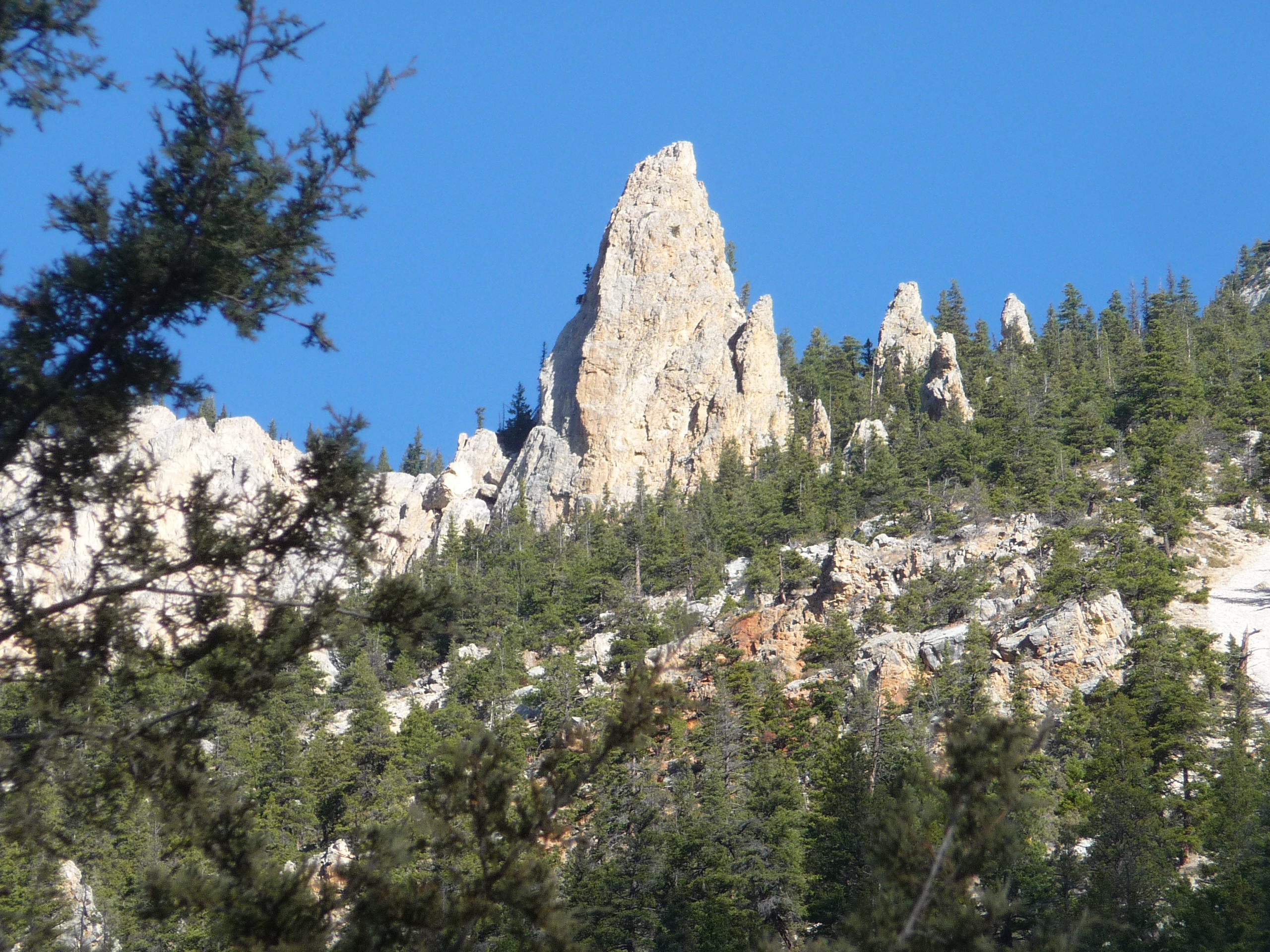
P1100726Hoodoos near Marble Canyon:

P1100736We didn’t drive into Walhachin this time but looked across the dry bench and over the Thompson River to where it exists like a small piece of history wrapped inside an enigma. Every time we pass, we realize that the flumes that were constructed in 1909-10 to carry water to the orchard community from springs near Deadman River, some twenty miles away, are a little more decrepit. They haven’t carried water for almost a century but when I did a reading tour for my novel The Age of Water Lilies, which is partly set in Walhachin, many people talked about the flumes and told me stories about a great-uncle who’d worked on them or a grandfather who went off to fight in the Great War, some of them with Lord Strathcona’s Horse, and I know that the flumes hold memories more seamlessly than they ever held water.

P1100738