redux: “five suns from a flying heaven”: Thanksgivings 1991 and 2020

Note: I posted this five years ago, remembering a Thanksgiving weekend nearly 30 years before that. Yesterday as I shopped for groceries, I realized that another Thanksgiving has come around. We were away last week and in two weeks, we’ll fly to London, then Portugal, so a quiet weekend at home is in order. I did buy duck(legs) to roast and we have lots of vegetables. And I still have some copies of Red Laredo Boots (it’s out of print) if you’re interested. $5, plus postage, whenever that might be possible again.
the last plate

1.

“I found the yellow plates on the day before Thanksgiving, 1991. We’d gone by boat down the length of Sakinaw Lake, tying up to some logs at the western end. From there, a boggy path leads through wild mint and arums to a small estuary. High cliffs on either side of the bay give the place a protected hidden feeling; you could be at a creek mouth at the edge of the world.”

2.

“Wading across the rising creek, I suddenly spotted an unusually large shell on the bottom, partly obscured by eelgrass. Curious, I lifted it out and put it in my bucket among the frilly oysters; it rang against the side of the galvanized bucket like a bell.

[…]

Remembering my strange disc, I took it out of the bucket and showed the others. Holding it up to the light, turning it this way and that, we could tell it was a plate.”

3.

“A rough shelf hung partly off one wall and on the shelf were four dusty yellow plates, the only things in the shack that were unbroken. They were waiting, as the first plate waited, in a dark corner, not underwater, but fallen the same, five suns from a flying heaven.”

4.

“Thanksgiving, 1991. We ate the oysters broiled in their own juices with lemon over top, clams stewed with garlic and garden tomatoes, turkey and all the classical trimmings, served on the yellow plates. We each said a grace before eating, something to be thankful for–food, family, the peace of the big trees around us, and the weather bringing rain, wind, the brilliance of sunlight in October, sometimes streaming from the great sun overhead and sometimes hidden in creekbeds, shacks, flawed under dust and barnacles, waiting to be found and praised.”

5.

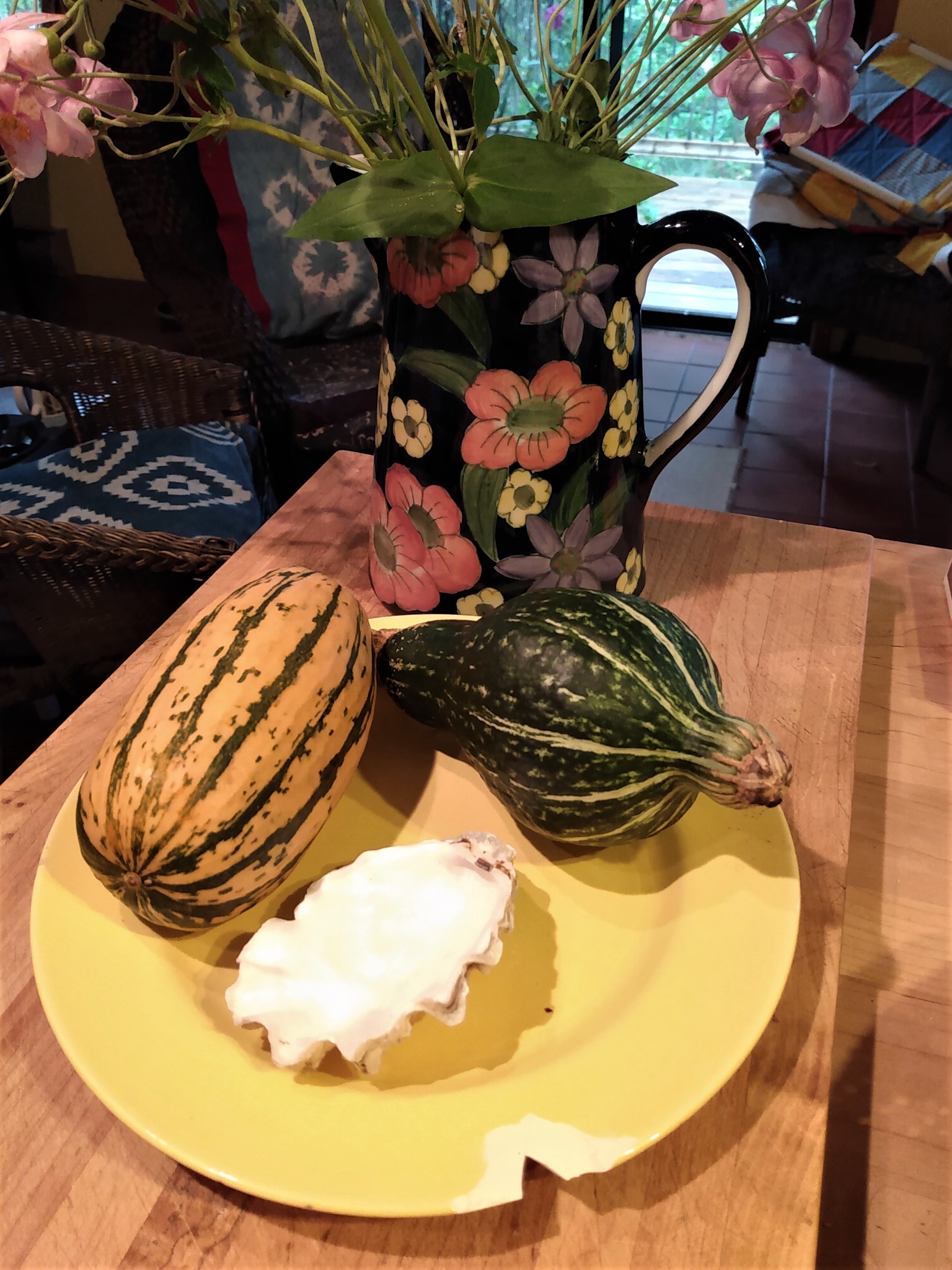
A small chicken defrosts in the kitchen. Squash, a savoy cabbage, blue potatoes grown from a couple brought home from Ottawa last year, apple and blackberry compotes topped with pastry fish. I am thankful for what I have but I am also wistful for feasts at the pine table, every chair filled, the silver polished and gleaming, the glasses at every place. 4 of the yellow plates broke and were thrown out but I bring the last one, chipped and cracked, down from the sunroom where it serves as a plant saucer. Let it hold an empty oyster shell, two squashes, the memory of that day 19 years ago when we went to a beach on the edge of the world, a family intact, “oysters blanketed with seaweed, the clams opening and closing in the cold water.”

empty

Note: the first four passages are taken from “Yellow Plates”, publishing in Red Laredo Boots, New Star Books, 1996. It’s out of print but if you are interested in a copy–it’s a collection of essays–I have a few copies available for sale.

“The cricket’s song of Autumn/holds us still.” (Du Fu)

soup

Yesterday I was working in the little greenhouse, preparing it for winter. I’d thought I might overwinter peppers and eggplants but it won’t be warm enough in there so I brought out the tubs, picked the remaining vegetables, and swept the floor. I was surprised to find a cricket on the low bench.

Years ago, when John taught at Capilano College in Sechelt, I remember how when I’d drop in over his lunch break in autumn, there were always crickets in the washrooms, dark ones, chirping on the cool tiles. It was as reliable an indicator of fall as the geese in their untidy scribbles, calling against the mountain, or the scent of smoke in the morning as the fire in our woodstove caught and snapped. Sometimes a cricket would come in with the firewood, a portent of prosperity and health for the household.

I rearranged the pots of things that will stay in the greenhouse—the 3 olive plants, one with 4 little green fruits on it; the bougainvillea; the scented geraniums; the long tubs of greens I planted a month ago and which gave us a salad to share with friends for our Thanksgiving dinner on Saturday. And when I looked for the cricket, I couldn’t see it. But I heard it, heard it as I pruned and sorted, as I gathered the fallen bracts of the magenta bougainvillea.

I love the autumn, though it’s not without its melancholy. How did it get to be this late? That’s a question I ask myself frequently. Late in the year, late in my life. The other day a young man from Greenpeace called, following up on a petition I’d signed against the use of glyphosate. I knew a request for a donation was coming but in the meantime we had a nice chat. He wondered if I was familiar with Greenpeace’s work and I told him I am 66, that I remember the Phyllis Cormack (a repurposed halibut boat) heading to Alaska in the year I was in grade 11, hoping to head off the underground nuclear test planned by the US on the Aleutian island of Amchitka. I remember (I think) a demonstration on the lawn of the Legislature in Victoria. So yes, I was familiar with the long arc of Greenpeace’s activism. And now it’s microplastics, glyphosate, and what have we done to our planet? Moving plants in the greenhouse reminded me of the heat dome this past summer when it was so hot in the little structure that I had to sluice the cement block floor with cool water every few hours.

On a Thanksgiving Monday I am making soup with the remainder of the turkey, the first I’ve cooked in two years because we were away over Christmas in 2019, leading up to the pandemic, enjoying a holiday meal with Forrest, Manon, the boys, and Manon’s family. That Thanksgiving I think I roasted a chicken for John and me. Soup is the great solace of autumn, pots of turkey noodle, roasted squash, comforting borscht, potato and kale, Greek lentil. When it warms up a little outside, I’ll finish the greenhouse work, taking more geraniums in, emptying the rest of the soil from the peppers and eggplants. And I’ll keep an eye out for the cricket. They are symbols of good luck and vitality and I will make sure it knows it’s welcome.

The song of ourselves may move us, restless,
Through long nights. The cricket’s song of Autumn
Holds us still.
                        –Du Fu

say their names

late anemones

A Thanksgiving dinner for two: small prime-rib roast with mushroom gravy (dried morels reconstituted in port, with chanterelles picked on today’s walk); garden potatoes (those underground nests discovered while digging over the finished beds, red-skinned French fingerlings, yellow-fleshed, veined in pink); some of the summer’s horseradish root softened with yoghurt and mayonnaise; salad (kale, late arugula, Chinese greens, picked by John while I made the gravy); and pears baked with coconut sugar and butter, then finished with cream. To drink? A beautiful jammy Desert Hills 2008 Malbec, in the Waterford goblets. Oh, so much to be thankful for. A home, a garden, a family. My work, which has me waking early to bury myself in its strange atmosphere, mysterious and maybe not exactly what the world wants to read, but mine. Mine. The turning of the maples — still green last week but now a deep Naples yellow and ochre. As we ate and talked, John said, raising his glass, “We should say their names.” And we did. Forrest, Manon, and Arthur. Brendan, Cristen, and Kelly. Angelica and Sahand. In candlelight, they were almost present at the old pine table. And certainly present in our thoughts. When they were here in August (though baby Arthur was still as yet unborn), I woke every morning, thinking, “Those I love best on earth are under our roof!” So a last sip of wine and more thanks — for the accumulation of years and for those still to come.

last sip