“to fly toward a secret sky” (Rumi)

Yesterday I swam in the local pool for the first time since early May. I’d been in the lake the day before and knew that it would be my last day. It’s not so much that the water is cold, though it’s certainly chilly. It’s more that the air is cool and I can’t get warm afterwards. Even wrapped in a big towel as soon as I get out of the water and even after a hot bath. Someone suggested a wetsuit but somehow that’s not how I want to swim, though I know it works for others. I want the water to polish my skin. And the pool is a good compromise, even if it’s loud (or was yesterday as the children from several families shrieked and whooped, a good sound for the most part) and crowded enough that John and I had to share the one lane roped off from the rest of the pool. You can’t enter that meditative state if you’re trying not to bash your partner with your arms as you back-stroke down the pool. The lane was not quite wide enough for two.

But luckily I’ve begun a new single-cloth quilt, some of the ecru linen I twisted and tied with hemp string and then dyed with indigo and rose madder. (You can see both of the lengths at the top of this page.) I threaded 3 sharp Japanese needles with blue sashiko thread and fitted the fabric into a frame. Then what. I looked at the watery pattern of the dye and began to sew a spiral. It will morph into something else and I’ll probably do what I’ve begun to think of as form of punctuation: ending a long line with a small akoya shell button.

Behind the frame is another single-cloth quilt made of white linen dyed with indigo. The colour is quite different. The process is always interesting because I think I’m being honest when I say that I don’t really care about results; it’s what happens as I twist and tie scoured fabric, as I prepare the dye vat set up on a long cedar bench out by my vegetable garden, as I dip the lengths into the vat and then remove them to oxidize, watching the swampy colour turn the most beautiful blue.

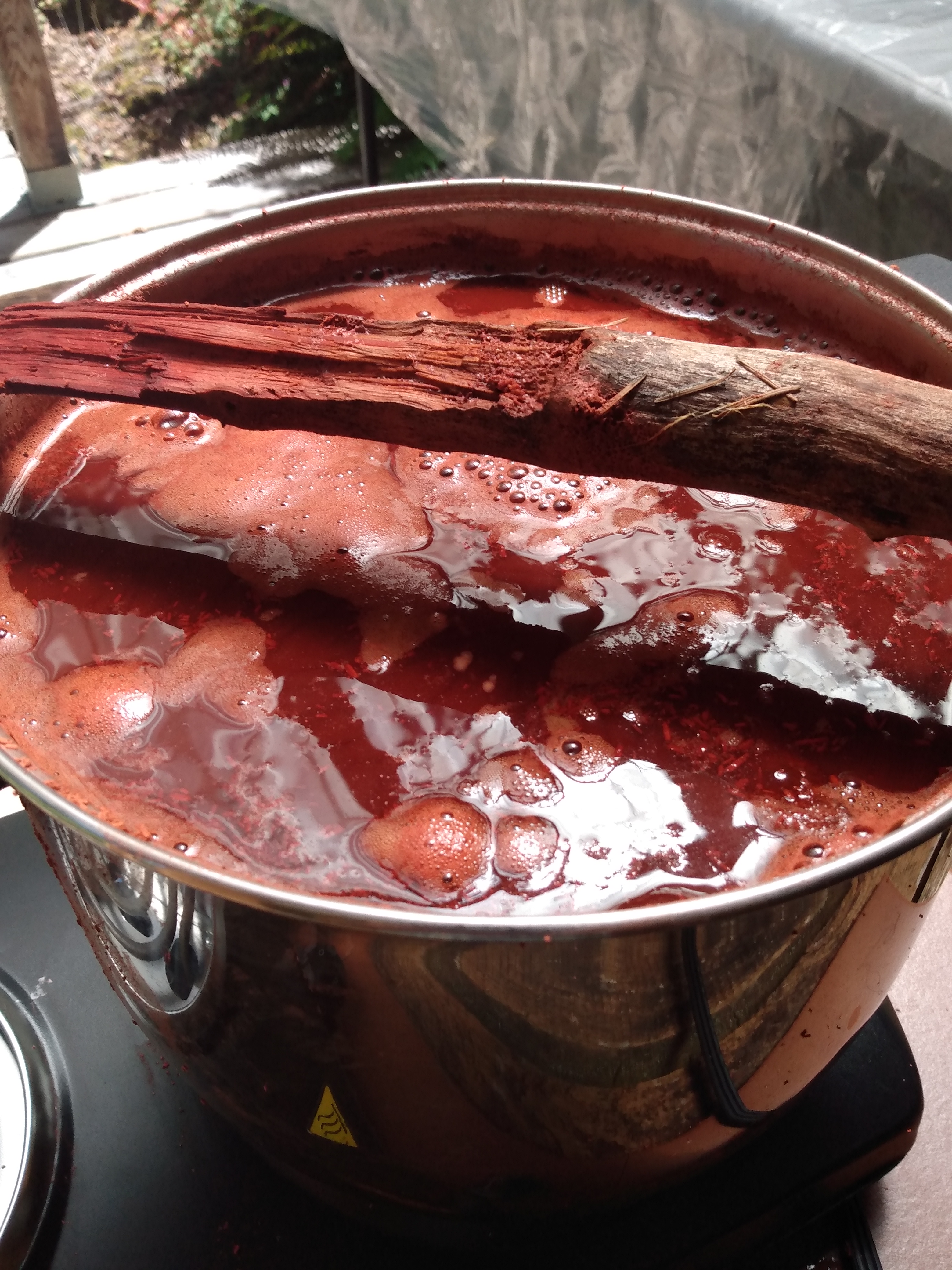
With the rose madder, it’s not quite the same. The fabric has to simmer in a mordant, then soak in a big pot of prepared dye on the little hotplate I have set up in my outdoor dye workshop.
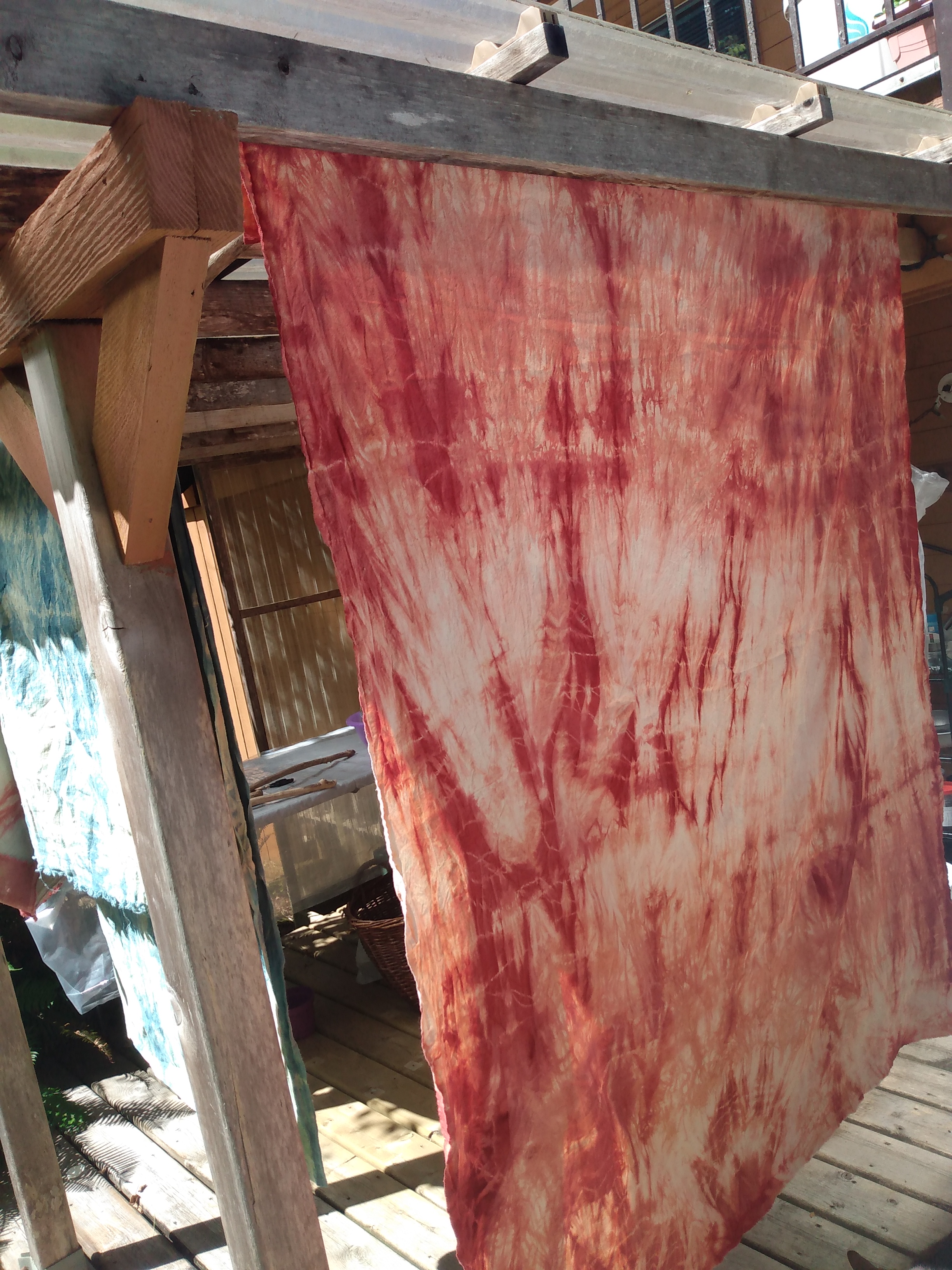
But when the dye has done its work and I unwrap the fabric, it’s like a gift. A birth. And as I sew, I’m thinking about a show I’ve learned about in London, which we will go to when we’re there in late October. Yto Barrada’s work sounds so congenial. (And what’s so interesting is learning that she has a property with arts residencies in Tangier, the Mothership, with a dye garden and workshops, and oh, of course I’ve been dreaming as I sew.)

There is a relationship between what happens when I swim and when I stitch. The two of them locate me in my body as well as elsewhere, a spirit realm, a cloudscape. When I swam all summer under blue skies, scraps of clouds drifting overhead, I was part of what was happening. And when I run my sharp needles through the dyed linen, I am making a veil, I am drawing together a seam of water, of sky, of self.

This is love: to fly toward a secret sky,
to cause a hundred veils to fall each moment.
–Rumi
redux: “the diver’s clothes/lying empty on the beach” (Rumi)

Note: this was a year ago today. And yesterday, the swallows dipping over me as I swam…

july 4

Last night the full moon (the Full Buck Moon, one of the 4 supermoons of this year, when the moon’s orbit is closest to earth) kept me awake for ages. It hovered out the south window by my bed, like a lantern in the tall Douglas fir the bear mother sent her cub up a month ago when they saw me watching them. It hovered and there was no point drawing the curtains — they’re white linen and moonlight comes through them as bright as anything. I lay awake and thought. I thought of the long essay–well, a book, really–that I’ve been revising. I’ve described the book here. Yesterday, talking about it with John, I suddenly said, I forgot about Frank! He was puzzled until I told him about another painter, one who’d worked at the same place as me in southwest London and who was, true to form, much older than me, who’d asked me to take off my clothes when I was 21, first giving me a beautiful lunch first in Wimbledon with a glass of Château d’Yquem to follow, then the request. I was spared more of Frank’s attention because I was suddenly called home to Canada. I don’t share this with any kind of vanity or pride. I was foolish, I didn’t always make the best decisions, and in the essay I am careful not to let myself off any hooks. I’d forgotten about Frank so I spent part of the day writing a section about that period. I was thinking about that when the cat trilled at the side of the bed, wanting out. I thought until the moon made its journey to the west, out of sight. The morning came early.

Mostly I try to go for my swim before 8:00. I’m almost always the only one in the water, with John reading on a bench nearby. (He’s having a reaction to swimmer’s itch these days so reluctantly doesn’t join me in the lake.) This morning, with one thing or another, we didn’t go down until after 9 and the parking lot was half-full. The prospect of doing my meditative swim between the big cedars at either end of the little beach, back and forth, back and forth, an eagle overhead sometimes, swallows dipping over the surface for mayflies, dragonflies skimming the water, anyway, the prospect of others around had me say, Let’s just go home. Maybe we’ll go in the evening though it’s not the same. A morning swim energizes me for the day, both physically and mentally, because I think in the water too, deep thinking, working my way through writing issues, personal dilemmas, even new ways to cook kale.

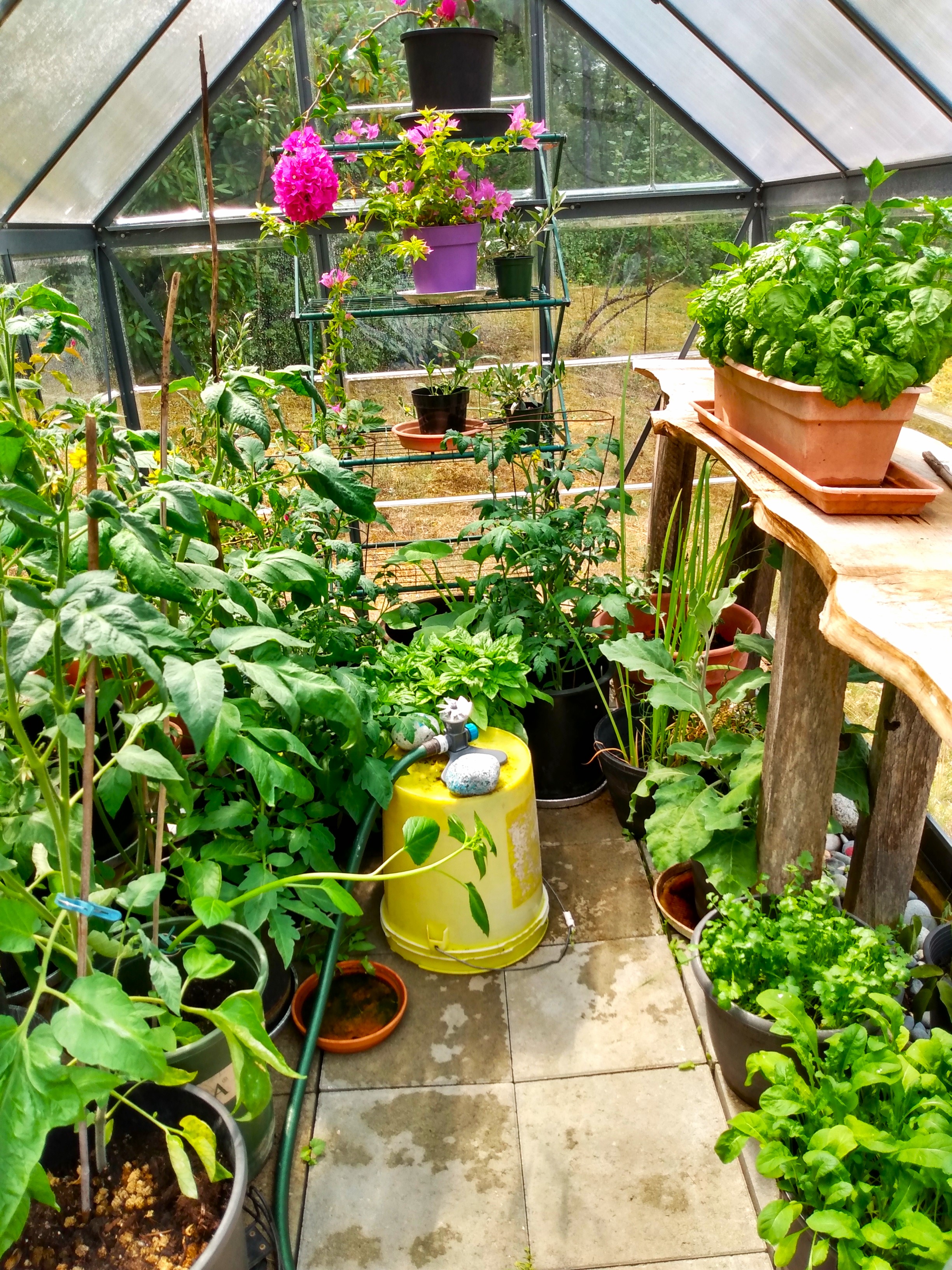
A supermoon, an abandoned swim, and now some smoky haze in air that has been so clean and clear for the past weeks. One thing doesn’t always lead to another. The days don’t go as planned. An essay begun to work out my feelings about something that happened 45 years ago, with ripples that continued for years, even continue now, has grown to include Frank. I’ve watered the greenhouse with its two new olive trees and the cucumber boxes and now at my desk, I am wondering about the future. I am working hard on something I will probably never publish but I need to get it right. I need to swim to keep the workings of my mind clear and nimble. A polished red branch of arbutus has meandered into view.

You’re in your body like a plant is solid in the ground,
yet you’re the wind. You’re the diver’s clothes
lying empty on the beach. You’re the fish.

In the ocean are many bright strands
and many dark strands like veins that are seen
when a wing is lifted up. (Rumi)

The undersides of the swallow wings are creamy, the dragonfly wings are tiny stained glass windows. Looking through them, you see the sky or the water, depending. Today I am the diver’s clothes, empty on the beach, no swimmer in sight, and the past, oh the past! It happened so long ago.

“Relish the Monday and the Tuesday” (Virginia Woolf)

the square

I’ve written about Virginia Woolf a fair bit on this site. She was one of the first writers I came to as a girl, not even really a young woman, not yet, and recognized in her something of a kindred spirit. I loved her use of language, of structure, of attention. Would she have recognized any of these things in me? Not then. Probably not even now. But for more than 50 years I’ve read her regularly, I keep her A Writer’s Diary on my desk and use it almost as a form of divination. What was she thinking around this time of year in 1930 when she was writing The Waves?

How to end, save by a tremendous discussion, in which every life shall have its voice–a mosaic–I do not know. The difficulty is that it is all at high pressure. I have not yet mastered the speaking voice. Yet I think something is there; and I propose to go on pegging it down, arduously, and then re-write, reading much of it aloud, like poetry. It will bear expansion.

What was she thinking in 1940, the war filling the airwaves? (She thought about it a lot. But she also tried to preserve her own sanity.)

Relish the Monday and the Tuesday, and don’t take on the guilt of selfishness feeling: for in God’s name I’ve done my share, with pen and talk, for the human race. I mean young writers can stand on their own feet. Yes, I deserve a spring…

What was she thinking, just before her suicide by drowning, by forcing a large stone into her coat pocket and walking into the River Ouse 83 years ago today, what was she thinking 20 days earlier, when her life must have felt like something she could leave behind with a letter (“You’re in your body like a plant is solid in the ground,/Yet you’re the wind. You’re the diver’s clothes/lying empty on the beach.” –Rumi).

I intend no introspection. I mark Henry James’ sentence: observe perpetually. Observe the oncome of age. Observe greed. Observe my own despondency. By that means it becomes serviceable. Or so I hope. I insist upon spending this time to the best advantage.

In London in late February, I walked over to Mecklenburgh Square where Virginia and Leonard lived briefly and ran the Hogarth Press before German bombs destroyed the house. A few years ago I read Francesca Wade’s Square Haunting, a history of the square and five women who called it home: Dorothy Sayers, the poet HD, Eileen Power, classicist Jane Harrison, and Virginia Woolf. It was a wet day and I could only peer through a hedge at the garden in the middle of the square, locked to the public. I’d left John in St. George’s Garden, among the newly flowering trees and birdsong. I thought of how traces are left, and not left, houses are bombed, and how we are both remembered and forgotten. The world hasn’t improved. At least Virginia Woolf was spared what was to come. We on the other hand are both burdened and spared.

This morning, after my swim, I was sitting on a bench outside, waiting for John and all around me the robins were singing. I waited all winter for this song, the long syllabic whistles over in the maples near the creek. On dark days in January, I thought of it, the way it almost drowns out every other bird in the area, except for the piercing note of the varied thrush. I even checked to see what Woolf was thinking in the months before her death.

It’s the cold hour, this: before the lights go up. A few snowdrops in the garden. Yes, I was thinking: we live without a future. That’s what’s queer: with our noses pressed to a closed door.

Or our ears longing, near an open window.

Note: the passages of VW are from A Writer’s Diary: Being Extracts from the Diary (Persephone Books, 2017). The passage of Rumi was translated by Coleman Barks.

cell by cell

afternoon deck

It felt like summer on this deck (with its bronze fish). Huge bees, bombus spp. of some sort (orange rumps…), going from flower to flower—crocus, daffodils, forsythia, low yellow primula. I planted out the seedlings of sugar peas I started indoors on March 16th. They were a foot tall and ready for their bed in Wave (the box where there’s a good screen of chicken wire for them to grow up against). I also transplanted some tiny kale seedlings, self-sown, in Long Eye. (My vegetable beds have names. What can I say.)

Over the past week I finished another of the essays for the collection I am calling Blue Portugal. The process of writing these essays feels a little like the fall of 2016, when I’d been tentatively diagnosed with something serious and I felt that I couldn’t waste time. I’d get up in the night and come down to my desk to work on the material that became Euclid’s Orchard. There was urgency in the work and also the daily rhythm of my life. I have no regrets, either for the sense that time was limited and I needed to use it well, and for the headlong energy I expended during that period. I felt lucky. I lived with someone I loved and who I knew would accompany me on any dark path that beckoned. I had a wonderful extended family. (Still have!) This work has that same urgency, though (as far as I know) I am strong and healthy. When I wake in the night, I have the sense that everything I know is connected, that I need to find way to stitch it all together like a useful and beautiful length of tapestry. Everything is connected, the flight of the bumblebees, the starlight, a pileated woodpecker just beyond my garden, drumming on a Douglas fir, the small blue scribble of my grandfather’s signature—he was learning to sign his name on a scrap of paper and mostly he gives up on the first syllable of his surname (my surname) but a single version is complete—the new chives so green and pungent in their pots on the deck.

The essay I just finished, “blueprints”, takes me back to house-building, the beginnings of our family, and then reaches back, back, to my grandparents’ years in Beverly, then a community outside Edmonton and now part of the city. It reaches back to the extraordinary photographer Anna Atkins, whose cyanotypes are botanical studies in blue and white. It ends with an informal picnic on the banks of the North Saskatchewan River as the ice breaks up, the ice I saw forming in late November as we drove across the Walterdale Bridge on our way to the Emergency ward of the Royal Alexandra Hospital because my retinas were trying to detach, the result of a hard fall on ice.

What I did today was shadowed by bees, their orange rumps glowing in sunlight. They entered the trumpets of daffodils, hovered over warm soil, paused from time to time on the sleeve of my flannel shirt.

We are bees,
and our body is a honeycomb.
We made
the body, cell by cell we made it.

—Rumi, translated by Robert Bly

“When the gift moves in a circle…”

gifts
I’ve always loved the idea of gifts and reciprocity. The circular pattern of that process. What you give, you receive. This time of year I fill our pantry shelves with preserves, more than we can ever use. But when we are invited to dinner with friends, we take wine, yes, and often a jar of jam or pickled beans or a herbal jelly. I remember the time I spent living on Crete in the 1970s and how I would accompany my love interest of the time, Agamemnon (yes, that was his name!), to dinners with friends of his family. At the door we would be greeted with a small tray holding a glass of water and a jar of quince or cherry preserves. A long spoon. We would take a spoon of the preserve, called “spoon-sweets”, followed by a drink of water. Sometimes a tiny cup of coffee. This practice was part of an ancient code called Xenia. The guest was treated well in part because he or she might be a god or goddess in disguise. And if that didn’t prove to be the case? Well, no matter. The host had done the right thing. And a guest treated well was unlikely to behave badly.
“When the gift moves in a circle its motion is beyond the control of the personal ego, and so each bearer must be a part of the group and each donation is an act of social faith.”– Lewis Hyde, from The Gift: Imagination and the Erotic Life of Property
When people come to us, they bring flowers or books or wine; I feed them; John keeps our glasses replenished; they tell us stories and we share our own. Sometimes they leave with a bag of kale or a rooted cutting of wisteria or scented geranium. It’s the world I want to live in so I do my part.
Someone who does not know the Tigris River exists
brings the caliph who lives near the river
a jar of fresh water. The caliph accepts, thanks him,
and gives in return a jar filled with gold coins.
                 — Rumi, from “The Gift of Water”, trans. Coleman Barks
Someone once said as she arrived for dinner and put a jar of beautiful raspberry jam on the counter, “It’s like bringing coals to Newcastle.” But it wasn’t. Not at all. We grow wonderful raspberries but I never make jam of them. I don’t know why, quite. It seems there are always other things happening when the raspberries (cherished, for sure, but also called “the frigging raspberries” late in their season when they have to be picked, yet again, almost always by John, and arranged on trays for the freezer. In peak season, there’s a bucket a day….), anyway, when the raspberries are ripe so I never make jam of them. And hot buttered toast, with raspberry jam, in January? Oh, man.
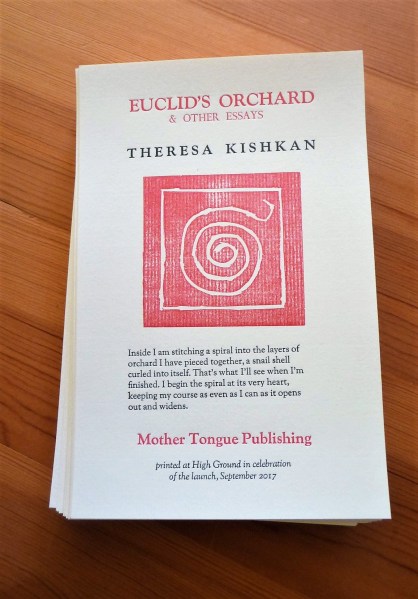
So this isn’t entirely about jam. It’s about exchange. John printed these keepsakes on our Chandler and Price platen press to give out at my book launch and yes, we did that. Or Bev Shaw did. She owns Talewind Books and is the gracious bookseller at so many literary events on our coast. (Those who attend the Festival of the Written Arts in Sechelt will recognize her name!) She is a true friend to writers and readers. We have copies of the keepsake left. I’ll take some to Munro’s in Victoria for the reading I’m doing there on October 4th with Bill Gaston. But in the meantime, send me a photo or maybe just a confirmation that you’ve bought a copy of Euclid’s Orchard (my contact info is in the menu on the right-hand side of my home page) and I’ll mail you a copy of this lovely little letterpress keepsake. I can’t offer you a spoon of jam at the door and a glass of our delicious well water, not unless you visit us here, but I can offer something else. And I’m very happy to do that.
keepsake with linocut

the moon won’t use the door

Last night was one of those rare celestial treats, a conjunction, where the young moon, Venus, and Mars all appeared in close proximity to one another, though “close” is of course relative. They were still millions of kilometers apart. The sky was clear, dark, and the three heavenly bodies formed a brilliant crescent in the southwestern sky.

When I came back inside, full of the night sky, its mysteries and beauties, I thought of how Islamic scientists from the Golden Age of astronomy — 9th to 13th centuries — refined the methods for calculating movements and positions of the stars and the known planets and also developed very sophisticated instruments for doing so.

I want to know more about the people the current American administration has decided are dangerous and evil and I’ve decided to study Islamic contributions to science and mathematics over the next while. And that pursuit will take me naturally to poetry and art. For instance, this morning I’ve been reading about Abū Rayḥān Muḥammad ibn Aḥmad Al-Birunī (973-1048). A mathematician, astronomer, linguist, physicist, geographer, geologist, and oh, compiler of a vast pharmacopoeia in several languages. Here’s his chart to explain the phases of the moon:

Lunar_eclipse_al-Biruni.jpg

The stars don’t make distinctions about us from their high beautiful place. Nor does the moon.

At night, I open the window
and ask the moon to come
and press its face against mine.
Breathe into me.
Close the language-door
and open the love-window.
The moon won’t use the door,
only the window.

—Rumi