over the dark water —

— the bridges outlined with light as I look out on a sleeping Amsterdam. My body is on home’s time, 6:28, when we’d be eating by the fire; not tucked into a billowy white bed at 3:30 a.m. (that’s time passing as I write).

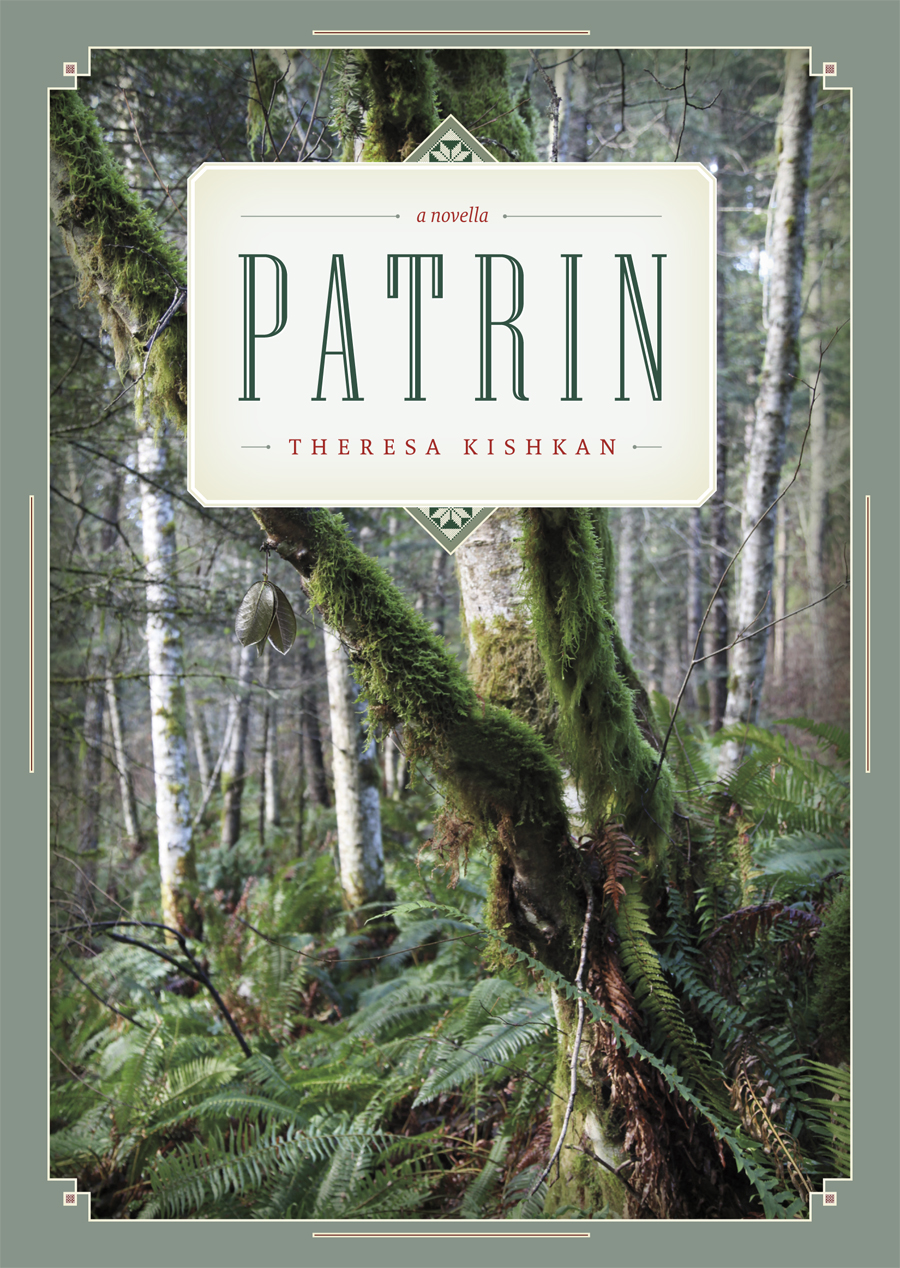
But look! The cover of my forthcoming book was waiting in my email box, designed by Setareh Ashrafologhalai:

Patrin_cover

small packages

P1020270(2)

As Christmas approaches, I’ve been shopping and making — and trying to remain true to my belief that good things come in small packages. With my family, it’s not difficult. We’ve never gone into the season with the sense that we had to go into debt or buy big electronic items or expensive bijoux. And it’s lovely to find the right thing, to know it as you see it, or to find the materials in your own surroundings. To plan the baking — white chocolate fruit cakes, savoury rosemary shortbread, gingerbread people with smartie buttons and silver dragee eyes. (I once tried to use a piping device to do fancy work with icing and failed miserably.)

I’m also having an interesting time discussing a new project with my friend Anik See in Amsterdam. Both of us have novella manuscripts which haven’t (yet) been able to find publishers. (Anik has published a novella, postcard, as part of her fiction collection, poscard and other stories; and I’ve published one, Inishbream, and have another, Patrin, forthcoming from the inspiring Mother Tongue Publishing in September, 2015.) Like John and I, Anik has a printing press and has designed and created some beautiful books through her Fox Run imprint. When she was here in September, on her way back to Amsterdam from three months as writer-in-residence at the Berton House in Dawson City, we continued talking about the idea (the madness?) of beginning a small imprint to publish novellas (and maybe some other forms not high on the lists of most commercial publishers). We’d probably begin with our work, my Winter Wren and Anik’s Cabin Fever, mostly because of logistics. We have them ready and we trust one another enough to work together in this way. She’s adept at page design, we have some sense of the market for these titles, and we don’t have illusions about commerical success.

Both of us love novellas. We love beautiful books. And we believe that there should be room in the literary conversation for this form. So we intend to try to expand the conversation, not with the intention of silencing any other voices but simply to ensure that the quiet ones continue to be included.  There are sure to be difficulties but is that a reason not to try? Nope.

Last night I finished re-reading Sheila Watson’s Deep Hollow Creek, written in the 1930s, before her extraordinary (and hugely influential) The Double Hook. It’s a hermetic story, set at Dog Creek in the Cariboo, in winter, and the language is precise and chilly, perfectly suited to the human relationships in the contained world of this novella.

As Miriam reached up the move the lamp Stella noticed the curve of her hip under the gold-haired brown wool of her Harris tweed skirt and the light bathing her braided hair as water bathes pebbles in the creek.

Nor in things extreme and scattering bright — no not in nothing — certainly not in nothing. Why, Stella thought, slipping from the literacy of the past into the literacy of the present, must the immediacy of the moment act itself out in the klieg light of a thousand dead candles.

She rose quickly from the end of the camp cot on which she was sitting and, going to the bucket, poured a dipper of water into the white enamelled hand-basin.

Is supper ready? she asked.

I think of a shelf of Canadian literature — or the literature of any civilized culture — missing this book and others, By Grand Central Station I Sat Down and Wept by Elizabeth Smart, Gillian Wigmore’s Grayling, Barbara Lambert’s Message for Mr. Lazarus, Ethel Wilson’s Swamp Angel, and so many others, simply by virture of their size, and it determines me to continue my discussions with Anik. Stay tuned!

waiting at home

Yesterday we returned home from a week in Ottawa, a week during which a deck was built, many walks were taken, large meals were indulged in, and some explorations were conducted at the Museum of Civilization. I kept seeing wildflowers I wasn’t familiar with (near Calabogie Lake), and trees. A pine with very long soft leaves. Oaks just coming into leaf, the leaves themselves almost frilly, with red margins. (I brought back an acorn and will try to grow one for myself.) On the Eagle Nest trail, there was a small toadlet and amazing views and I brought back memories of those stored in a safe place.

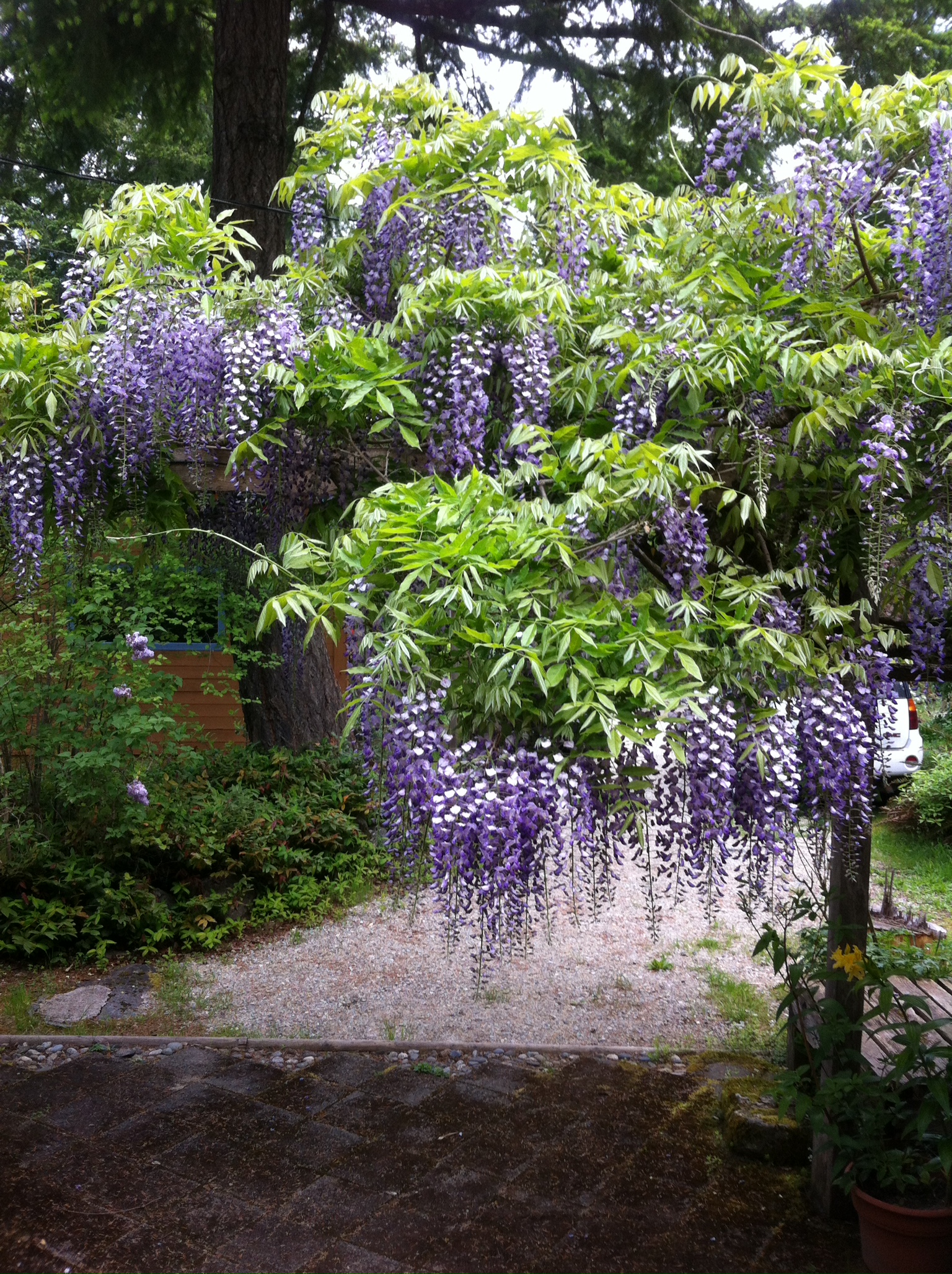
Coming up the driveway, we were so thrilled to see that the wisteria framing our patio (on a long cedar beam taken from a tree we took down years ago and had milled into lumber, a process described in Mnemonic: A Book of Trees) was in full bloom. When we left last week, it was in bud, the leaves opening but not yet fully out. Friend Jeffrey, who stayed here for a couple of nights while we were away, took this photograph:

wisteriaThere are two more of these beauties around the house and I took a root to Forrest and Manon for their garden. (John has already been booked for next spring to help them to build a pergola over one end of the new deck.) The wisterias came from John’s mother who brought them in turn from her mother’s garden in Felixstowe, along with mint, perennial geranium, honeysuckle, tucked into her suitcase after summer visits. I took kale to Ottawa and a tiny mountain ash; and I brought back violets, the ones growing like weeds in the grass and which I carefully dug up from the place where the deck was going to be built.

And it looks like one of my novellas has found a home. A publisher who is enthusiastic about the form has written to say she would love to publish Patrin in the spring of 2016! More on this as things develop but this news is too good to keep to myself!

spring bells

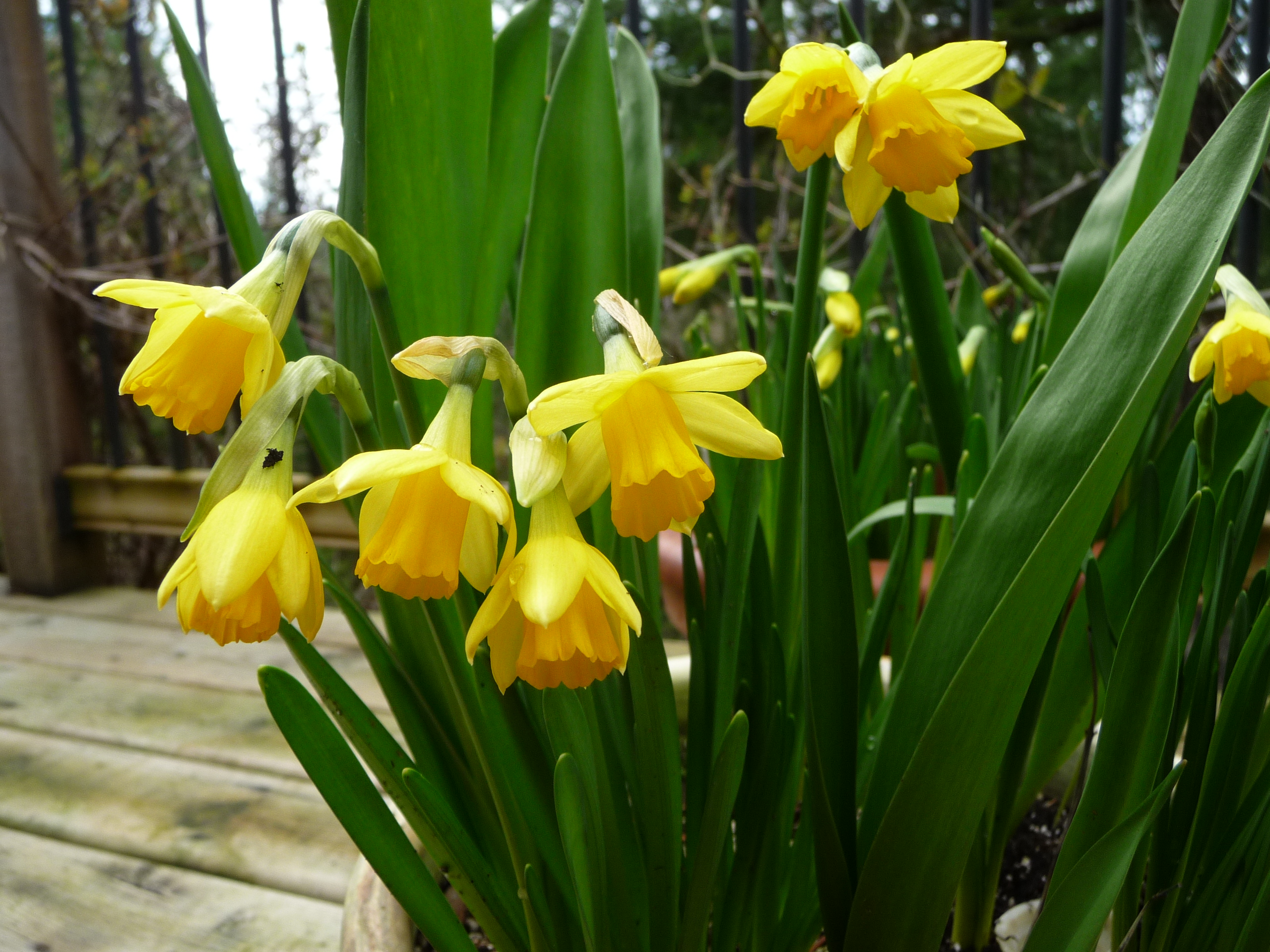
Tomorrow we’re heading away for a couple of weeks so I’ve just been wandering around, seeing what’s in bloom (not much: miniature daffodils, crocus, snowdrops, a few stray blossoms on the rosemary bushes), and generally sighing heavily at all the work there is do around our garden. It’s not that I mind the work — I love it! But I’m wondering about time. Will there be enough? I’m also moving quite rapidly to the conclusion of my novella-in-progress (Patrin) and I’m trying to slow down that process, to spin it out a little longer, as I’m enjoying the writing of this book so much. My character is in the maple pastures, the javoriny (and any of my Czech friends can correct me if I’ve misunderstand this concept) which I think are the grassy areas in mixed forests in the Beskydy Mountains of eastern Moravia.

So, time is what I’m thinking about, and spring flowers, and also the fact that the two lovely female deer who visited regularly last spring and summer have been around again. Their small heart-shaped footprints are in the mud and they’ve been grazing on daylilies. I wish they wouldn’t but how to stop them? We no longer have a dog, always the best protection against deer in the past. When I came in from my wandering, I was looking at the rose around the front door, wondering if I’ve pruned it enough (it’s very rampant), and I noticed the elephant bells hanging there.

P1070941

They might be a solution if only one had enough of them. How lovely that would be — the sound of thousands of elephant bells in the wind! But honestly I can’t imagine them keeping deer away, or elephants for that matter.

Here’s a bouquet for St. Patrick’s Day!

P1070939

The Next Big Thing

My friend Barbara Lambert has “tagged” me in “The Next Best Thing”, a lively literary relay making the rounds of Canadian writers. The idea is that we answer a series of set questions about our current work-in-progress and then tag (ideally) five other writers, providing links to their websites or blogs. Barbara’s own answers can be found here (and if this also leads you to her recent novel, The Whirling Girl, you won’t be disappointed!): http://barbaralambert.com/writer/author/books/177-Blog+Tour+That+Ran+Itself

Ten Interview Questions for the Next Big Thing:

— What is your working title of your book?


I am half-way through a novella – working title is Patrin (a Romani word for “leaf” or to indicate a trail marked by sticks, leaves, etc.). It will be a companion-piece to a recently-completed novella, Winter Wren.

— Where did the idea come from for the book?


Patrin grew out of research I am doing for an extended non-fiction work based on the life of my grandmother, born in what is now the Czech Republic in 1881. She was poor and it turns out poor people don’t leave a huge material record. I said to someone, “I might just have to imagine her early life as a work of fiction.” About a week later, I began to write a novella based on the life of a woman who turns out NOT to be my grandmother but who has allowed me to imagine another world, a woman who is as far away from my own life as my grandmother was, who came to Canada under similar circumstances but with a very different background. I am also interested in how material objects  can hold family history, often undecoded, so when I saw Patrin opening a box containing a tattered quilt with a curious pattern of loden leaves, connected by trails of grey wool, I knew it was a map directing me to the heart of the story.

— What genre does your book fall under?

Literary fiction.

— Which actors would you choose to play your characters in a movie rendition?

Someone dark and willowy for Patrin, the 20-something woman at the heart of the novella-in-progress. The young Juliette Binoche from The Unbearable Lightness of Being? A young Adrien Brody for Petr, her guide in Prague and further afield. And if anyone has a suggestion for Patrin’s grandmother, a woman in her late eighties, heavy-set, rugged, and with dark-ish skin (she is a Kalderash woman from eastern Moravia), do let me know so I can tell the studios when they come calling.

— What is the one-sentence synopsis of your book?


Victoria, British Columbia and the forests of the Beskydy Mountains in the Czech Republic form the backdrop for a brief lyrical narrative about a young woman in search of her family’s mysterious past.

— Will your book be self-published or represented by an agency?

I have never been able to interest agents in my writing, alas. But I’ve been lucky enough to have placed my books with lively small(ish) presses over the years and have nothing but praise for the presence of these presses on the literary landscape. They keep the cultural conversation diverse and authentic.

— How long did it take you to write the first draft of your manuscript?


I haven’t yet finished Patrin. Winter Wren took me a year. I anticipate that Patrin will take about the same time.

— What other books would you compare this story to within your genre?

I’m not finished yet and don’t want to suggest relationships that might not survive the writing. But I admire the novels of John Berger for their fiercely idiosyncratic structure, the consummate story-telling of Louise Erdrich, the intelligent trajectory of anything by John Banville…


– Who or what inspired you to write this book?

I partly answered this in the second question but of course who ever knows where, exactly, the inspiration for a book truly comes from? As well as family history, I’ve also been immersing myself in Czech cultural history and look daily at the photographs of Josef Sudek who has given me entrance to the Beskydy Mountains where my grandmother lived as a child. And I’ve been listening to Roma music, both the styles of Central Europe as well as Macedonia.

— What else about your book might pique the reader’s interest?


Joe Fassler wrote a wonderful piece on the novella, published last April in The Atlantic. (http://www.theatlantic.com/entertainment/archive/2012/04/the-return-of-the-novella-the-original-longread/256290/) He mentions Dennis Loy Johnson, co-founder of Melville House Publishing and its “Art of the Novella” series: “He was daunted by the genre’s limited viability—and yet the idealistic prospect of novella-writing pleased him. ‘It always struck me very romantically,’ he said. ‘A pure writerly exercise that was only for the love of writing. We had no expectations our novellas would ever circulate.”

Maybe this is part of the pleasure of the novella. Years ago I wrote Inishbream, a brief narrative set on an island off the west coast of Ireland. It was published by the Barbarian Press in a beautiful edition, illustrated by the American wood-engraver John DePol; and then given a second life a few years later by Goose Lane Editions. Yet when I wrote it, I had no expectation that anyone would ever want to publish it at all. The thing about getting older is that you come to terms with what’s possible and what’s unlikely. I’m probably never going to write a block-buster, a best-seller which will be sold to Hollywood (I hate to disappoint Juliette Binoche and Adrien Brody), but every morning I can come into my study, turn on my desk-light, and write for the sake of the language and the story. What a privilege.

I’ve tagged five writers and so far can tell you that Anik See, Catherine Owen, and Don Gayton will carry the baton forward in the near future. I can’t wait to see what they write!

www.aniksee.com

http://blackcrow2.wordpress.com/

www.dongayton.ca

Ceznecka

Think of those two “c”s with little hooks over top. (I hope that’s the right way to describe that particular diacritic…) And that’s the name of the wonderful Czech garlic soup. I’ve been thinking about it this afternoon as I plant next year’s garlic. It’s a soup I had almost daily when we spent a month in the Czech Republic last winter. Martina in Brno said, when I asked her how it was made, that it’s a soup you can make when you have almost nothing in the house. Water, or stock. Onions, if you like. Garlic. Fried bread. Potato cut into little cubes. Maybe some cheese or ham. Some caraway seed. I had many types. I think my favourite might have been the two bowls I had at the lovely Brasserie Avion in Roznov. I’d intended to have soup, then something else from the inventive menu. But that first bowl was so satisfying that I had another. The fried bread came on the side, crisp and hot, and you put in as much as you liked, offering some to the others at the table.

Yesterday I woke with such a vivid scene in my mind that I sat at my desk and wrote the first thousand words of a novella I’m calling Patrin. Part of it takes place in the Czech Republic and part of it in Canada, two brackets of my grandmother’s life. It’s not about her, exactly, but something of her life will echo in its pages. This morning I wrote a little more and am filled with that excitement that the beginning of a book produces. I’m trying not to think of the other two projects I have in the works but I do believe that they won’t go away and might even be better for waiting.

Today I planted four varieties of garlic —  Chesnok Red, Leningrad, Georgian Fire, and Northern Quebec, all purchased from a late summer Farmer’s Market in Sechelt. Last year I grew Russian Red, bought in Grand Forks, and a porcelain variety from Gabriola Island, bought at Coombs on our way home from the Pacific Rim. They did well, producing 80 good-sized heads, enough for John and I to use this winter. Here’s a bowl of them, against the Japanese maple:

It’s definitely fall here on the west coast. Last week we picked a big bag of chanterelles and made some of them into soup for the freezer. This morning I noticed that there’s fresh snow on Mount Hallowell. Yesterday there were chum salmon in Angus Creek, undulating in the tea-coloured water, a sight that always moves me to tears. And several days this past week, we saw skeins of geese flying very high on their way south, their scribble telling of northern waters, the prospect of long dark nights, our hemisphere turning to winter.

Time to make Ceznecka with the summer’s bounty, a few red potatoes tumbled from their soil, and the scent of garlic to remind me of my grandmother’s country.