a publishing history, with asides (third instalment)

21st century, second decade

Sandcut Beach

My parents died at the beginning of the second decade of the new century, a year apart to the day. Several close friends died. My sons married their sweethearts. (My daughter married hers a few weeks ago!) Every day held sorrow and joy. And also a sense of possibilities for my long-held interest in my family’s history. After my father’s death, I took home the small hoard of papers and photographs he’d kept to himself. I don’t know exactly why he was reluctant to share the materials, or to pursue answers to questions–the ones I had and surely ones he had too? And a year later, after my mother’s death, I felt the uneasy sense that I was now the family matriarch, the one responsible for keeping the lines of kinship clear. They were not clear. There were half-stories, careless genealogies. In retrospect, I see that much of the research and writing I did during this decade was in service to these histories.

I’ve always loved the literary novella. Without ever really intending to, I’ve built up a nice collection and have read many more, via library or generous friends. Inishbream was a sort of accidental novella, beginning as it did as a linked group of prose poems, eventually drawn out and given a structure. I loved the possibilities of the form, how it could hold so much in such a hermetic shape. A year or two after The Age of Water Lilies was published, I was invited to a book club to talk with members who’d just read it. I always enjoy these occasions. During our time together, one woman asked what happened to Grace after the novel ended. Good question. Grace was born to a single mother in the spring of 1915. She is sort of tangential to the narrative. But the more I thought about her, the more I wondered too. I began to write Winter Wren to find out. I think I knew from the beginning that the book would be a novella. I put Grace in a cabin I’d always thought I’d like to live in, a cabin I first saw as a teenager, on a beach west of Sooke, B.C. (It’s the one above the waterfall in the photograph at the beginning of this post.) She was in her late 50s, an artist trying to paint the view at dusk. I wanted to write about the 1970s—the novella takes place in 1974, an interesting time for ceramics in B.C. (Grace’s love interest is a potter in the tradition of those who studied with Bernard Leach in Cornwall and then returned to Canada), for museums where the salvage paradigm was part of the ethos, and perhaps the last possible time for Grace to meet one of the late 19th c-early 20th c artifact collectors.

winter wren

But you know already what I’m going to say: I sent Winter Wren to dozens of publishers and all of them rejected it. To make a long story short, my dear friend Anik See was visiting enroute from Dawson City to the Netherlands and we shared similar stories about novellas we’d written. We decided to begin a micropress to showcase the form and we decided to begin with mine. Our rationale was this: if our endeavour didn’t work, then I would be disappointed, sure, but at least it would only be me and not someone else. I could shake it off, poof, and move on. (Ha!) Anik designed the book, I photographed a pottery dish with a length of scouring rush (it figures in the book), and we found a really good printer in Victoria. And you know, we sold our first print run of 250 copies within weeks and we reprinted. I still get orders for it. We went on to publish 4 more novellas and we are very proud of Fish Gotta Swim Editions. Our latest is Anik’s Cabin Fever.

I’ve been to the small Vancouver Island beach near Jordan River where Theresa Kishkan’s novella Winter Wren (Fish Gotta Swim Editions) is set; I’ve seen the waterfall that tumbles over sandstone onto the shingle just below, and the solitary cabin facing south and west, surrounded by salal. Winter Wren tells one possible story from the many that cabin could tell. (Michael Hayward, Geist)

After I finished writing Winter Wren, I wrote another novella, Patrin, and it was published (beautifully) by Mona Fertig’s Mother Tongue Publishing in 2015 and then in French by Marchand de Feuilles in 2018. I also wrote a long essay, “Euclid’s Orchard”, about quilting, mathematics, coyote music, apple trees, and love; and when Mona showed interest in publishing a collection of my essays, I gathered together a group. Eulid’s Orchard & Other Essays was published in 2017 and was shortlisted for the Hubert Evans Award.

Each image is a perfect crystallization of a detail, gesturing toward a truth much larger than the tiny pinpoint of its composition. Near Victoria, she recounts an exquisite memory of “an abandoned house completely knitted into place by honeysuckle and roses” (p. 101). Near Drumheller, she sings the prairie: “turn, turn, bend the song to the roadside plants … free verse composed of craneflies, dragonflies, bluebottles, broad-bodies leaf beetles, greasewood and cocklebur” (p. 61). And near her home, she concludes with the cries of coyotes: “lilting joyous youngsters unaware that a life is anything other than the moment in the moonlight, fresh meat in their stomachs, the old trees with a few apples and pears too small and green for any living things to be interested in this early in the season” (p. 155). (Catriona Sandilands, The British Columbia Review)

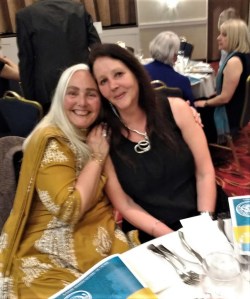
An aside: Mona Fertig and her Mother Tongue Publishing enterprise deserve gratitude from writers everywhere for the beauty of the books and the huge effort Mona put into designing them, editing them, bringing them into the world with sparkling wine and flowers, arranging public events for the writers, and being the kind of publisher writers dream of. I’d have published with her forever and was sad when she announced her retirement but also glad for her because she’s been able to return to her own writing projects. She did everything that bigger publishers did and she did it with joy. (She’s the one on the left, with the big smile.)

at-the-book-prizes

Novellas, novellas. I wrote The Weight of the Heart as a way to lament the gaps in my own education in the 1970s when the instructor of my Canadian literature course told me not to bother writing about Sheila Watson and Ethel Wilson, saying they were minor, and the former was barely coherent. I wanted to celebrate these two literary cartographers of our province and to highlight the importance of their work. I also wanted to spend time, real time and imaginatively, in the Thompson Canyon and the dry Interior of B.C. Palimpsest Press published The Weight of the Heart in the spring of 2020, just as most publishers and some writers were required to pivot to a virtual presence because of the pandemic. I wish I’d been better at this, though we still had such a slow internet connection—we live in a rural area– that even if I had been able to Zoom more effectively, our bandwidth wouldn’t have allowed me to participate much. (We were able to upgrade a bit later.)

The Weight of the Heart also finds in Wilson’s and Watson’s writing an experimental style and a mode of consolation. Like Wilson’s independent protagonists, the narrator discovers her autonomy and grit in the landscape she travels. Watson’s spectral figures and interest in sacred rituals resound in the symbolic scenes of almost drowning in which the narrator is saved by her brother’s mysterious presence and in Kishkan’s invocation of Egyptian burial rites as a refrain throughout. Most obviously, the double hook of Watson’s title recurs in the dualities throughout the novel—in the two rivers, in twin foals (the colt unfortunately lost in birth) by a mare named Angel, and most clearly in the two siblings who are bound together in a landscape where life and death regularly meet. So, Kishkan and her narrator know where to look in Canadian fiction for a view of the British Columbian landscape that reveals these striking oppositions and their consoling unions. A unique and compelling creation in its own right, Kishkan’s poetic exploration of grief lives up to its literary precursors. (Kait Pinder, the Malahat Review)

I wrote another novella in this decade, begun perhaps in the middle, put aside, but finished in 2020, during the long lonely weeks of the pandemic when I was missing my family and wondering if we would ever get together again for our summer meals, swims, and talks late into the night by a campfire. I used Virginia Woolf’s Mrs. Dalloway as a template, following the main character through a day of preparations for a party. There are shadows and owl voices in the woods and an unexpected guest coming up the driveway at dusk, carrying a knife. I tried to find ways to present the material innovatively, with sections of call and response, lists, and the music of an oud. I called it The Occasions. I don’t know if it will ever be published.

Another aside: I am lucky in life and love if not in publishing. And I wonder how many writers have a husband who is also a letterpress printer and who offers to make keepsakes to celebrate new books? For the past ten years or so, John has printed beautiful objects, some of them embellished by me, to give away at book launches and to provide local book stores with so they can tuck a keepsake into the books of mine that they sell. I have a few remaining of some of these and if you want to order a book from me, I can include one for you.

keepsakes remaining

At the beginning of this instalment, I wrote that I was trying to untangle the knots of family history and genealogy. Some of this work resulted in essays in Euclid’s Orchard but I wasn’t finished and kept on writing. I’d also had a health issue in 2016 that resulted in many tests, half-diagnoses, fearful assessments (though it all worked out well), and I also wrote about those things against the backdrop of all I loved: my family, the rivers of this province, textile work (which is always a way of meditating for me, sewing myself in and out of mysteries, riddles), the countries my grandparents left for new lives in Canada, and more. These became Blue Portugal & Other Essays, published with care and generosity by the University of Alberta Press in 2022. It received SUCH good reviews.

In Blue Portugal the essays’ themes are allowed to slip their boundaries; a topic addressed in one essay recurs in later essays, a recognition, perhaps, that thoughts and interests develop over time, shifting slightly as they are put in the company of other thoughts, are seen from different perspectives. The essays in Blue Portugal seem to talk to each other; they interlace in interesting and thought-provoking ways. The book is a fine example of the personal essay at its best. (Michael Hayward, The British Columbia Review)

It was a book that others noticed, gifted to friends, and reading it now, I am sort of surprised that I was led into some of the essays so mysteriously. A voice in the night, murmuring, The river door. Whose voice? I only know I took it to heart.

To those of us who’ve been following Theresa Kishkan on her blog for many years, the preoccupations of her latest book, the collection Blue Portugal & Other Essays, will be familiar, the quilts, the homesteads, the memories, the blue. But it’s the stunning craftsmanship of the book, the fascinating threads that weave the pieces together and also recur throughout the text, that make this book such a pleasure to discover. How quilting squares are analogous to the rectangles from which, one by one, Kishkan and her husband literally constructed their home on BC’s Sechelt Peninsula, and the blueprints, and the blues of dye, and of veins, and of rivers, and of how one thing turns into another—how? How does a body get old? How do children grow? How does a family tree sprout so many new branches? And from where did it all begin, Kishkan going back to seek her parents’ nebulous roots in the Czech Republic and Ukraine, in a 1917 map of lots in Drumheller, AB, in everything that was lost in the Spanish Flu, and how we’re connected to everything our ancestors lived through. (Kerry Clare, picklemethis.com)

And now? Now? 4 years into the 3rd decade of the century, I’ve completed another collection of essays. The centrepiece is a long postmortem and reassessment of a relationship I had with a painter when I was 23 years old. My walls are hung with some of his paintings, portraits of me among them, and I attempt to reclaim the gaze by entering into a daily conversation with one particular portrait hung in a stairwell; she is one of the first things I see each morning as I come down to the kitchen. There are other essays in the collection that meditate on war, climate change, injury and recovery, swimming and Herakleitos, and the nature of love. I’ve begun the long process of trying to find a publisher (my last publisher wasn’t interested, feeling perhaps that the collection is too personal and potentially risky in terms of sexual politics). As I write, it’s been rejected by 4 publishers and is currently awaiting decisions by 6 more. I’m also about halfway through writing a novel set in a small fishing village called Easthope and in the city of Lviv, in western Ukraine. I began the novel 4 years ago, just home from a trip to Ukraine, and set it aside to complete editorial work on Blue Portugal. And then the Russians invaded Ukraine and I couldn’t imagine ever writing about Lviv. But I decided that I’d stay with my original intention and setting— 2015—and write to set down what I love about both places.

And now in a hurry just
pack, always, each day,
and go breathless, go to Lvov,
after all it exists, quiet and pure as
as a peach. It is everywhere.

–Adam Zagajewski, trans. Renata Gorezynski. The poet used a variant for his native city which has known many administrations since it was first established in the 5th century and is currently known as Lviv

It may seem that I am a bit cranky about publishing in the 21st century but I have to say that it’s always the end point in writing for me. I began to write with the sense that the process was complete when the piece found a place in the larger world. I don’t begin a work with any idea of what might happen when I’ve finished, though. Not yet. I live in the language, the world of the writing, and when I come up for air, it’s then that I realize that I have no idea if the work will ever find a readership. I am too many things that are not what the current world wants or needs. Who wants to read about a fishing village or a party under fairy lights in a garden on the edge of the world or eye injury or indigo dye or the musings of an aging grandmother? A woman married for 45 years. I know some people do but maybe not enough of them. Enough of you, I mean. But I have some years left and those will find me at my desk, finding a way to map out the terrain I dream about, yearn for, to find ways to knit together strands of music, roots of family trees, and real trees too, embellished with salmon bones, the beautiful holdfasts of bull kelp and bladderwrack (the tired images scorned by A.F. Moritz all those years ago). There’s a little quote from the writing of the early naturalist and advocate for wilderness, John Muir: “When we try to pick out anything by itself, we find it hitched to everything else in the Universe.” I keep this in my mind and heart as a mantra. I don’t know how this might be worked into a synopsis or query letter or proposal but it keeps me anchored, heldfast, to what I want to do in my life. Everything else is a bonus.

holdfast

a year later

what's new

This morning, because it’s cooler and I don’t have to rush out to water everything that droops, shrivels, or turns brown overnight, I was looking at posts from this time last year. In a way, my blog is my journal. Between it and my datebook, I am able to keep track of what happened when. On this day last year, my publisher Mona Fertig sent me two photographs of the advance proof copy of Euclid’s Orchard. I wrote about that here. As I’ve said before, it was a book I hadn’t expected to write. Or at least I hadn’t expected it to come together quite so quickly. I’m very glad it did. I’m very glad the reasons I wrote most of it—facing a potentially devastating health issue—have resolved themselves. The year leading up to Euclid’s Orchard‘s publication was filled with appointments and tests and the year leading away from it had some of those but also the relief that comes with knowing that the thing I dreaded was almost certainly not going to happen. At least not yet.

reading copy

It was a good year, this past one. My book took me to various places for readings and festivals. People wrote reviews and letters with such generosity. My book took me to the B.C. Book Prizes Gala because of its place on the Hubert Evans Award shortlist and that was fun. Some of the writing has led me to new work and for that I’m grateful. This is one of the best things about the essay form: it can be truly open-ended and you don’t have to think of it as “finished”.  It turns out “West of the 4th Meridian: A Libretto for Migrating Voices” was only the beginning of the stories I was listening to in the night as I came down to my desk to work during those weeks of waiting to learn if I had metastatic lung cancer. I’d sit in the dark with only the glow of my laptop light and the tiny desk lamp to one side and feel the presence of my father’s family around me. There is no logical way to explain this and I won’t but it was a source of comfort and now that I know a little more about them, I want to  explore their lives. In “West of the 4th Meridian”, there’s a line from Ovid’s Tristia, the letters he wrote in exile in Tomis: “I wish to be with you in any way possible.” To this end, I’m reading books about the Holodomor, about the politics of early 20th c. Ukraine, about the waves of emigrants who came to North America any way that they could. I want to find out who this woman was, the tiny image that was part of my grandfather’s archive. She is somehow familiar.

single woman

Time and the essay are related, I think. Spacious and widening, circling back on themselves when necessary, asking questions, pausing to listen to music, to take the air, remembering to keep the mind and the heart open to chance, to love, to the complexities of what a sentence can hold and also to what it can let go.

the day after

at the book prizes

Last night was the B.C. Book Prizes gala. I was glad to be there, glad to be nominated for a prize, though I didn’t “win”. (Here’s the link to the winning titles!) It was lovely to see old friends, meet some new people, and to realize again what a vital literary community we have in this province on the far edge of the country, west of the Rocky Mountains. People put so much effort into the event, from the jurors (and how nice it was to spend a bit of time with Jean Barman, a historian I believe to be a national treasure) to the organizing committee to the librarians, booksellers, and everyone else who gathered to honour the nominated writers.

I want to commend my own publisher, Mona Fertig, at Mother Tongue Publishing. She is so supportive, so enthusiastic, and she runs her business out of an old heritage house near Ganges on Salt Spring Island. She celebrates the unsung artists of our province, the writers who are working in forms not part of the best-seller culture, and she insists on their importance. Not “instead of” but “as well as”. It’s harder to do this work, I know, with financial constraints and reluctance on the part of much of the media to embrace what might not seem popular. Last night Mona was her bounteous generous self and I was glad to be there for the reception and dinner as well as the awards ceremony for the opportunity to share a glass or two of wine and to know that my book, Euclid’s Orchard, was possible because of her encouragement, her faith.

“…will the voices come to us again?”

euclid
Euclid’s arrival at Mona’s place

This morning the B.C. Book Prizes announced the 2018 shortlists and I am so thrilled to see Euclid’s Orchard nominated for the Hubert Evans Non-Fiction Prize.

Awarded to the author(s) of the best original work of literary non-fiction. Topics such as philosophy, politics, biography, history, belles lettres, etc. Quality of research and writing along with insight and originality are major considerations in the judging of this prize. (from the Book Prizes website)

I’ve always admired Hubert Evans. When John and I first moved to the Sechelt Peninsula, Hubert was still alive, living at Roberts Creek. I met him once and told him how much I loved his Mist on the River and O Time In Your Flight. In the way that these things happen in small places, his granddaughter, a nurse at the hospital in Sechelt, helped to deliver my son Brendan. Brendan, for those of you who’ve read Euclid’s Orchard, is the mathematician who inspired the title essay. When my publisher Mona Fertig and I were making decisions on images for the book, I had to call on Brendan several times to help with something I had in mind: a photograph of a tree in our old orchard with Euclid’s algorithm hanging over it like mist. Another layer of meaning. I remember my relief when Mona sent a photograph of the spread for that essay, relief that both Brendan’s work and the wonderful eye of designer Setareh Ashrafologhalai helped to bring my vision alive.

page

My other children are in these pages too. Son Forrest, a historian, helped with the work of decoding a whole complicated knot of information about a squatters’ community in Drumheller in the early 20th century, the first place my grandmother lived when she came to Canada. My daughter Angelica is always the first person I ask about classical texts (she has an M.A. in Greek and Roman Studies and can read Latin with an impressive fluency). And my husband John, well, he makes so much of what I do possible. The beautiful young women who are the mothers of my grandchildren are also in these pages, entering the family story with grace and humour.

I dedicated Euclid’s Orchard to those grandchildren and my late parents. They bracket my specific time on earth and the stories in my book are theirs. Ours. No one knows when they might need to know something and when I was undergoing medical tests in the fall of 2016, I needed to know how the pieces of particular family stories fit together, both within our own ecology and also the larger picture. How a squatters’ community on the banks of the Red Deer River echoed much of the immigrant experience, the languages of loss and grief and deprivation. How a child dazzled by patterns and numbers might grow up in a family of dreamers and poets and how a mother might try to parse the meaning of those patterns late in life. How letters might be written to the dead.

Migratory, like monarchs, we find our own urgent way to a place where the sun and earth greet us, give us rest.We find our place among wild plants on a roadside, we hear beetles and the lazy drone of bees. If we sit on the grass and let the dry wind ruffle our hair, will the voices come to us again? — from “West of the 4th Meridian: A Libretto for Migrating Voices”

Courtepointe, on Mona’s counter

courtepointe

Very excited to receive this photograph of the French translation of PatrinCourtepointe—newly arrived in my (English-language) publisher Mona Fertig’s kitchen! The whole experience, from the interest shown by Mélanie Vincelette at Marchand de Feuilles, to a wonderful photography session with Alexandra Bolduc, has been lovely. I look forward to reading my novella in Annie Pronovost’s translation! And of course we toasted this new book just now but I wish we’d had some of the Czech wine Patrin (and her creator) love: Veltlínské Zelené.

In the hubbub of a weekend…

…crowd in Ganges, on Salt Spring Island, we took refuge in Mouat’s Store. Located in the heart of the village, Mouat’s has been serving customers since 1907. When I was a child, camping at St. Mary’s Lake with my family, I used to love going to the store with my father. He’d been looking for a lure, a hook, a new reel of fishing line. Or a part for a pot — he was nothing if not resourceful. He’d spend hours in hardware stores, looking (it seemed) at each nut and bolt, each small hook, determined to find its weak point or flaw. If he found none, he’d buy it, taking money out of a worn brown wallet. If we were lucky, we got a quarter. There was always something in Mouat’s to spend money on. Or dream of buying.

I never would have had enough money to buy a music box. But yesterday I did and so when I spotted this beautiful tin box with a little handle and painted with Jemima Puddleduck, Peter Rabbit, and that rogue Pigling Bland, I knew I had to have it. When you turn the handle, it plays Für Elise in a hesitating way. I love it. At first I thought I was buying for a grandchild but no. It’s for that little girl who wanted to play piano, who wanted something to transport her occasionally far from the world she knew.

music box

We were on Salt Spring for an event at the library. I was to read with Sarah De Leeuw and we were going to talk a bit about the essay—I’ve just published Euclid’s Orchard and Sarah’s Where it Hurts came out in spring from NeWest Press. But then Sarah wasn’t able to come and so Mona Fertig and my husband John read a little from Sarah’s work. Then I read passages and answered a few questions and we drove back to Peter and Mona’s in a drizzle of rain. We had drinks with an old friend Diana Hayes and her Pete and slept in a room overlooking the ocean, window open to the rain. Driving down to Fulford Harbour to take the ferry back to Vancouver Island, I felt (rather than thought) the beginning of a, well, a long essay, maybe even a book about the old coast. The coast I knew as a girl and still find traces of, on Salt Spring, on Vancouver Island, on the shore of Okeover Inlet or at Earls Cove, at Egmont, in places where the wood is weathered, the boats are useful, and people still know where they are. They’re not busy plotting for bridges from one island to another, for fancy forms of governance, for a billion dollar highway to blast its way from Squamish to Gibsons. They aren’t interested in sidewalks in rural fishing villages or buried power lines (because that’s how it’s done in Montreal). A bucket of clams is a dinner, a sockeye salmon a feast.

This morning we ate slivers of the most beautiful smoked salmon as we talked and then Mona poured tiny glasses of crabapple liqueur she’d made last year. I thought of Crete when I lived there and how sometimes the father of the man I was in love with poured Metaxa from a bottle he kept on his boat and we toasted the morning and our collective health. His son, who owned a taverna, took home a string of fish to gut and fillet for the evening crowd. I thought of my old friend Charles Lillard and his lines from “Closing Down Kah Shakes Creek”:

This is the old west where a secret cove with an old house
is called history, a raven cackling on a limb, mythology…

Where a music box playing Für Elise summons it all back. For now. Until I can write it all down.

some brought flowers

So, Euclid’s Orchard is well and truly launched.Maybe it began to feel like it was actually in the world when I saw the sign in Talewind Books earlier in the week,

window

and certainly when my publisher Mona Fertig and her husband arrived for lunch yesterday on their way back from Savary Island,

lunch

and, well, the day before that, when I baked the desserts that were waiting to be packed up for transport down to Sechelt.

just desserts

Two apple galettes (“One apple tree remains under my care. It’s a Merton Beauty, bought as a tiny plant at a produce store in Sechelt.”), a peach and blueberry galette (“…that road led back to the foot of Poignant Mountain, forgotten and then found, lard pails stained by blueberries…”), and a dense chocolate torte that uses 2 Tbsp. of flour so it’s easy to make it gluten-free with rice flour for those who don’t eat wheat. A round of Brie, a jar of last year’s pepper jelly, fierce with Vietnamese peppers, and a few Merton Beauties to have with the cheese.

The Sechelt Library opened its doors, set up chairs, long tables for those desserts, tea and coffee, and lots of posters of Euclid’s Orchard‘s vivid cover. I wondered to Margaret Hodgins (the Chief Librarian) if anyone would actually come but by the time she introduced me, people were spilling out of the doors. It was so wonderful to talk about my book and read passages to people I’ve known forever and new faces too. To talk about how math came late to me, after a visit to Brendan when he was at the Mathematical Sciences Research Institute above Berkeley in 2013—he’d told us that he and Cristen were expecting a baby and I saw for the first time how we move forward in time, how we anticipate the future and how the past is hovering still, as potent as anything, that we are everywhere and nowhere simultaneously, and that Brendan knew equations that might help me to know this more deeply. To know him more deeply, as a man, as a father. And it was the Sechelt Library that had the copy of Joy of Math dvds that I brought home and diligently watched on my computer screen, understanding about 30% of the material but realizing how beautiful the structures are. (At least one person came to me afterwards to say that he was going to have a look at the Joy of Math. T. Kishkan, math recruiter?) I’d asked for a screen to have behind me as I read and on it a series of images passed quietly, some of them photographs from the book, and others of those strange presences who hovered as I was writing the essays: my grandmother and her first husband in the early days of their marriage; my grandfather’s sisters (I think they must be); the dusty streets of Drumheller, circa 1913, when my grandmother arrived with her 5 children after a long ocean voyage; an ultrasound of a beloved grandchild; my mother in a garden as a small girl; a funeral gathering by the house my father grew up in, though three years before he was born. I felt them in the room as I felt them last fall.

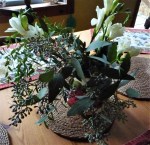
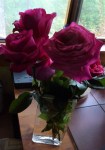
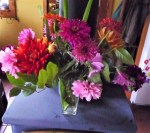
Anyway, it was wonderful, all of it. Some brought flowers.

jane's bouquet

roses

harrisons on the woodstove

After the reading, Bev Shaw sold books and tucked a copy of the little keepsake John printed into them. (It helps to have a husband who is a letterpress printer, among his other accomplishments.)

keepsake with linocut

People ate and talked and I thought how the whole evening was a gift. A year ago, I wasn’t sure how the future would unfold because of what tests and scans had revealed. That’s all in the past now, part of the never-ending story that I am constantly listening to, trying to tell.


today

Today I’m expecting my new book to arrive. It’s my thirteenth book and I should be blasé about it but I have to confess that this never gets old—the anticipation, the greediness to simply hold the book in my hands. To read what I wrote in a form that is not a computer screen or pages from my printer. Will the cover really look as lovely as I hope it will? Did I leave anyone out in the acknowledgements? Did I miss any major spelling errors? (I have the excellent Mother Tongue team behind me…)

A year ago this week, John and I went to Vancouver for a couple of reasons. He was scheduled for a biopsy and we were meeting Forrest, Manon, and Arthur at a hotel near the airport; their flight was going to be late and because we had to be in town the day before, we booked a room at the hotel where they’d be staying so we could bring them back home with us the next day. John had already had a biopsy a few years earlier and thought this one would be like that one—a little uncomfortable but not so big a deal. Somehow the fasting was more difficult this time around and by the time we drove down the Coast, took the ferry across Howe Sound, made our way over to the hospital, and waited, waited, for the procedure, he was pretty woozy and depleted. It didn’t seem like the time to tell him that I could barely breathe.

After a belated breakfast, we went to Richmond to the hotel and had a long nap, followed by dinner nearby. If I sat up straight, it was better. Lying down was painful. I quietly wondered if it was something to do with my heart. Or what? But then a text came to say that our young’uns were enroute to the hotel and there we were in the parking lot as the shuttle pulled in, hugging them, helping them up to their room with all the stuff you need when you travel with a baby. (Arthur was not yet a year old.) Though I have to say they travel quite light. And we have a big basket of cloth diapers, covers, shelves of clothing bought at thrift stores, in varying sizes because there are three grandchildren. We have a crib, a highchair, toys, and books.

And then it was morning and we were in our car heading home, Arthur in the car seat we’d recently bought. We were driving home, singing to the baby (though I had a hard time catching my breath), and stopping here and there for snacks, a bit of a break.

That night, just as we were getting ready for bed, I told John I thought he better take me to Emergency in Sechelt, a 45 minute drive from us. I couldn’t breathe and the pain in my chest was phenomenal. He was feeling a little grim himself but raced us down the Coast and the rest is the story of the year between then and now. Double pneumonia, which shouldn’t have been such a big deal—antibiotics worked quickly and well—but the first chest x-ray was disturbing apparently, full of weird stuff, and a second was scheduled for two weeks later.

But before the second x-ray, somehow the week of my family’s visit was memorable. Angelica came for part of it and everyone helped to make beautiful meals. After a day or two of the antibiotics, my breathing improved and the pain went away. We went up to the Laughing Oyster restaurant one day for lunch (it took the whole day because there was the ferry between Earls Cove and Saltery Bay, the long drive to Desolation Sound…) and it was wonderful to sit by the weathered wooden rails and look out to Okeover Inlet, drinking lovely cool white wine (I’m not one of those people who eschews wine while on medication…), watching seals in the water below us.

okeover.jpg

The second x-ray led to a CAT scan 6 weeks later, then a second hurriedly arranged (I was driving home from the first scan as the radiologist was frantically trying to call me) because that one showed not only a pulmonary embolism but also strange shadowy areas in my lungs which were thought to be metastases. There were tests, more tests, blood thinners to keep more clots from forming (and not rat poison but something new and very expensive that made me grateful again for Tommy Douglas and our health system), doppler scans of my legs, a visit to a specialist who showed me images of my lungs that were like maps of deep water, with areas I thought resembled amoebas. No, not amoebas, he assured me very formally. But maybe metastases. He used a pointer to describe the margins. He spoke of biopsies, gold standards of treatment, and so forth. He also scheduled a PET scan at the Cancer Clinic. He hoped this could happen before Christmas but it was possible I’d have to wait until shortly after.

So that was the fall. John’s biopsy results were negative, a huge relief, but the poor man was so worried about me that other issues developed. I insisted he swim to relieve some of the stress and he went off three mornings a week to our local pool (where our children learned to swim three decades ago). And what did I do? I wrote most of a book. In late summer, around the time that I was developing double pneumonia (though I’m not implying the two are linked!), Mona Fertig of Mother Tongue Publishing wondered if I might have a non-fiction manuscript she could consider for fall of 2017. I didn’t think I did. I’d written a long essay called “Euclid’s Orchard” and I had two other short essays in something like final draft form. Masses of notes, masses of fragments, all of which I hoped to eventually turn into essays or maybe even something longer, of a piece. These had to do with research I was doing into my family’s history in Canada. In the spring of 2016, John and I were in Alberta and I spent a little time at the Archives in Edmonton, thinking I’d find one thing and instead discovering a whole chapter of my grandmother’s early years in Drumheller that I hadn’t known and I suspect my father hadn’t known either. We drove down to Drumheller that spring, hoping to find out more. And it might sound strange to say this but there were ghosts everywhere, some of them mine.

In the nights while John slept, I came down to my desk and turned on the little lamp to make a small light to work by and I wrote about three quarters of the work in the manuscript that I did send Mona in late November and that she liked enough to say, Let’s do it! It wasn’t in finished shape in the fall and winter but I felt that I needed to do what was required to make it as good as I was able to. I didn’t know if I’d have more time, more seasons, and there was no one else who cared enough about the material to do anything with it. Maybe “care” is the wrong word. My brothers care and my children care but somehow I felt that I was called to do the work. I saw my ancestors everywhere in the winter. Looking out to the patio, they were just leaving, wispy in the cold air. Before sleep, they were around my bed, holding the edges of the sheet. I felt their hands on my shoulders. I felt them in me. I can’t say I regret the strangeness of that time, the uncertainty. I learned things. I was given things. I was welcomed into the odd embrace of people dead a hundred years. They spoke to me, though I couldn’t understand their language; and they sang to me. In the darkness, I might have felt alone but thanks to my ghosts, I was never so surrounded by love and continuity. This is true for my living family as well.

I wrote about the post-Christmas PET scan here and was relieved a few weeks later to learn that there was no sign of cancer after all. A final scan in June was also negative. My specialist says he doesn’t need to see me again. A happy ending certainly, though there are still mysteries: if not metastases, then what? And the embolism? Who knows. I joined John at the pool three mornings a week and all summer we’ve been going down to Ruby Lake around 8:30 and swimming for half an hour. Some mornings there are kingfishers. Always crows. Some mornings there are bear tracks in the damp sand. Ghosts there too but more familiar ones. My children from infancy to adulthood, and their children. When Forrest, Manon, and Arthur were here last month, they came down to the lake  with us and I loved hearing their voices as I swam back and forth in the green water under the old cedars.

P1130317.JPG

Someone recently said to me, “I didn’t think you’d have another book out so soon.” Well, no. I didn’t either. But sometimes the stars conspire, they spark and set off fierce events in our lives, and we respond. I felt like a door opened. What was beyond was a little frightening but also mysterious and beautiful. Some days I still feel as I felt on the winter day when John and I listened to Christy Moore singing an arrangement of the Yeats poem, “The Song of Wandering Aengus”.

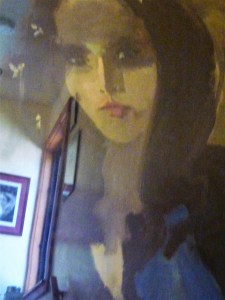
We held each other and wept, for the uncertainty of our future, and for everything we loved, and when the song finished, I went downstairs, looking up to an old portrait of me, painted when I was 22, another of the ghosts who gave me comfort on those dark nights. Who is still alive to me. (I couldn’t photograph her well because she’s in a stairwell and so you see everything else reflected in the glass but maybe that’s appropriate.)

me, in the last century

…someone called me by my name:

It had become a glimmering girl

With apple blossom in her hair

Who called me by my name and ran

And faded through the brightening air.

And look, apple blossoms in her hair.

proximate

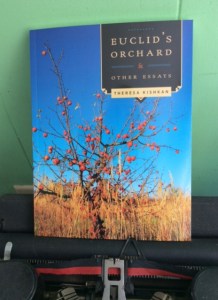
Yesterday my publisher Mona Fertig sent me photographs of the approval copy of Euclid’s Orchard. (It had just arrived at her house on Salt Spring Island and she knew I’d like to see how beautifully it turned out. The physical book, I mean.) And oh how lovely! The cover’s sky is particularly gorgeous, given our own grey haze, the result of fires burning all over British Columbia.

euclid

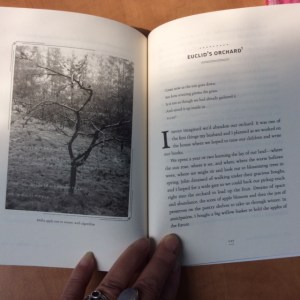
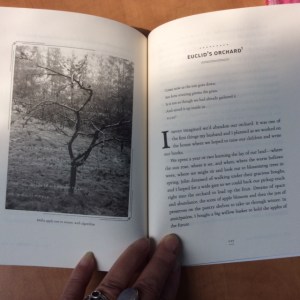
But it was the inner spread she also sent, the opening page of the title essay and the image I chose to take the reader into its world, that I am so happy with. It’s a Melba apple tree, in winter, in the orchard we planted so joyfully (and with a lot of hard work) back in the 1980s and then finally abandoned, with sorrow, a few years ago. The essay explores this and it also explores my attempt to decode some of the mathematical ideas so integral to my son Brendan’s life, both in his childhood and now as a math professor in Alberta. I wanted an image that was somehow proximate, that referenced history, pattern-making, botany, the relationships between quilting and Euclidean geometry, and the ghosts who hover in our lives—our younger selves, our ancestors, the disembodied voices of coyotes in the night, even Euclid of Alexandria himself, with his Elements and his proofs. Brendan was good-natured about helping me with so many things while I was writing this essay and his patience continued as I co-opted him to produce a Euclidian algorithm in various forms in the hope that one of them could be layered with the Melba apple tree in winter. Designer Setareh Ashrafologhalai worked her magic and voila!

page

Old moss and lichen, bare boughs, and the technique for finding the greatest common divisor of two integers. Magic.

it’s a (cover) wrap!

I’m really thrilled with Setareh Ashrafologhalai’s cover design for my forthcoming collection of essays, Euclid’s Orchard. Mona Fertig at Mother Tongue Publishing is a pleasure to work with. Small but vital! And she pays attention to important details, using excellent graphic designers for the books she publishes. One thing I love about this cover is that the title caps are from the late Jim Rimmer’s font, Amethyst. Jim was devoted to fine book design and his fonts are very durable and elegant.  And Setareh’s work is always so fresh and beautiful. She designed my novella, Patrin, and the pages are as lovely as the cover. I can’t wait to see what she does with Euclid’s pages!

Euclid's Orchard_cover Final.jpg