Today she’d be 98.

new spiral

This week I’ve been working on a quilt, sewing by the fire, and thinking. My mind wanders along paths, some expected (travel plans a bit later this month have me figuring out some details) and some sort of unexpected. My mum’s birthday is today. If she was still alive, she’d be turning 98. A few years ago I was impatient for 2026 to arrive because that’s 100 years after her birth and I would finally be able to access her original birth certificate, the one with both her parents’ names on it. She knew it existed but then it disappeared. And although she was reluctant to pursue the search for her birth parents, I have been doing it ever since she died. She had been raised by a foster mother, the one she thought of as her mother, in a household with a much older foster sister and brother. When I first met her foster mother and sister — we were instructed to call them Grandma and Aunt Helen– I knew, even at the age of 8, that they didn’t consider my mother a member of their family. She had a place in the stories they told about her childhood but every one was qualified by her status as a foster child. Don’t you want to know who your parents were, I’d ask her, and she would cry a little and say, I did want to know from time to time but then I’d remember that Grandma Emma was my mother. She raised me after all.

I was impatient for 2026 but in the past few years, little by little, the information about her birth parents has come to me. First there were the DNA matches, the close ones, and there was a pattern to them, leading to a single name: the name of her biological father. I had some correspondence with members of his family and they conceded that it was possible, even likely, that the connection was real. There were dates and places and those lined up. Then in October of 2023, the woman who would have been my mother’s sister-in-law contacted me to tell me of a discovery in an old tin box. A letter from my mother’s biological mother to the man who was my mother’s father. I wrote about this then. And little by little, more information has come my way, mostly thanks to my son Forrest who found my mother on the 1931 census, listed as a “lodger” in her foster mother’s house. He found information about her mother, who was a widow with 4 children when she became pregnant with my mother. I gather she didn’t want anyone to know and so she gave my mother away and had no contact with her for the rest of her life. She remarried and died of cervical cancer at the age of 57. Forrest found obituaries for some of her children, who were of course my mother’s half-sisters and brother. My mother’s father also had two sons so in total she had three half-sisters and 3 half-brothers. She never knew any of this. This, in contrast to my father’s mother, who had 9 children, one of whom died, with her first husband, and after she was widowed, she met my grandfather, with whom she had 2 more children, one of whom died. In my grandfather’s obituary, these children were all listed as his children, and my father considered them his brothers and sisters, no halves about it. My mother was always a bit of an outsider at the gatherings of my father’s family, mostly because they all liked to drink and carouse, and this made her nervous. But I wonder if she simply didn’t know how to be a member of a large and loving family. When she met my father and married him, when the two of them brought 4 children into the world, her family became her whole world.

with mum on stoop

This week I’ve been working on a quilt, sewing quietly by the fire, listening to the snap of dry fir, and thinking about my mother. What would I tell her, if I could have an hour or so with her now? Would I tell her the whole saga of her mother in a house in Sydney, Cape Breton, with 4 children, waiting for the 5th to be born, hoping to do this unnoticed. There’d been talk of her going to Quebec to have the baby but she didn’t. Instead my mum was born and given away to a widow in Halifax with two children, the older daughter, who always reminded us later that my mother wasn’t a true sister, and a son, who was almost certainly abusive. He did not come to a good end. I think I wouldn’t tell my mum any of the stuff she didn’t know. Who needs to be reminded they were handed over to a woman living in a dark house in Halifax, her status described as “age 5, a lodger” in the 1931 census, and who needs to be reminded her biological parents never sought her out in later years? No, I’d hold her hands and tell her I love her, loved her always, even during those years when we barely talked and she called me ungrateful and I wished I lived a million miles away. Today she’d be 98. Each of her children is still alive, I keep her camphor wood chest in my house with her bottle of My Sin perfume in its box inside. And the path I am sewing, the winding path of blue thread, leading away from the spiral where it began, winding away for too many miles to count on my fingers, leads to her. It always will.

winding paths

All these years and all these roadsNever led me back to youI’m always five hundred miles away from homeAway from home, away homeAlways out here on my ownI’m still five hundred miles away from homeI’m still five hundred miles away from home
“when sorrows come”

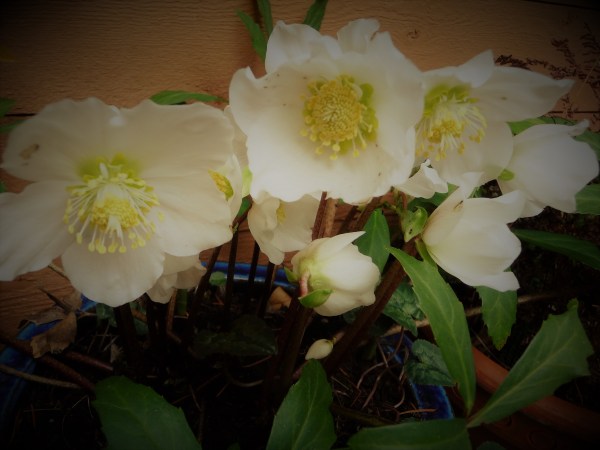
hellebore

The hellebores are blooming by the front door. Sometimes on a grey day that’s all it takes to boost the spirits. Sometimes a little sleep would help too. For the past few nights I’ve had difficulty sleeping—last night I got up at midnight to spend a few hours at my desk and then went back to bed. I was still awake at 5. I feel as though I’m underwater, moving slowly, asking for everything to be repeated. But to be honest? I love to be up in the very small hours of the morning, just after midnight, when the house is so quiet you could hear a mouse. And sometimes it is a mouse, one brought in by Winter, scurrying around and trying to find a safe place. Last week a mouse huddled under a wooden box and I used a feather duster to brush it into a rubber boot. When I let it go on the upper deck, it raced to the grape vine and disappeared down its woody trunk, as though it knew exactly how to navigate the sides of our house. But no mouse last night. Utter quiet. I was trying to puzzle through some family connections and had a file folder, an actual paper one, on my desk. Just as we were leaving for Ukraine in September, in fact sitting in the ferry lineup at Langdale enroute to the airport, an email arrived on my tablet from the young woman who is my aunt Ann’s great-granddaughter. (Hello Amanda, if you’re reading this!) We share some relations but not all. Her great-grandmother was my father’s half-sister. My grandmother was Amanda’s great-great-grandmother. But Amanda is on the same quest as I am, finding out how people fit in our vast family tree and she’s been very helpful in locating documents. What arrived in September were some death certificates as well as a marriage certificate. And they weren’t what I expected. The story I’d always been told was that my grandmother’s 9th child, the last one born to her and her first husband, died of diphtheria, just 7 months after my grandmother’s husband died of Spanish flu. I’ve known that story and a few years ago I learned another sad part of it: my grandmother’s brother, who’d come to Drumheller just a month after she arrived in 1913, and whom my father never knew anything about and who isn’t remembered in the village he and my grandmother came from in what’s now the Czech Republic, died within days of my grandmother’s first husband. I learn from the forms sent by Amanda that my grandmother’s brother died in her home, a bare shack in a squatters’ community in Drumheller, and that he died of Spanish flu, yes, but also of blood poisoning. And that the baby, 10 months old at the time of her death, died not of diphtheria but of malnutrition and whooping cough. Malnutrition. I was shocked to read that but maybe I shouldn’t have been. A woman with 9 children, one an infant, loses her husband and her brother within a couple of days of one another, without much English, with no means of support, in a shack in a small town ravaged by a flu epidemic—how difficult it must have been to simply go on, let alone produce milk to keep an infant alive and strong. In later years, my grandmother had a cow but not then. So that infant died in May of 1919 and less than a year later, my grandmother re-married. Her new husband was the man who became my grandfather. They had a child in 1921, her 10th child, his first, and almost exactly 3 years later, that child died too. My father told me his sister had died of diphtheria but on the death certificate, the cause of death is “Septic tonsillitis”. Two years later, my father was born.

In the night when I was puzzling through these details, making a little drawing to figure out the time-frame of each event, I thought how sorrow must have been the abiding atmosphere in my grandmother’s house during those years. One death after another, two of them the frayed threads that connected her to the home she’d left in the Beskydy Mountains, the young husband she’d married in her early 20s and her brother, who lived in a dwelling dug into a bank of the Red Deer River, the third a thread of hope, a small life to care for and to survive for. Or maybe she simply couldn’t care for the baby, couldn’t rise from her bed, couldn’t nurse it. There were 8 other children in the shack. Probably not much food. I thought of Claudius, in Hamlet: Oh Gertrude, Gertrude, when sorrows come, they come not single spies, but in battalions.

Hellebores have their roots deep in folklore and the one growing by my front door is a Christmas rose, its name alluding to an old legend in which a young girl who had nothing to give to the Christ child wept; her tears fell onto snow and hellebores sprouted from them. They are lovely, yes, but also toxic.

redux: the Passable Builders at work

Note: this was two years ago today. I’ve been out on my own deck, planting zinnia seeds and moving pots around, remembering the pleasure of watching my sons and their father work together, making jokes, adjourning for beer at the end of the day. And somehow during those days in Edmonton, inbetween walks with the children, making food with my daughters-in-law, driving out to the Ukrainian Village Museum,  I proof-read the final galleys of Euclid’s Orchard with those same men and their lives on almost every page.

********

One plan for our time in Edmonton, if weather and time conspired congenially, was to help Brendan and Cristen replace a rotting porch at the back of their house in Strathcona and to build a new free-standing deck under the leafy maples in one corner of their back yard. It’s the place where outdoor tables go for summer meals and so plans have passed back and forth between John and Brendan for a few months. Best size? Lumber dimensions? John loves a project like this. It’s been a long time since two neophytes (poets!) built a house on the Sechelt peninsula and though many projects have arisen since then—adding rooms to accommodate a growing family; replacing the original decks —I have to say that my husband loves construction. I told him once that I thought humans had vestigial building knowledge in their hands and when the need arose to call on that knowledge, it would be there. (I know you’re rolling your eyes!)

Forrest, Manon, and Arthur planned to spend a week in Edmonton too. Five of our days overlapped with theirs. (I just took them to the airport.) All week John and his sons measured wood, hammered joists, screwed down long lengths of lumber for the decking. They joked that they were the Passable Builders (their surname being Pass). This morning, after breakfast, I asked them to sit on the porch (which may or may not see railings and perhaps a bench or two):

passable builders, with foreman

The old porch is waiting to have its nails removed:

old porch.JPG

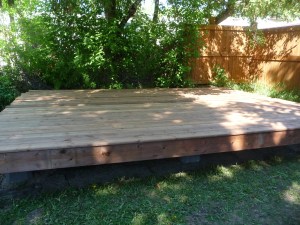
And here’s the deck where we’ll eat our dinner tonight (the remaining two Passable builders are out buying the last two pieces of lumber to finish it as well as stair materials):

deck under maple

While details were being weighed and pondered (“Measure twice, cut once.”), I looked over to see how weeds thrive in sunlight:

weed thrive in sunlight


“Something that happened a century ago, west of the 4th Meridian.”

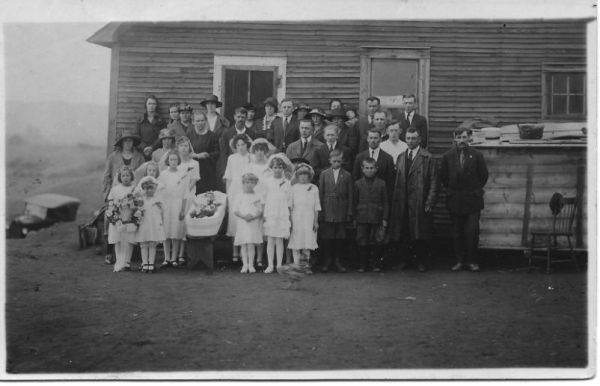
julia's funeral

From Euclid’s Orchard, published last fall by Mother Tongue Publishing:

And did my grandmother ever tell us of her first husband and the shack he built for her on the banks of the Red Deer River, how he dug a garden in preparation, how he went under the earth for coal, some cold potatoes wrapped in clean cloth, or did this come from an aunt, looking back under poplars in a yard, thinking of the distance a family travels, by water, by rail. As far away as the Carpathian Mountains, so far that some of them die on the way to lives of their own? Two babies buried in the Drumheller cemetery, where we saw showy milkweed, heard the click of beetle wings, the small strophe of local music almost too faint to hear. And a husband, a brother, either sleeping in the mass flu grave or else somewhere forgotten,their own journey abandoned too soon.No,I don’t believe she told me.All of this I gleaned from a sentence here or there, a fragment of song, a remembered prayer on a string of beads. Something that happened a century ago, west of the 4th Meridian.

Migratory, like monarchs, we find our own urgent way to a place where the sun and earth greet us, give us rest. We find our place among wild plants on a roadside, we hear beetles and the lazy drone of bees. If we sit on the grass and let the dry wind ruffle our hair, will the voices come to us again?

“Boy and baby only. Fair. Grey blue.”

I’ve recently finished reading Lorri Neilsen Glenn’s Following the River: Traces of Red River Women in which she travels both physically and imaginatively through the country where her great-grandmother Catherine lived and died. Rupert’s Land, Selkirk, Norway House, Warren’s Landing—all these places hold traces of the family story. I won’t tell it here. But it’s worth reading, both for the elusive strands that have been painstakingly recovered, in part or in whole, and woven into something both practical (because we need these records of our ancestors to help us understand our own place in the world) and beautiful, and for the deep sense of the land and what it remembers (those traces). Abandoned graveyards, modest monuments to lost or murdered young women, foundations of buildings long fallen to earth. There’s poetry here, there’s prayer, there’s the simple naming of names in all their possible variants, from both English and the different dialects of Cree that shaped Lorri’s family.

My family history began on a different continent. But there were many moments when I saw in Lorri’s book something of my own attempts to parse the language of old documents and photographs, some of this in a language as difficult to shape in my mouth as Cree was for Lorri. Sometimes what I tried to read wasn’t language at all but images. It was often strange and frustrating but then there’d be a moment when I understood what I was seeing. Lorri realizes that a photograph of her great-grandmother with her husband and children was taken after Catherine’s death and that Catherine’s head has been imposed upon another woman’s body for the sake of the photograph. Thinking about Catherine’s daughter, Lorri’s own grandmother, she wonders, “What must it have been like to stand behind someone else’s body wearing your mother’s clothes, holding still until the exposure was complete, feeling such profound absence?”

I had such a moment with my musings about family photographs and I remembered writing about it on this blog. Here is a post from July, 2011, as I was finalizing the proofs of my book, Mnemonic: A Book of Trees.

 The Moirs Happiness Package


In my forthcoming book, Mnemonic: A Book of Trees, there’s an essay about my father and his father. I don’t know much about my paternal grandfather and in this piece, I try to puzzle through the mysteries of family connection, try to find traces of my grandfather through the small clues in my father’s stories, the tiny hoard of memories. At one point, I was thinking about two photographs in the basement of my parents’ home in Victoria. This is what I wrote about one of those photographs:

“In the second photograph, my father stands in his white shirt, short pants, dark stockings, and boots on a rattan chair. Someone has told him to stand still, because there is nothing natural about his pose. But — and here’s the bizarre thing — hovering in the air, as though balanced on the arm of the chair, is the swaddled form of his sister Julia, who died three years before he was born. This is the late 1920s, before Photoshop — before any of the techniques we are now so accustomed to using. I know that photographers could manipulate images even in the nineteenth century (I think of Hannah Maynard in Victoria with her trick portraits and artistic interpretations). But this is clearly the work of someone who didn’t have much skill at all. The half of the photograph in which baby Julia has been inserted is blurry.

That only this one photograph survives suggests that although money was probably in short supply, my grandparents wanted a record of the two children they had conceived together. Perhaps they were more sentimental than I’ve been led to believe, because what other reason would result in an image of a baby being inserted into the photograph of her brother-to-be, at least five years after her death? Julia was nearly three when she died, and yet the photograph is of an infant, wrapped in a blanket, wearing a hat against the cold.

Photographs are intriguing but ultimately unsatisfying. I’ve tried to read these ones for hidden narratives of love and family connection and perhaps I’ve interpreted them completely incorrectly. Still, sometimes photographs with their cryptic stories and forgotten conclusions are all we have.”

I wrote the essay as my father was dying and since then my mother has died as well. I brought home that photograph (a grainy image clumsily cut to fit in a wooden frame) and many boxes of family papers which I’ve been slow to sort. Every time I open a box, the smell of the past – dust, old cigarette smoke, the sadness of missed or lost connections – overpowers me and I close it again, thinking that the time will come when I’m more resilient or at least able to look at the materials without crying.

The day before yesterday, I opened one of the boxes, determined to put together some photographs for a family project. The problem is, nothing is sorted or organized, so in some ways, I’ve no idea where to look. There are some albums, yes, but then there are also envelopes with bank statements, stray photographs caught between them, or my high school report cards shoved into folders with baby pictures, drawings, my grandmother’s naturalization papers from 1937, etc. Where to begin?

I began with the Moirs Happiness Package, a chocolate box with a bluebird on it, and the slogan, “There’s happiness in every box.” Inside, a small collection of  photographs, all of them bent and foxed, and all of them as astonishing to me as anything I’ve ever seen. My father was the only surviving child of his mother’s second marriage. The first child of that union was Julia. She died of diphtheria, I believe, and is buried in Drumheller, Alberta, where the family lived. There are two photographs of Julia’s funeral. One shows a group of solemn people in front on a bleak house, the men and women dressed in dark suits, the girls (some of them must be the daughters of my grandmother’s first marriage) in white dresses and veils. A small white casket is set on a wooden bench. The second photograph is taken inside. The casket is on a table covered with a starched white cloth and is flanked by two girls in white. A child’s face can be seen surrounded by flowers: Julia.

There are two other photographs, too, which I realized were the ones which had been brought together to create the large image of my father and his sister. What’s amazing is that there are notes on the back of them, obviously the work of the person charged with “regrouping”. Notes about tint and placement. “Boy and baby only. Fair. Grey blue.”


There’s so much I don’t know. I want to find out more about my grandmother, a woman who was born in Horni Lomna, in what was then Czechoslovakia, in 1881 and who left, with her first husband, Joseph Yopek, in 1913. He died of flu in 1918 and she was left with 8 children. She married my grandfather a year or two later (I should know when and will try to find out), giving birth to Julia, and to my father, in 1926.

Our recent house-guests from the Czech Republic, Petr and Lenka, showed me pictures of Horni Lomna. It’s a small village in Moravia, nestled in the Beskydy Mountains. When John and I return to the Czech Republic next February, I intend to go to my grandmother’s birthplace and see if anything remains – a name in a cemetery, in a parish record, perhaps.

And a coda to that post. I did go to my grandmother’s birthplace and although I couldn’t enter the graveyard because of snow several feet deep, I did walk down a road by the Lomna River to stand in the snow and look at the house where she was raised, where she lived with her parents and her five children while her first husband went to Canada to make a home for them to come to the next year (1913). What happened then is the subject of a long essay in my most recent book, Euclid’s Orchard. And yes, it involves photographs, old documents, reading a landscape as foreign to me as the languages my grandparents spoke.

horni-lomne-26