a small jug of sweet peas for their 67th anniversary

sweet peas

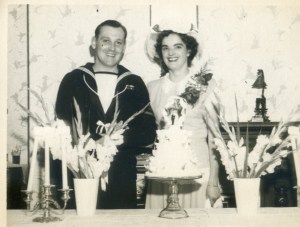
It would have been the 67th anniversary of my parents today. They were married in Halifax not long after they met. Four children, many houses (my father was in the navy), many tea-chests opened in new places to discover that treasured items had been broken. Hockey games, Little League practice, hospital visits for tonsils, fire-cracker burns, a fractured pelvis from a horse accident (me), camping trips to places far and near, fishing rods propped against a wood pile. Readers of my forthcoming book will learn far more about our relationship than might be comfortable—like so many families, ours was complicated. But there are moments when you’ll see how much I loved them. Love them still. And am grateful for them meeting (it was a blind date), marrying, raising their children to care about the world.

When we returned that day from CFB Esquimalt with the stranger who was our father to our house on Eberts Street, my parents went into their bedroom and we were asked to leave them alone. I imagined my mother twirling for my father in her new suit and then the two of them hugging on the bed. Her Harris Tweed coat was hanging in the front closet, and I went in, closed the door from the inside, and put my arms into its satin-lined sleeves where I could smell my mother’s Avon underarm deodorant mingling with the wool. I was inside her coat, inside the embrace she was now sharing with my father. I was my mother, hidden from her children, the collar of the tweed coat rough against my neck.

(from “Tokens”, in Euclid’s Orchard)

mum and dad wedding day

Some days, she was Mrs. Nobody.

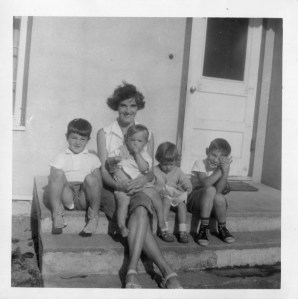
with mum on stoop

Thinking of my mum this morning, dead seven years.

Some days, she was Mrs. Nobody. How airily she’d say that, and of course it meant nothing to me. I never parsed the sentence, her too-bright smile. And some days, the Girl From Sooke, also said airily, a person who washed dishes in the one sink, putting them in the blue plastic rack, then dried them one by one with a linen cloth printed with lobsters from Peggy’s Cove or wild roses from Alberta. The Girl From Sooke, who lugged the laundry bag downstairs to sort and wash our clothing. And who polished the wood furniture with Pledge.

Mrs. Nobody sat at the kitchen table with her cup of instant coffee and an Export-A, wondering why the house never stayed clean, why it was so hard to make ends meet, why the dollars never stretched far enough. Her Redbook magazine helped her prioritize—put so many dollars aside for food, shop in bulk, can this marriage be saved?

—from “Tokens”, an essay in Euclid’s Orchard, forthcoming September, Mother Tongue Publishing

a rose is a rose is a rose

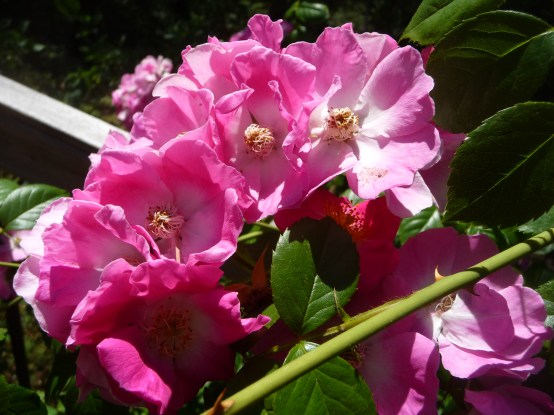
american pillar.JPG

This past week, I finished the final proofs of Euclid’s Orchard and now it’s gone to the printer. Publisher Mona Fertig is so diligent, asking about tiny details that I’d overlooked, questioning dates on photographs, spacing. It’s a book of essays and each essay tries something different so there’s no standard format. Individual essays use epigraphs as starting points, or conversational ploys, or simply homages. Sometimes they need to be part of the actual text and sometimes set off more formally. Mona’s questions helped me clarify my own intentions. Some essays have endnotes, though the work is anything but scholarly. I wanted to remove too much extraneous material from the actual text but of course I also want to cite sources and identify the various voices that enter to speak at various points.

Today I’ve been watering and doing other chores with the thought of the book in my mind. Standing on the west deck just now, I looked at the beautiful old “American Pillar” rose that is pondered and finally identified in an essay called “Ballast”. It’s not the rose mentioned in this brief passage but it might as well have been. It can be found in settings just like this one.

In the woods between Elk Lake and Beaver Lake, I remember an abandoned house completely knitted into place by honeysuckle and roses. Knitted into my memory by roses of a kind I’ve never seen since, apple-scented, white, and humming with bees. On my black horse, I approached with the sense that here was an ancient fairy tale hidden in the woods. Which were not wild exactly but remnant—a few forgotten apple trees, pruned by deer, beaked hazelnut, even laburnum. I entered the tale, as a girl will, with a sense of wonder and expectation. I tied my horse to a tree and tried to peer in the window…

–from “Ballast”

in any way possible

new dawn

This morning I was up early, just before 5, to work on the corrections of Euclid’s Orchard. Before I got out of bed, I heard the dawn chorus begin, the sound coming in the window as it does every year. I wrote about this in my essay “Love Song”, included in The Summer Book, which had one of its launches yesterday at the Sylvia Hotel in Vancouver, an event I’d loved to have participated in but we’re leaving tomorrow morning for 10 days in Ottawa so I couldn’t get away so soon before our departure.

On an early summer morning, I wake to the sound of Swainson’s thrushes. Beyond my bedroom window, beyond the house, they sing where the woods begin. And there are robins, vireos, the long whistle of a varied thrush. My curtains are rough white linen and they filter light, the light at dawn, coming from the east, pink and golden as the sun finds its way over Mount Hallowell. My husband sleeps closest to the window and he pulls the curtains aside to let in more song. There is honeysuckle blooming, and dog roses, trumpet vines. Hummingbirds bury themselves in the flowers. The pink throats of the tree frogs inflate, a loud vibrato close enough to touch.

This morning I listened and then came downstairs to work at the dining table (my desk is too cluttered…), reading and correcting, and stopping now and then to think about how an essay began or to wonder if others would remember a particular event the way I do. I confess to a little trepidation about this book. It’s very personal. But when I wrote at least three of the essays, I was in a strange place; I was living between worlds, between the living and the dead. I know that sounds dramatic but it felt very much that way in the fall as I waited for the results of tests and scans, all undertaken because of the suspicious nature of some nodules in my lungs. For a time, it was thought that they might be metastases, which meant that every effort had to be made to determine either the location of primary cancer or to rule it out. I am grateful that the results were so good and that I am actually very healthy (I always took my robust health for granted) and in a profound way I am grateful also for the time I spent in the company of ghosts. I learned things. I finished things. My daughter Angelica translated a line from Ovid’s Tristia for me to use as an epigraph for one section in the essay “West of the 4th Meridian: A Libretto for Migrating Voices”:  I wish to be with you in any way possible. When I was writing the essay, I didn’t know what might be possible. I only knew I didn’t want to waste time. And this morning, getting up from the table to make coffee, I looked out to see the New Dawns cascading over a beam on the patio.  A warbler paused for a moment on the little hanging birdbath by the kitchen window. In any way possible

hold down the pages with flowers

pages

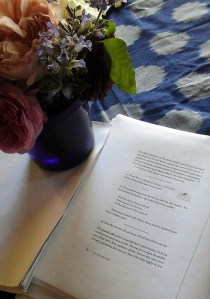
This morning, a pdf of the interior of my forthcoming book, Euclid’s Orchard. And notes about how to send the corrections. Print it out, read it, and send the corrections as pdf comments. I’ve published 12 books and every time I’m surprised by how different the text looks in the capable hands of a good designer (I mean you, Setareh Ashrafologhalai!). I love the font — the late Jim Rimmer‘s Amethyst — and I’m interested to see how the photographs, most of them old family snapshots, amplify the writing. So now I’m going to read the essays and correct my errors and hope for the best. For this book about family history, about the unwritten and strangely coded stories I’ve tried to parse, and about (of course) the role of plants in my own history and reading of the landscape, it seems fitting to use a pot of roses to hold the pages in place. It’s a sunny morning, with a soft breeze. There are hummingbirds in the honeysuckle and the robins are singing the salmonberry song. I wish there was a way to encode this music into the book, and the scent of roses.

“her gift of New Dawns”

morning roses

This morning I cut a bowl of roses for the kitchen—Madame Plantiers, a few dog roses from a wild cane (the rootstock for an alba which has since died), and few deep pink Tess of the D’Ubervilles. I love roses and grow a lot of them, not in any kind of tidy way, but simply finding a place where they’ll get light, pruning them in spring, and letting them go. I put pots of mint in among the tubs of roses on our upper deck—it helps to deter aphids. And I like to watch the vespid wasps scouring the leaves for scale and any other insects they can find to feed their larvae.

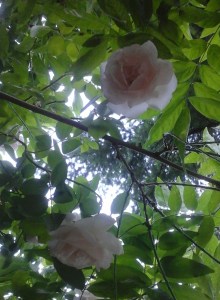
I’ve noticed this year that some of my roses haven’t thrived after our unusually long cold winter. One of the New Dawns, the one around the front door, is skimpy in both new growth and buds. There are two others so I think I will take some cuttings and see what happens. These roses came to me via an elderly neighbour of my parents when we first began our lives in this house. I wrote about her and her gift of New Dawns in an essay, “Ballast”, in my forthcoming Euclid’s Orchard:

I’ve taken my share of cuttings. My three New Dawn roses come from the garden of my parents’ neighbour, Daisy Harknett. In her eighties, she told me how her mother started the roses from a slip given her by the Ferry sisters, a duo who lived nearby in one of the oldest houses in Saanich. The New Dawns, the palest pink (the colour of my baby daughter’s shoulders when Daisy gave me these cuttings), tangled themselves in the limbs of an equally ancient pear tree. That tree, with its cargo of roses! Later, the property was subdivided, and the back part, with an old stable, was sold. A man pulled out the rose with a backhoe. I don’t know where he took it.

     Some old wood, some new wood, said Daisy Harknett. So I cut pieces with both. I dipped the lower part of the wood in rooting hormone (though I could have used a tea of willow bark) and stuck them into little pots of soil. And now my New Dawns tumble over a beam, a pergola, and the front door of my house.

I want the New Dawns to continue, both because I love the roses themselves and because I want something of that time—the Ferry sisters, whom no one else seems to remember; Daisy, who had a family who will remember her and her roses (and wonderful pears); and the kind of ballast that inherited plants provide to our lives.

the same chair

my father

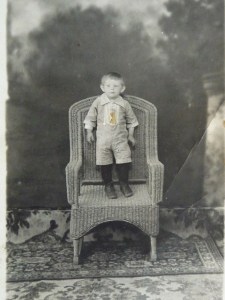
It was the same chair where he sat fifteen years before, newly liberated from his job as a radar technician, and made himself simple tools—a cottage cheese lid cut into a circle and rigged with glass and a tiny mirror became a sextant; cardboard, string, a plastic straw, and a fishing weight became a quadrant. He had patience for this intricate work, but I don’t believe he ever did anything beyond finding latitude in his back yard and filling paper with sums. Maybe on the long sea voyages that took him away from us for two or three months at a time—once, six months—to the “Orient,” Australia, around South America. Maybe he was the sailor who left his bunk and looked at stars at night and wanted to know how to find his way, though by day he worked with radar systems, repairing them, fine-tuning them so the vessels were anything but dependent on celestial navigation. It would have made sense to have learned then, when he could perhaps have applied the knowledge to the dark skies near the Antipodes or approaching Madagascar. (from Euclid’s Orchard, forthcoming, Mother Tongue Publishing.)

among schoolchildren

in school
two schoolchildren, one with a black eye.
O chestnut tree, great rooted blossomer,
Are you the leaf, the blossom or the bole?
O body swayed to music, O brightening glance,
How can we know the dancer from the dance? —William Butler Yeats (of course)

Here in Edmonton I am caught in a wrinkle of time. Every day I walk over to spend time with my grandchildren, the two that live here and, until yesterday, the one visiting from Ottawa. This neighbourhood, Strathcona, isn’t one my family lived in. When my grandparents moved to the area from Drumheller, in the late 1930s or early 1940s, they moved to Beverly. I’ve written in previous posts about the bill of sale from the Prins family for a small house my grandfather relocated to a piece of property in Beverly; and I have a file of bills and receipts for materials that indicate my grandfather also built a house on the property. I remember sleeping in a small house with a tin roof, separate from the main house, and how my brothers and I raced to the other house during a hail storm where we found my parents and my grandparents drinking coffee and talking.

The other day, some of us drove out to the Ukrainian Cultural Village Museum. I’d been before but wanted Forrest in particular (a historian who works in a museum) to see the churches, the train station, the Bukovyna house that must be something like the one my grandfather lived in before he came to North America. The grandbabies loved the chickens and pigs and spent a lot of time picking dandelions while Forrest, Manon, Cristen, and I tried to see as much of the historical material as possible. I think there’s something missing at the site (thank you, Myrna Kostash…)—from my explorations in Drumheller last year, I know that the Ukrainians in Canada were involved in the labour movement, and yet there’s not a whiff of any of that history at the Cultural Village Museum. My grandfather was a coal miner and so was my grandmother’s first husband, as was her brother. But still we had moments in the Museum, walking to and from the churches, watching a man scatter seed for the hens, hearing the price of cream (with and without freight charges) at the train station, where I had some insights into the lives of my grandparents in those early days in this province. And when we went to the Russia school (so-called because of transcription slips between the Cyrillic and the Latin alphabet), two of my grandchildren sat at a desk to scribble on slates and I remembered something my father once told me about his mother. It’s included in one of the essays in my forthcoming collection of essays.

Your parents barely spoke English. You said your mother attended school with you when you were six so she could learn to write, her large body somehow fitting into the chairs in a primary classroom. Of course this brings me to tears. Your parents were struggling to make a living so you were raised mostly by your grown half-sisters. They adored you, gave you every attention, and made you into one of those boys convinced of their superior authority. —from “Herakleitos on the Yalakom”, forthcoming in Euclid’s Orchard, September 2017.

a few more hours

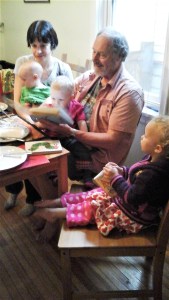
The hours pass. The days. I spend time with my sons and their families and I work on the copyedits of my forthcoming book (Euclid’s Orchard) in the quiet hours in between. I hear cars on 99th Street and magpies in the trees right outside the window. The hours pass. A soccer practice—

in the moment

Time at the splash park—

cooling off

And lots of time for reading—

reading

I respond to the copyeditor’s queries about commas and the use of italic and my mind is both in this collection of essays (which is itself rooted in my family’s history in this province, among others) and in the lives of these beautiful children.

What I took home: the memory of all of them laughing, baby Kelly crawling on the grass, the sound of glasses clinking, the excitement of waking in the morning with the knowledge that I could be among them for another two days, another day, a few more hours. A few more hours. (from “Ballast”)

“it will all become clear to me”

Yesterday we left the Word on the Lake Festival in Salmon Arm after two intense days of workshops, conversations, much merriment, some interesting connections and reconnections. Myrna Kostash, for instance, read from a work-in-progress about her Ukrainian grandparents and old photographs and the urgency she felt to find out and record what she could of their lives. It was beautiful work. We talked afterwards about the stories we never heard as children but how we feel compelled to tell them now, though they’re in tatters and fragments.

John and I drove to Canmore for a night and then along Highway 1 to Cochrane, taking quieter highways until Olds and the journey north to Edmonton where our sons were gathered with their wives and children, ready for a building project that will happen this week. John’s family drove often from Calgary to the mountains in the years after their arrival in Canada from England in 1953. The road was windy and slow. It’s a route I took also as a child, though in the opposite direction, with my parents and brothers, traveling from Vancouver Island to my father’s parents who lived by then in Beverly and a little later to Edmonton itself after my grandfather’s death when my grandmother went to live with one or another of her daughters. My father would drive us to Drumheller to try to make peace with his earlier life there and there was so much he didn’t say, didn’t tell us, though the past hovered in the air as light and as fierce as mosquitoes. Once we stayed in the Rosedale Hotel and my mother made us sleep on top of the beds on our sleeping bags because the sheets were stiff with dirt. This wasn’t the Rosedeer Hotel in nearby Wayne, a little gem where John and I stayed for a night in the honeymoon suite last April and woke to frost on our window and the sound of magpies. For ages I didn’t think much about those earlier years but now it seems I am haunted by them and the decades that preceded them, when I was not yet born or even imagined.

I keep thinking that if I just pay attention, it will all become clear to me, the old house, how close it was to the Red Deer River, who slept where within its small dimensions, and how to find my own way to it, dreaming or awake. The place on the bridge where my father fished, his line taut in the current, his eyes green as the water. Dragonflies stung the surface of the river, wings like nets. — from “West of the 4th Meridian: a Libretto for Migrating Voices”, part of Euclid’s Orchard, forthcoming in September 2017.

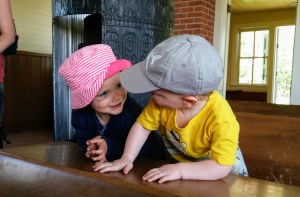
I looked over from my dinner under the maples in Brendan and Cristen’s backyard to see my older son Forrest playing with his niece Kelly and her cousin (Forrest and Manon’s son Arthur).
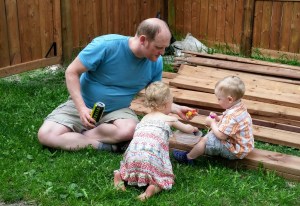
Forrest, Kelly, and Arthur

The lumber behind them will become a porch and a deck this week, if all hands are willing. And we will eat our dinners under the trees while overhead the magpies in the nest Manon and Arthur spotted yesterday in a big spruce make their sociable chatter. We don’t know how many there are but maybe by the end of the week we’ll see more of them.

Long walks through the ravine where we went today to see frogs (who remained hidden) in a tiny pond surrounded by lily-of-the-valley. Stories — I read five bedtime stories to Kelly (Arthur had already gone to bed at the little apartment his parents are staying in for the week) and looked over to see Brendan reading to Henry:
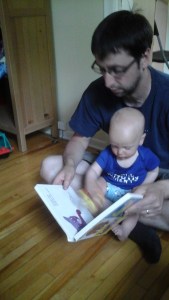
brendan and henry

These are the days, the nests, the babies and young children, the meals under leafy shade, and an urgency to record it also. To keep it all alive.