“One cannot step twice…

northwest territories

…into the same river, for the water into which you first stepped has flowed on.” — Herakleitos of Ephesus, trans. Guy Davenport.

I am thinking of my father today, his difficult love. As I work on an essay about his father, I begin to understand him differently. What was held close for reasons I’m trying to fathom, what was withheld, too, and for what reasons.

Herakleitos on the Yalakom River, on the Cowichan, on the far-seeing MacKenzie when you were young, the Red Deer, all those waters changing as we changed—and were ever the same. All roads leading to them, and away.
—from “Herakleitos on the Yalakom”, Euclid’s Orchard


Euclid’s Orchard also contains roses

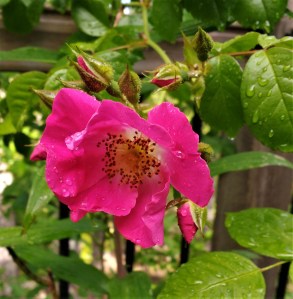
american pillar

The rose came from one of the annual spring plant sales at the Community Hall when we first lived here; you brought your box with you, and you got there early because everyone wanted the tomatoes or irises or Muriel Cameron’s dahlia tubers or bits of Vi Tyner’s roses. I’m not sure this one came from Vi Tyner, who did give me moss roses, a soft pink one and another one deeper pink in colour. But it grows everywhere—old homesteads, seaside gardens, along fences in semi-industrial areas as if remembering a former house, ancient care. It grows across from the Post Office in Madeira Park, for example, and I don’t know if it ever gets pruned or watered. And there’s a place on the highway, near Middlepoint, where one grew for years and years, until it was absorbed by the forest taking over the site of a cabin that I believed burned to the ground before we arrived in 1981. I’d thought a little about trying to identify it but somehow never did.

And somehow today was the day, so I took my rose encyclopedia and a cup of coffee out to the table and went through, page by page. Until I came to ‘American Pillar.’ Bred by Dr.Van Fleet in1902. A very prolific and widespread rose,and yes, it will survive any kind of neglect, it seems.

—from “Ballast”, in Euclid’s Orchard, Mother Tongue Publishing, 2017

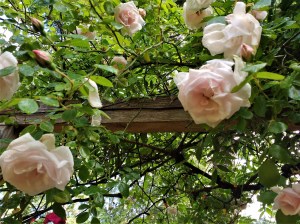
new dawn

Some old wood, some new wood, said Daisy Harknett. So I cut pieces with both. I dipped the lower part of the wood in rooting hormone (though I could have used a tea of willow bark) and stuck them into little pots of soil. And now my New Dawns tumble over a beam, a pergola, and the front door of my house. The pear tree, with its heavy crop of honeyed fruit, is lost now forever, consigned to the same fire as the rotting fence posts, the stable door. Yet anyone who ate one of those beauties must surely remember the flavour. I took a bag of them to one of my classes at the University of Victoria in 1974 and handed them around to my classmates. The instructor, an Irish poet of some note, ate a couple of the pears in quick succession and said they were the best he’d ever tasted. Years later he published a memoir with ripe pears in the title, and although I haven’t read it, not yet, I’d like to think it might be an unconscious homage to Daisy’s pears.

— from “Ballast”, in Euclid’s Orchard, Mother Tongue Publishing, 2017

Watering the Melba

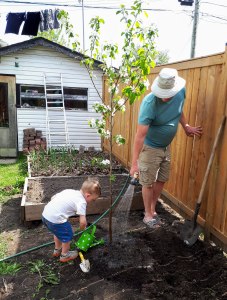
Yesterday this photograph arrived from Ottawa, with the caption, “Watering the Melba”:

watering the melba

These two young men are very dear to me. The taller one is my son. He was two years ago when we had land cleared below our house for an orchard. He and his younger brother, then an infant (and now a mathematician), sat in their car seats in our old brown pickup truck when we went to buy apple trees from Mike Poole on Norwest Bay Road in Sechelt.

Those first trees—bought from a man who collected heritage varieties and had an apple tasting weekend at his orchard on Norwest Bay Road in West Sechelt: we tasted, then ordered a Melba, a Golden Nugget, a Cox’s Orange Pippin. The trees were tiny, and we planted them reverently, shrouding them in old gillnet salvaged from the dump.

The Melba was my favourite. I loved sitting on the big flat rock under the mature tree, gorging on its fruit. When we finally gave up on our orchard and when John arranged for someone to come and clear out the underbrush to create a firebreak as a sort of insurance against what we fear most during the long hot summers that have come with climate change, he asked the guy to work around the Melba. But maybe the guy misunderstood or maybe he didn’t care. Our Melba is gone, and so is the Cox’s Orange Pippin, though I think the Golden Nugget is still there. I don’t go down there anymore because it makes me sad though in truth it’s been ages since we’ve able to count on any fruit because of the way elk, deer, and bears have damaged the trees. Gillnet, strands of wire, strands of wire with an electric current, chicken wire—the animals found a way through.

I was curious this morning to read a bit more about Melbas. My first thought when the photograph arrived yesterday was that Ottawa might be too cold for what I think of as a delicate tree. But this is what I found out on a site devoted to heritage apples:

Melba was developed in 1898 by the Central Experiment Farm in Ottawa, Canada, and introduced commercially in 1909. Lightly sweet with a hint of tartness, Melba’s fine, white flesh and thin skin give it a pleasing crispness, and it is good for both fresh eating and cooking. Its skin is yellow to lime in color, with streaks and blushes of pink and red.

Melba’s parents are McIntosh and Liveland Raspberry. Also known as Lowland Raspberry or Red Cheek, Liveland Raspberry is an early season apple that originated in the Lithuanian province of Lievland. Now rare, it was introduced into the United States in 1883. While McIntosh contributes to Melba’s fragrant, sweet-tart flavor, Liveland Raspberry influences its early ripeness, and supplies its tender flesh and thin skin.

The younger man in the photograph is my grandson, who is two, the same age his father was when we brought home our Melba. In “Ballast”, in Euclid’s Orchard, I wrote, “I’m interested in how plants travel, how they are carried to new places, how they are botanical palimpsests, in a way. And how they hold stories,some plain and true, and some cryptic.” The first thing I thought of when I woke this morning was the Melba in Ottawa, newly planted, newly watered, with a young family to care for it (another grandson is anticipated in July) and to enjoy its beautiful fruit.

“…we can’t help growing older.”

“O day after day we can’t help growing older.
Year after year spring can’t help seeming younger.
Come let’s enjoy our winecup today,
Nor pity the flowers fallen.” —Wang Wei (Tang Dynasty poet, c. 699-759)

just now

This May is warm and beautiful. Today, driving back from errands and lunch in Sechelt, the thermometer in our car read 24° until we reached the hill above Sakinaw Lake and then it read 27°. I am watching the tomato plants grow by the minute. And the purple tomatillos I planted, the ones that sulked for weeks, are also shooting up. Beans are green and vigorous, the kale is, well, everywhere (because it seeds itself so happily and prolifically), and the first rose is out, a Madame Alfred Carrière, soft blush pink, almost white. Last night a friend came for dinner and we sat out in the falling light and he wondered what we’d done with our orchard. Looking down the bank from the deck, he could see what I try not to think about: an area scraped clear of salal and spindly cedars, both of which had encroached upon the old area of grass, moss, and fruit trees. Some of the trees had been broken by bears. And with the shift in our climate, with the long dry weeks of summer that were once rare but now seem to be the norm, John has been increasingly concerned about fire. He wanted a cleared area to act as a fire-break if the woods ever did burn. He arranged for a guy with a machine to come and do stuff I didn’t want to know about.

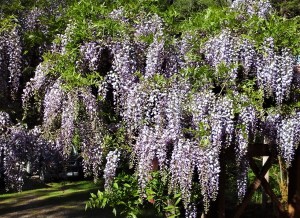
Our friend has been coming here for more than 30 years. He noticed all the lovely things—the faint birdsong, the wisterias in full and glorious bloom, the clematis fully recovered after the willow that supported it died and fell, taking the vine down with it. We watched blue orchard mason bees and paper wasps and drank wine as the air cooled once the sun went down. Overhead the various wind-chimes sounded their own music of shells, wood, and copper, all animated by the evening air.

I woke in the night, wondering how to allow myself to acknowledge the actual space where our orchard was. I try not to look at the bare ground when I stand on the deck overlooking that area. Last month, I refused to go down to smell the stray blossoms on a stunted pear, a stubborn Melba apple. But life is too short and too precious to turn away from what I’ve loved and what changed. As I’ve changed. As everything changes.

I did go once or twice over winter when various family members were here and wanted fires to roast marshmallows. Henry and Kelly helped John pile more sticks on the fire; Arthur too a few months later. It’s a different place. Maybe that’s the way to think of it, populated by others now—we saw a pair of coyotes trot across the cleared space in February, scouting out territory for their own family, at that point still unborn.

abandoned

This morning I woke to the most generous review of Euclid’s Orchard. It has received lovely attention from people I know and some I don’t know and so it’s somehow easier to try to adjust to what is. What was has been recorded and loved. And now it’s time to make peace with the new possibilities of clear space, a few old trees, the delicate feet of others testing the ground, its potential, its seclusion.

“…of origins”

mum on gonzales beach
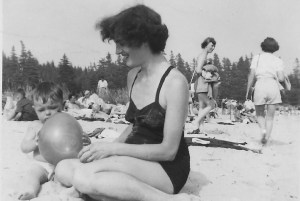
Mum on Gonzales Beach, with Dan

Under Cape Breton’s rocky soil, under the parks in Halifax with their views of the sea, the sound of gulls, of commerce, of pianos and fiddles from open windows, under the earth the buried creeks hide their secrets. And you can hear something, a murmuring, a rill of original water, of origins, of fish in their lost habitats, eels, amphibians entering their dark waters, and in memory, birds at the vanished banks, their beaks poised, and secrets, secrets, my mother’s buried history in the damp ground where water longs for the sky.

                    —from “Tokens”, in Euclid’s Orchard

the day after

at the book prizes

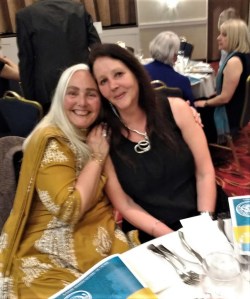
Last night was the B.C. Book Prizes gala. I was glad to be there, glad to be nominated for a prize, though I didn’t “win”. (Here’s the link to the winning titles!) It was lovely to see old friends, meet some new people, and to realize again what a vital literary community we have in this province on the far edge of the country, west of the Rocky Mountains. People put so much effort into the event, from the jurors (and how nice it was to spend a bit of time with Jean Barman, a historian I believe to be a national treasure) to the organizing committee to the librarians, booksellers, and everyone else who gathered to honour the nominated writers.

I want to commend my own publisher, Mona Fertig, at Mother Tongue Publishing. She is so supportive, so enthusiastic, and she runs her business out of an old heritage house near Ganges on Salt Spring Island. She celebrates the unsung artists of our province, the writers who are working in forms not part of the best-seller culture, and she insists on their importance. Not “instead of” but “as well as”. It’s harder to do this work, I know, with financial constraints and reluctance on the part of much of the media to embrace what might not seem popular. Last night Mona was her bounteous generous self and I was glad to be there for the reception and dinner as well as the awards ceremony for the opportunity to share a glass or two of wine and to know that my book, Euclid’s Orchard, was possible because of her encouragement, her faith.

the day before the B.C. Book Prizes

Euclid's Orchard_cover Final

Last night I read at the Gibsons Library and engaged in a conversation with Dick Harrison, dear friend and fine scholar. I had one of those moments, after people had made generous comments or asked interesting questions, when I realized that I’d written the book I’d hoped to write, one that weaves family stories into a larger pattern of natural, cultural, and regional history. Someone said at the end that the one word they (well, it was she) would use was “textured”. And yes, that was at least one of my intentions.

But it’s a quiet book. The writing doesn’t exactly ignite fireworks. I’m not apologizing. I believe that the world needs all kinds of books and I hope that the quiet ones can continue to find a place in the literary conversation. The ones that notice the plants and birds (right now there’s an orange-crowned warbler on the rugosa rose out the window!), record the dailiness of lives, ask us to remember the ordinary people who made us. Ask us to listen as the coyotes sing in the woods beyond the house, to birdsong on a May morning.

Tomorrow is the Gala for the B.C. Book Prizes awards. If you visit this site frequently, then you know that Euclid’s Orchard has been nomination for the Hubert Evans Award. I don’t have any expectations regarding the award. I do believe that it’s an honour to know that a jury read all the non-fiction books published in B.C. in 2017 and included mine among their top 5. I’ll pack my glad rags, cross Howe Sound on the ferry, and go to the reception and dinner, then sit among the well-wishers as the awards are given out in the big ballroom at the Pinnacle Hotel in Vancouver. It’s a chance to celebrate the vital writing and publishing community in this province and I’m happy to be part of it. And what a thrill to be in this company for the past two months.

Hubert Evans Non-Fiction Prize

Supported by the BC Teachers’ Federation

Dead Reckoning: How I Came to Meet the Man Who Murdered My Father
by Carys Cragg
Publisher: Arsenal Pulp Press

When Carys Cragg was eleven, her father, a respected doctor, was brutally murdered in his own home by an intruder. Twenty years later, and despite the reservations of her family and friends, she decides to contact his murderer in prison, and the two correspond for a period of two years. She learns of his horrific childhood, and the reasons he lied about the murder; in turn, he learns about the man he killed. She mines his letters for clues about the past before agreeing to meet him in person, when she learns startling new information about the crime.

Carys Cragg is an instructor in Child, Family & Community Studies at Douglas College. Her personal essays and reviews have appeared in such venues as The Globe & Mail and The Tyee.

» More

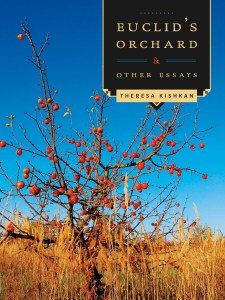
Euclid’s Orchard & Other Essays
by Theresa Kishkan
Publisher: Mother Tongue Publishing

In her new collection of essays Kishkan unravels an intricately patterned algorithm of cross-species madrigal, horticulture, and love. Opening with ‘Herakleitos on the Yalakom,’ a turbulent homage to her father, and ending in ‘Euclid’s Orchard,’ amidst bees and coyotes, her touchstones of natural history and family mythology are re-aligned and mortared with metaphysics and math. Along the way her signature lyricism of place and home sings us from her grandparents’ first homestead near Drumheller via an actual ‘Poignant Mountain’ of her girlhood to her beloved home on the Sechelt Peninsula in BC.

Theresa Kishkan is the author of thirteen books of poetry, fiction, and creative non-fiction. She has been a finalist for the Hubert Evans Non-Fiction Prize and the Ethel Wilson Fiction Prize and won the Edna Staebler Personal Essay Prize.

» More

Ice Ghosts: The Epic Hunt for the Lost Franklin Expedition
by Paul Watson
Publisher: McClelland & Stewart

In a masterful work of history and contemporary reporting, journalist Paul Watson tells the full story of the Franklin Expedition: Sir John Franklin and his crew setting off from England in search of the fabled Northwest Passage; the hazards they encountered and the reasons they were forced to abandon ship after getting stuck in the ice hundreds of miles from the nearest outpost of Western civilization; and the dozens of search expeditions over more than 160 years, which collectively have been called “the most extensive, expensive, perverse, and ill-starred . . . manhunt in history.”

Paul Watson earned three National Newspaper Awards for foreign reporting and photography, the 1994 Pulitzer Prize for Spot News Photography, and the 2006 Hal Boyle Award from the Overseas Press Club of America.

» More

The Reconciliation Manifesto: Recovering the Land, Rebuilding the Economy
by Arthur Manuel and Grand Chief Ronald Derrickson
Publisher: James Lorimer and Company Ltd., Publishers

Manuel and Derrickson offer an illuminating vision of what Canada and Canadians need for true reconciliation. They show how governments are attempting to reconcile with Indigenous Peoples without touching the basic colonial structures that dominate and distort the relationship. They review the current state of land claims, tackle the persistence of racism among non-Indigenous people and institutions, celebrate Indigenous Rights Movements while decrying the role of government-funded organizations like the Assembly of First Nations, and document the federal government’s disregard for the substance of the United Nations Declaration on the Rights of Indigenous Peoples while claiming to implement it. These circumstances amount to what they see as a false reconciliation between Indigenous and non-Indigenous Canadians.

Arthur Manuel was a widely respected Indigenous leader and activist from the Secwépemc Nation. He was known internationally, having advocated for Indigenous rights and struggles at the United Nations, The Hague, and the World Trade Organization.

Grand Chief Ronald Derrickson served as Chief of the Westbank First Nation from 1976 to 1986 and from 1998 to 2000. He was made Grand Chief by the Union of BC Indian Chiefs in 2012.

» More

The Sacred Herb / The Devil’s Weed
by Andrew Struthers
Publisher: New Star Books

The Sacred Herb / The Devil’s Weed is informative and even enlightening, but above all, it’s a hilarious look at a humble plant that has entertained, inspired, and occasionally terrified so many for so long. One side of this double paperback answers all your questions about the world’s most misunderstood plant, from how “the bikers of the Stone Age” spread it across Europe to why it makes music sound better. The other side is a non-stop trip as Struthers weaves together true stories, collected from 100 friends, of marijuana-inspired misadventures.

Andrew Struthers is the author of Around the World on Minimum Wage (2014), The Last Voyage of the Loch Ryan (2004), and The Green Shadow (1995). His films include The Magic Salmon, TigerBomb: A Symphony in Dynamite, and Spiders on Drugs.

» More


blossoms ignite on the long, unpruned branches

It all comes around again. The blue orchard miner bees depositing their eggs in the cedar houses, the return of the violet-green swallows, a tree frog on the deck where our hot-tub sits. I have tomatoes waiting to be planted in tubs on the second-story deck, honeysuckle to coax through the supports on the pergola built as an entrance to the vegetable garden, and paper wasps to brush out of the house when I find them trying to build inside.

We were away yesterday, up at 4 a.m. so that I could make a mid-morning appointment with a hematologist in Vancouver. We drove through Stanley Park, past big clumps of bleeding heart in full bloom, and I wondered if it might be a good omen (blood doctor, after all!) or, yikes, something worse. I wondered if the appointment might lead to more tests, more appointments, a life of caution and pills. But no! Reviewing my file with its numbers and scans and images of my body, listening to my lungs, asking a hundred very precise questions (and wasn’t I glad I’d brought careful notes about dates, symptoms, etc.), he said that he recommended I come off the medication I’ve been taking and that I could consider myself no longer at risk. Was it my imagination or was that when the sun came out yesterday? Because it was dark when we left home, and cloudy as we found parking, walked to the high tower where the hematologist practiced his occult art.

And now, this morning, I’ve been looking through Euclid’s Orchard to choose passages to read at the Gibsons Library tomorrow (at 6! Please come if you’re on the Sunshine Coast!) and I suddenly wondered if the stray apple was in blossom yet. It grows out of rock just in front the deck leading off our kitchen.

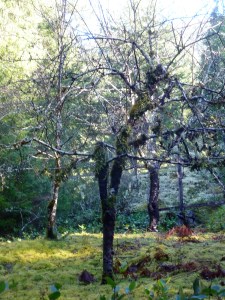
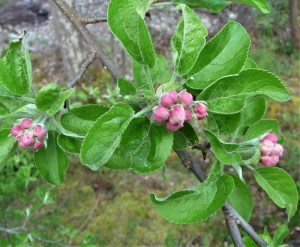
Blossoms ignite on the long, unpruned branches of the stray apple. The bees are in heaven, their faces buried in the open flowers, rising on legs heavy with pollen to find another, and another. Nearby a sapsucker tests the cotoneaster where the young are brought, year after year, to learn to feed on insects their parents have trapped in pools of sap. Leaning over the railings,I try to see the pattern of the leaves on their stems, because it’s a wonder the tree is where it is, rooted in a cleft of rock, its branches nudging into light. It’s a wonder, how far children travel from a house buffeted by winter storms, spring rain, the sound of loons nesting summer after summer on the lake just below the forest, and for a time, the promise of fruit from trees planted in their infancy until the orchard was abandoned to the alders and bears, and to the late-coming coyotes who made their home in its remains.

And yes, the blossoms are ready to open.

blossoms ignite

“…a hole on my sleeve the shape of a heart”

my mum

In an essay about my mother, in Euclid’s Orchard, I wrote this:

As an adult,I seldom asked her what she knew about her biological parents, though I did try, at least twice. The first time, she cried. The second time, she said her foster mother had discouraged her from trying to find them, saying that they knew where she was and never contacted her. My mother told me that she had decided to figure out who they were when our family went to Nova Scotia in 1963, but seeing her foster mother after a long absence—my parents lived in Halifax in 1953 before moving to the West Coast—convinced her that this was her mother, this was the person who’d raised her and to whom she owed loyalty and love, and she abandoned her plan to locate her birth parents. Could I try, I asked. And she was fierce in her disapproval. So I quietly put the notion aside. But she did say that her foster mother had a copy of her birth certificate with the names of both parents. Her birth mother was a MacDougall and her father, a MacDonald. And his was the surname she had until she married my father in 1950. She’d been told that her biological father was the brother of a prominent Halifax physician.

Last summer I sent a sample of my DNA to one of the companies offering to analyze it and tell you who you are. Oh I wish. The results came back and there are still as many mysteries as there ever were. But I’ve been following up on some clues, writing to people who show up as probable 2nd or 3rd cousins, and I think I may have found the trail leading to my mother’s biological father. He would have been 30 years old when he fathered her. Five years later he was married and he went on to father two sons, both dead now. One of them was a physicist which is interesting to me in light of the fact that one of my own sons did his first degree in physics and mathematics before going on to complete a PhD in mathematics. (You’ll know this if you’ve read Euclid’s Orchard!) The man whom I believe was my mother’s father wasn’t (as far as I know) the brother of a physician but he married one and she came from a family of doctors. Stories have a way of changing as they are told over decades and perhaps my mother was told a slightly altered version of her parentage. Perhaps not. Maybe I haven’t remembered it accurately.

And as I sit again at my desk and try to puzzle through where to go next, what to try, I am wondering if it’s worth it. To me, yes, but to anyone else? A recent review of Euclid’s Orchard suggested that it’s boring material to readers who are not part of my family. (“Stories of ancestors, whether couched in the author’s discovery or not, can only be as interesting as those people were, and let’s face it, many of us are not. It requires tremendous skill to animate lives, let alone make sense of them, and Kishkan gives it her best in this book, breaking many of the essays into segments, weaving in ruminations to liven things up. Yet, by end of the book, I felt that nothing was truly made sense of, the knot-work made more complex, having been intellectually tackled as opposed to emotionally teased apart.”)

Yet the story of a child, kept from knowing her parents, and their own history, which might have been romantic or violent or simply sad, is a tale at the heart of many families. We can learn the precise composition of our DNA, what we are in terms of our ethnicity (for me, it’s 53% Eastern Europe, 21% Scotland, Ireland, Wales, 19% Great Britain, and tiny bits from Iberia, Scandinavia, and south Asia), but the question of who we are might still haunt us. As it does me. Yesterday I sent off material to a researcher in Ukraine who will help me to trace my family there, in preparation for a trip we will make in the fall. I want to know what lives were lived, were abandoned, were reconstructed elsewhere, in part as homage and in part as escape.

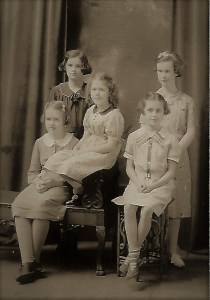
What you think you know is the shaky foundation on which you try to build something. The photograph above, for example: I’ve always thought the dark-haired girl on the left was my mum. She looks like photographs of me as a child. But my mum was born in 1926 and these girls now seem a bit old-fashioned for girls in, say, 1938, which was when the image would have been taken if my mum was about 12. It’s a postcard. Did people still do that in the late 1930s? I have a few photographs-as-postcards from my dad’s family, taken (I know) in the very early years of the 20th century. So who knows? Maybe that girl is my mother’s mother. Maybe there was a connection between the house she was raised in (a widow who took in foster children) and her biological mother. I’ve already found names on a list that suggests that the foster mother’s late husband knew the father of the woman my mother’s biological father married. Yes, the knot-work does become more complex the more you try to tease it apart. That’s the nature of stories across time and continents.

Does any of it matter? In Euclid’s Orchard, I said this about my mum:

At the Foundling Museum, a spyglass, a hairpin, the handle of a penknife. Padlocks, a tiny black hand pierced with a hole for a ribbon, a handful of coins, pierced, notched, worn thin by thumbs stroking, stroking, stored in the archives. I have My Sin,a tweed coat, a memory of Mrs.Nobody on her chair in the kitchen. I have a hole on my sleeve the shape of a heart but no scrap to match it with and the sound of a creek running underground on its way to the sea,with everything of my mother in it, and nothing. I have every regret for the way her life began, and ended, a motherless child, so far, so far from her home, no one looking for her in the listservs, among the dry records of Vital Statistics, no one, no one but me, my face against the glass case of all those unclaimed tokens, those stories begun perhaps in love and ending in sorrow.

And stubbornly, I want to make sense of her story, even though she will never know I’ve tried.


“…all the more wonderful for its mysterious provenance”

the stray

For readers of the blog, the recurrence of plants, coyotes, frog-song, births, deaths, phrases of poetry (sometimes the same poetry), musings about dandelion pizza, the various rivers I love, the growth of grandchildren (and even a fourth one due in July), swimming, must get, well, a little tired. Yesterday I was driving to a meeting and I saw that the coltsfoot at Misery Mile is in bloom and I thought, oh, I should write about that (remembering my own young horse and how the leaves reminded me of his feet), and then almost immediately realized that I already had, in my essay collection Phantom Limb.

I stop on the roadside and carefully lift a plant of the coltsfoot to bring home to my own garden. Petasites palmatus, butterburr, sweet coltsfoot. There are the blooms on their fleshy stalks and the broad leaves with fine hairs on the underside. And there is one small inrolled leaf-shoot, not yet opened, the foot of that colt I hold as I once held the entire weight of his delicate ankles in my hands.

(The plant I lifted didn’t survive.)

And just now, looking out the glass door to the deck, I saw the buds on the volunteer apple tree growing in the rocks on the bank leading down to where our orchard used to be, the orchard I celebrate and mourn in Euclid’s Orchard.

Did this tree sprout from a seed spit over the side of the deck or excreted by birds or even seeds from the compost into which I regularly deposited cores and peelings from apples given us by friends in autumn? Belle of Boskoops from Joe and Solveigh, for instance, which make delectable fall desserts and cook up into beautiful chutney. Or else a seed from the few rotten apples from the bottom of a box bought from the Hilltop Farm in Spences Bridge, their flavor so intense you could taste dry air, the Thompson River, the minerals drawn up from the soil, faintly redolent of Artemesia frigida. This stray is all the more wonderful for its mysterious provenance, its unknown parents, and its uncertain future, for it grows out of a rock cleft, on a dry western slope. I won’t dig it up since I have no doubt its roots are anchored in that rock, but I will try to remember to water it occasionally and maybe throw a shovel of manure its way this spring.

It all comes around again. That’s what I’m saying, I guess. (Even the meeting I was driving to was to work on details for the upcoming—14th!—Pender Harbour Chamber Music Festival, one of the pleasures of summer; I’ve been part of the organizing committee, off and on, since the beginning.) We sit on the deck at the end of the afternoon with a glass of wine and we notice that the big-leaf maples are heavy with incipient leaves and blossoms. And that means warblers and other songbirds drawn to both the nectar and to the small insects gathered on the blossoms. And as the leaves unfurl, we’ll watch for the western tanagers who nest either in the maple canopy or near it because we see them going back and forth during the nesting season, a flash of red and yellow, brilliant in summer sunlight.

My noticing, if I may call it that, is part of the way I remember, the way I try to keep intact the world I cherish. I am as political a creature as many or most; I have issues I follow, organizations I support, and lives beyond my own family and friends that I advocate for and with. But what I can do daily is record the place I have lived on and in for nearly 40 years—its cycles, its weather, its rich and ordinary earth. So the coltsfoot, the stray apple tree, the tanagers, even the samaras that fall from the maple in autumn and echo in the middle name of my first grandchild. Not only my home but what surrounds it, holds it. That people want to read these things never ceases to astonish me and I am grateful to you. And to Gaston Bachelard, who feels like a lifelong companion in his wise book about space—both the architectural space we inhabit but also how it fits into its environment, in our actual experience and how we recall it, how it influences our dreams and memories.

We comfort ourselves by reliving memories of protection. Something closed must retain our memories, while leaving them their original value as images. Memories of the outside world will never have the same tonality as those of home and, by recalling these memories, we add to our store of dreams; we are never real historians, but always near poets, and our emotion is perhaps nothing but an expression of a poetry that was lost.
                                     —from The Poetics of Space