following the hum

Most days I spend a fair bit of time in my garden. There’s watering, transplanting, weeding (though not much of that, alas), staking, deadheading, and most of this is done in a kind of dreamy state. I am there, in that place, almost out of my self. Or more deeply into myself, is perhaps more accurate. Some days I don’t know where the natural world begins or ends because I am deeply embedded in it, my hands heavy with soil, pollen all over my arms and shoulders when I stake tomatoes or reach among the beans to coax tendrils to cling to their poles.

Mostly the critters out there ignore me. Sometimes I’ll be doing something and I’ll see a snake lying on the damp path and it won’t move until I’m almost on top of it. The deer too. The buck browsing clover the other day had to be directed, almost at arm’s length, to head into the woods, away from “our” garden. He’s perhaps the one nibbling the lower leaves from the Kwanzan cherry and he’s probably the one who regularly nips off the tender new rose leaves that push through the fence around the vegetable area. I can’t blame him. They’re delicious! And the bees are everywhere, almost unnoticed. I don’t bother them. They’ve never bothered me.

Today I listened to the humming of the bees as I hadn’t really before. I hear the hum, sure, it’s always there but mostly I hardly notice because it’s part of the texture of the day, like the ravens bickering in the woods or the drone of planes out over the Strait of Georgia. I water the tomatillos and it’s all around me. The cucumber boxes, which I water first thing — everywhere. I’ll follow the hum, I thought after lunch, and it will tell me something about what the bees truly love.

You’d think it would be this —

P1120143

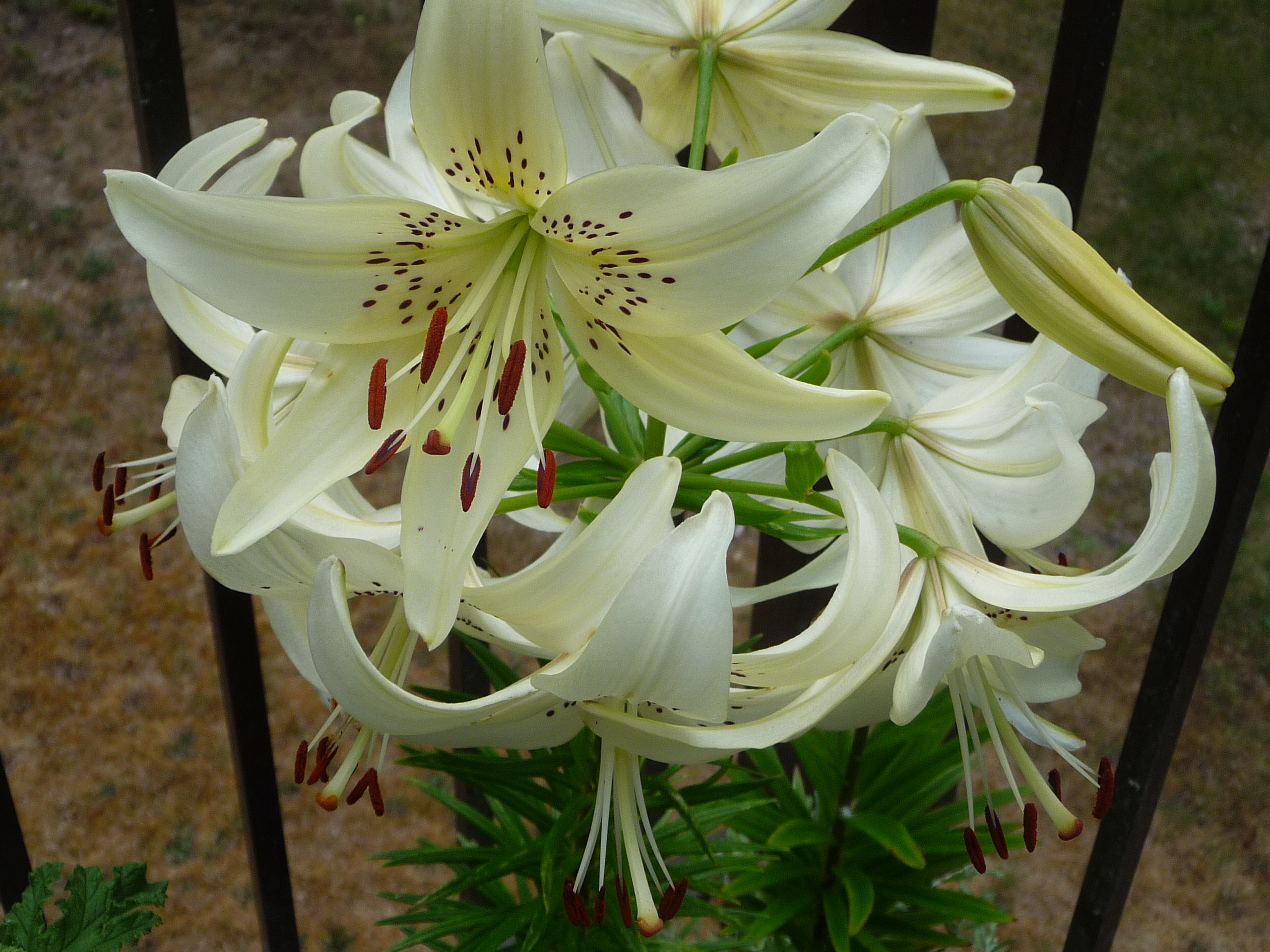
or these —

P1120144Look at those anthers! The stigmas! But no bees. I peered into the gorgeous squash blossoms and saw ants, not bees.

P1120150And I’m sure those plants receive their share of visits. But mostly it’s the flowers you hardly notice. The tiny yellow blooms on the tomatillos, volunteers I brought back from Forrest and Manon’s Ottawa garden when I was digging their vegetable bed in May. Wrapped in damp paper towel and put in a ziplock bag, they happily travelled home with me and are more than 6 feet tall now, loaded with both flowers and developing fruit. And as it turns out, bees.

P1120147I stood with the camera, trying to get them to hold still, but they purposefully moved from one flower to the next, burying their faces in the tiny open throats.

And they love the oregano, which I’ve let self-sow over the thirty-three years we’ve been here. It grows everywhere, doesn’t need water, smells like Greece when you brush against it on a path or even tiny clefts in the rocks. When you see it dense with bees, when you hear the humming as you bend to watch them at their work, you realize they are one of the foundations of our world. The Greeks knew this. They believed bees were a bridge between the human world and the divine. There’s no food we eat that doesn’t owe its existence (and ours) in some way to the work of bees. When I was researching the origins of mathematics for my essay, “Euclid’s Orchard”, I learned that Pythagoras attributed his long life — he lived to be nearly a hundred! — to a diet of honey.

Following the hum has me wanting to know more about our specific bees. A difficult but enticing task — I saw at least four kinds of bombus today and reading their names takes me to that dreamy state: orange-rumped, yellow-faced, bright yellow, red-belted, Sitka. A line of poetry, the beginnings of a whole meditation on origins, culture, social organization, military strategy, a recipe for mead, for meadow, for the music of their dance, the choreography of their lives, the elegance of their movement from one stem of oregano to the next. My mentor Pliny the Elder shares my interest, though of course he knows far more (and thinks he knows even more: he calls honey “the saliva of the stars”, fanciful but true?). And as for identification, he’s as useless as I am:

There are wild bees and bees found in woods; they have a bristling look and are much more easily stirred up, yet are noteworthy for their industry and application. There are two kinds of domesticated bees: the best is short and speckled and of a compact, round shape; the inferior kind is long and looks like a wasp, while the worst is hairy.

oregano

What do you call?

What do you call an essay that’s 48 pages long? And no, that’s not the opening line of a really great (literary) joke. I’m serious. Because I woke this morning with such good ideas for wrangling a recently-completed first draft of “Euclid’s Orchard” into shape. Maybe it was the cool breeze. Or the strong coffee. I sat with the pages on my lap — I can’t edit on my computer, or at least not at this stage, when I need to know how things are balanced (or not). I like to have the whole thing on paper so I can make notes in the margins, cross out words, use arrows to indicate that I want sentences, or even whole paragraphs, to move down a bit, or else to simply disappear.

P1120038And it was such a pleasure to work my way through and to understand where the gaps where but also that I believe the essay has some strengths, some originality. (Last week I felt I was simply writing the same old story over and over again.)

So I’m finished a second draft, which is so much better than the first (which went through a number of stages before it even became an entire first draft). My writing practice has always been to work on something for myself alone, to follow a thread into the maze (or knotted tangle, depending…), and try to understand its pattern, its relevance. I don’t show others my early drafts and mostly not even my later ones. I’m the one who has to figure out the way I need to do something and I don’t think it would be useful for me to try to work by consensus, even if it’s in a generous context. I do live with a writer, though, and sometimes we give each other our writing when we think it’s finished. John taught composition for years and he’s a wonderful grammarian. My own understanding of language is intuitive. Don’t ask me what a gerund is, or a prepositional phrase. (I don’t know what a gasket is either or a universal joint but I’ve been driving for almost 45 years without an accident and I’ve only run out of gas once.)

I know there are lots of writers who write only for themselves. I write by myself but not necessarily for myself. I can’t explain why but I’ve always thought of my work as truly complete when it’s been accepted by a publisher. For individual essays, this is generally a journal or magazine. For novel, well, I don’t try to publish chapters of those but I do always intend the whole thing to be published eventually. It’s not in my mind while I’m writing but when I’ve finished a work, then I begin to wonder about where, how, when. This is me, wondering.

In the meantime, the weather has changed again. The cloud cover at dawn and the cool breeze of the morning have both disappeared and the sky is clear blue. It’s not as hot as it was yesterday but there’s no sign of rain. I think of the beautiful Fraser Canyon south of Lytton on fire and I wish I knew a charm for rain. A tiny frog has huddled under the eaves on the upper deck and I’m going to put out a bowl of water for it. And then label the jam I made this morning (between editing and another cup of coffee). Gooseberry (we have the green variety) with ginger. A batch of jam, though it’s not even summer yet…

P1120036

what does a carrier bag hold?

For the past month or so, I’ve been trying to work on a long essay, “Euclid’s Orchard”, which is loosely about mathematics, wine, love, horticulture, and genetics. It’s a hodgepodge, yes, but I know that there’s also a coherence there, a pattern, and I’m a little at a loss right now to see it. (I’ve also begun a novella which is taking my attention, though not all of it.) The essay has a quilt to accompany it; the quilt is a textural meditation on the mathematics in the essay and the essay also details the making of the quilt. The individual parts of the quilt are all designed and made and now I need to piece it together, to find a pattern for the individual squares (though in fact they’re rectangles!) to echo the elements in the essay. This is where I’m puzzled and can’t see or think my way through it.

I don’t like being idle. And I think best when I have some sort of hand work to do. I am a terrible knitter but sometimes I knit just to feel the accumulation of yarn making itself into a scarf or a blanket, a kind of magic emerging from the needles. And my quilting skills are only a little better but I love to see the possibilities of colour, harmonies, even narratives in fabric and to find ways to work with those. My brain is not logical and I can’t follow directions so the quilts I’ve made over the years (more than 25 — years and quilts) are very much my own. And they’re explorations.

Maybe they’re also carrier bags. Years ago I visited a class of students studying my novel, Sisters of Grass, and when I met their instructor before the class, he told me that he thought of my work in the tradition of Ursula LeGuin’s “The Carrier Bag Theory of Fiction”, from her essay collection, Dancing at the Edge of the World. As it turned out, I’d brought along a basket of objects central to the novel — a sampler, some Ponderosa pine cones, photographs taken by the ethnographer James Teit — so I noticed the instructor (a very congenial man) smiling as I unpacked my basket, reading a little from my novel, and passing around objects for interested students to look at.

If it is a human thing to do to put something you want, because it’s useful, edible, or beautiful, into a bag, or a basket, or a bit of rolled bark or leaf, or a net woven of your own hair, or what have you, and then take it home with you, home being another, larger kind of pouch or bag, a container for people, and later on you take it out and eat it or share it or store it up for winter in a solider container or put it in the medicine bundle or the shrine or the museum, the holy place, the area that contains what is sacred, and then next day you probably do much the same again-if to do that is human, if that’s what it takes, then I am a human being after all.

A carrier bag holds more than food, of course. It holds anything you want it to and sometimes it holds ideas, simple ones and more adventurous ones. It holds scraps of fabric and pine needles for baskets and memories of campfires and the sweet scent of a baby sleeping.

This weekend I had such an urge to make something, my hands yearning for work. But I’m still weighing and pondering the final pattern of “Euclid’s Orchard” and wasn’t able to take that any further. I went into the trunk holding my stash of fabrics and pulled out a whole passle of scraps, bits and pieces left from other quilts but too pretty to throw away. There wasn’t enough to anything big or elaborate so I decided to cut what I had into five-inch squares and find a pleasing way to piece them together. It took two mornings to cut out all the squares — 168 of them — and then an afternoon and a morning to get to the point I’m at now: ten courses of the eventual fourteen pieced together. The cottons have no relationship other than the one I’ve imposed on them. Some of them are French prints, some scraps from intricate quilts I’ve made in the past, and some of the fabric comes from an unfinished dress begun by a friend and passed along to me because she thought I’d like the print and might want to cut up some of the usable areas.

This morning, as I sewed lengths of squares together, I found myself thinking about “Euclid’s Orchard” and I think I might be ready to work on the essay again.  Something about the quiet labour of fitting pieces together, aligning their edges, trying to make the seams even, looking for a way to highlight a colour — the punch of yellow in this simple patchwork quilt has me remembering the sunlight on the orchard that is central to the essay…

If you haven’t got something to put it in, food will escape you–even something as uncombative and unresourceful as an oat. You put as many as you can into your stomach while they are handy, that being the primary container; but what about tomorrow morning when you wake up and it’s cold and raining and wouldn’t it be good to have just a few handfuls of oats to chew on and give little Oom to make her shut up, but how do you get more than one stomachful and one handful home? So you get up and go to the damned soggy oat patch in the rain, and wouldn’t it be a good thing if you had something to put Baby Oo Oo in so that you could pick the oats with both hands? A leaf a gourd a shell a net a bag a sling a sack a bottle a pot a box a container. A holder. A recipient.

And wouldn’t it be wonderful to have a bright quilt to keep away winter’s chill? Blues, yellows, and a long diagonal of red, bright as berries and necessary as blood.

P1100972

from “Euclid’s Orchard”: a work-in-progress

“As I said earlier, we ran strands of wire covered with green plastic, stapled to 4×4 posts set into earth with great difficulty, some of them fitted onto pins in plinths created with big boulders and cement (these in areas where the ground was too rocky to dig). We ran strands of barbed wire between these after deer kept getting in between the green wire. We ran strands of wire connected to an electrical source after the deer persisted, and the bears. We bought rolls of chicken wire and unrolled these around the posts, stapling the 8 foot high sections as taut as we could. There was that gate, generously wide so we could bring in our truck, with big baskets for when the trees produced the harvests we thought might be possible. I filed recipes for apple preserves, for plum jams, for bottled cherries in exotic liqueurs.

Finally we gave up, though the chicken wire and the green-covered wire still surround the trees, gaping in places where the animals muscled their way through. We returned the battery, almost unused, because the bears didn’t care about electric fences any more than they were afraid of barbed wire. They didn’t give a fig – and when they discovered the fig tree by the house, they ravaged the young fruit until the tree grew too tall for them to reach and because the trunk grew against the side of the house, they didn’t care to climb it. But down in the orchard they’d eat every pear on the trees and then shit out golden pulp as their own parting barb. Some mornings in summer I walk down the driveway and see the lattice of chicken wire strung with dew-covered spider-webs, glistening in the sun.

The chicken wire is composed of cells like the hexagonal cells bees create from wax taken from abdominal glands of the worker bees and softened in the mouths of house bees. The wax is shaped by their bodies into circles which quickly form into hexagons. Mathematicians such as Pappus of Alexandria attributed this to “a certain geometrical forethought” on the part of the bees — Bees, then, know just this fact which is useful to them, that the hexagon is greater than the square and the triangle and will hold more honey for the same expenditure of material in constructing each.– but modern physics suggests that it is less calculated than that. Bees make cells that are circular in cross-section, all packed together like bubbles. Surface tension in the soft wax pulls the cell walls, as the wax hardens, into hexagonal, threefold junctions. I think I am with Pappus on this one, though. Try dropping circles of wax as close to one another as possible onto a flat surface and watch what happens. I’ve done this, several times, dropping wax from a beeswax candle (for authenticity) and the result is not hexagonal threefold junctions.”

cells

“the secret of secrets”

I don’t watch much television so after dinner, when the kitchen is tidied and food put away, I head upstairs to read. I love to get into my bed, arrange four pillows comfortably behind me, and find my way into a novel. Or poetry. Or (as was the case the night before last) a recent Harper’s Magazine panel discussion on the Israeli-Palestinian conflict. There are windows on four sides of my bedroom and I can hear whatever is going on outside — boats down on Sakinaw Lake, teens on the highway laying rubber in the most extraordinary scribbles (this is surely a form of graffiti?), owls, loons, sometimes coyotes singing solo or in beautiful intricate harmonies. I’ve done this all the years we’ve lived in this house — we officially moved in on December 18th, 1982 but had been spending most of our time camping and then building (and sleeping on the floor of what’s now the dining area) for 18 months previous to that. I know that I don’t often have original thoughts and with my reading lately, I realize that I am repeating old habits. For some reason, I’ve been pulling old books off the shelf and taking them up to my bed. Yesterday it was Anna Akhmatova’s Poems, translated by Lyn Coffin. I have other translations — D.M. Thomas, Judith Hemschemeyer — but this collection is one I read 23 years ago when I was coming back to writing after an absence, one filled with babies and play-school and herding little children up and down the driveway to and from the school bus.

When I re-read “On the Road” last night, I was transported back to those years. It’s a poem that entered my body, my heart, and found a place in my own pulse. “This land isn’t native to me…” it begins. And how often I’ve felt that. As a young woman I travelled, mostly alone, through Europe, lived for a time in London, then on an island off the west coast of Ireland, trying to figure out how to be a writer. I wanted something. I wasn’t sure what it was. I’d burned bridges in the city where I’d grown up and wasn’t sure I could ever return. (I did, briefly.) I had such yearning, a girl’s yearning, and I’d try to imagine myself into the future. Would anyone ever love me? Would I find a place to make a home? In retrospect, these questions seem so melodramatic and silly but they were so real at the time. I remember staying with some new friends in the south of France just after my 21st birthday and wanting so badly to live among them, maybe in the grove where we ate lunch with a tribe of actors who’d restored an old stone house and made their own wine and brandy (an orange suspended on a wire in one vat). Or maybe in the caravan in the corner of a farmer’s field in Turlough, Co. Mayo, where an elderly friend cared for stray animals (me included) and shared her extraordinary memories day after day over pots of strong tea.

In my bed at night, I keep track of sunsets and they’re earlier now, redder (because of the haze of forest fires burning in the Interior, I think), and my white linen curtains turn pink for a moment as the sun tumbles down behind Texada Island. Last night, the lines of poetry were exactly true, as they were when I first read them and was preparing a manuscript of poems (which became Black Cup):

And the sunset itself in waves of ether

Is such that I can’t say with certainty

Whether the day is ending, or the world, or whether

The secret of secrets is again in me.

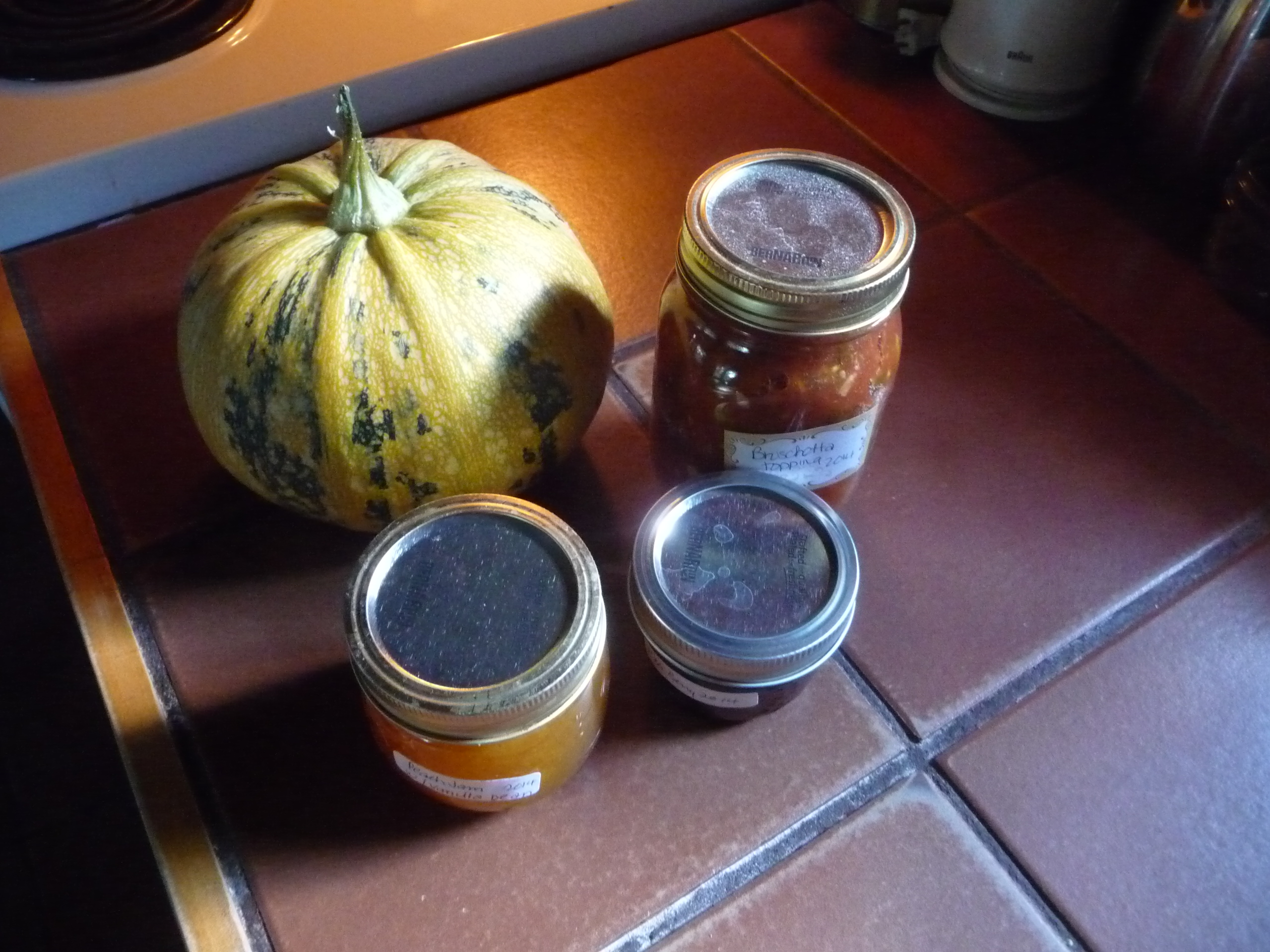
It’s been a summer of short trips — to Ottawa, the Okanagan, Edmonton (to meet my beautiful grand-daughter Kelly) — and house-guests and I’ve enjoyed every bit of it. The garden has flourished, still flourishes, and I’ve been making preserves, curing garlic, shallots, and squash:

P1100481And I have writing to return to. For some reason I haven’t been able to work this summer, though the stack of quilt blocks on the trunk at the foot of my bed keeps me thinking about “Euclid’s Orchard” — both the essay about math and family history and horticulture as well as the actual quilt whose conception and making has been a companion to the writing. This morning I tried a pattern on my bed, tried to find a pleasing arrangement of the blocks. I’m not sure whether to arrange them in the order I made them or in an order that makes sense mathematically or in an order that resembles poetry and not science. (I’m leaning in that direction…) They’re a bit bigger than book pages and will be sashed with deep blue Moravian blue-print which I bought a few years ago in Roznov. (The quilt under them is a log-cabin I made for my parents’ 50th anniversary.)

P1100483

But last night — and this morning — I feel as though the secret of secrets is again in me. And I’m ready.

from “Euclid’s Orchard”, a work-in-progress

wild apple

The stray, the unexpected variable

One apple tree remains under my care. It’s a Merton Beauty, bought as a tiny plant at a produce store in Sechelt. An organic gardener had grafted interesting varieties to dwarf rootstock and I chose one almost at random. Merton Beauty is a cross between Ellison’s Orange and Cox’s Orange Pippin. For years it sort of sat sullenly in a little circle of stones near the garden shed, caged in chicken wire. I’d water it, give it the occasional mulch of compost and drink of fish emulsion. A few frail blossoms, a inch or two of new growth. Then it produced some fruit and those apples were delicious. The information I’ve read about this variety stresses the aromatic flavour of the apples – their spicy taste, redolent of pears, cinnamon, aniseed. I can’t say I noticed those particular notes but the skins were pretty, russeted at the shoulders, and the flesh was crisp, with a true flavour of apple. Not the empty watery taste of many supermarket apples, sprayed, waxed, gassed, and stored for months.

When we rebuilt the vegetable garden after the septic field over which the garden was first made needed repairs, I replanted the Merton Beauty within the newly fenced area. I gave it lots of mushroom manure, bone meal, alfalfa pellets, and a long drink of liquid kelp to help it settle into its new home, a raised bed I called Apple Round.

We also have four crabapple trees up near the house. Two of them, growing in tandem, were given us twenty-five years or more ago by John’s mother, and each spring they bloom like debutantes, one in a pink gown and one in a white one. Working near them, we hear the bees. Most falls a bear comes for their scabby fruits which are the size of plums. And further down the driveway are two small crabapples, white-blossomed, with tiny apples the size of cranberries. Once upon a time I made jelly from a combination of the crabs but no one in our house really liked it and there are so many more rewarding preserves to make in fall so the bears are welcome, if they would only not break branches in their eagerness to gather fruit from the high limbs. And grouse too like to graze on the frost-bitten apples in late fall. More than once we’ve joked about a Thanksgiving dinner of apple-fed grouse but neither of us has the heart (or gun) to make this happen.

So one eating apple and its array of pollinators. And now the stray. Just beyond the sliding doors that lead from our kitchen to the sundeck, coming up from rocky ground, is a small tree that has revealed itself to be an apple. Not a Pacific crabapple – our native Malus (or sometimes Pyrus) fusca — which is what I thought it was when I finally recognized its leaves and bark. I left it to grow up beyond the pink rambling rose tangled among the deck railings so we could enjoy its blossoms in spring. Last year it had fruit, and they weren’t crabs but fairly large green apples: there were four of them and when it seemed they might be ripe, when they came easily off the branch when twisted a little, I picked one to try it. Not delicious, not even remotely. I think now of Euclid: “The whole is greater than the part.” A tree’s beauty is more than the taste of its fruit. But the question of course is how the tree got there. I know that apples don’t come true from seed. Blossom from a Merton Beauty, say, is pollinated by an insect bearing reciprocal pollen from another apple – here, it would be a crabapple – and although the resulting apples would be true to their tree, their seeds would be the children of the Merton Beauty and the crabapple. One in ten thousand of those seeds might produce something worth eating. Who are the parents of this stray apple tree? It started growing before the Merton Beauty began its small production of fruit. Did this tree sprout from a seed spit over the side of the deck or excreted by birds or even seeds from the compost into which I regularly deposited cores and peelings from apples given us by friends in autumn? Belle of Boskoops from Joe and Solveigh for instance which make delectable fall desserts and cook up into beautiful chutney. Or else a seed from the few rotten apples from the bottom of a box bought from the Hilltop Farm in Spences Bridge, their flavour so intense you could taste dry air, the Thompson River, the minerals drawn up from the soil, faintly redolent of Artemesia frigida. This stray is all the more wonderful for its mysterious provenance, its unknown parents, and its uncertain future, for it grows out of a rock cleft, on a dry western slope. I won’t dig it up since I have no doubt its roots are anchored in that rock but I will try to remember to water it occasionally and maybe throw a shovel of manure its way this spring.

summer dramas and ballets

When you live in one place for a long time — it’s been around 33 years for us here in the house we built near Sakinaw Lake (I say “around” because we bought our property in 1980, spent as much time as possible, more than half of most weeks, here until we “officially” moved to our unfinished house in the fall of 1982) — you notice the small and large dramas of those you live amongst. Lately we’ve been watching mud-daubers fill their nests with spiders for the larvae to feed on until they become long-waisted wasps themselves. It’s a bit creepy but also really interesting. Last night we must’ve been right in the flight path as one gathered spiders from under the deck and then flew to the small nest it had built under the eaves of the deck where we eat our dinner. It kept flying right by me but they are quite benign and although I moved my chair a little, I didn’t feel threatened. Not the way I feel later in summer when the vespula wasps (hornets and yellow-jackets) come to the table while we’re eating, landing on any kind of protein. They love the skins of barbequed salmon or roast chicken and they’re quite aggressive. I know, I know. They have a place in the scheme of things (and I love to watch them eat scale insects off my lemon tree) and they mostly go about their own business until late in the season when they seem desperate for meat, even humans.

The Roosevelt elk in our area were introduced in the late 1980s, though most people agree that this was part of their range until they were extirpated in the 19th c. The idea was that the elk would move up and down the big Cheekye-Dunsmuir power line and forage on maple and other brush that was being removed at that point by herbicides. Every time B.C. Hydro applied for a permit to spray or hack and squirt some terrible toxin in what was actually watershed, people understandably got upset. It was hoped that the elk would be part of a natural solution to the problem. And I think they were but no one expected them to settle in quite so happily and make themselves at home in local orchards, a market garden, the golf course…

I don’t like it when they eat the vines on the side of our house or essentially our whole small orchard (this is partly the subject of my work-in-progress, “Euclid’s Orchard”) but it’s always a thrill to see them. They’re huge. Some nights when we’re driving home from dinner with friends, we see them crossing the highway, 20 or more, the heart-shaped yellow rump patch glowing in moonlight. Or we encounter them while we’re hiking, a long fluid line of them disappearing into the woods when they catch our scent or see us in the distance. Last week we saw two cows, one lying down, and the other standing near her. They were on the other side of the cutline but didn’t move. I wondered if there might be a calf nearby. (The females leave the herd to give birth and return 2 or 3 weeks later, once the young one is mobile enough to keep up with the herd.) Elk are creatures of the ecotone, the transistion area where two ecological biomes meet. In this case, there’s a wide grassy corridor under the power-lines, scattered with thimbleberry, salmonberry, elder, wild gooseberry and currant, ocean spray, and other deciduous shrubs, bordered on both sides by dense woods. The grass is as golden as hay right now. Where the cows rested and watched us was perhaps a quarter of a mile away.

This morning we went for a walk in that same area, early, to avoid the heat. We kept an eye out for the elk but didn’t see any. Then at one point on the gravelly trail (the Suncoaster trail system utilizes old logging roads and Hydro access roads), we saw many many recent tracks on the dusty ground as well as very fresh scat. (It was still wet and when we returned that way 40 minutes later, it was dry.) I loved the stories in the tracks. A few really large ones — the bull? — and many slightly smaller ones. And then really small ones, tiny ones, the prints of calves who’d recently joined the herd with their mothers. The air was full of the scent of elk, as pungent as horses. Had they paused to take the sun? Were they watching for predators (there are bears up there and coyotes, the occasional cougar, and sometimes even wolves)? Or was this a social moment, calves shy by their mothers’ sides, and the herd (or harem it is really) accomodating new members in sunlight while ravens circled, red-shafted flickers feeding on ants and other insects in the dry grass, and no bears or coyotes in sight? Here are some notes towards the wild choreography, the fancy footwork. And the score? Oh, something moody and sweet, featuring woodwinds, particularly the flute and the oboe d’amore!


notes from a work-in-progress

Anyone expecting to see regular updates on my Euclid’s Orchard quilt and essay must be thinking I am very lazy indeed. And in a way I am. It’s been a long process to figure out how to translate the material I am working on in the form of this essay to actual tangible quilt blocks. I’m not much a seamstress although I’ve been sewing since grade eight when we made aprons and jumpers in Home Economics. I was careless then, in a hurry to finish so I could have an actual made object in my hands, and I’m careless still. I’ve made more than 25 quilts and the sewing has never progressed to the point where anyone looking at them ever comments on the actual stitching. But never mind. I love the process and if you kind of squint when you look at one of my quilts, you might mistake it for something accomplished.

The problem with this quilt is that I am using images from textbooks, many of them graphic representations of particular mathematical theorems or ideas. I’d thought of simply trying to draw them onto white cotton and then embroidering them to highlight the parts that are relevant to the ideas I’m pursuing in my essay. But when I tried to do the drawings, they were lopsided and I knew that every step along the way would compound this problem. And let’s face it: a person who is careless at sewing isn’t going to be any better at embroidery.

I’ve seen quilts with computer-printed images on them so that seemed like a good solution. I thought I could design the blocks on my computer and then take the files somewhere to be printed. That didn’t work. The place I thought would do it, wouldn’t. So then I planned to print them myself, backing cotton with freezer paper which supposedly makes it possible to use it in a printer. But ours is a  a laser printer, a good one, and those won’t work. (They generate too much heat, apparently.) Finally, after some more weighing and pondering, I ordered an ink-jet printer (which seems like the height of self-indulgence) and bought four packages of specially prepared ink jet printable fabric.

Then I looked at my images again and they seemed awfully busy. I wanted one element to travel from one block to another, to provide continuity. But what could that be? Because this is an essay about mathematics and ideas but also about a real orchard, ours, which is fenced with chicken wire, and because one section of the essay is about bees and how they construct their honeycombs in hexagonal cells (which Pappus of Alexandria attributed to “a certain geometrical forethought”), I decided to use a simple model of those cells which echo the pattern of chicken wire. So here’s one block, just printed, the one I chose to accompany the section of the essay which meditates on inheritance. This uses a graphic representation of dominant and recessive phenotypes:


P1100087

Something else will happen to this block when the entire quilt top is completed — and so think of it  bordered with Moravian blueprint cotton, brought back from Brno two years ago, and maybe embellished with beads and gold thread among those cells. There will be 14 blocks altogether and I hope I have enough of the blueprint for the top. If not, there will have to be more improvisation…

 When I first began to work on this essay, I wrote this little aria, which I think I posted ages ago. But it’s still at the heart of this work I’m doing, so I will conclude with it.

Aria leading to summer

“Yes, but what can I say about the Parthenon – that my own ghost met me, the girl of 23, with all her life to come…” (Virginia Woolf, A Writer’s Diary, April 21, 1932) How I felt that as I looked at our photographs of White Pine Island – Brendan and Angie in their little bathing suits, Lily on a log, Forrest rowing the boat away from us, my parents smiling the summer of their 40th wedding anniversary. All the years of our family, the warm days, the smell of pine, the silken texture of dry grass flattened under our towels, taste of lemonade from the River Trails thermos jug, all of them collapsed into an hour, a moment, held in my hands, water falling through my fingers. How do I keep my memories intact, how apart from this, a brief time in the middle of the night, darkness pressed to the window by my desk, myself reflected in glass as I sit in my white nightgown, every cell in my body yearning for those I have loved, still love, though the only one left in the sleeping house is John. Whom I have loved, still love.

Emboldened by Virginia, I think of what I want to say, not what form it must take. There will moments when I embellish, or downright invent; there will be brief arias, phrases of poetry, the instructions for making a quilt, for working out the puzzle of Mendelian genetics.

convergent threads (an equation)

I’m (slowly) working on a long essay, “Euclid’s Orchard”, which hovers in and around mathematics, horticulture, family history, and memory. Part of the work of the essay is puzzling through some theories and planning a quilt to accompany this thinking. I’ve gathered many images from my reading about math and genetics and am struck over and over again by their beauty. My mind is always drawn to pattern so looking at some of the graphic representations of Mendelian inheritance, Pascal’s triangle (esp. his own drawing of this, with his beautiful handwriting), the elegant Hardy-Weinberg principle, and others has been a fascinating journey into design and method. Friends Joe and Solveigh gave me Edward Frenkel’s Love & Math: The Heart of Hidden Reality for my birthday in January and it’s been such a revelation to spend time in the company of this extraordinary mathematician. The book is part memoir, part explication of his introduction to, and life-long commitment to, the Langlands Program, essentially a grand unified theory of mathematics. I really enjoyed his joyous presentation of braid groups in Chapter Five (serendipitously titled “Threads of the Solution”); the illustrations are clear and nicely organized and I’ve been pondering how to translate one (or more) to a quilt block.

Sometimes a gift comes from an unexpected source. The other day an email friend, Andrea, sent a link to a Discover magazine feature on artists using math ideas to make art. http://discovermagazine.com/mathart 

scarf
A fashionable equation: the Yang Baxter scarf, by Robin Endelman, 2013. Manos del Uruguay’s Silk Blend (merino and silk, hand-dyed).

I’m not sure yet what my quilt block will look like but I was thrilled to see this scarf and am happy to know that others in the world experience math by translating its equations to thread and texture.

from “Euclid’s Orchard” (a work-in-progress)

“What I want to do is find a way to sew the graphic representation of Euclid’s orchard. For nearly thirty years I’ve quilted to find a way to explore texture, to try to bring a one-dimensional space into something resembling two: runnels of cotton pierced with small stitches; stars slightly embossed on a bed of dark velvet. I think of these surfaces as a kind of landscape relief, something for the hands to read as though reaching down from the sky to learn something about the earth – hills of brown corduroy, cabins built of strips of coloured fabrics, a red hearth at each centre; an indigo river alive with the ghosts of salmon, their eggs glittering among the stones below them.

I want to create those neglected trees rising from the surface of the ground, the clovers and wiry grasses around their trunks, the spring daffodils I planted in hope, and all the teeming biota under the earth: worms tunnelling through the porous soil, the burrows of field mice, the root systems of the native wildflowers. I want the nematodes, the protozoa, fungi, the broken rocks, minerals, the decaying organic matter creating the humus needed to keep the soil healthy. I want to commemorate a dream, now abandoned, but potent in the collective family story. We had an orchard. We gave up on it.”