“to fly toward a secret sky” (Rumi)

Yesterday I swam in the local pool for the first time since early May. I’d been in the lake the day before and knew that it would be my last day. It’s not so much that the water is cold, though it’s certainly chilly. It’s more that the air is cool and I can’t get warm afterwards. Even wrapped in a big towel as soon as I get out of the water and even after a hot bath. Someone suggested a wetsuit but somehow that’s not how I want to swim, though I know it works for others. I want the water to polish my skin. And the pool is a good compromise, even if it’s loud (or was yesterday as the children from several families shrieked and whooped, a good sound for the most part) and crowded enough that John and I had to share the one lane roped off from the rest of the pool. You can’t enter that meditative state if you’re trying not to bash your partner with your arms as you back-stroke down the pool. The lane was not quite wide enough for two.

But luckily I’ve begun a new single-cloth quilt, some of the ecru linen I twisted and tied with hemp string and then dyed with indigo and rose madder. (You can see both of the lengths at the top of this page.) I threaded 3 sharp Japanese needles with blue sashiko thread and fitted the fabric into a frame. Then what. I looked at the watery pattern of the dye and began to sew a spiral. It will morph into something else and I’ll probably do what I’ve begun to think of as form of punctuation: ending a long line with a small akoya shell button.

Behind the frame is another single-cloth quilt made of white linen dyed with indigo. The colour is quite different. The process is always interesting because I think I’m being honest when I say that I don’t really care about results; it’s what happens as I twist and tie scoured fabric, as I prepare the dye vat set up on a long cedar bench out by my vegetable garden, as I dip the lengths into the vat and then remove them to oxidize, watching the swampy colour turn the most beautiful blue.

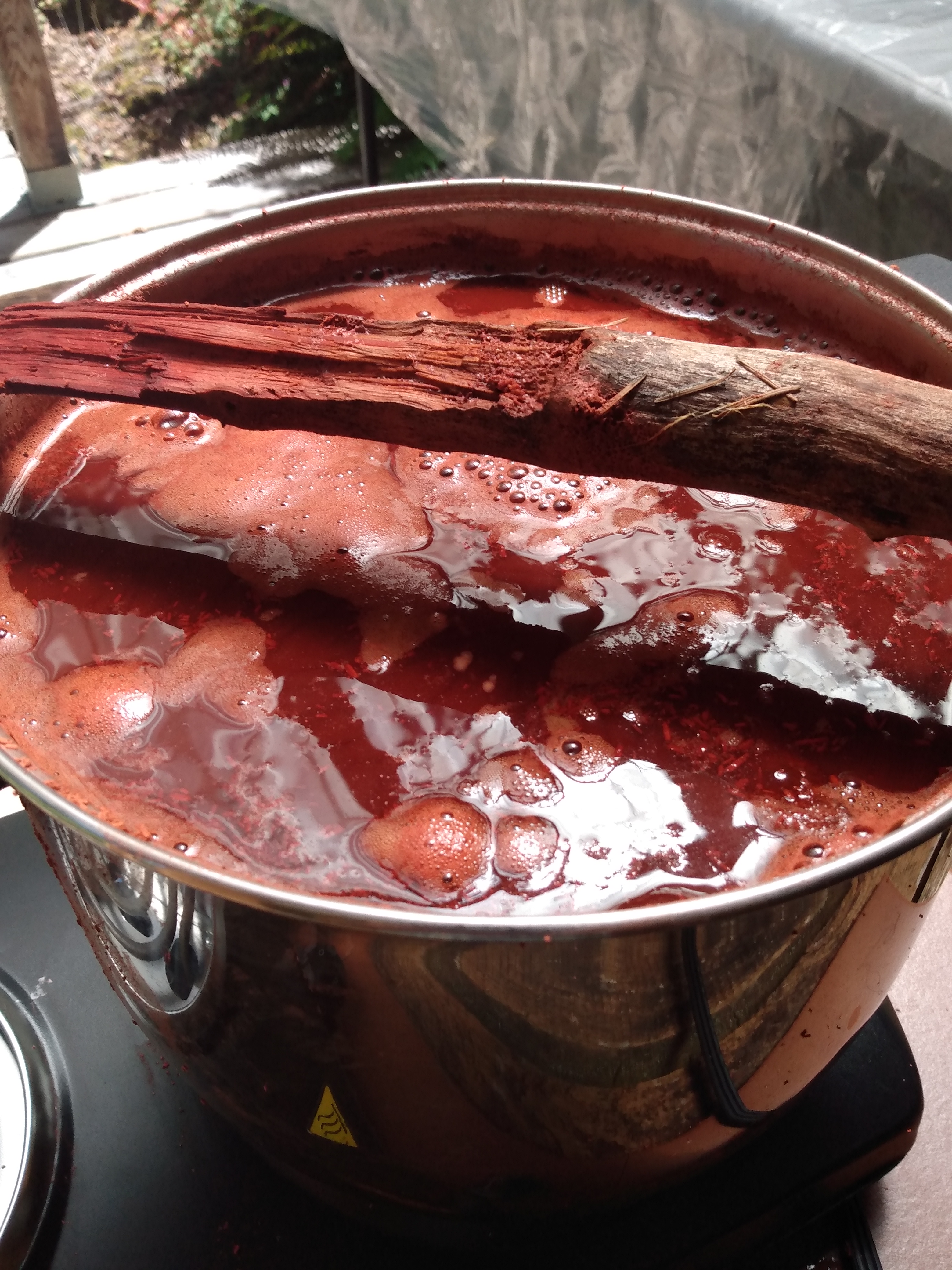
With the rose madder, it’s not quite the same. The fabric has to simmer in a mordant, then soak in a big pot of prepared dye on the little hotplate I have set up in my outdoor dye workshop.
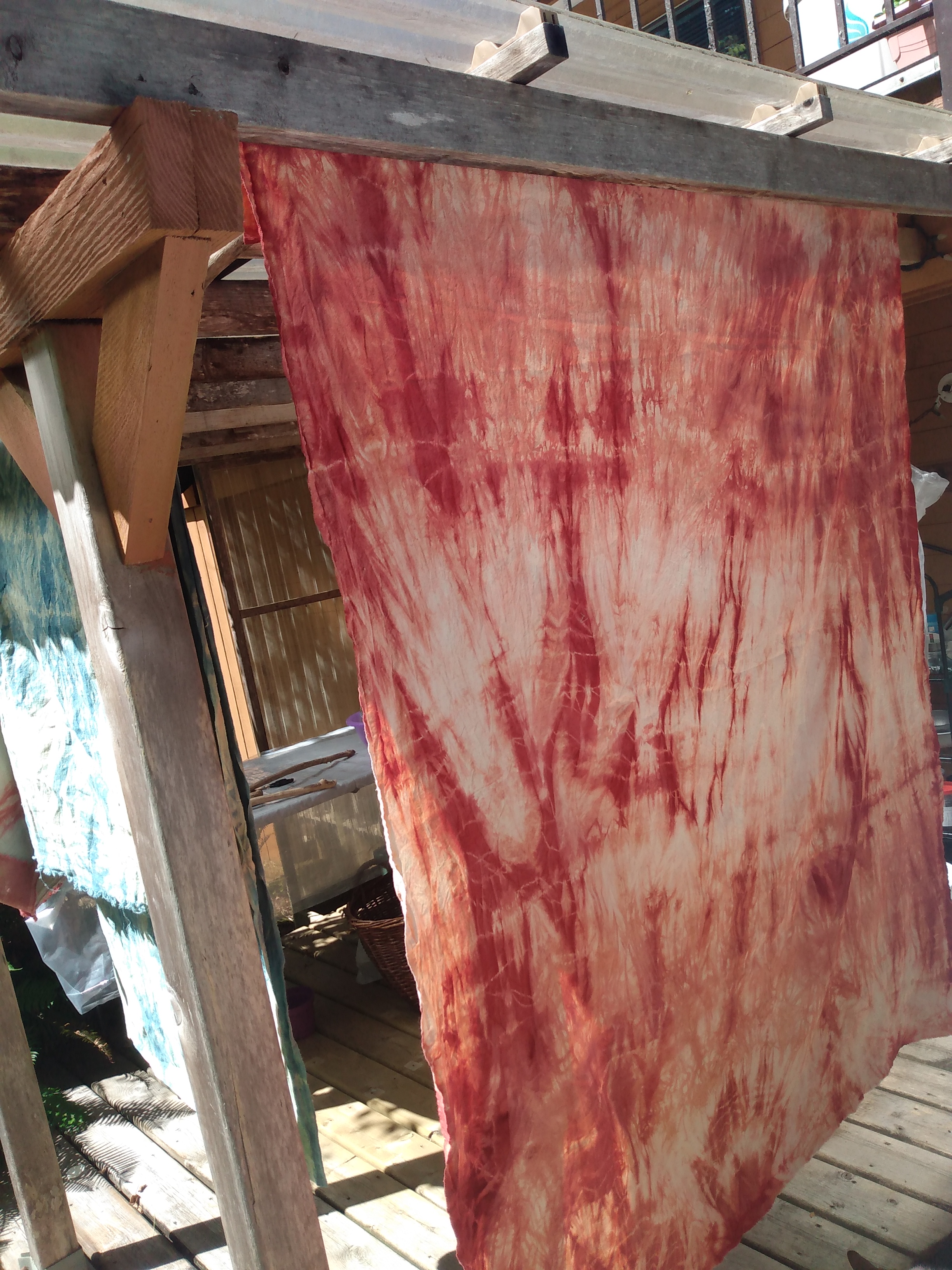
But when the dye has done its work and I unwrap the fabric, it’s like a gift. A birth. And as I sew, I’m thinking about a show I’ve learned about in London, which we will go to when we’re there in late October. Yto Barrada’s work sounds so congenial. (And what’s so interesting is learning that she has a property with arts residencies in Tangier, the Mothership, with a dye garden and workshops, and oh, of course I’ve been dreaming as I sew.)

There is a relationship between what happens when I swim and when I stitch. The two of them locate me in my body as well as elsewhere, a spirit realm, a cloudscape. When I swam all summer under blue skies, scraps of clouds drifting overhead, I was part of what was happening. And when I run my sharp needles through the dyed linen, I am making a veil, I am drawing together a seam of water, of sky, of self.

This is love: to fly toward a secret sky,
to cause a hundred veils to fall each moment.
–Rumi

redux: “Once I told them, You look like goddesses, all of you, there in the water, so graceful as you raise your arms.”

Note: this was 4 years ago and this morning, re-reading, I was surprised to realize I was revising “How Rivers Break Away and Meet Again”,  an essay that is central to my Blue Portugal & Other Essays. I didn’t know then that the collection would be finished, would be published, and that a copy would sit on my desk to remind me of how the thinking and writing I do gradually accumulates until, voila, a book….

morning swim

Kerry Clare at Pickle Me This has a wonderful post this morning, a review of Swell: A Waterbiography, by Jenny Landreth. It’s a book I’d like to read, and will. I’ve been reading books about water lately, about swimming, about various kinds of immersion. Jessica Lee’s Turning: A Swimming Memoir was so beautiful and so brave that I began to plot ways of swimming in winter. Wait, I do swim in winter, though in a pool, not the lakes Jessica has found near Berlin, where she lives. I swim daily in Ruby Lake from June to late September and then it’s the Pender Harbour Aquatic Centre, where my children learned to swim more than 30 years ago, and where the lifeguards do their best to save my lane for me, the one closest to the big windows and on the side of the pool because otherwise I can’t keep straight.

I’ve been revising a long essay on rivers and the venous system, mostly because it keeps getting rejected and I return to it with a nervous eye, wondering what to do to make it something more attractive to readers. I loved writing the early drafts. I wanted to do something I hadn’t done before, not in prose, so I used both margins to justify different parts of the text. I wanted the typography to echo the text. I wanted the text to meander on the page as a river meanders through a landscape and our veins and arteries carry our blood through our bodies. (Writing this description, or justification, I realize how this might be the reason no one wants to publish it. It looks odd. It uses space in an unexpected way. But who wants to keep doing the same old, same old?)

Here’s a little of the essay, a section justified to the right margin (though some sections move back and forth between margins, as a swimmer moves through water):

8. Deep Venous drainage system

The fibular vein. Anterior tibial vein. Posterior tibial vein. The three become the popliteal vein at the knee; and then that vein enters the thigh, via a passageway called the adductor canal, as the femoral vein. These are the veins where the thrombosis formed, a clot poised like a temporary island, breaking free, travelling into my pulmonary system where it lodged as an embolism, threatening my heart.

My heart never knew it was threatened. My heart grew large with love that time, in anticipation of a third grandchild, surrounded by other family members, hearing their voices, sitting with them at the long table we’d eaten at for more than three decades. My heart, unaware, as I tried to catch my breath. It never knew it was threatened. It was filled with love, it was heavy with love.

And other minor veins drain into the femoral vein, like small creeks. The femoral vein graciously receives its tributaries as rivers receive theirs, the threads of mountain courses, of run-off, of bog-dark sweet creekwater, limestone, gritty, clear as mirror glass, dense with salmon, lively with mayflies and dragonflies catching fire, of rivulets, right-bank, left-bank, forked, streamlet, greater saphenous vein, which usually receives the external pudendal vein as well as the superficial epigastric vein, and the superficial circumflex iliac vein.

When I go for my swim at the local pool, I see the older women whose class is finishing just as I enter the water for my laps. They are thin, large, stooped, high-stepping, and lame. On their legs, the story of their lives thus far. Varicose veins, spider veins, venous insufficiency, superficial phlebitis, swellings and dark bruisings, lymphedema: some of them use walkers or canes to help them into and out of the water, to the hot-tub where they are helped down the stairs. But in the pool—sometimes I arrive early enough to see this—they raise their arms, they float, they are light as birds in the clear water while gentle music plays and the instructor leads their movements from the walkway at the edge. In the hot-tub after, their heads above the warm froth, they are beautiful, talking among themselves as the music continues and I swim my laps, listening to them.

…listen to your suppliants voice, come, and benignant in these rites rejoice;
Give plenteous Seasons, and sufficient wealth, and pour; in lasting streams, continued Health.

Once I told them, You look like goddesses, all of you, there in the water, so graceful as you raise your arms. Join us, one of them says, smiling, using her cane to walk unsteadily to the change room. My own legs are uncertain rivers, uncertain streams, their courses changing, islands forming of my own blood, its platelets and fibrins turned semi-solid.

late swimmer

“The lake of my mind, unbroken by oars…” (Virginia Woolf, from The Waves)

lake2 (1)

I learned to swim at the age of 6 and as a child, I lived for water. Summers in lakes, the ocean, the shallows of Englishman River where my family camped. Lived for the clarity of immersion, the moment when you release your attachment to ground and push off into water. Later, as a teenager, I used to ride my horse to Island View Beach on the Saanich Peninsula. I’d take off his saddle and ride him into the water. Sometimes I thought we could push right on to James Island. He loved the chuck as much as I did.

But for years I didn’t swim much. The lake near us where we took our children daily in summer is lovely but the little wild beach became tame and the local regional district trucked in sand, expanded the parking lot, and it was harder and harder for me to want to join my husband on his daily swim in late afternoon. I didn’t like the changes. I missed parting the hardhack and mint to enter the water, missed finding a clump of grass or a warm rock to sit on after a swim. When my children came home in summer, they headed down to the lake each day, sometimes twice, and while I didn’t join them very often (except when we took our little boat out to one of the islands for a picnic), I felt that the planets were all properly aligned when I saw the towels draped on railings and smelled the wild scent of the lake on their skin when they hugged me.

But then I had some health issues that prevented me from taking my regular walk and I missed the exercise. I’d already sent John to the local pool–this was November of 2016– because I knew he was worried and I wanted him to channel the stress into something relaxing. I didn’t want to swim in the pool for some of the same reasons I gave up the lake. I don’t like crowds. But then I did join him, in January of 2017, and discovered there are seldom crowds at the Pender Harbour pool in winter. I swam 3 times a week, a kilometer each time, and found myself more and more attached to the experience. A few people would ask me, How much do you do?, meaning, how far, how long, and when I told them 50 lengths, they were impressed. Imagine! I liked the sense of myself as a swimmer. My mum loved to swim and one of my favourite photographs of her was taken by my dad on Gonzales Beach in Victoria where they rented a little house and learned to be parents.

mum on gonzales beach

Once I’d become habituated to regular swimming, I wanted to go the lake again. But not in late afternoon when the beach area is filled with people and reckless young men who bring their jet skis to the shore and others who ignore the signs saying No Boats and tie theirs up to branches of cedar. Well, what about mornings, said John. What an idea. So we began to go down around 8:00 or 8:30 when no one was there except the friendly man hired by the regional district to collect garbage and clean the outhouse and rake the sand. I don’t have a device to tell me how far I swim but I think it’s about 3/4 of a km. And we go almost every day in summer.

This morning was so lovely. It’s not sunny, except in fits and starts. But the water was so green and clear, the air clean, the cedars laden with cones, and not a single boat on the lake. A cutthroat trout jumped 3 times right in front of us and swallows dipped over the surface of the water, probably feeding on the same hatch as the trout. Later in summer, we’ll see tracks in the sand when we come down — deer, even a bear last year, wanting what we want: solitude, the old sense of the lake before the crowds, its cool welcoming licks against the shore.

lake2 (2).jpg

when a book is a companion

bucket list

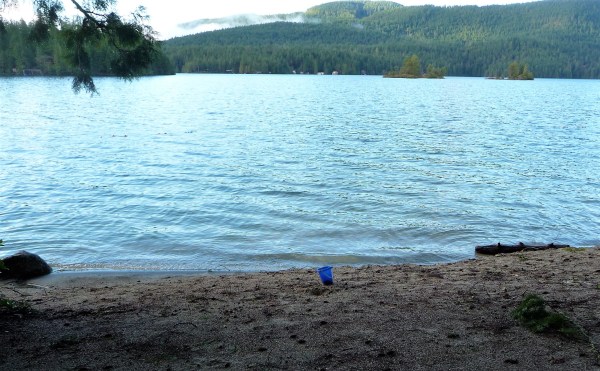
This is where I swim most mornings from late June until October. I love the water and have been swimming in this lake since 1980. There have been some changes around the lake but not many. My children swam daily, in summers, all the years they lived here and returning, it still brings them to its shores at least once a day. I’ve always understood that it was once an ocean inlet and that the water at the very bottom is salty. I know it’s deep. And one summer there were jelly-fish in the lake. One summer, leeches. Cutthroat trout. Last week I saw loons, a family of them, and there are mergansers, mallards, heron, eagles, Canada geese, stands of huge firs and cedars along the lake, little pockets of wild mint, arbutus, hardhack (which is blooming now), a few of the beautiful Pacific rhododendrons at the far end by the ecological reserve, Nootka roses, sweet gale, and whew, I didn’t mean to write the lake shore but it seems I have. This is partly because I’m reading the most wonderfully companionable book right now, Jessica J. Lee’s Turning: A Year in the Water, in which she details the lakes she swims in around Berlin over the course of a year, sometimes cutting through the ice to make a place large enough for her to submerge her body for a brief dip.

Jessica is an environmental historian, tracing landscape changes on Hampstead Heath in London, and part of the book’s narrative follows her as she works on her dissertation. She says, “I”m not trained as a scientist, but an environmental historian must be adaptable. For this reason, I jump between history, ethnograph(y) and botany. Archives, interviews and plant keys. As a swimmer, limnology is another kind of key. A way to read the lakes.” And this is a thread that guides the reader as it guides the author. Water quality and how it shapes the experience of someone swimming the lakes is affected by so many things and we see them from the perspective of a woman who notices the plants, algae, mushrooms by the shore, plantings near the shores, whether the water bodies are naturally-occurring or anthropogenic (old quarries and so on), and how widely the lakes are used seasonally.

She is interested in language, too, and how it shapes our understanding of a landscape.

It starts with a marsh. Birch wood gives way to straight, skinny alder, sunken deep in the marsh along the River Briese, which cuts north of the city. A successful stage between swamp and forest, this Erlenbruchwald is known in English as a ‘carr’. Like ‘Berlin’, ‘carr’ basically means ‘swamp’.

[As an aside: I wondered at the etymology of Briese. Was the river named for Bri(e)seis, the woman taken by Agamemnon from Achilles in the Iliad? But no, it seems the root is “breza”, an Old Slavonic word for birch…]

Turning is about swimming, yes, and it’s about love, about estrangement—from our bodies, from our families—and how we make that turn back to wholeness. It’s no accident that Jessica’s swims are always towards the centres of the lakes. On a swim just before flying to Canada for Christmas:

I slip into the water and it’s exactly as I expect: bracing cold, the metallic feeling of its grey sliding over me. I swim out to the centre, counting my strokes, longing to be out and dry away. I count to sixty and then turn back. Better things wait for me in the days ahead: warmth, light and respite from the grey of the city. When I come back, I hope it will have turned to white.

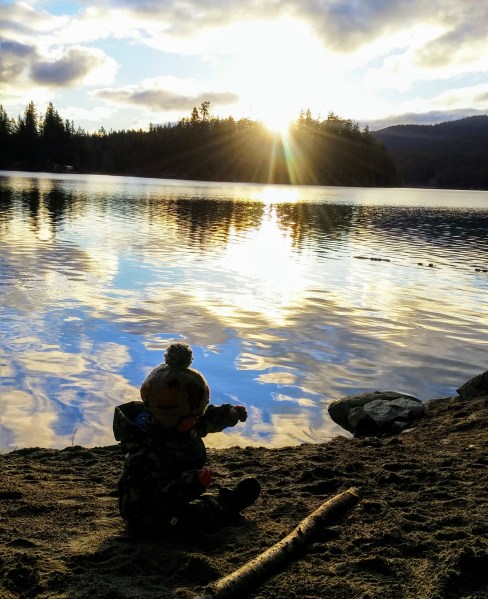
The book takes us through the places (Canada, Berlin and surrounding Brandenburg, London and Hampstead Heath’s Ladies’ Pond), plunges us into  lakes while reminding us of their unique seasonal stratifications, and is the most congenial book to read after a morning swim in Ruby Lake where the water is green and familiar. I have two short chapters to go and I’m going to make them last. And I must confess that the author’s bold habit of swimming in winter might just be infectious. Here’s what our lake looked like two winters ago, on New Year’s Eve:

arthur at ruby lake

It’s tempting.