Yesterday we went in our little boat down Sakinaw Lake. Manon and Forrest are here from Ottawa and it was such a beautiful day that a picnic at the bay beyond the end of the lake seemed like a good thing to do. Sakinaw is a long narrow lake with a fishway connecting it to the ocean at its western reach. Sockeye and coho salmon make their way through a flow control weir and into the lake, spawning in several locations each fall. When our children were small, we regularly visited the bay, sometimes to collect oysters and clams, once the gift of five yellow plates on a Thanksgiving weekend (only two remain intact!), and we always stopped at a cliff face to marvel at pictographs there.
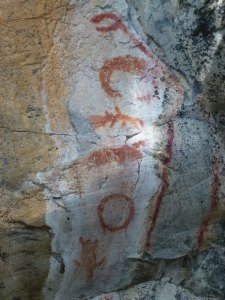 Pictographs can be found in all sorts of places in B.C. and had, still have, important commemorative and ceremonial functions. They are records, burial markers, boundary markers, and have significance beyond what we might to able to determine. This particular group of images — fish, crayfish, prawns — has always seemed to me to be an inventory, a list of marine life common to our area. It speaks to the notion that when the tide is out, the table is set. And how lively these animals still are, after perhaps a hundred and fifty years! The pigment is red ochre, bound with animal fat or fish eggs; it’s extremely durable.
Here is the end of the lake as we approached it.

And here is the bigleaf maple, a study in arboreal architecture, against the October sky.
 The tide was high, but heading out, so while we ate our picnic — baguette, pate, cheeses, apples, dark chocolate, accompanied by robust red wine — , the music was of water, herons, kingfishers.
 And this was our view, in the distance — little islands, and the larger Texada beyond:
 This bay has always seemed haunted to me. A place where human beings have sat in their privacy for centuries, a small relict of an older time. In the immediate past, our family and our dog Lily, children perching on rocks and unearthing tiny crabs to watch race back into the darkness of the boulders. And poking around the area above the high tide line, I found the remains of a midden — dry earth dense with clam shells. And this little ring of bone (vertebra?), light as air, an echo of other picnics, other feasts in sunlight, while above the maples turned gold and the mergansers muttered on their log.




 ...Theresa Kishkan