a publishing history, with asides (second instalment)

A new century, the first decade

horses leading me into novel

When I’d finished writing Sisters of Grass, I didn’t know quite what to do. The publisher of Red Laredo Boots felt it was between readerships—teen and adult. I sent to a couple of the bigger publishing houses and had quick rejections, one editor telling me that I was simply not ready for Harper Collins yet. Sometimes, looking for something else, I find an old notebook with lists I’d made of publishers sent to and their response. 20 rejections. Or 25. Some silences, though fewer of those in the beginning than now. The current fashion seems to be to tell writers that if they don’t hear within 3 months, or 6, to consider the manuscript has been rejected. This seems like such an abrogation of common courtesy. An email takes a few minutes. Surely we deserve at least this? I thought I’d try to find a literary agent who might be able to represent me because I wasn’t– I’m still not—a very good advocate for my own work. Several rejected me outright but one wondered if she was right in assuming that my name was First Nations, in which case she thought she could do something with my book. I didn’t pursue that. I packaged up the manuscript and sent it to several smaller publishers. I remember receiving an email from Laurel Boone, who was then fiction editor at Goose Lane Editions, telling me that there were many things she liked about the novel but that she felt there were missed opportunities with the two narrative perspectives, and if I agreed with her and made some revisions, she would be happy to look at the manuscript again. Sometimes an editor’s comments make no sense but hers struck a chord and I opened a new file, inspired again by Jack Hodgins, and retyped, added a formal dimension to both separate and connect the two narratives. When I’d finished, I sent Laurel the manuscript and she immediately accepted it with such enthusiasm that I floated through the next few days. Working with her and the team at Goose Lane was wonderful. I loved Julie Scriver’s cover design. And when Susanne Alexander phoned to say that they would be interested in another book, I told her about Inishbream. Although of course it had been published the year before, the print run was very small and all copies were quickly sold. At that time, Goose Lane published novellas in a small format ideally suited to the form and after discussion with the Barbarian Press, Inishbream was accepted, along with some of John DePol’s images for the cover and frontispiece.

Kishkan’s prose is clearly that of a poet, but it’s restrained in service to the narrative – rich and evocative, but never overwrought. Sisters of Grass is beautifully understated, with a quiet grace that succeeds in transforming the regional to the universal, filling the reader with a sense of the mysteries of the world, and humanity, that can never fully be resolved. (Robert Wiersema, Quill and Quire)

Interesting and unexpected things happened, maybe the sweetest being the man who owned the bookstore in Merritt telling me (after my children held up my book in the store and told him I’d written it) that people all over the Nicola Valley were impressed that I’d got the lineages of the horses right! I was invited to several festivals after Sisters of Grass and Inishbream were published. I remember sitting at the book table at the Vancouver Festival of Writers and having a BC publisher introduce himself. He wondered if I might be interested in publishing a collection of essays with his press. I didn’t think I had enough essays but he followed up and I realized I did. I was also finishing another novel, A Man In A Distant Field, which I’d begun after a conversation with two men in my community, one a fisherman my own age and one much older. The older man was describing what it had been like to come up to Pender Harbour as a child, in a storm, on a boat carrying seed oysters, and how his father had tied him to the gunwales so he wouldn’t wash away. I felt an intense shimmer, that’s the only word I can think of, as the story settled into my imagination. A few nights before the conversation I’d dreamed of a man curled up in the bottom of a Columbia gillnetter, the craft drifting to rest on a shore, and the two strands came together in my consciousness, turning and twining, and I wrote myself into a story echoing the middle books of the Odyssey, a poem I’ve loved since I was an undergraduate, 50 years ago. I thought I’d try again to find an agent. I wondered if I might be doing my books a disservice by not pursuing possibilities that arose: a film query, foreign sales. I did enter into a relationship with a woman who read my new manuscript, signed me, and then kept telling me the book wasn’t quite ready to send around. After a year of this, without any clear direction, she told me she’d had a brainwave: I could rewrite my novel as a sort of modern retelling of the Odyssey! I gently responded that the ancient and beautiful poem already anchored much of my narrative, the relationships subtle and implied, and I wasn’t interested in an obvious scene-for-scene equivalency. And I realized that as much as I liked her, she wasn’t going to do anything for me that I couldn’t do myself.

That book found a publisher, Dundurn, and came out in 2004, receiving a nomination for the Ethel Wilson Prize. It was also a book that inspired two generous readers to pursue possible film interest on my behalf. Nothing came of it but I was grateful for their efforts. And who knows, the novel still exists and maybe it would make a good film. I only wish Daniel Day Lewis was still considering roles.

Kishkan carries all this off masterfully in a scant 300 pages by combining the crafts of the poet and the screenwriter. There isn’t a moment in this novel when you can’t “see” something intensely, whether it’s the shining black dorsals of a pod of killer whales shadowing a cedar canoe or the wildflowers growing around a secret “Mass stone” where Irish Catholics were driven to take the sacraments in the wilds. The cadences of Irish speech, not only in the dialogue but subtly woven into the narrative, maintain the continuity of Declan O’Malley’s mood, as well as a sense of the period. Kishkan also uses a technique from classical Greek drama. A powerful sense of horrific violence informs the story, but the violent events all occur “offstage,” recounted in dialogue or as memory flashbacks. The only one that forms part of the action is the aftermath of a beating. (John Moore in the Vancouver Sun)

Oh, and that publisher who asked for the essay collection? I put one together, he accepted it, I signed a contract, received a small advance, his designer made a beautiful cover using a friend’s photograph, he advertised it in the catalogue as Forthcoming; as I waited for the edited copy, his publicist set up a book launch, and two weeks before it was to happen, after invitations had been sent out but I still hadn’t had edited copy or proofs, I read the writing on the wall, as they say, and realized the book wasn’t going to come out. My emails went unanswered. I waited until the next catalogue came out with my book listed as Recently Published and with some advice from a lawyer friend, I sent a registered letter cancelling our contract. It was a time when small publishers were experiencing difficulty and I was not unsympathetic but I also didn’t want my name to be associated with shady practises. I remember unexpectedly encountering one of the Literary Press Group sales representatives in a book store and his first words were, “Everyone is asking what happened!”
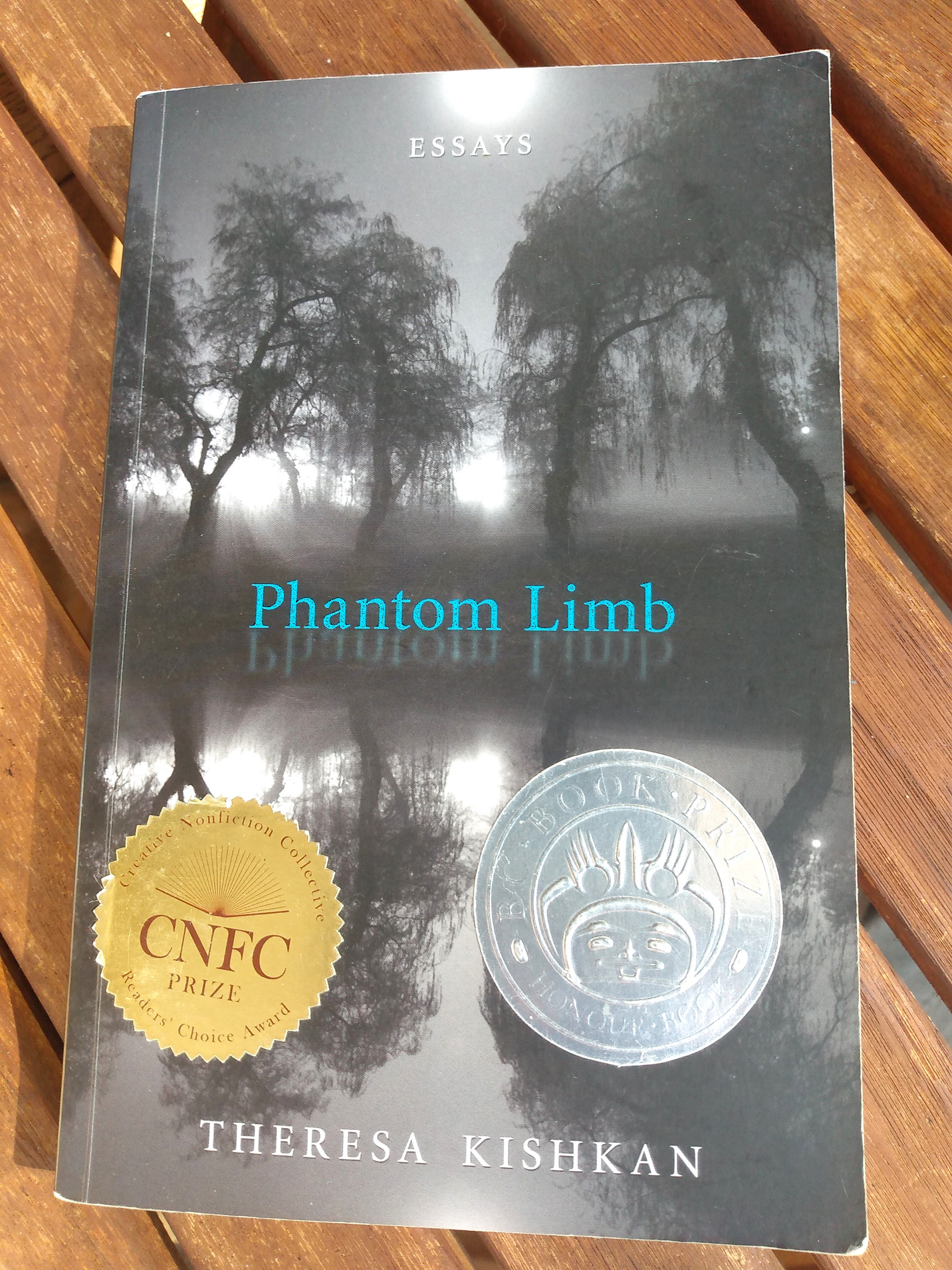
phantom limb

That book, Phantom Limb, found another publisher, Thistledown Press, and my friend let us use another of her photographs. Apart from a small tussle with the editor over my use of the c word – I finally agreed to replace it with “vulva”, a compromise for both of us—the editing was intense and respectful. The book was shortlisted for the Hubert Evans Award for Nonfiction in 2008 and received the Creative Nonfiction Collective’s inaugural Readers’ Choice Award.

Who knows where a book comes from in a writer’s hoard of memory and possible investigations. When I was spending a fair bit of time with aging parents, talking about a beloved family home near the Ross Bay Cemetery, I realized, so late, too late, that the elderly neighbours my mother befriended and offered her children to for errands, well, I realized that a couple of them were Great War widows. The photographs on their mantle-pieces, the quiet beyond quiet in their tidy homes—they represented a legacy I couldn’t have understood at the age of 6 but in around 2005, I began to try. I also realized that a man who used to come out from his long driveway with his spinster daughter, he with a shooting stick, and her with a strange crocheted hat—this was in the neighbourhood my father retired to, in Royal Oak, then still quite rural—and asked me to stop with my horse so the man could stroke his neck, were both notes in the history I was trying to examine in the novel I’d begun. He was Bert Footner, the architect of many of Walhachin’s colonial bungalows, and the daughter was Mollie, born and raised in Walhachin, a place central to my book. I wish I’d known then about Walhachin, though I could have known if I’d paid more attention to my father’s frequent discourses on family trips. Children, he’d say as we drove the Trans-Canada Highway between Cache Creek and Kamloops on our way to his family in Edmonton, there’s the remnants of Walhachin! He pointed vaguely to what looked like a few houses above the Thompson River, some remnants of wooden irrigation flumes, and it wasn’t until I was an adult, driving the same highway with my own children, that it occurred to me to turn off onto the gravel road and see what was left. The book I was writing became The Age of Water Lilies and again, it had a long road itself to publication. Those lists again! 24 rejections for this one. The Age of Water Lilies was published in 2009 by Brindle & Glass. One of the nicest things that happened was that I was invited to be part of International Women’s Day celebrations in the Soldiers Memorial Hall in Walhachin and slept in the old post-office, really a shed used as guest quarters by the woman who’d invited me. Her grandparents had been part of the second wave of settlers to the community, the ones who came during hard times in the 1930s. There was no electricity or plumbing in the little shed, and I got up in the night to pee under a star-filled sky while coyotes sang quite near. I remember that Gordon Parke of the Upper Hat Creek Valley, whose family had ranched in the Valley, as well as on the lower Bonaparte River, came to my reading and he told me I got the details right. I carried his durable praise for months.

water lilies

The title of this series of histories promises asides and here’s one: I always sent new manuscripts to previous publishers. Sometimes there was a contractual requirement to do this but it also felt like a courtesy. So if you’re wondering why I didn’t simply stick with one publisher, it’s because none of them wanted to stick with me. Maybe they had expectations that my books (or me) didn’t rise to. I don’t think I’m a diva. I enter the editing process respectfully and I meet deadlines. I do my part. I know that Sisters of Grass sold very well, had excellent reviews, and I still receive royalties. But Laurel Boone retired and the new fiction editor had other writers she wanted to work with. I have to admit that I wish for a publisher who would stay with me but as I approach 70, I think it’s unlikely it will happen.

In the first decade of the 21st century, I published 4 books and I wrote another, Mnemonic: A Book of Trees, which came out in 2011. That one is a kind of hinge in my writing life and in the way I see some changes in publishing. I received a phone call from an editor mid-decade. She wondered if there was a book I was interested in writing because she professed to love my work and wanted to guide something of mine through the channels of the company she worked for. I told her I had some ideas for a memoir and we talked at length about it. She suggested I send her a proposal which she would share with the publisher. I thought at length and submitted something. Next I received a call from the publisher, suggesting we meet for lunch. This was in Vancouver. He was very kind and had some ideas for improving my proposal, requiring it to tick a bunch of boxes. He sent me samples of killer proposals, some he’d been able to snap up and publish, others he couldn’t (because others were interested too and offered more money). I remember I came back from the lunch and talked to John about the whole thing. I remember he listened and then he asked, Is this something you actually want to do? It was a proposal, after all, not creative work. I thought and thought about it. No, I didn’t want to “make” a book with constant guidance and editorial shaping as we went along. Because that’s in truth what was being suggested and offered. My writing, their market sense. I need to say that I understand that and I read books all the time that are “made” that way and I enjoy many of them. There’s a logic for certain books: cookbooks, field guides, how-to books, scholarly studies, and so on. I know publishers need to be financially secure and many writers need to write books that are carefully adapted to markets and trends. But it’s not my modus operandi. I wonder when this became the model for the writer-publisher relationship? I see advertisements for courses that teach a writer how to write a synopsis, a proposal, a query letter. On social media, people post updates on the progress they are making with the description of their book. About 5 years ago I was finishing a collection of essays (more on this in the 3rd instalment) and I thought I’d try, once again, to interest an agent in the book. One had been circling me a little on social media and had said some nice things about my work. I sent that person a detailed description of the manuscript, knowing that they had already read one of the essays, published in Brick– a fulsome comment had been made. A response came the next day, suggesting that I visit the area of the agency’s website describing how to submit a proposal. I admit to being somewhat blindsided because I thought this was something that could be discussed over the phone or via email if the agent was interested in the description and other information I’d provided. Did I really need a proposal for a book that was already written? But the new gates, the new gatekeepers! Some of us who came of age as writers in the last century can’t find our way through.

I thought and thought about what and how I wanted to write about my life and as I began essays that I knew would accumulate and talk to one another and share common nodes, I realized I was writing a kind of literary arboretum. (In another life I’d have been a botanist.) I’d grown up among trees, influenced by them, shaded by them, given sustenance figurative and literally by them, and so I followed the trail leading into forests, orchards, lumber yards (an important part of the section about building a house with John), mythologies, and family relationships. I thought about the architecture of memory, of love, and when I was finished, I had Mnemonic: A Book of Trees, a book-length grove of connected essays. I offered it first to the publisher who’d taken me to lunch. He said nice things but ultimately it wasn’t for him. And then I began sending it out. Many of the individual essays had been published, one of them won the New Quarterly’s Edna Staebler Personal Essay Contest, one of them appeared in a journal in the Czech Republic focused on the work of scholars and others (I am definitely one of the others) who participated in a conference in Brno in 2010. As the year turned into the next one, the manuscript was taken by Goose Lane Editions and published in early fall of 2011.

The essay reaches its fullest flower in mature hands. Kishkan’s are practiced and confident, and her prose, while fresh and smooth, also accommodates the knottiness of genuine thought. Mnemonic may seem an easy read, but it richly rewards revisiting. If this book were a tree, it would have deep and thirsty roots; broad and elegant branches; its leaves would always be tipping toward the light; and its fruit would be tangy and sweet. (Susan Olding, The Malahat Review)

The next spring John and I were back in the CR, teaching a course in Brno and giving readings around the country. On our final night in Brno, he received an email from his publisher to tell him that his latest poetry book, crawlspace, had just been shortlisted for the Dorothy Livesay Prize (which it subsequently won). We celebrated that evening with friends over a delicious Czech dinner. Ok, I admit I was a little disappointed not to have received a similar message about Mnemonic but when we arrived in London the next afternoon, there was an email waiting from Goose Lane to say my book my shortlisted for the Hubert Evans Award. I remember we toasted our luck in a Greek restaurant in Bloomsbury where we were staying. And no, I didn’t win that one, though a book about trees did win, published by the man who’d taken me to lunch.

mnemonic

to be continued…

“it lives in my spine” (Leonard Cohen)

core

Yesterday we went down to the old orchard, now overgrown and returning to forest, and John bucked up some of the cedar logs left after some we had some work there 3 or 4 years ago. Cedar’s not a great firewood. It doesn’t burn as hot or as long as fir, maple, or alder. But we have the logs and they’ll provide some heat. After John’s double hip surgery in October, 2020, he was left with a paralyzed foot after a nerve was compressed during the procedure. We hoped for a complete recovery but two years have passed and that’s unlikely now. But it’s much better than it was. Using a chainsaw is possible now, for example, because his balance is better. So that’s why we were down in the orchard, him bucking and splitting, and me carrying logs to the back of our Element. Two years ago, a friend came with his son and they cut up a couple of the logs. I wrote about it here. At the time, looking out the kitchen window as Joe and August stacked logs in our woodshed, I thought I was seeing angels. And maybe I was. Sometimes people offer exactly the thing you need and that day it was the offering of logs to warm our house.

the very core

I was lifting logs from the area by the chopping block when a long stick the width of a pencil dropped to the ground. It was the core of the log John had just bucked into stove lengths and then split. I must have seen the core of a cedar log before but this time I really looked at it. Hard, and smooth as skin, faintly pinkish–you can see it in the photo at the top of this post, though the pink is lost in that image. It is its own thing, its own strength. I put it aside and will keep it on my desk with all the other objects–the paperweight John brought me from Toronto years ago and which led me into an essay about my mother (“Paperweight”, in Phantom Limb); a large smooth rock from the Skeena River; a chunk of fossil-filled rock from a beach west of Sooke; two ikons, one from Greece, courtesy of Angelica, and one from Skagway; the pelvis of my beloved dog Lily; a tiny ceramic tree frog; a glass heart (a gift from John); and a bowl of shells and stones collected over the years.

We were in the old orchard, the one I wrote about in Euclid’s Orchard, and sunlight was bright on the house above us, the bigleaf maples on the edge of the orchard, and we were doing work we’ve done for decades, willingly, grateful to still have the strength to bring in the wood. There are things I’m having a hard time with these days and I’m trying to write my way through, hoping for clarity and peace. The core of the cedar reminds me of days past, days of kindness, which of course is the title of one of my favourite poems of Leonard Cohen. Reading it just now, I find lines to carry with me, to hold as strength and courage.

There was good light then
oil lamps and candles
and those little flames
that floated on a cork in olive oil
What I loved in my old life
I haven’t forgotten
it lives in my spine

It lives in my spine, what I haven’t forgotten. The fires we lit in the orchard to burn old brush, the ones when our children were still here, the ones when they returned with their own children. The days of apple blossom and pear blossom, rich as sandalwood. The good light of a few candles on the deck at the end of a dinner. The bees. The friends who have passed into memory, the ones who turned away, the dark nights driving home when elk crossed the highway in a long stream, the single snowy owl on the tree by our driveway. In my spine, what I loved in my old life, holding me true in the days since, the ones to come.

redux: it’s a long way from Clare to here

Note: This time last year I dreamed of Galway, and last night? Again. The soft iodine wind that came in the window by my bed in my cottage on Inishturbot. The wild fuchsia on the narrow roadsides. The music.

And is it courting bad luck to say that the Ukraine trip has been rebooked? Fingers crossed. All of them.

********************

Does this happen to you? That you wake, knowing you dreamed of something deeply important, but you’ve forgotten what? How did you sleep, I asked John just before 7 and he replied, Not well; strange dreams. Given that he is experiencing a new health thing, I wasn’t surprised, but sort of sad, because sleep is the one time we can leave the daily worries and be transported. I knew I’d dreamed of something unsettling too but couldn’t remember just what.

Putting laundry into the washing machine, I found myself singing softly and I realized it was this song:

And then I remembered my dream. John and I were somewhere, don’t know where, and two guys were also there, obviously bored. Never mind, one of them said, we’ll just drive on to Galway. I was pierced, in the dream, and now, that someone could simply drive to Galway, a city I love and have spent a little time exploring. It was the nearest city to me when I lived on an island off the west coast of Ireland and sometimes I got to tag along with someone going there with fish or on other business. Later, in Ireland with my son Forrest in 2001 so I could research Irish history and revisit some special landscapes while I was writing A Man in a Distant Field, Forrest and I spent three nights in Galway. He was just finishing an undergraduate degree in history at the University of Toronto and he’d taken a course in Irish history and was full of information I’d never known. But I knew places and plants and another kind of history so I think we were a good pair that spring. We were blessed with weather. I think it rained the day we arrived in Dublin and it might have rained another day but mostly it was warm and sunny, ideal for following the Ordnance Survey Map I’d ordered from Kennys, a book store and art gallery in Galway, before flying to Ireland. I wrote about that trip in an essay, “Well”, in Phantom Limb, how we used the map to find (or not) sacred sites:

We didn’t see St. Patrick’s Well off the Maam Valley road, nor his bed a little further on. We drove as far as the path to that Well but then it led through a farm yard and the sign told us Do Not Enter. Later in our trip, we ignored the signs and ventured into Hoare Abbey, a field of beehive huts on the Dingle Peninsula, a grove on ogham stones on a private drive, but we hadn’t yet found the courage to climb the gate, and walk up the path, smoothed by centuries of travellers and believers.

near dingle

Forrest found a small map in Galway that took an interested person, or two of them, on a walking tour of medieval sites, many of them hidden in plain view. You looked up and saw a gargoyle, an oriel window, the hall of the Red Earl. We walked, parsing the streets in their layers of occupancy. Streets I’d walked and never thought to look up.

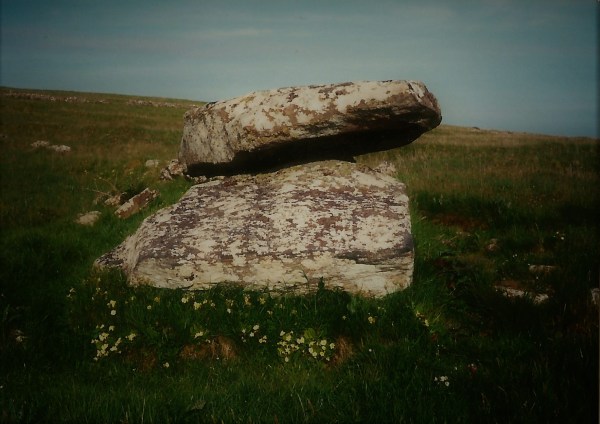
We went to places I’d been but had never known to look at with an historian’s eye. At Sellerna, this megalithic tomb:

at sellerna

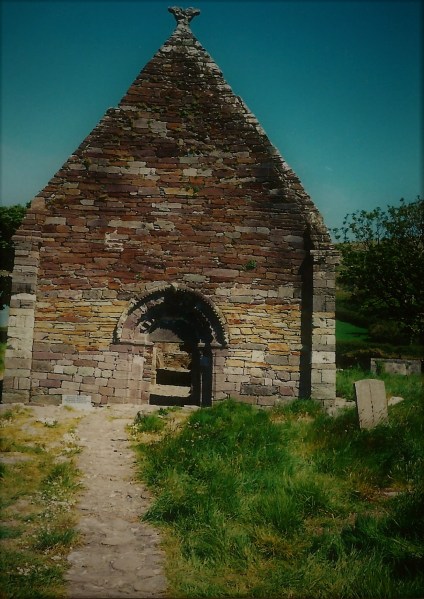
The Kilmalkedar church on the Dingle Peninsula:

kilmalkedar

In my dream, this was all somehow in the atmosphere, that a person could simply go to Galway, or by extension, Ireland. But that person wasn’t me. I know I am mourning in a mild way the loss of our trip to Ukraine and London in September, wondering (perhaps) if we will be be able to plan such things again. Things happen. One day you are healthy and vigorous and another day you aren’t. And a song helps, or doesn’t. It’s a long long way from Clare to here, from Galway to here, from the village in Bukovina my grandfather left in 1907, maybe for good reason, maybe not. It’s part of a project I’m working on, a series of essays that might become a book. I didn’t think Ireland was part of it but, well, are dreams instructive? Was I being told to pay attention to where the heart longed towards?

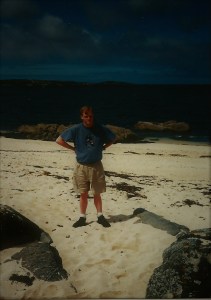
We had to stop while John Smith drove his cattle to their evening pasture, him still in the black wellingtons with a familiar dog at the heels of the last wild-eyed heifer. He waved to us as though to anyone and for a moment I thought to call to him, asking him…but what? Where have the years gone, John Smith, that you are still with the cattle and I am driving with a son the age I was when I lived on the island we’ll see when we park the car and take our picnic to the sand.

forrest

Was I being told to at least look at old photographs and remember that ramble through narrow roads so overhung with fuchsias and hawthornes that we kept having to pluck blossoms from our clothing when we got into the car, or out of it.

I sometimes hear a fiddle play or maybe it’s a notion
I dream I see white horses dance upon that other ocean
It’s a long, long way, it gets further by the day
It’s a long way from Clare to here

redux: where my limbs are in space

Last year I was dreaming of this lane. And looking at it this morning, I am remembering the Olson line, “…is it not a heart which has gone lazy?” Is it? Sometimes. But not this morning.

inishbream

I woke in the night from a dream of Ireland, where I lived in my early 20s. I lived on an island and I’ve written about it, first in a novella, Inishbream, and in an essay in Phantom Limb. In the dream I was walking down the boreen that crossed the island. I was wearing the old sandals I had then, even though it was raining. I was swinging my arms and my shoulders ached a little. I knew where I was, knew the air my arms were swinging through, misty, smelling a little of turf-smoke and dung. This was the path the cattle took when they were moved from one field to another and it was the trail leading up from the quay so that when the turf was brought from the mainland by currach and loaded into a donkey pannier, the donkey walked to its owner’s cottage along its rocky ground.

I wonder if I had the dream because I was reading yesterday about proprioception? It’s a term I remember from the American poet Charles Olson whose work on projective verse, field composition, the guiding breath of the poet dictating form, and so forth was an important influence for the poets I was reading as a young woman.

And the threshing floor for the dance? Is it anything but the LINE? And when the line has, is, a deadness, is it not a heart which has gone lazy, is it not, suddenly, slow things, similes, say, adjectives, or such, that we are bored by? — Charles Olson, “Projective Verse”

Proprioception is the knowledge of where your limbs are in space and in relation to each other. It’s sometimes called a sixth sense, a sense of self. It’s the thing that allows us to move in a room without bumping into people, to descending stairs in the darkness without falling (I do this often, reaching forward with my foot and trusting my own body) and without really thinking about it. I remember when our dog Friday, towards the end of her life, lost the use of her hind legs. When we took her to the vet, he said she’d lost her sense of proprioception and it was the first time I’d heard the word used outside of poetics.

In my dream last night, I knew how it felt to walk that boreen. I knew the effort needed to avoid the stones, to make sure my swinging arms didn’t graze the stone walls on either side of the path, I knew how I would feel as I approached the side path leading to my cottage (which was just behind the rise you see to the left in the photograph). I knew to be quiet as I walked past the school (that building on the right) because I loved to hear the children’s voices through the open window. Sometimes they were having their Irish lesson and the words sounded like music: gualainn, lámh, béal…Sometimes there was even music, one of the men playing a tin whistle at a gate you can’t see just beyond where the path curves away. Sometimes I’d try a few dance steps as I approached my house with the music all quavery in the wind.

Soft is the grass, my bed is free.
Ah, to be back now in Carrickfergus
On that long road down to the sea.

But even in the dream, I knew I was dreaming. I knew my shoulder was sore because of my swim yesterday when I didn’t get my usual lane for the first half and so I had to keep turning my head when I was doing the back-stroke to make sure I didn’t crash into the end of the pool. (In the water, in my usual lane, I know exactly where I am by how it feels to stretch out under a particular section of ceiling, and how many arm strokes it takes to get me from the shallow end to the deep.)

This morning I am looking at some recent work, my body still wistful for that walk on an Irish lane. Maybe it’s the rhythm I’m hoping for in the writing, the careful foot, a swinging arm, my ear listening for new words on an old wind.

This is so long ago now but thinking of it brings back the music of Miceal’s tin-whistle as clear as anything and I ache to walk out to the boreen and learn to play along. — from “The One Currach Returning Alone” in Phantom Limb

redux: “What did the thrushes know?” (for Anna)

Last night friends were here and of course we talked about the weather–how (unseasonably) cold it’s been, the snow, the fact that salmonberry blossoms are weeks away at least. But this morning I was looking through old posts to see what happened, when, and here’s my entry for March 2, 2014. Plus ça change, plus c’est la même chose.

___________________________________________________________

I’m writing this while snow falls. Again. Snow is not unheard of in our part of the world but it’s late this year, and abundant. Usually by now we are seeing salmonberry blossoms in the woods near us  — single blooms as early as February 17, I see in my notes, and often many by the end of February — and am I completely wrong or do we also hear the long whistles of varied thrushes when we walk down Sakinaw Lake Road in March? That may be pushing it — memory is not always reliable when it comes to hope.

The varied thrushes are around right now but this is because it’s cold and they’re drawn to the seeds that fall from the bird feeder strung on the clothes line. The clouds of chickadees and the animated Steller’s jays always spill some seed while eating and the thrushes wait quietly on the ground for an opportunity to forage a bit. They’re shy. This is the only time of year we can reliably see them. But that whistle — a long note on one pitch, then rising to another, ringing out of the dense woods: it’s one of my favourite bird songs. It’s both sweet and mysterious, somehow. Some mornings I hear it when I first wake, the rising notes pulling me to consciousness, and I lie in my bed listening with something close to pure joy.

Friend Anna in England sent me a link to an Edward Thomas poem this morning. “March” is a poem about spring, about thrushes, primroses, and snow. About faith too. These lines spoke to me so clearly:

What did the thrushes know? Rain, snow, sleet, hail,
Had kept them quiet as the primroses.

I had them in mind when I went out to fill the feeder just now, though the thrushes were not in sight. And the only primroses are in memory, the drifts of them in the hedgerows near the island where I lived for a time in Ireland and used to pass on my way to the nearest town for groceries. I wrote about those hedgerows in an essay, “Well”, in my book Phantom Limb: “…a dense hedge, with fuchsia among it, on either side of the narrow road and the raised banks white with wild garlic, yellow with primroses. Birds sang unseen within its depths.” The only time in my life I’ve seen a badger was then. I watched it amble across the road and disappear into a tunnel or sett in the hedgerow. The rich growth above the ground was all the more remarkable for the thought of the tunnels below with their sleeping clans.

Edward Thomas’s poem has a special poignancy when I think of his life. He suffered from depressions and physical and psychological breakdowns. He wrote all his poems during a two-year period before his death, at the Battle of Arras, on April 9, 1917. His great solace was the natural world. His poems are filled with birds, with the sights and sounds of the countryside.

Something they knew–I also, while they sang
And after. Not till night had half its stars
And never a cloud, was I aware of silence
Stained with all that hour’s songs, a silence
Saying that Spring returns, perhaps to-morrow.

It’s still snowing — even harder now. I couldn’t resist taking a photograph of the tray of  primula from the supermarket, arranged by our front door. I always buy the creamy ones, the closest thing to the Irish beauties I still dream of and which Edward Thomas quietly memorialised more than a hundred years ago.

P1090505

winter jasmine, crocus, the first circle of hell

Like so many others, I find January a long month. A dark month. And although we are not in the middle of the polar vortex that is creating such frigid temperatures in other parts of the continent, it’s cold here. In the mornings I put on two or three layers and drink my coffee close to the fire.

But then there’s a morning when it’s somehow lighter. I woke at 5 a.m. on Monday and the sky was dense with stars against the deepest indigo. I thought, oh, that would make a beautiful quilt and then I realized I’d made several inspired by winter skies. In my book Phantom Limb, there’s an essay called “An Autobiography of Stars” in which I detail the making of a quilt for my daughter Angelica, set against a meditation on astronomy and the Leonid showers.

On each bed, a patchwork, for warmth and for safe passage through the night. In the sky we might fashion a parallel life, a world mirroring the topography of our own lives, irregular and beautiful, geometry in service to love. Sewing stars for my daughter to sleep under, I am fashioning a metaphor for my love of her and a belief in her luminosity, a parable of meteors and radiance and grace.

I have no photograph of that quilt to share but it was silvery stars—Variable Star blocks—on a ground of deep purple and blue. And I’m pretty sure I was making it in winter.

So a morning when it’s lighter, when you walk across the patio and realize that the winter jasmine has begun to bloom, single yellow stars in a thicket of branches:

winterjasmine

A morning when you are looking forward to reading more of Dante’s Inferno by the fire. Last night we read the 4th Canto, the long beautiful lines taking us into the first circle of hell with Dante and Virgil. And in that place too is a bright fire with poets gathered—Homer, Horace, Lucan, and Ovid. More company appears, every poet or philosopher or mathematician important to Dante. In the poem’s notes, written by Robert Pinsky’s daughter Nicole, she calls this “an abundant, almost ecstatic identifying list.” Dante and Virgil spend some time with them and then

         …my wise guide leads me away from that quiet
Another way—again I see air tremble,

And come to a part that has no light inside it.

Tonight we’ll go there, into the second circle. But even in that darkness, there will be beauty. I remembered in 2013, in the aftermath of having to take the vegetable garden apart for a septic field repair and then rebuilding it again, digging in a new border and finding, underground, unexpected beauty. When I’d dug up all the plants and trees a few months earlier, I thought I’d also lifted all the bulbs to set aside and replant again. But there, in the dark, an incandescent clump of crocus.

underworld


it’s a long way from Clare to here

Does this happen to you? That you wake, knowing you dreamed of something deeply important, but you’ve forgotten what? How did you sleep, I asked John just before 7 and he replied, Not well; strange dreams. Given that he is experiencing a new health thing, I wasn’t surprised, but sort of sad, because sleep is the one time we can leave the daily worries and be transported. I knew I’d dreamed of something unsettling too but couldn’t remember just what.

Putting laundry into the washing machine, I found myself singing softly and I realized it was this song:

https://www.youtube.com/watch?v=BVFJ0Z-OTqo

And then I remembered my dream. John and I were somewhere, don’t know where, and two guys were also there, obviously bored. Never mind, one of them said, we’ll just drive on to Galway. I was pierced, in the dream, and now, that someone could simply drive to Galway, a city I love and have spent a little time exploring. It was the nearest city to me when I lived on an island off the west coast of Ireland and sometimes I got to tag along with someone going there with fish or on other business. Later, in Ireland with my son Forrest in 2001 so I could research Irish history and revisit some special landscapes while I was writing A Man in a Distant Field, Forrest and I spent three nights in Galway. He was just finishing an undergraduate degree in history at the University of Toronto and he’d taken a course in Irish history and was full of information I’d never known. But I knew places and plants and another kind of history so I think we were a good pair that spring. We were blessed with weather. I think it rained the day we arrived in Dublin and it might have rained another day but mostly it was warm and sunny, ideal for following the Ordnance Survey Map I’d ordered from Kennys, a book store and art gallery in Galway, before flying to Ireland. I wrote about that trip in an essay, “Well”, in Phantom Limb, how we used the map to find (or not) sacred sites:

We didn’t see St. Patrick’s Well off the Maam Valley road, nor his bed a little further on. We drove as far as the path to that Well but then it led through a farm yard and the sign told us Do Not Enter. Later in our trip, we ignored the signs and ventured into Hoare Abbey, a field of beehive huts on the Dingle Peninsula, a grove on ogham stones on a private drive, but we hadn’t yet found the courage to climb the gate, and walk up the path, smoothed by centuries of travellers and believers.

near dingle

Forrest found a small map in Galway that took an interested person, or two of them, on a walking tour of medieval sites, many of them hidden in plain view. You looked up and saw a gargoyle, an oriel window, the hall of the Red Earl. We walked, parsing the streets in their layers of occupancy. Streets I’d walked and never thought to look up.

We went to places I’d been but had never known to look at with an historian’s eye. At Sellerna, this megalithic tomb:

at sellerna

The Kilmalkedar church on the Dingle Peninsula:

kilmalkedar

In my dream, this was all somehow in the atmosphere, that a person could simply go to Galway, or by extension, Ireland. But that person wasn’t me. I know I am mourning in a mild way the loss of our trip to Ukraine and London in September, wondering (perhaps) if we will be be able to plan such things again. Things happen. One day you are healthy and vigorous and another day you aren’t. And a song helps, or doesn’t. It’s a long long way from Clare to here, from Galway to here, from the village in Bukovina my grandfather left in 1907, maybe for good reason, maybe not. It’s part of a project I’m working on, a series of essays that might become a book. I didn’t think Ireland was part of it but, well, are dreams instructive? Was I being told to pay attention to where the heart longed towards?

We had to stop while John Smith drove his cattle to their evening pasture, him still in the black wellingtons with a familiar dog at the heels of the last wild-eyed heifer. He waved to us as though to anyone and for a moment I thought to call to him, asking him…but what? Where have the years gone, John Smith, that you are still with the cattle and I am driving with a son the age I was when I lived on the island we’ll see when we park the car and take our picnic to the sand.

forrest

Was I being told to at least look at old photographs and remember that ramble through narrow roads so overhung with fuchsias and hawthornes that we kept having to pluck blossoms from our clothing when we got into the car, or out of it.

I sometimes hear a fiddle play or maybe it’s a notion
I dream I see white horses dance upon that other ocean
It’s a long, long way, it gets further by the day
It’s a long way from Clare to here

parades

pipe band

For more than a few years, we’ve been away over the May long weekend. Last year it was to Edmonton where we helped Brendan and Cristen replace a porch and build a deck under a leafy maple in one corner of their Strathcona yard. For several years before that, it was to Ottawa to help Forrest and Manon build a deck, then a pergola the next year to provide support for grape vines to shade their summer dinners.

But for the first, oh, twenty years we lived here, we always went to the May Day parade in Madeira Park. When I was a child, my mum always took us to the Victoria parade and it went on for ages—every school band in the city and maybe even the province marching, floats, old cars, banners, clowns throwing candy, and is it just my imagination or was it always hot? My mum never bought us pop or cotton candy and we’d walk home afterwards, cranky and sun-burnt.

The Pender Harbour parade was always just long enough. A single marching RCMP officer in parade dress, a single band (a pipe band, with one black piper with dreadlocks providing the only diversity in those days), a couple of floats, kids on bikes with crepe paper threaded through the spokes, the volunteer fire crew sounding the sirens as they drove the firetruck, hoses spraying those unlucky enough to be within range. And yes, throwing candy. Some years the snow plow would be festooned with balloons. One year an eccentric woman marched alone, a hood covering her head, a papier mâché head carried under her arm, and a sign on her back reading, “Ann Boleyn can be found at the library.” After the parade, everyone went to the school field where a May Pole waited for the dance. And there was a basketball tournament my son Brendan waited for. Booths with games my daughter loved. Cotton candy. A beer garden adjacent to the barbeques set up by the local fishermen and where a plate of halibut and potato salad cost 5 bucks. You saw everyone you knew there. Grown children came back for the parade and the dance that evening.

This year we’re home. And Angelica is here. When John picked her at the seaplane yesterday, she asked if we could go to the parade. So we did. It hasn’t changed much, apart from the fact that old cars opened it, vintage ones I guess you’d call them, and then the lone RCMP officer who had to stamp in place for a bit as people took pictures of the old cars. One or two more floats. Fewer kids on the May Queen float because the demographic of this small community has shifted. Fewer young families and more retired people. But we bought fudge and watched the little kids next to us scramble for candy tossed by the firefighters. There was even a Volvo driven by an older couple who’d somehow entered the fray inadvertently and were simply driving ahead of the last float, trying to find their way out of the procession.  And I remembered every other parade, or maybe just one (because they were all so similar), the one where the playschool kids were dressed as Care Bears and the mothers had to paint a backdrop of trees and bears or maybe the one where the kids were a school of fish and we had to make cardboard fish for them to hang from their shoulders with suspenders. One year, when Angelica was in grade 6, she rode the May Queen float as one of the attendants. And it meant work for the mothers. I was writing about bears then, a long essay, “month of wild berries picking”, and I used the occasion as a postscript.

It’s nearing the long weekend when my daughter will join girls of her age to ride on a parade float as queens and princesses of May in our community. For this they need dresses, or gowns really, and a willing group of mothers to help plan and decorate the float.

My daughter’s gown is finished, a blue so true to nature that I keep seeing it around me—in the opening buds of pulmonaria and scilla, the intense spring sky, the carpet of a flower I’m not familiar with in an abandoned homestead by Sakinaw Lake where we go to collect long lengths of ivy to garland the sides of the flatbed truck that the mothers are transforming into a spring grove for their daughters.

The bear has been around this spring. We haven’t seen him yet although the dogs have been barking and running into the woods in the early mornings and we’ve seen the piles of excrement on our walks for the past two weeks. I’ve been studying them, wondering at the diet of the bear, how he can sustain himself on grasses and what appear to be shoots of thimbleberry and primeval horsetails. Wondering too, when I find piles on the trail that is one of our property boundaries, whether he was entering out woods or leaving them when he left his mark.

—from “month of wild berries picking”, Phantom Limb (Thistledown Press, 2007)

Today, watching the girls on the boat trailer their mothers had turned into a pirate ship, Angelica said, I remember that we were shown how we had to wave. Like this…” and she slowly passed her hand back and forth, like a young queen. For a moment, I was there in that time of wild berries, bears, draping ivy over the plastic lawn chairs arranged on a fern-strewn truck bed, imagining the girls enacting again the spring rituals of gowns and flowers, anticipating the dance.

may queens

“…all the more wonderful for its mysterious provenance”

the stray

For readers of the blog, the recurrence of plants, coyotes, frog-song, births, deaths, phrases of poetry (sometimes the same poetry), musings about dandelion pizza, the various rivers I love, the growth of grandchildren (and even a fourth one due in July), swimming, must get, well, a little tired. Yesterday I was driving to a meeting and I saw that the coltsfoot at Misery Mile is in bloom and I thought, oh, I should write about that (remembering my own young horse and how the leaves reminded me of his feet), and then almost immediately realized that I already had, in my essay collection Phantom Limb.

I stop on the roadside and carefully lift a plant of the coltsfoot to bring home to my own garden. Petasites palmatus, butterburr, sweet coltsfoot. There are the blooms on their fleshy stalks and the broad leaves with fine hairs on the underside. And there is one small inrolled leaf-shoot, not yet opened, the foot of that colt I hold as I once held the entire weight of his delicate ankles in my hands.

(The plant I lifted didn’t survive.)

And just now, looking out the glass door to the deck, I saw the buds on the volunteer apple tree growing in the rocks on the bank leading down to where our orchard used to be, the orchard I celebrate and mourn in Euclid’s Orchard.

Did this tree sprout from a seed spit over the side of the deck or excreted by birds or even seeds from the compost into which I regularly deposited cores and peelings from apples given us by friends in autumn? Belle of Boskoops from Joe and Solveigh, for instance, which make delectable fall desserts and cook up into beautiful chutney. Or else a seed from the few rotten apples from the bottom of a box bought from the Hilltop Farm in Spences Bridge, their flavor so intense you could taste dry air, the Thompson River, the minerals drawn up from the soil, faintly redolent of Artemesia frigida. This stray is all the more wonderful for its mysterious provenance, its unknown parents, and its uncertain future, for it grows out of a rock cleft, on a dry western slope. I won’t dig it up since I have no doubt its roots are anchored in that rock, but I will try to remember to water it occasionally and maybe throw a shovel of manure its way this spring.

It all comes around again. That’s what I’m saying, I guess. (Even the meeting I was driving to was to work on details for the upcoming—14th!—Pender Harbour Chamber Music Festival, one of the pleasures of summer; I’ve been part of the organizing committee, off and on, since the beginning.) We sit on the deck at the end of the afternoon with a glass of wine and we notice that the big-leaf maples are heavy with incipient leaves and blossoms. And that means warblers and other songbirds drawn to both the nectar and to the small insects gathered on the blossoms. And as the leaves unfurl, we’ll watch for the western tanagers who nest either in the maple canopy or near it because we see them going back and forth during the nesting season, a flash of red and yellow, brilliant in summer sunlight.

My noticing, if I may call it that, is part of the way I remember, the way I try to keep intact the world I cherish. I am as political a creature as many or most; I have issues I follow, organizations I support, and lives beyond my own family and friends that I advocate for and with. But what I can do daily is record the place I have lived on and in for nearly 40 years—its cycles, its weather, its rich and ordinary earth. So the coltsfoot, the stray apple tree, the tanagers, even the samaras that fall from the maple in autumn and echo in the middle name of my first grandchild. Not only my home but what surrounds it, holds it. That people want to read these things never ceases to astonish me and I am grateful to you. And to Gaston Bachelard, who feels like a lifelong companion in his wise book about space—both the architectural space we inhabit but also how it fits into its environment, in our actual experience and how we recall it, how it influences our dreams and memories.

We comfort ourselves by reliving memories of protection. Something closed must retain our memories, while leaving them their original value as images. Memories of the outside world will never have the same tonality as those of home and, by recalling these memories, we add to our store of dreams; we are never real historians, but always near poets, and our emotion is perhaps nothing but an expression of a poetry that was lost.
                                     —from The Poetics of Space


where my limbs are in space

inishbream

I woke in the night from a dream of Ireland, where I lived in my early 20s. I lived on an island and I’ve written about it, first in a novella, Inishbream, and in an essay in Phantom Limb. In the dream I was walking down the boreen that crossed the island. I was wearing the old sandals I had then, even though it was raining. I was swinging my arms and my shoulders ached a little. I knew where I was, knew the air my arms were swinging through, misty, smelling a little of turf-smoke and dung. This was the path the cattle took when they were moved from one field to another and it was the trail leading up from the quay so that when the turf was brought from the mainland by currach and loaded into a donkey pannier, the donkey walked to its owner’s cottage along its rocky ground.

I wonder if I had the dream because I was reading yesterday about proprioception? It’s a term I remember from the American poet Charles Olson whose work on projective verse, field composition, the guiding breath of the poet dictating form, and so forth was an important influence for the poets I was reading as a young woman.

And the threshing floor for the dance? Is it anything but the LINE? And when the line has, is, a deadness, is it not a heart which has gone lazy, is it not, suddenly, slow things, similes, say, adjectives, or such, that we are bored by? — Charles Olson, “Projective Verse”

Proprioception is the knowledge of where your limbs are in space and in relation to each other. It’s sometimes called a sixth sense, a sense of self. It’s the thing that allows us to move in a room without bumping into people, to descending stairs in the darkness without falling (I do this often, reaching forward with my foot and trusting my own body) and without really thinking about it. I remember when our dog Friday, towards the end of her life, lost the use of her hind legs. When we took her to the vet, he said she’d lost her sense of proprioception and it was the first time I’d heard the word used outside of poetics.

In my dream last night, I knew how it felt to walk that boreen. I knew the effort needed to avoid the stones, to make sure my swinging arms didn’t graze the stone walls on either side of the path, I knew how I would feel as I approached the side path leading to my cottage (which was just behind the rise you see to the left in the photograph). I knew to be quiet as I walked past the school (that building on the right) because I loved to hear the children’s voices through the open window. Sometimes they were having their Irish lesson and the words sounded like music: gualainn, lámh, béalSometimes there was even music, one of the men playing a tin whistle at a gate you can’t see just beyond where the path curves away. Sometimes I’d try a few dance steps as I approached my house with the music all quavery in the wind.

Soft is the grass, my bed is free.
Ah, to be back now in Carrickfergus
On that long road down to the sea.

But even in the dream, I knew I was dreaming. I knew my shoulder was sore because of my swim yesterday when I didn’t get my usual lane for the first half and so I had to keep turning my head when I was doing the back-stroke to make sure I didn’t crash into the end of the pool. (In the water, in my usual lane, I know exactly where I am by how it feels to stretch out under a particular section of ceiling, and how many arm strokes it takes to get me from the shallow end to the deep.)

This morning I am looking at some recent work, my body still wistful for that walk on an Irish lane. Maybe it’s the rhythm I’m hoping for in the writing, the careful foot, a swinging arm, my ear listening for new words on an old wind.

This is so long ago now but thinking of it brings back the music of Miceal’s tin-whistle as clear as anything and I ache to walk out to the boreen and learn to play along. — from “The One Currach Returning Alone” in Phantom Limb