late roses for a 30th birthday

It’s my daughter Angelica’s 30th birthday today. I was 30 when I gave birth to her, our last child. My memories of that autumn are happy ones. I’d bathe her in a plastic tub on the dining table with sunlight streaming in the big window. She loved her father to hold her on his stomach as he watched television — he’d pat her back and sing little songs to her. And her brothers were fascinated by her and quite impressed that she knew them well enough to bring them a special gift home from the hospital — a Playmobil gas station, complete with tiny parts that all had to be assembled in secret by parents and grandparents late into the night before they discovered it the next morning.

Having a daughter has been one of the great pleasures of my life (as is having sons, but the pleasures are different, something I’ll try to analyze another time). I’ve had access to a thread that runs from girlhood to womanhood and back. As a writer this has been so valuable. When I was writing my first novel, Sisters of Grass, Angelica was about ten. And when it was finally published, she was 16, nearly the age of the novel’s protagonist Margaret Stuart, who is a young woman living in the Nicola Valley in 1906. That period intrigued me — so much of the valley still retains traces of that time: names on gravestones, old buildings, a legacy of ranches and settlement. And Margaret Stuart is in turn fascinated with the cist burials she finds evidence of on the Douglas Plateau, particularly an incised bone drinking tube which would have been buried with a pubescent girl for her afterlife. Our family camped in the valley in those years and I felt as though I was seeing the world through a series of shifting transparencies, shapes visible now, and now, and now, and then fading as something else replaced them for a time. I know now that this was the awakening of the part of my imagination that allows me to write fiction but then I was in a constant state of wonder.

In the epilogue to the novel, I meditate on memory and the apprehension of those transparencies:

What secrets do the hills contain in their suede hollows, what mysteries are lifted from the stones in the unbearable stillness of morning? Which is the way where light dwelleth?and as for darkness, where is the place thereof? My daughter has rolled into the grassy hollow of the kikuli pit at Nicola Lake, closing her eyes as she imagines the life of its ghostly household in the time we nearly know as we sit on the shore of the lake. Looking up, she sees a fresh moon in the daylight sky, hears the girls singing wherever they might be — in memory, in photographs, crumbling bones under a cairn of boulders, a little necklace of elk teeth at what was once a youthful throat, in the heart, the imagination. You remind me a girl I once watched picking flowers. On the shoulders of the young girls, golden pollen; in their hair, a halo of seeds, ruffled by the breeze. If we are very quiet, they might sing to us, dry husks in the wind, dust of stars.

That line from Sappho is something I’d like to say to my daughter now. You remind me of a girl I once watched picking flowers. And here’s a bouquet of late “Mme. Alfred Carriere” roses, as sweetly scented as anything on earth, to say Happy Birthday, Angelica!
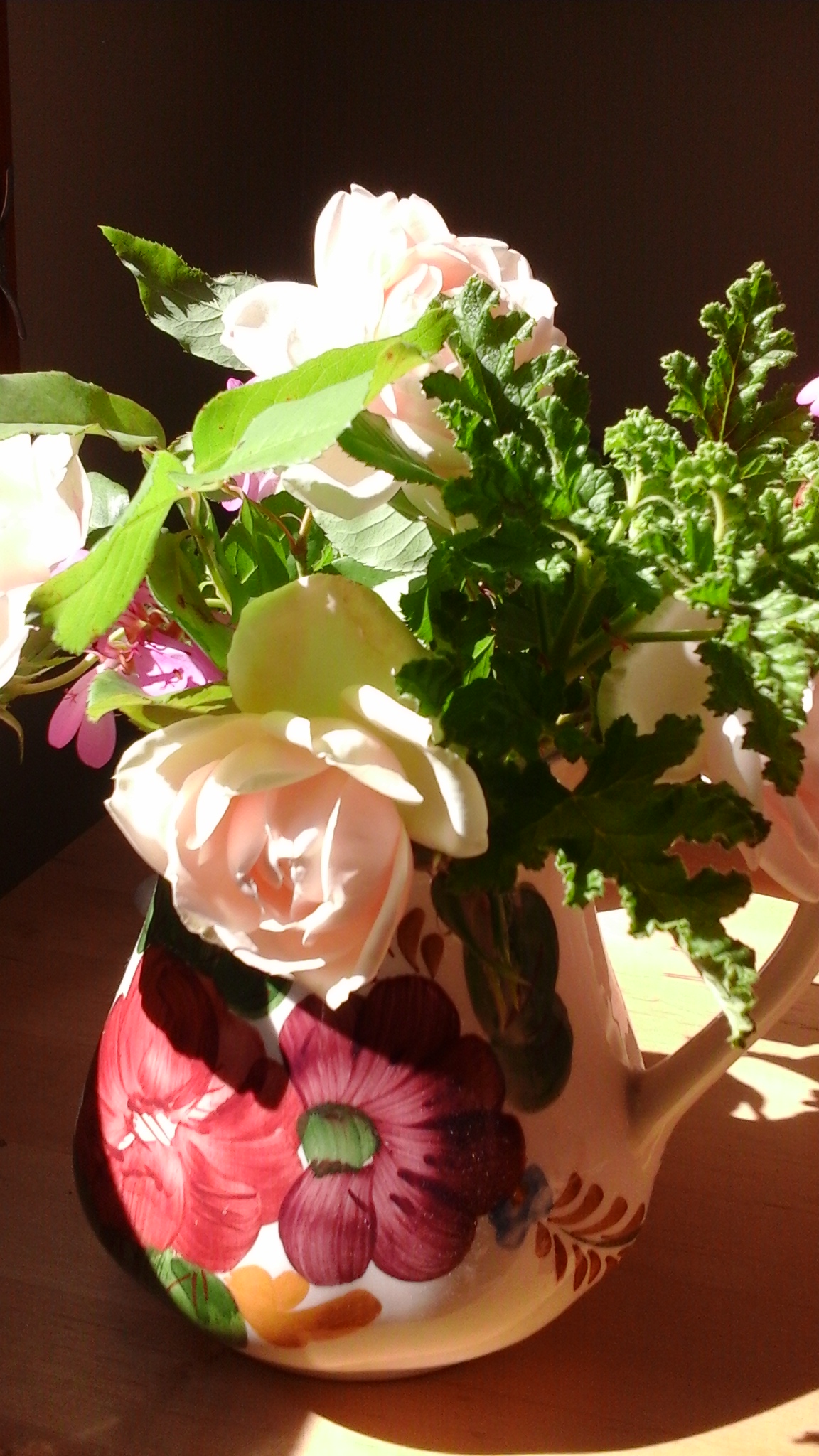
birthday roses

“radiating light”

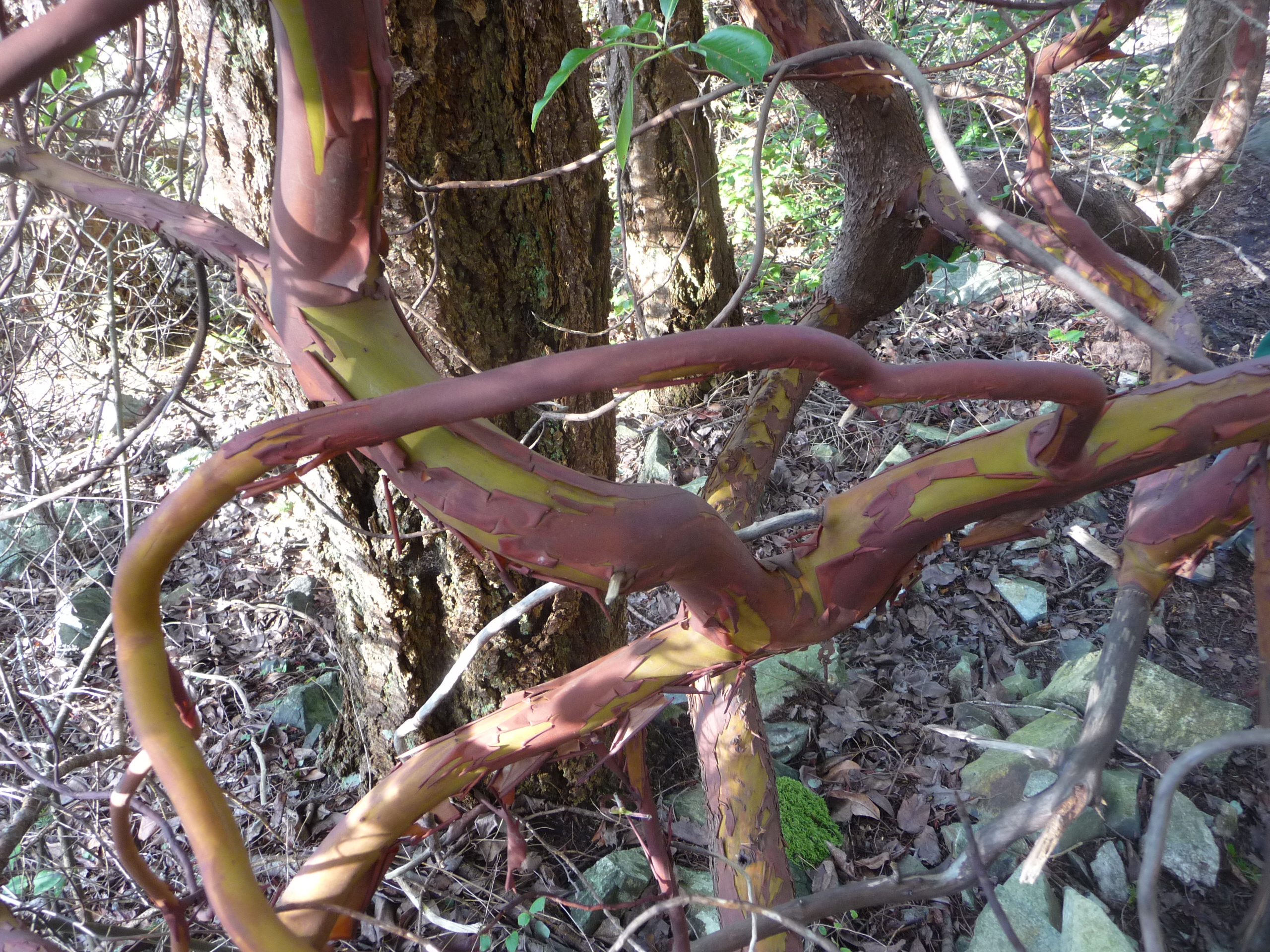
arbutus at Francis Point“There are arbutus trees at Francis Point, a grove of them, leaning out to sea, wanting to partake of the cool air off the water on summer days. Mount one and stretch your body along its length. Has there ever been a tree more seductive to the touch? Has there ever been a trunk, peeled of its bark and new, more like the smooth torso of a beloved? Without mark or blemish, asking us to run our hands along its taut muscularity? The underwood is chartreuse, radiating light.

How many times do we shed our outer layers in a life? How many times expose our tender new skin to the world, soft as the soles of a child who has never touched the earth? Looking out my window, I see the bark curling from the arbutus on the south side of my house. Like paint peeling from an old surface, we hardly notice it but are drawn to what’s revealed underneath. Steaming the bark with the pale bulbs of camas would turn them pink as young flesh, beauty for the eye and the palate.”

                                                              from Mnemonic: A Book of Trees (Goose Lane Editions, 2011)

arbutus bark

An argument for the novella

As a writer who loves the novella, I am always interested to read what others have to say about the possibilities of this strange and lovely form. Most recently there’s this:

http://blogs.publishersweekly.com/blogs/PWxyz/2013/12/09/what-is-this-thing-called-novella/

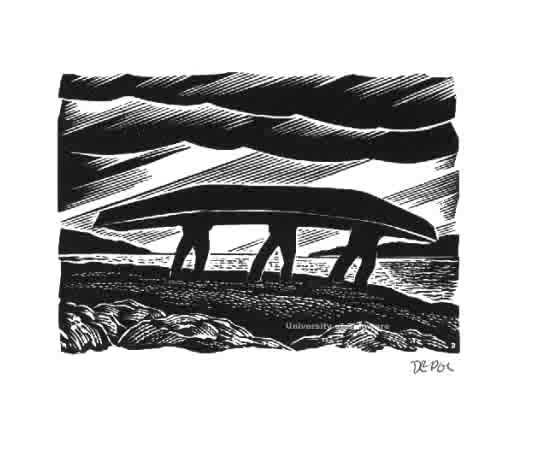
Although I wonder why the default suggestion seems to be that they are a perfect size for ebooks, I am glad to know that novellas inspire panels at literary festivals, debates online and off, and much discussion about length and the parameters of plot. I wish publishers weren’t so afraid of them. I have two out now, as a single manuscript, making the rounds. How would we market these, seems to be the lament — and although I understand it in some ways (a small book in a culture driven by excess and hype), I have to wonder where that old bold spirit went, the one that motivated publishers to take on unlikely titles and market them in the same way they would market anything: as necessary and vital books, not as something to apologize for. Years ago Jan and Crispin Elsted made a beautiful book of my novella, Inishbream, with wonderful wood-engravings by John DePol:

inish2


And Goose Lane Editions published a lovely trade edition of the book a couple of years later. I never felt that the manuscript was treated with anything less than respect as a work of literature rather than a abbreviated version of a real book. And for the New Year, my wish is that I find an equally congenial home for Winter Wren and Patrin.

It’s a perfect time of year to re-read James Joyce’s elegant example of the novella, The Dead. In his essay on the novella in the New Yorker last year, Ian McEwan wrote about The Dead: “A simple binary structure (a party, a hotel room) supports the evocation of an entire social milieu (decorous and fractious by turns) with extraordinary warmth. They seem to play out in real time, the dancing and singing at the aunts’ annual dinner, the family tensions, the barbed exchange about national identity.”

The Next Big Thing

My friend Barbara Lambert has “tagged” me in “The Next Best Thing”, a lively literary relay making the rounds of Canadian writers. The idea is that we answer a series of set questions about our current work-in-progress and then tag (ideally) five other writers, providing links to their websites or blogs. Barbara’s own answers can be found here (and if this also leads you to her recent novel, The Whirling Girl, you won’t be disappointed!): http://barbaralambert.com/writer/author/books/177-Blog+Tour+That+Ran+Itself

Ten Interview Questions for the Next Big Thing:

— What is your working title of your book?


I am half-way through a novella – working title is Patrin (a Romani word for “leaf” or to indicate a trail marked by sticks, leaves, etc.). It will be a companion-piece to a recently-completed novella, Winter Wren.

— Where did the idea come from for the book?


Patrin grew out of research I am doing for an extended non-fiction work based on the life of my grandmother, born in what is now the Czech Republic in 1881. She was poor and it turns out poor people don’t leave a huge material record. I said to someone, “I might just have to imagine her early life as a work of fiction.” About a week later, I began to write a novella based on the life of a woman who turns out NOT to be my grandmother but who has allowed me to imagine another world, a woman who is as far away from my own life as my grandmother was, who came to Canada under similar circumstances but with a very different background. I am also interested in how material objects  can hold family history, often undecoded, so when I saw Patrin opening a box containing a tattered quilt with a curious pattern of loden leaves, connected by trails of grey wool, I knew it was a map directing me to the heart of the story.

— What genre does your book fall under?

Literary fiction.

— Which actors would you choose to play your characters in a movie rendition?

Someone dark and willowy for Patrin, the 20-something woman at the heart of the novella-in-progress. The young Juliette Binoche from The Unbearable Lightness of Being? A young Adrien Brody for Petr, her guide in Prague and further afield. And if anyone has a suggestion for Patrin’s grandmother, a woman in her late eighties, heavy-set, rugged, and with dark-ish skin (she is a Kalderash woman from eastern Moravia), do let me know so I can tell the studios when they come calling.

— What is the one-sentence synopsis of your book?


Victoria, British Columbia and the forests of the Beskydy Mountains in the Czech Republic form the backdrop for a brief lyrical narrative about a young woman in search of her family’s mysterious past.

— Will your book be self-published or represented by an agency?

I have never been able to interest agents in my writing, alas. But I’ve been lucky enough to have placed my books with lively small(ish) presses over the years and have nothing but praise for the presence of these presses on the literary landscape. They keep the cultural conversation diverse and authentic.

— How long did it take you to write the first draft of your manuscript?


I haven’t yet finished Patrin. Winter Wren took me a year. I anticipate that Patrin will take about the same time.

— What other books would you compare this story to within your genre?

I’m not finished yet and don’t want to suggest relationships that might not survive the writing. But I admire the novels of John Berger for their fiercely idiosyncratic structure, the consummate story-telling of Louise Erdrich, the intelligent trajectory of anything by John Banville…


– Who or what inspired you to write this book?

I partly answered this in the second question but of course who ever knows where, exactly, the inspiration for a book truly comes from? As well as family history, I’ve also been immersing myself in Czech cultural history and look daily at the photographs of Josef Sudek who has given me entrance to the Beskydy Mountains where my grandmother lived as a child. And I’ve been listening to Roma music, both the styles of Central Europe as well as Macedonia.

— What else about your book might pique the reader’s interest?


Joe Fassler wrote a wonderful piece on the novella, published last April in The Atlantic. (http://www.theatlantic.com/entertainment/archive/2012/04/the-return-of-the-novella-the-original-longread/256290/) He mentions Dennis Loy Johnson, co-founder of Melville House Publishing and its “Art of the Novella” series: “He was daunted by the genre’s limited viability—and yet the idealistic prospect of novella-writing pleased him. ‘It always struck me very romantically,’ he said. ‘A pure writerly exercise that was only for the love of writing. We had no expectations our novellas would ever circulate.”

Maybe this is part of the pleasure of the novella. Years ago I wrote Inishbream, a brief narrative set on an island off the west coast of Ireland. It was published by the Barbarian Press in a beautiful edition, illustrated by the American wood-engraver John DePol; and then given a second life a few years later by Goose Lane Editions. Yet when I wrote it, I had no expectation that anyone would ever want to publish it at all. The thing about getting older is that you come to terms with what’s possible and what’s unlikely. I’m probably never going to write a block-buster, a best-seller which will be sold to Hollywood (I hate to disappoint Juliette Binoche and Adrien Brody), but every morning I can come into my study, turn on my desk-light, and write for the sake of the language and the story. What a privilege.

I’ve tagged five writers and so far can tell you that Anik See, Catherine Owen, and Don Gayton will carry the baton forward in the near future. I can’t wait to see what they write!

www.aniksee.com

http://blackcrow2.wordpress.com/

www.dongayton.ca

the novella

I’ve always loved the novella, even before I knew what it was, how it differed from a full-length novel, a short story. So it was marvellous to find this piece by Ian McEwan in the New Yorker.

http://www.newyorker.com/online/blogs/books/2012/10/some-notes-on-the-novella.html#entry-more

This is so right, so true: “Let’s take, as an arbitrary measure, something that is between twenty and forty thousand words, long enough for a reader to inhabit a world or a consciousness and be kept there, short enough to be read in a sitting or two and for the whole structure to be held in mind at first encounter—the architecture of the novella is one of its immediate pleasures.”

As a reader, I appreciate the entry into that world, so complete and contained somehow. And as a writer, I treasure the making of that world. It seems to me that the writing of a novella is a bit like musical composition, developing a theme and modulating it over time, space, keeping the language concise and taut, then introducing lyrical variations on the main theme.

The first long piece of fiction I wrote was a novella called Inishbream. I wrote it when I was 23, trying to find a form to contain the music, the landscape, the weather, and the human interactions of the period I lived on a small island off the west coast of Ireland. The Barbarian Press published it in three states — all of them gorgeous —  in 1999, illustrated by the great American wood-engraver John DePol. Here’s one image from the book:

And then in 2001, Goose Lane Editions published it as a lovely small trade edition, with John DePol’s images on the cover and the titlepage.

Last week I began a new novella and have been immersed, again, in the pleasures of the form. I see it as a companion piece to Winter Wren, a novella I finished last year. I don’t have any illusions about their “marketability”.  But I wouldn’t trade the daily exhilaration of sitting at my desk and finding my way into a cosmos contained in less than 100 pages for anything.