redux: “What would the world be, once bereft” (Hopkins)

Note: This was written 2 years ago. And this morning? I obsessively read the news out of Ukraine following the destruction of Kakhovka dam by Russia (and the bothsideism of the coverage is driving me crazy; read Timothy Snyder for clear thinking about this), I watch for smoke to fill our skies if the wind changes from Vancouver Island. In a few minutes I’ll go for my morning swim and maybe for half an hour the sky will be blue, my heart-rate normal.
It is a very unsettling time to be human. To be trees, to be weeds, to be vast areas of the western North American continent currently on fire. To be a reader of documents detailing atrocity. We are in the middle of a heat wave here on the Pacific west coast. Yesterday I closed the door of my greenhouse at 8:30 (leaving the roof vent open) and it was 44. Outside, 32 in the shade. We swim in the mornings and that’s a blessing but the idea of a late dip is unthinkable because the place where we swim, where we’ve gone for more than 40 years, is packed with people. The man who rakes the sand and takes away the garbage said this morning that he was taking away 200 cans from yesterday. Those are the ones left, mostly in the bins but some on the beach. Many people take their cans and other stuff away with them. I was awake for a lot of the night, hearing boats on the lakes, traffic on the highway at 2:30 a.m., and even gunshot around 5.

On my desktop, a copy of Canada’s Residential Schools: Missing Children and Unmarked Burials, Volume 4 of the Final Report of the Truth and Reconciliation Commission of Canada. It’s overwhelming in both its detail and its clarity. The statistical information is shattering. One example: the percentage of enrolment from 1891-1909 who died at two institutions, Old Sun’s Boarding School and Peigan Anglican School: 47.4 and 49.2 respectively. I was thinking about that in the night, listening to the noise of summer, and wondering how our country can ever reconcile goodness with this terrible legacy.

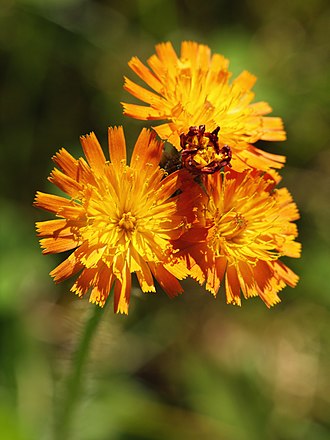
The other morning when we drove out, I saw a sign on the bottom of our driveway, put there by the Ministry of Transportation and Highways, to alert people to herbicide spraying along the gravel shoulders. The target? Orange hawkweed. It’s a pretty wildflower, introduced to North America somehow, called fox-and-cubs in Europe where it’s a native plant. We’ve lived here for 40 years and it’s always been part of the roadside flora. I notice these plants and I notice their pollinators — bees, butterflies, etc. I contacted the Ministry of Transportation to register my objection and had the usual round of back and forth, some of it on Twitter, and it’s like talking to logs. Glyphosate, I said? Really? It’s implicated in so many cancers, significantly non-Hodgkin’s lymphoma and blood-related cancers. That’s for humans. What about songbirds, what about butterflies, what about the snakes who lie in the sunny gravel on summer mornings? Oh we have to control it, was the response. A species that can take people to space and back, can decode the human genome, develop safe vaccines within a year for a deadly virus, compose symphonies, is still committed to toxic herbicides on our public highways. I think of Inversnaid, written in 1881 by Gerard Manley Hopkins after a visit to the poem’s namesake village on the shores of Loch Lomond.

What would the world be, once bereft
Of wet and of wildness? Let them be left,
O let them be left, wildness and wet;
Long live the weeds and the wilderness yet.

I’m looking out now to sun on a cascara and arbutus and blue sky without a cloud in it. A chicken is roasting, dusted with herbes de Provence, and some new potatoes in a separate pan, for salad. Yesterday I made the mistake of waiting until late afternoon to begin preparations for dinner: chiles rellenos, for which the peppers had to be broiled and skinned, filled with chorizo and cheese, battered and baked with sauce from the freezer. By the time they were ready, I was too hot to be hungry. Tonight dinner will come from the fridge.

John was awake in the night too and at one point I said to him, “I’m scared.” Not of the dark, not because of the relative isolation of our house where gunshot is unexpected to say the least, but of the future. Mine, his, the planet’s. We’ve talked about climate change for decades now and as New Mexico, Idaho, Arizona, and California burn, as the rivers and lakes dry up, as we face the consequences of our species’ ability to grow at an unsustainable rate, to consume, to refuse to adjust our expectations, I don’t look forward to what the future brings or takes away. What would the world be? I wonder if it’s too late to imagine.
morning post card from Ruby Lake, as kingfishers catch fire…

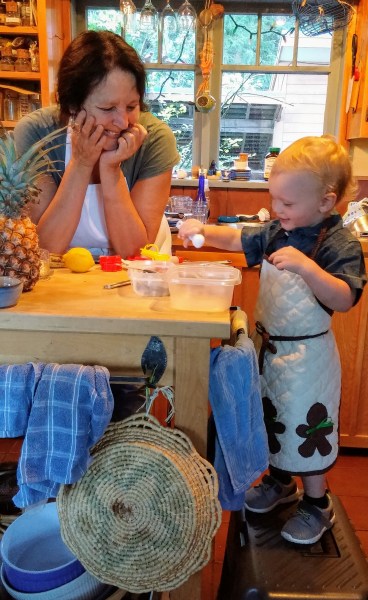
There’s a lot of cooking going on. Five pounds of spot prawns (thank you, Joe Denham!) briefly boiled, then served with tangy butter made with the succulent cloves of Metechi garlic. Sourdough bread. Salad from the garden. Last night, French fingerling potatoes dug with the help of Arthur and roasted with a bit of duck fat and olive oil to have with prime rib beef. Raspberries picked in the morning by John and topped with creme fraiche. Tonight friends are coming for barbecued sockeye and a galette of gooseberries and blueberries. Arthur helped mix the berries with some honey and lemon zest. And then he measured black beans from one container to another because he’s not yet two and he wants to do things himself.

cooking

After we cooked, we swam. We were the only ones at the little park and the water was green and lovely. Arthur looked exactly like his father Forrest looked at his age and John and I were taken back more than three decades. Same place, same water, same trees, but all of us older. A kingfisher flashed by, rattling, and settled on a limb of cedar hanging over the lake. Name the poet, I called, reciting the first verse:

As kingfishers catch fire, dragonflies draw flame;
As tumbled over rim in roundy wells
Stones ring; like each tucked string tells, each hung bell’s
Bow swung finds tongue to fling out broad its name;
Each mortal thing does one thing and the same:
Deals out that being indoors each one dwells;
Selves — goes itself; myself it speaks and spells,
Crying Whát I dó is me: for that I came.
(And to be honest, I couldn’t remember the whole verse but the first two, and last two lines…) There was some delay. (My husband a poet, my son a scholar.) Think Jesuit, I said. And no, not Dylan Thomas, not Roethke. Hopkins! Selves, what I do is me. Morning light on the water, ravens klooking nearby, our bodies cool and buoyant, the prospect of coffee on the deck with lemon pound cake and the scent of tomato plants. (Wish you were here, too, Brendan, Cristen, Kelly, and Henry.)

dragonflies draw flame

A poem I’ve always loved came alive for me today as we walked around the Hallowell loop, a favourite walk which takes us by a chanterelle patch if we’re lucky (and today we were), a pine mushroom hoard (and we’ll start looking for those in a few weeks), a marsh where we’ve often heard the kingfishers’ rattles as they called to each other from one end of the marsh to the other. In warm weather, turtles sun themselves on the logs that jut out into the water and there’s a beaver lodge. We saw the wedge of tail once as a beaver swam underwater to its home. Once, inexplicably, two swans on the winter marsh. Cutthroat trout spawn in the creek that flows through the marsh, from Ruby Lake to Sakinaw Lake, and herons wait for them during the fall run. There are river otters too, though we’ve never seen one.

Today, walking back from the marsh area to our mailbox, then home along the highway, I found a stunned dragonfly on the road. I often see crushed ones that have flown up from another small marsh along the highway and been hit by cars, but this one was alive, undamaged (that I could tell), and I gently lifted it onto the junk-mail I was bringing home for fire-lighter. I carried it in front of me while it tried its wings, stretched its legs. A car passed and the draft blew the insect off the paper. So we put it on some grass on the other side — the safe side — of the ditch along the road. What does it remind you of, I asked John, and he said, Hopkins.

As kingfishers catch fire, dragonflies dráw fláme;
As tumbled over rim in roundy wells
Stones ring; like each tucked string tells, each hung bell’s
Bow swung finds tongue to fling out broad its name;
Each mortal thing does one thing and the same:
Deals out that being indoors each one dwells;
Selves—goes itself; myself it speaks and spells,
Crying Whát I do is me: for that I came.

It felt like a moment full of meaning. The chance to study a beautiful creature as it found its way back to life, the beauty of its anatomy.

dragon fly anatomyIt seemed to me that the compound eyes were plated, like armour (though would that protect it from a glancing blow from a fast car?), and its abdomen was so beautifully patterned with turquoise. The wings shimmered. When I got home, I looked it up and discovered it was Aeshna palmata, the paddle-tailed darner.

paddle-tailed darnerThis is the season of the dragonflies. I see them everywhere, dipping and floating over the garden, the decks, the highway (unfortunately), landing on leaves or posts, stitching sky to earth. “Myself it speaks and spells”. the spell of its flight catching us briefly, “crying Whát I do is me: for that I came.” And I remember the tiny weight of it in my hand.