memory

this year

I’ve just been mowing grass and thinking about memory. In a way, grass mowing is an act of memory. You can just let your muscles remember how to coax the mower over the rough ground (we don’t exactly have a “lawn”; we have cleared areas that have accumulated moss and wild grasses and drifts of oregano, so beloved by bees…), you watch for rocks, sleeping snakes, but mostly your mind drifts. You remember all the springs you’ve dragged a mower across the grass, though to be honest it’s usually John who does the mowing. You remember the old vegetable garden, before the septic field gave up and had to be rebuilt, giving you the opportunity to lay out proper raised boxes in a fixed geometry, with paths between them. The old garden had beds that continued to sink, no matter how much seaweed and manure and alfalfa you added to them over the seasons.

One reason I’ve been thinking about memory is because I’ve read several accounts of how scientists have supposedly transplanted memory from one California sea hare (a hermaphrodite sea snail) to another. The experiment involved implanting wires into the snail tails, giving them electrical shocks, inducing a defensive action, then transferring RNA, or Ribonucleic acid (one of the 3 biological macromolecules necessary for life),  via injection, to another snail, where it seems the sensitivity to the electrical prod had been transferred. (Snails who were wired but not shocked did not transfer the sensitivity to the animal receiving RNA.)

Not everyone is convinced that memory is being transferred in this process. In an article in the Guardian, I read this:

Tomás Ryan, who studies memory at Trinity College Dublin, is firmly unconvinced. “It’s interesting, but I don’t think they’ve transferred a memory,” he said. “This work tells me that maybe the most basic behavioural responses involve some kind of switch in the animal and there is something in the soup that Glanzman extracts that is hitting that switch.”

But Ryan added that radical thinking about memory was sorely needed: “In a field like this which is so full of dogma, where we are waiting for people to retire so we can move on, we need as many new ideas as possible. This work takes us down an interesting road, but I have a huge amount of scepticism about it.”

I don’t know, tell me I’m wrong, but this kind of experimentation seems excessive. Why on earth should we be tampering with memory, any organism’s memory? Surely that’s a profoundly disrespectful trespass. Imagine how it could be used in the future (remembering how the tendency to exploit life-forms for the sake of science has been a hallmark of our species). I can imagine researchers making an argument for transplanting or removing memory from humans who have suffered terrible trauma and you might say there’s justification for this in order for those individuals to live lives without that particular suffering but who would decide? Who would be ultimately responsible for determining what memories should be removed and from whom?

In the meantime California sea hares are being wired and shocked and injected in order to make room for new research ideas, “radical  thinking about memory.”

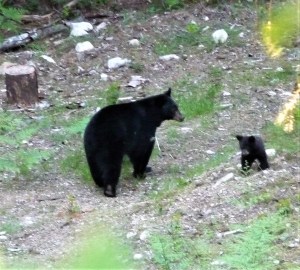
Last night we watched the pair of coyotes in what remains of our orchard and after they left, we watched a black bear sow, possibly the same one we saw last year, and the year before, with her two cubs. I’ve read that bears have quite sophisticated memory maps that allow them to move across a landscape feeding from remembered and reliable food sources. It’s what brings them down from the berry patches to the salmon streams year after year and to our orchard in years past for the apples and pears. I think this mother is helping her cubs to develop their own maps but is probably puzzled by how the orchard has changed. Last May this mother, if it’s the same one, urged her yearling up onto the second story deck where we grow our tomatoes and the young one dragged several big pots down the stairs before realizing there was nothing in them to eat. Not yet. And was it the mother who encouraged the yearling to drag down the mason bee house above the tomato plants tucked against a warm wall?

Right this minute I can hear a robin singing the long beautiful salmonberry song, as complicated and beautiful as a partita. In the moment is every time I’ve heard it, something deep and complicated, not easily transferred via injection to anyone else. Taken. I think of Gary Snyder’s beautiful sequence, “Little Songs for Gaia”, some of them I remember almost perfectly, each of them observant and alert to the paradoxes of being alive at this point in the history of the planet:

The stylishness of winds and waves—
nets over nets of light
reflected off the bottom
nutcracker streaks over,
hollering

Nature calls,
bodies of water
tuned to the sky.

“Find a need and be filled by it.”

the news

the brothers

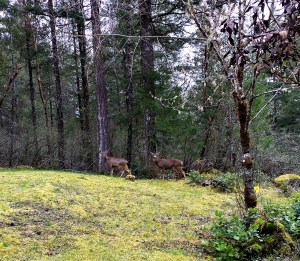
Late afternoon yesterday I looked up from my desk through the big window facing south and two bucks were staring at me. Just at the edge of the woods. They had small antler buds which might mean they’re young ones, brothers maybe, but black-tail bucks lose their antlers every January or so and grow new ones in April so maybe these are mature adults. But then I wonder if they’d be traveling together? They looked at me, they ambled, they both darted back to the the bluff they’d just come up, alert as they watched for something I couldn’t see. People have recently encountered wolves just up the mountain behind us and we hear coyotes fairly often so it could have been either. I was reminded of this poem, not because of the snow (luckily we’re spared that!) but because of all the news carried by their presence. The white muzzle and throat of the one on the right, the tentative step forward, then back. And when I went out to greet them, they bounded into the woods, tails high.

Three Deer One Coyote Running
               in the Snow

First three deer bounding
and then coyote streaks right after
tail      flat out

I stand dumb a while two seconds
blankly black-and-white of trees and snow

Coyote’s back!
good coat, fluffy tail,
sees me:            quickly gone.

Later:
I walk through where they ran

to study how that news all got put down

—Gary Snyder, from No Nature: New and Selected Poems

“go light”

twin-flower

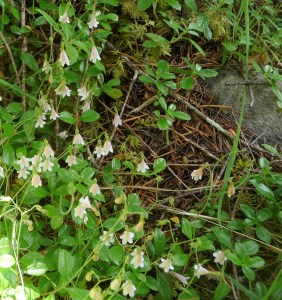
A week ago, foxgloves, yellow violets finishing, flashes of orange on the side of the highway that I knew were Columbia lilies, flashes of orange down the bank that I knew was the native honeysuckle, hummingbirds drinking deeply from the trumpets we used to taste as children. And today, on a walk on one section of the Suncoast Trail, orchids just about to bloom (or a week or so away), pink wintergreen (the prince’s pine still in bud), the last of the bleeding hearts, salal full and creamy, little clumps of rattlesnake plantain orchids about a week away from opening and alongside, what I think are ladies’ tresses. Thimbleberry by the fast creek. Siberian miner’s lettuce. Enchanter’s nightshade. Bending down to the scent of almonds in the twinflower patch—so beloved of Linnaeus that he gave the modest plant his name.

Just to say their names, to acknowledge their persistence in a world increasingly difficult to fathom—the incivility, the violence, terrible inequities, fires, shootings, knife attacks. Just to say their names as we walk a trail so familiar, along a flank of the mountain we’ve lived by for more than half my life and almost exactly half of John’s. To say their names, to remember them in poems, in songs, in dreams:

In the next century
or the one beyond that,
they say,
we can meet there in peace
if we make it.

To climb these coming crests
one word to you, to
you and your children:

stay together
learn the flowers
go light

—Gary Snyder, from “For the Children”

Hawkweed, ninebark, self-heal.


“Nature not a book, but a performance”

I dreamed last night of a stream filled with salmon smolts and on a rock in the stream, an orange-crowned warbler was dipping and doing knee-bends the way American dippers do. I was so close I could see the tiny russet-y patch on its head. When I woke, I was in a sleepy state of wonder. Such abundance — thousands of little fish in a clear stream, a bird I see sometimes foraging for insects in a wisteria beyond my study window, its dull olive feathers a foil for the beautiful crown it wears and which is rarely seen.

I think my dream was the result of a conversation we had at dinner last night. We were drinking the last of our Desert Hills syrah, dark and jammy, and a joy to have with roast lamb. At our table, facing the west, we’ve seen sunsets and dense fog. We’ve seen the trees fill in over the years, so thickly that a couple are going to be topped in a few weeks, not just because they obscure the view but because they lean to the house in wind.  Sitting and talking with that deep red wine in our glasses, we started listing the wonders we’ve seen here over the years without ever searching them out. Was it luck, we asked, or coincidence? Maybe they’re the same thing? Maybe if you live in one place for 35 years, you will see everything there is to see?

Snakes mating. Northwestern alligator lizards mating. 6 chestnut-backed chickadees taking their first flight one after another from the cedar nesting box on the arbutus tree. A black bear sow passing within a few feet of the living room window with two cubs ambling behind her. A least weasel entering a narrow passage of our metal roof in search of mice and the same weasel on a branch of dog-rose, peering in the window as I drank my coffee in bed. A doe and her twins coming most mornings and shimmering in sunlight like gods. A margined burying beetle slowly carrying a dead mouse away to bury it. A coyote pup coming day after day for a week, pausing one morning to enter a dog-house (its original occupant long-dead), turn around, then sit in the entrance looking out at the world. A western toad sending out a sticky tongue to take sowbugs from my hand. A huge bull elk running into the woods, its antlers shedding their golden velvet.

more than friends

Yesterday I was doing something in the vegetable garden and I saw Winter, the cat that came out of the woods in January and decided to live with us, crouched by a tangle of daylilies, thatched over by montbretia leaves. Something was in the tangle. Her body was quivering and alert. Then I saw a mouse come out of leaves and go up to her. It stopped about two inches from her face. It went back into the leaves. Then came out again and did the same thing, pausing for several seconds. Winter is a good mouser — we see evidence on the patio, on the decks… — so I was surprised that she did nothing. She seemed taken aback (if that’s not too anthropomorphic an explanation). It was a moment I’ll never forget.

I think now of my dream, the salmon all swimming quickly in the silver water, and I know it was about wonder. To stay alive to it.

“Ripples on the surface of the water—
were silver salmon passing under—different
from the ripples caused by breezes”

A scudding plume on the wave—
a humpback whale is
breaking out in air up
gulping herring
—Nature not a book, but a performance, a
high old culture

— Gary Snyder, from “Ripples on the Surface” (No Nature: New and Selected Poems)

“with the days unspooling”

tracks

North America and Europe have been experiencing cold weather, colder than usual. We often have a few very cold days in mid-winter, some snow, but this year — and last, because we’re only just into 2017 — we’ve had a lot of snow and temperatures around minus 10. Last night it rained and everything is melting today. What I’ve enjoyed about the snow is seeing the tracks and realizing, again, how populated this area truly is. Deer tracks, elk, weasels winding up and down the driveway — and a cat. A wild cat. Not a bobcat (we have those too) but a black and white cat hovering around. Yesterday its tracks were so clear in the snow, wandering around under the bird feeder, the woodpile (where mice nestle in for the season), the compost box (where mice nest, too, for the warmth), and then darting under the old dog-house, uninhabited now but restored, just in case. I was surprised because there are coyotes around and a cat would make a good breakfast for a hungry canine. Especially in winter. I put a little dish of food out in a protected area and see this morning that it’s empty.

The other day we went for a walk around what we call the Sakinaw loop. Down our driveway to the highway, along for about a quarter of a kilometer to Sakinaw Lake Road, down that long hill to the lake and Haskins Creek where the coho spawn, and then along a trail that leads through the woods below our property, meeting our driveway again beyond the gate to our neighbour’s place. We were talking, talking, as we always do. It’s been a 38 year conversation at this point in our lives. I’ve just finished a book of essays and John is coming to the end of a collection of poems so we discussed what we hoped the work had done –in my case, to explore old ground in a new way; and in John’s, to complete a sequence long in the making, about animals. At the top of Sakinaw Lake Road, we noticed the coyote tracks, fresh, in the snow, two sets, one on either side of the road, leading down the hill that we were also walking (carefully) down. Sometimes one set of tracks would edge closer to the other set and at one point, there were signs of a skirmish or play in the deeper snow by the salmonberry bushes. You could see at another point that one animal had run for a bit. But mostly the pair was ambling, as we ambled. I expected the tracks to lead over to the creek where there might still be some carcasses to feed on. But no. They continued, as we continued, along the trail through the woods. Fresh scat. The bodies coming closer together as ours came closer together where the trail narrowed.

There’s lots of research that tells us coyotes practice social monogamy – they live together for long periods but might mate with others. But recent research suggests they also practice genetic monogramy. They only reproduce with each other. I don’t know if the tracks we were following belonged to the pair who mate each year, in late February, in the woods near us. We’ve heard them. (It’s something that I wrote about in my essay, “Euclid’s Orchard”, part of the book titled for that essay,  due out in September…) And one year one of their pups came most mornings for a week, in August, eating salal berries just below the deck where we were drinking coffee with one of our sons, watching as it explored, even entering the old dog-house to try out the space.

So I walked down the road with my life partner, talking, and just ahead of us on the trail, the coyotes were ambling too, either talking, or not, with the days unspooling ahead of them.

The creak of boots.
Rabbit tracks, deer tracks,
what do we know.
    --Gary Snyder

“I go to meet it at the edge of the light”

visitors.jpg

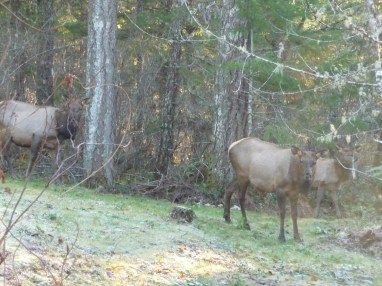
The other day John was in the back woods looking for possible Christmas trees. We usually cut ours from the designated area up on the mountain where we walk regularly. There’s a power line up there and (free) permits are issued for tree cutting under the lines. (We always cut our tree on December 23 and let it sit in the woodshed overnight, bringing it to dress on the afternoon of Christmas Eve.) But because we’ve had a fair bit of snow lately, we’re not sure we’ll be able to get to those trees when our family members join us for Christmas so John is looking for other options. There’s a bluff back in the woods and he said that it’s covered with elk droppings. An hour ago I went out to cut (frozen) kale for my morning smoothie, taking a flashlight with me because it was still almost completely dark. I heard a strange sound, a bleat, a whistle. And it was close. Then I heard crashing. The elk had been on the trail behind the garden shed and heard me, I guess — a solitary woman in a dressing gown and flip-flops, gathering kale behind the fence the elk have been known to stand beside to gaze longingly at the garden bounty. The garden is fenced with black mesh, 8 feet high, and although an elk could easily tear it to bits, they don’t. The best theory I’ve heard is that they can’t see it and it freaks them when they touch it with their faces. They’re quick learners. And, fingers crossed, they’ve never broken the fence, though they’ve torn grapevines from the side of the house, eaten fig leaves (wouldn’t you?), broken apple branches and eaten uncaged roses to the ground. So this morning, the sound of huge bodies crashing into the woods, probably a dozen of them — we’ve seen a herd recently at various points between us and the Kleindale corner and I think this must be the same one.

Before I went out for kale, I was working in my study, drawn back to the novella I keep putting aside for other things. This morning, my character was spreading her maps on the side of the Deadman River, in the shadow of the hoodoos, inspired about some discoveries she’d made about women and the way their writing echoes the landscapes they love. How they carry these landscapes in their bodies and write from that experience. And while I was doing this, the elk were out just beyond the house, sleeping maybe. (I’ve seen most of a herd lying down on the grass below the Hydro Line near us, one cow keeping watch while the others rested.) I’ve felt so excited to be writing these mornings, before the sun comes up, in the dark, the little lamp on my desk hovering over my computer.

How Poetry Comes To Me

It comes blundering over the
Boulders at night, it stays
Frightened outside the
Range of my campfire
I go to meet it at the
Edge of the light

                      –Gary Snyder

Exactly.

boughs

Our tree has just come into the house. Cut this morning, a nine-foot Douglas fir, it has all the odour of the winter forest, and its boughs are so green and lush that I’m almost tempted to say, “Let’s leave it naked this year.” A paradox — to dress an evergreen in baubles and stars? Little ceramic birds? To remind it of the world it’s been taken from, to give us green through the darkest days? No living bird will settle on these boughs again. No snow will accumulate on the needles, no cones will form. Tomorrow we’ll pull out the boxes of decorations and place them on every branch, against the trunk, the one special star on the top (which had to be trimmed to fit into our house). For now, I want to stand on the edge of the room and look at its splendid undressed beauty.

Trees bring in the scent of the outdoors and they remind us too of moments when we sat by them, cut them for firewood, burned them gratefully all winter for their heat, brushed against them and ran our fingers along their various barks, reminded of them later as we raised resiny hands to our faces.

Remember “Mid-August at Sourdough Mountain Lookout” by Gary Snyder? (From Riprap and Cold Mountain Poems):

Down valley a smoke haze
Three days heat, after five days rain
Pitch glows on the fir-cones
Across rocks and meadows
Swarms of new flies.
I cannot remember things I once read
A few friends, but they are in cities.
Drinking cold snow-water from a tin cup
Looking down for miles
Through high still air.
I don’t have cones from this tree but here’s a pair of elegant long cones I picked up under a small stand of Pinus monticola at the Dominion Arboretum in Ottawa last month while walking there with Forrest and Manon. They still smell alive. They can stand in for absence, tokens of affection, what we keep to remember the miles between us this time of year.
P1110002

what were the owls up to…

…in the night, so loud near the house that I woke and came down to sit in the darkness, listening? They were barreds, one calling — Who cooks for you, who cooks for you-all? — and the other buzzing. I thought of Gary Snyder, who wrote so beautifully of the deep night:

Long streak of cloud giving way

To a milky thin light

Back of black pine bough,

The moon is still full,

Hillsides of Pine trees all

Whispering: crickets still cricketting

Faint in cold coves in the dark

(from “True Night”, in Ax Handles)

It wasn’t pines in moonlight I saw, but Douglas firs, and the black limbs of arbutus. And owls, not crickets. But awake, in a private place, with the moon so tangled in the far boughs that only a little of its light filtered through to where I sat by my window. And that moon! Almost full — tomorrow night’s moon is the perigee full moon,  the time when it’s  closest to the earth. A time to wake and listen, to take in the sounds and cool air, to wonder about the snap of a branch, the click just beyond the window.  Maybe the owls feel the heightened beauty of the night before the perigee too. A perfect time for hunting.

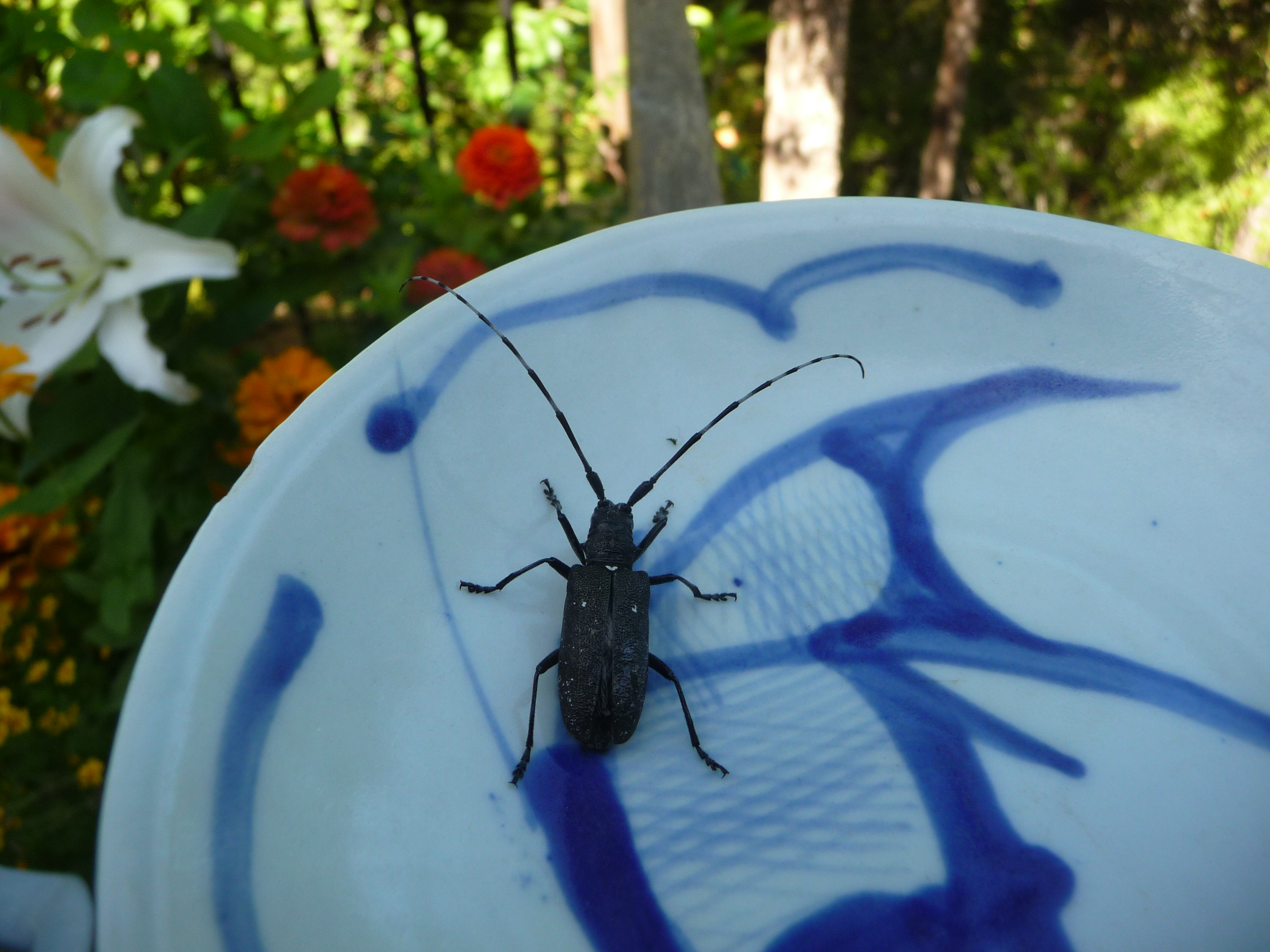
This morning I was watering tomato plants on the upper deck and I almost stepped on this sawyer beetle, newly hatched from the bark of one of those trees. I think it’s Monochamus scutellatus, the white-spotted beetle. This one was big — I took out an old wooden ruler and discovered it was 30 mm. and its antennae were another 25 mm. long.  It wouldn’t stay still for a photograph but here it is, climbing out of a dish.

P1100473


Gary Snyder by firelight: a moment

I was awake in the night and came down to put more logs on the fire. It was snowing outside, the last hurrah of the cold snap we’ve had for the past week. I know that cold is relative. When I talk to my sons in Ottawa and Edmonton, I realize that minus 8 celsius is actually pretty mild. But here, on this coast, it felt cold. We don’t have down parkas or felt boots. But we do have an airtight woodstove and its heat is very welcome. It doesn’t burn through the night though and at 3, after putting logs on the orange coals, I sat in the rocking chair by the hearth to wait til the logs caught and burned well before partly closing the damper.

The snowflakes were huge and soft as they fell to the deck off the kitchen. There was smudgy moonlight and the night felt big and mysterious. There ought to be a poem for this moment, I thought — the fire, the weather, the dark night. But I didn’t want to turn on a light to find a book.

And now, at my desk, watching the snow melt in the inevitable rain, I know the poem. “Milton by Firelight”, from Gary Snyder’s Riprap & Cold Mountain Poems:

No paradise, no fall,

Only the weathering land

The wheeling sky,

Man, with his Satan

Scouring the chaos of the mind.

Oh Hell!

Fire down

Too dark to read, miles from a road…

And here’s the poem written out on the patio this morning:

patio

postcard from wildcat canyon

Yesterday our host told us about the Botanic Garden up in the Berkeley Hills, devoted to the collection, growth, display, and preservation of native Californian plants. There’s another garden up there, too — the University of California Botanical Garden, which I’m sure is extraordinary. But having realized how little I know about the plants I’m seeing daily, I wanted to figure out a few things about the native plants. So up we drove. And drove. The views were more beautiful at each turn in the winding road.

And the Botanic Garden ranges over ten acres, divided into ten sections, then three subsections, representing the distinctive natural areas of California:  seacoast bluffs, coastal mountains, interior valleys, dry foothills, alpine zones, and two kinds of desert. There are clear labels and lovely stone or bark paths taking you around the plantings.

Everything was interesting. To recognize a leaf but not a shape — and to find out that there are 60 (or more, depending on whether you are clumper or splitter, a guy in the visitor centre cheerfully admitted) species of manzanita. We have the hairy manzanita near us on the Sechelt Peninsula, and its low cousin kinnikinnick. But I loved seeing the common specific names for the various manzanitas of California: refugia, insular shaggy-barked, Little Sur, brittleleaf. I thought of Gary Snyder:

Manzanita     the tips in fruit,

Clusters of hard green berries

The longer you look

The bigger they seem,

               `little apples’

And the oaks! Such variety. Here’s a coast live oak (Quercus agrifolia):

P1090279

On a little rocky area, near the stone foundation of a shed:

(for Angie)
(for Angie)

And then we continued up to Inspiration Point, where we could see down into Wildcat Canyon: P1090284 Manzanitas, golden hills, oaks and pines…