a publishing history, with asides (third instalment)

21st century, second decade

Sandcut Beach

My parents died at the beginning of the second decade of the new century, a year apart to the day. Several close friends died. My sons married their sweethearts. (My daughter married hers a few weeks ago!) Every day held sorrow and joy. And also a sense of possibilities for my long-held interest in my family’s history. After my father’s death, I took home the small hoard of papers and photographs he’d kept to himself. I don’t know exactly why he was reluctant to share the materials, or to pursue answers to questions–the ones I had and surely ones he had too? And a year later, after my mother’s death, I felt the uneasy sense that I was now the family matriarch, the one responsible for keeping the lines of kinship clear. They were not clear. There were half-stories, careless genealogies. In retrospect, I see that much of the research and writing I did during this decade was in service to these histories.

I’ve always loved the literary novella. Without ever really intending to, I’ve built up a nice collection and have read many more, via library or generous friends. Inishbream was a sort of accidental novella, beginning as it did as a linked group of prose poems, eventually drawn out and given a structure. I loved the possibilities of the form, how it could hold so much in such a hermetic shape. A year or two after The Age of Water Lilies was published, I was invited to a book club to talk with members who’d just read it. I always enjoy these occasions. During our time together, one woman asked what happened to Grace after the novel ended. Good question. Grace was born to a single mother in the spring of 1915. She is sort of tangential to the narrative. But the more I thought about her, the more I wondered too. I began to write Winter Wren to find out. I think I knew from the beginning that the book would be a novella. I put Grace in a cabin I’d always thought I’d like to live in, a cabin I first saw as a teenager, on a beach west of Sooke, B.C. (It’s the one above the waterfall in the photograph at the beginning of this post.) She was in her late 50s, an artist trying to paint the view at dusk. I wanted to write about the 1970s—the novella takes place in 1974, an interesting time for ceramics in B.C. (Grace’s love interest is a potter in the tradition of those who studied with Bernard Leach in Cornwall and then returned to Canada), for museums where the salvage paradigm was part of the ethos, and perhaps the last possible time for Grace to meet one of the late 19th c-early 20th c artifact collectors.

winter wren

But you know already what I’m going to say: I sent Winter Wren to dozens of publishers and all of them rejected it. To make a long story short, my dear friend Anik See was visiting enroute from Dawson City to the Netherlands and we shared similar stories about novellas we’d written. We decided to begin a micropress to showcase the form and we decided to begin with mine. Our rationale was this: if our endeavour didn’t work, then I would be disappointed, sure, but at least it would only be me and not someone else. I could shake it off, poof, and move on. (Ha!) Anik designed the book, I photographed a pottery dish with a length of scouring rush (it figures in the book), and we found a really good printer in Victoria. And you know, we sold our first print run of 250 copies within weeks and we reprinted. I still get orders for it. We went on to publish 4 more novellas and we are very proud of Fish Gotta Swim Editions. Our latest is Anik’s Cabin Fever.

I’ve been to the small Vancouver Island beach near Jordan River where Theresa Kishkan’s novella Winter Wren (Fish Gotta Swim Editions) is set; I’ve seen the waterfall that tumbles over sandstone onto the shingle just below, and the solitary cabin facing south and west, surrounded by salal. Winter Wren tells one possible story from the many that cabin could tell. (Michael Hayward, Geist)

After I finished writing Winter Wren, I wrote another novella, Patrin, and it was published (beautifully) by Mona Fertig’s Mother Tongue Publishing in 2015 and then in French by Marchand de Feuilles in 2018. I also wrote a long essay, “Euclid’s Orchard”, about quilting, mathematics, coyote music, apple trees, and love; and when Mona showed interest in publishing a collection of my essays, I gathered together a group. Eulid’s Orchard & Other Essays was published in 2017 and was shortlisted for the Hubert Evans Award.

Each image is a perfect crystallization of a detail, gesturing toward a truth much larger than the tiny pinpoint of its composition. Near Victoria, she recounts an exquisite memory of “an abandoned house completely knitted into place by honeysuckle and roses” (p. 101). Near Drumheller, she sings the prairie: “turn, turn, bend the song to the roadside plants … free verse composed of craneflies, dragonflies, bluebottles, broad-bodies leaf beetles, greasewood and cocklebur” (p. 61). And near her home, she concludes with the cries of coyotes: “lilting joyous youngsters unaware that a life is anything other than the moment in the moonlight, fresh meat in their stomachs, the old trees with a few apples and pears too small and green for any living things to be interested in this early in the season” (p. 155). (Catriona Sandilands, The British Columbia Review)

An aside: Mona Fertig and her Mother Tongue Publishing enterprise deserve gratitude from writers everywhere for the beauty of the books and the huge effort Mona put into designing them, editing them, bringing them into the world with sparkling wine and flowers, arranging public events for the writers, and being the kind of publisher writers dream of. I’d have published with her forever and was sad when she announced her retirement but also glad for her because she’s been able to return to her own writing projects. She did everything that bigger publishers did and she did it with joy. (She’s the one on the left, with the big smile.)

at-the-book-prizes

Novellas, novellas. I wrote The Weight of the Heart as a way to lament the gaps in my own education in the 1970s when the instructor of my Canadian literature course told me not to bother writing about Sheila Watson and Ethel Wilson, saying they were minor, and the former was barely coherent. I wanted to celebrate these two literary cartographers of our province and to highlight the importance of their work. I also wanted to spend time, real time and imaginatively, in the Thompson Canyon and the dry Interior of B.C. Palimpsest Press published The Weight of the Heart in the spring of 2020, just as most publishers and some writers were required to pivot to a virtual presence because of the pandemic. I wish I’d been better at this, though we still had such a slow internet connection—we live in a rural area– that even if I had been able to Zoom more effectively, our bandwidth wouldn’t have allowed me to participate much. (We were able to upgrade a bit later.)

The Weight of the Heart also finds in Wilson’s and Watson’s writing an experimental style and a mode of consolation. Like Wilson’s independent protagonists, the narrator discovers her autonomy and grit in the landscape she travels. Watson’s spectral figures and interest in sacred rituals resound in the symbolic scenes of almost drowning in which the narrator is saved by her brother’s mysterious presence and in Kishkan’s invocation of Egyptian burial rites as a refrain throughout. Most obviously, the double hook of Watson’s title recurs in the dualities throughout the novel—in the two rivers, in twin foals (the colt unfortunately lost in birth) by a mare named Angel, and most clearly in the two siblings who are bound together in a landscape where life and death regularly meet. So, Kishkan and her narrator know where to look in Canadian fiction for a view of the British Columbian landscape that reveals these striking oppositions and their consoling unions. A unique and compelling creation in its own right, Kishkan’s poetic exploration of grief lives up to its literary precursors. (Kait Pinder, the Malahat Review)

I wrote another novella in this decade, begun perhaps in the middle, put aside, but finished in 2020, during the long lonely weeks of the pandemic when I was missing my family and wondering if we would ever get together again for our summer meals, swims, and talks late into the night by a campfire. I used Virginia Woolf’s Mrs. Dalloway as a template, following the main character through a day of preparations for a party. There are shadows and owl voices in the woods and an unexpected guest coming up the driveway at dusk, carrying a knife. I tried to find ways to present the material innovatively, with sections of call and response, lists, and the music of an oud. I called it The Occasions. I don’t know if it will ever be published.

Another aside: I am lucky in life and love if not in publishing. And I wonder how many writers have a husband who is also a letterpress printer and who offers to make keepsakes to celebrate new books? For the past ten years or so, John has printed beautiful objects, some of them embellished by me, to give away at book launches and to provide local book stores with so they can tuck a keepsake into the books of mine that they sell. I have a few remaining of some of these and if you want to order a book from me, I can include one for you.

keepsakes remaining

At the beginning of this instalment, I wrote that I was trying to untangle the knots of family history and genealogy. Some of this work resulted in essays in Euclid’s Orchard but I wasn’t finished and kept on writing. I’d also had a health issue in 2016 that resulted in many tests, half-diagnoses, fearful assessments (though it all worked out well), and I also wrote about those things against the backdrop of all I loved: my family, the rivers of this province, textile work (which is always a way of meditating for me, sewing myself in and out of mysteries, riddles), the countries my grandparents left for new lives in Canada, and more. These became Blue Portugal & Other Essays, published with care and generosity by the University of Alberta Press in 2022. It received SUCH good reviews.

In Blue Portugal the essays’ themes are allowed to slip their boundaries; a topic addressed in one essay recurs in later essays, a recognition, perhaps, that thoughts and interests develop over time, shifting slightly as they are put in the company of other thoughts, are seen from different perspectives. The essays in Blue Portugal seem to talk to each other; they interlace in interesting and thought-provoking ways. The book is a fine example of the personal essay at its best. (Michael Hayward, The British Columbia Review)

It was a book that others noticed, gifted to friends, and reading it now, I am sort of surprised that I was led into some of the essays so mysteriously. A voice in the night, murmuring, The river door. Whose voice? I only know I took it to heart.

To those of us who’ve been following Theresa Kishkan on her blog for many years, the preoccupations of her latest book, the collection Blue Portugal & Other Essays, will be familiar, the quilts, the homesteads, the memories, the blue. But it’s the stunning craftsmanship of the book, the fascinating threads that weave the pieces together and also recur throughout the text, that make this book such a pleasure to discover. How quilting squares are analogous to the rectangles from which, one by one, Kishkan and her husband literally constructed their home on BC’s Sechelt Peninsula, and the blueprints, and the blues of dye, and of veins, and of rivers, and of how one thing turns into another—how? How does a body get old? How do children grow? How does a family tree sprout so many new branches? And from where did it all begin, Kishkan going back to seek her parents’ nebulous roots in the Czech Republic and Ukraine, in a 1917 map of lots in Drumheller, AB, in everything that was lost in the Spanish Flu, and how we’re connected to everything our ancestors lived through. (Kerry Clare, picklemethis.com)

And now? Now? 4 years into the 3rd decade of the century, I’ve completed another collection of essays. The centrepiece is a long postmortem and reassessment of a relationship I had with a painter when I was 23 years old. My walls are hung with some of his paintings, portraits of me among them, and I attempt to reclaim the gaze by entering into a daily conversation with one particular portrait hung in a stairwell; she is one of the first things I see each morning as I come down to the kitchen. There are other essays in the collection that meditate on war, climate change, injury and recovery, swimming and Herakleitos, and the nature of love. I’ve begun the long process of trying to find a publisher (my last publisher wasn’t interested, feeling perhaps that the collection is too personal and potentially risky in terms of sexual politics). As I write, it’s been rejected by 4 publishers and is currently awaiting decisions by 6 more. I’m also about halfway through writing a novel set in a small fishing village called Easthope and in the city of Lviv, in western Ukraine. I began the novel 4 years ago, just home from a trip to Ukraine, and set it aside to complete editorial work on Blue Portugal. And then the Russians invaded Ukraine and I couldn’t imagine ever writing about Lviv. But I decided that I’d stay with my original intention and setting— 2015—and write to set down what I love about both places.

And now in a hurry just
pack, always, each day,
and go breathless, go to Lvov,
after all it exists, quiet and pure as
as a peach. It is everywhere.

–Adam Zagajewski, trans. Renata Gorezynski. The poet used a variant for his native city which has known many administrations since it was first established in the 5th century and is currently known as Lviv

It may seem that I am a bit cranky about publishing in the 21st century but I have to say that it’s always the end point in writing for me. I began to write with the sense that the process was complete when the piece found a place in the larger world. I don’t begin a work with any idea of what might happen when I’ve finished, though. Not yet. I live in the language, the world of the writing, and when I come up for air, it’s then that I realize that I have no idea if the work will ever find a readership. I am too many things that are not what the current world wants or needs. Who wants to read about a fishing village or a party under fairy lights in a garden on the edge of the world or eye injury or indigo dye or the musings of an aging grandmother? A woman married for 45 years. I know some people do but maybe not enough of them. Enough of you, I mean. But I have some years left and those will find me at my desk, finding a way to map out the terrain I dream about, yearn for, to find ways to knit together strands of music, roots of family trees, and real trees too, embellished with salmon bones, the beautiful holdfasts of bull kelp and bladderwrack (the tired images scorned by A.F. Moritz all those years ago). There’s a little quote from the writing of the early naturalist and advocate for wilderness, John Muir: “When we try to pick out anything by itself, we find it hitched to everything else in the Universe.” I keep this in my mind and heart as a mantra. I don’t know how this might be worked into a synopsis or query letter or proposal but it keeps me anchored, heldfast, to what I want to do in my life. Everything else is a bonus.

holdfast

redux: the other fish

Note: this was posted last July and in the meantime, the 5th title in our novella (and innovative prose forms) program has been published. And it’s Anik’s book, Cabin Fever! When we were first discussing the possibility of creating a micropress to showcase novellas, we’d each written one and our experience with publishers was the same. They’d tell us they liked our work but they couldn’t possibly publish a novella! So I remember we smiled at each other over a glass of wine by our woodstove — she was visiting for a few days, enroute back to Amsterdam from Dawson City — and it was in that moment Fish Gotta Swim Editions was formed. We began with my novella Winter Wren, followed by Frances Boyle’s Tower, Barbara Lambert’s Wanda, and Jennifer Falkner’s Susanna Hall, Her Book. We intended to publish Cabin Fever as well but Anik kept saying, No, not just yet, until last summer as we ate spot prawns and garden salad and Reader, she said Yes. So we began planning immediately and now Cabin Fever is fresh off the press, ready for orders. In fact, we’ve shipped an entire case of books in the past week. If you’re interested in buying your own copy, visit us at https://www.fishgottaswimeditions.com/books-1

___________________________________

snickett rock

I met my dear friend and publishing partner Anik See in 2003. She came to live in a cabin at Bargain Harbour and for the next two years, I saw her every week or so, sometimes more often. A writer, a letterpress printer, a world traveller (by bicycle; see her book, A Fork in the Road, for details of this), a chef, and a remarkably kind and intelligent woman. In 2005 she met a Dutch artist who won her heart and a new chapter of her life began, one that included moving to the Netherlands, having a child, working in broadcasting, teaching, creating podcasts, restoring books and manuscripts, and more. I see her whenever possible. In 2014, she came for a few days enroute back to Europe from a residency at the Berton House in Dawson City, and over a glass or two of wine by our woodstove, the two of us decided to establish a micropress to publish the occasional novella. (You can read about that here.) John and I flew to Amsterdam the next year for Anik’s wedding to the Dutch artist. And because of, well, life, we haven’t seen her since. Until Friday. With great pleasure, we welcomed her family for a couple of days. I remembered how much she liked Harbour suppers (because that was what Edith Iglauer called them)– steamed spot prawns, garlic butter, fresh bread, salad, a galette of fruit in season–so that’s what we had the first night, talking into the dark. When I see her, we just pick up where we left off. We cook food, talk, share books, ideas, and this time we got to celebrate her son’s birthday with a little party on Saturday night, setting the table under the vines with platters of Greek lamb kebabs, chicken with Sicilian salt and herbs, lemon potatoes, salad, warm focaccia with rosemary and flaky salt, a chocolate torte with homemade maple ice-cream. And as we talked, we made a decision about the 5th novella for our Fish Gotta Swim Editions. We’ll share details in a newsletter in October.

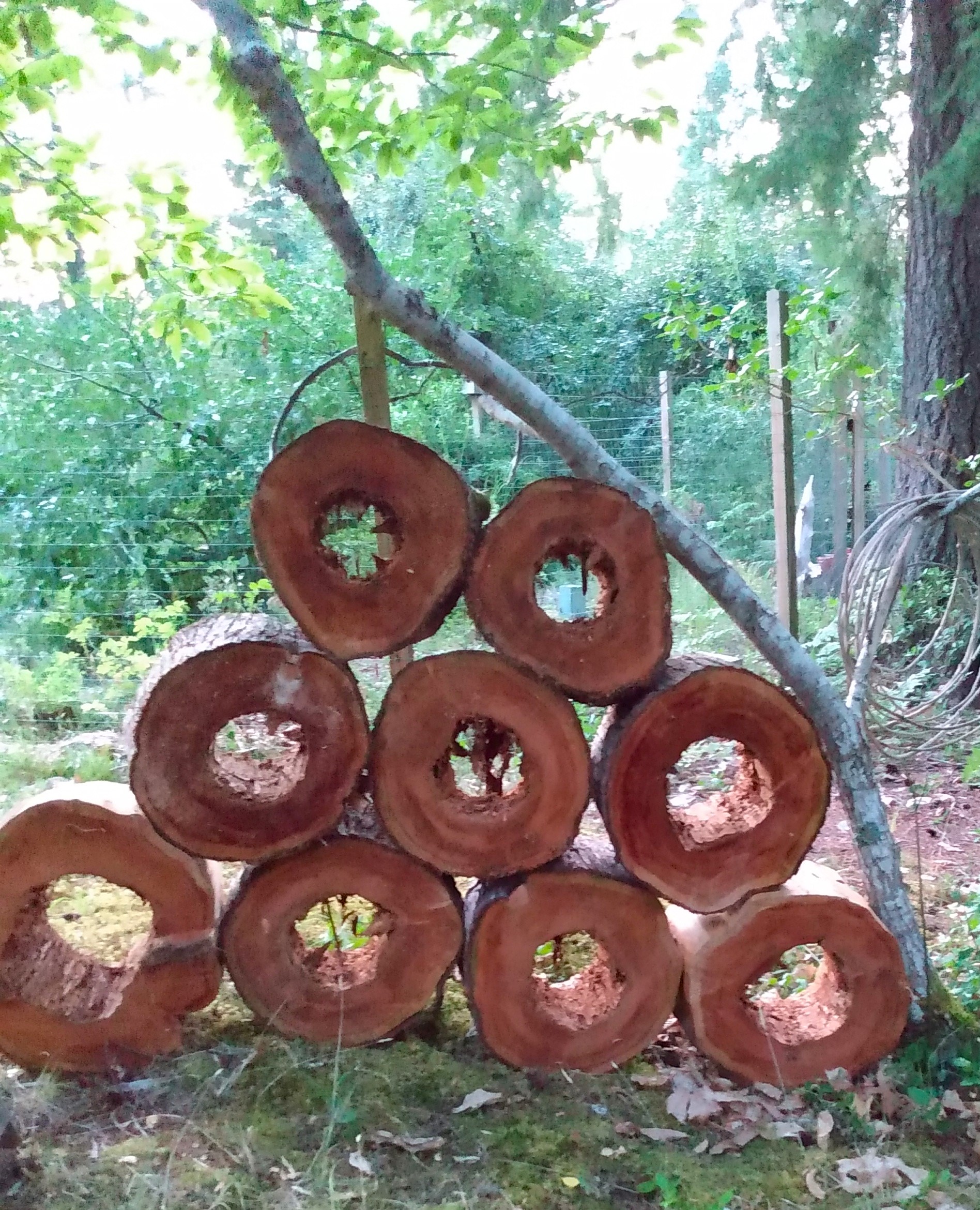
On Saturday night, after the birthday boy had gone to bed and the guest (Anik’s former neighbour at Bargain Harbour) was getting ready to leave, Anik’s husband, Walter Von Broekhuizen, said to me quietly, I made something for you. Come and see. If you’ve been reading this blog for a bit, you might remember I’ve mentioned some cedar rounds from time to time, cut from dead trees we had taken down last fall, victims of the climate emergency. (Western red cedars don’t tolerate the periods of excessive heat and drought well.) I kept thinking I wanted to make something with them. But what? I’m not an artist. I had in mind just organic constructions that would let them show their beauty, maybe supported in place by nets of old rope. I thought I might be able to “knit” the nets. I showed Walter the piles of cedar the other day and then somehow, without anyone seeing, he made this for me.

portals

The rounds are braced to some extent by a helpful arm of chestnut. Walter showed me how I could use metal flanges if I want to secure the rounds for a time–eventually they will deteriorate of course and anyway life is ephemeral–but when I said I hoped I could somehow net some of them with knitted rope and add shells, he liked that idea. He also said, You can put things in the middles too. And yes, that will be something I know my grandchildren will enjoy thinking about. A birds nest, a special rock, the tiny skull of a shrew.

After we took them down to the Langdale ferry yesterday, John and I stopped for a swim at Trail Bay. As we walked back to the car, I stopped by the rock at the top of this post. It’s big enough for two people to sit on, looking out across the Strait. Two women maybe, talking about novellas, making a place for them in the currents of literary activity. We knew what we’d call our press at the same moment. Fish Gotta Swim, we both said at the same time. Because novellas gotta. They do.

wren

wren

This morning there’s a dusting of new snow on the mountain, winter’s tentative nudge. And on the railing of the porch outside my study window, a wren perched for a few minutes, then investigated the little bird house hanging from the eaves. No one nests in it but in the depths of winter I’ve seen as many as 6 wrens enter at dusk to gather together for warmth. I confess I still call them winter wrens. I knew them before it was decided that there are actually two distinct species in North America and that the ones I’ve loved all my life are more properly Troglodytes pacificus or Pacific wrens. It doesn’t matter. They’re wrens. They are always around in winter, singing in the salal, the woodshed, their song as lovely as anything I’ve ever heard. In my novella Winter Wren, the main character Grace hears them singing near the cabin she’s bought above Sandcut Beach, west of Sooke. She hears them and then she listens to Bach’s Flute Partita in A Minor, the Bourrée anglaise, and realizes that there are intricate convergences.

She was on the porch, wringing the mop over the edge when her favourite movement of the Bach Partita in A Minor, the last, the Bourée Anglaise, began. Leaning on the railing, she loved how the passage floated out in the wintry air, a counterpoint to waves and wind. She hummed a little of it from memory. She’d heard Jean-Pierre Rampal play this in Paris, the amazing backward rhythm of the bourrée balancing the rapid run of sixteenth notes, and ever after thought of it as music she would choose before all else.

It wasn’t until the movement was almost complete that she realized she was hearing another sound, another melody answering the bourrée, ascending as the flute descended. Startled, she looked around, fearful. Was it someone whistling on her property? No, it was a bird. It must be a bird because there wasn’t anyone or anything else in sight. And it came from within the salal on the trail down to the waterfall. Peering into the undergrowth, she came face to face with a tiny dark bird, very pert, bobbing and bending on the stem it had claimed. From its open beak came a long undulating series of notes as melodic as anthing Bach had put to paper.

It was this time of year that my friend Anik See stopped in to visit us on her way back to the Netherlands from a residency at the Berton House in Dawson City. We’d both recently completed novellas and we’d both received many rejections from publishers, who all said something like, Oh, this is lovely work but we can’t publish a novella. Anik and I looked at one another after about the 6th story of rejection and we laughed. You know what this means, one of us said, and in that moment, our little imprint fishgottaswimeditions.com  was born. We decided to start with one of our novellas because then, if the whole enterprise didn’t work, there’d be fewer people to disappoint. We decided on Winter Wren (and I’m hoping Anik will consider including her Cabin Fever on our list too). We’ve published 4 novellas thus far: Winter Wren was followed by Frances Boyle’s Tower which in turn was followed by Barbara Lambert’s Wanda and our most recent title was Jennifer Falkner’s Susanna Hall, Her Book. You can visit our website (linked above) for more information.

Because I’ve been visited by the wren and because I just washed the bowl that was used for the cover of Winter Wren and I’m reminded all over again of these birds in the low brush, their song, I’m offering copies of my novella for $10 plus postage (currently $3.50 in Canada, $5.50 to the US, and I don’t know how much to other places right now but I’d simply charge the cost).

rural publishing

just arrived

The small literary novella imprint that Anik See and I run, Fish Gotta Swim Editions, is a continuing source of delight. Our fourth title, pictured above, arrived from the printer last evening. I’d been expecting the shipment all week, either by finding a card in my mailbox saying there were boxes to pick up at the post office or by hearing a courier van come up the driveway. When deliveries are via the latter, there’s usually a phone call first, someone parked in the lower driveway, wondering how to find me. Our neighbours use our lower drive to access their properties on Sakinaw Lake and when they’re not there, they have a locked gate at the point that our property becomes theirs. Because of complicated zoning, we share a street number, although technically ours is the actual number and their addresses have an A, B, or C suffix. Couriers never understand this subtlety and so once they arrive at the post with our number on it, they call. And we tell them how to find us. Last evening I heard a vehicle spinning its wheels on the turn in our actual driveway, the area with coarse gravel — we know to accelerate at just the right time to make the turn. I watched from the window as the headlights at the turn disappeared back down the driveway and then I heard the vehicle try again, faster this time. It was our neighbour. They’d come up to their house from another house they own elsewhere, just for a night or two, and the gate was open for an hour while they did some errands. When they returned, they found two heavy boxes by their front door. One of them was bringing the boxes to me, to whom they were clearly addressed, with my telephone number right on the label. This is rural publishing. In the past couriers have left parcels for us at the hardware store in Madeira Park, at the gas station 15 minutes away, and a couple of times they left packages for us at Harbour Publishing. Go figure. Luckily the Harbour Publishing owners are our friends and they called us with some amusement to let us know where we could find our delivery.

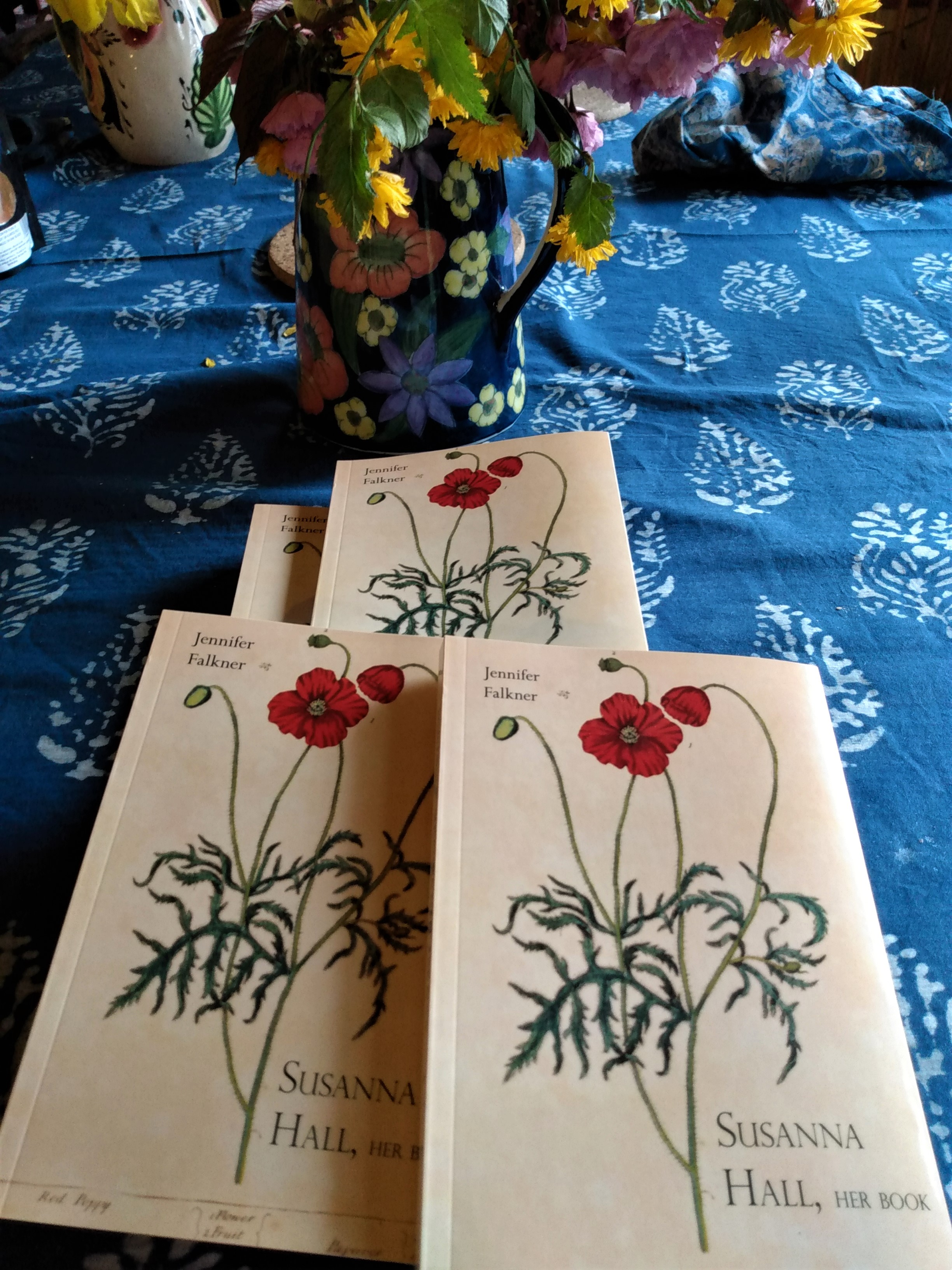
Anyway, the fourth title, the beautiful Susanna Hall, Her Book, by Jennifer Falkner, arrived unexpectedly via the neighbour last night. It was a funny moment, except it almost wasn’t. If the neighbours hadn’t used the door where the boxes were left — and they have a big house, with several entrances — and returned to their other home, then who knows when we might have put 2 and 2 together to possibly make 4: the 4th title. I received the printer proof about a month ago and Anik and I had a Zoom meeting, her in Dordrecht and me in the kitchen here, to go over the fine details of the production to make sure that everything was as it should be. Some tiny adjustments had to be made and they were and now the books are ready to go out into the world, some to the patient author, and some to people who ordered after receiving our newsletter in early April. You can subscribe to it if you’re interested. Go to our website — fishgottaswimeditions.com — and just fill out the form at the ordering/contact page. Read about Susanna Hall, Her Book at the Books page and by all means order one. I don’t think you’ll be disappointed.

It’s a lovely spring evening here after a day of clouds and rain. A hummingbird keeps hovering at my window. A pileated woodpecker is hammering down towards the lake. I’m going to take a copy of this wonderful novella up to my bed to read. I’ve read it several times, as an initial submission to our press, as a document sent back and forth to Jen for edits and small changes, as a designed book block, and then as a printer proof. But tonight it will be the book itself, with its elegant French flaps and the beautiful cover (designed by Anik, using an illustration from Elizabeth Blackwell’s Curious Herbal, an 18th century gathering of botanical cuts of plants used in the practice of physick) and Jen’s excellent writing. I know I will enjoy it immensely and I think others will too.

the decades

lino

I looked out just now to see if there’s the first snow on the mountain because it feels cold enough down here. There isn’t yet, but I bet it’ll come by next week. I love the cold nights, stars, that beautiful scimitar moon in the mid-November dark sky.

I just made a (clumsy) linocut for this year’s Christmas card. A winter wren, with a slightly foreshortened beak and awkward legs. (The lino was brittle this year, even when warmed by the woodstove.) I’ve chosen a short passage from my novella, Winter Wren, and John will print later this week.

Every year I make a linocut and he sets type and prints a card. I remember the first one we created, in the basement of the house we rented in North Vancouver before moving here in December of 1982, after a year and a half of living first in a tent here, then the shell of our house while we made it comfortable enough to live in. That first card used some old wooden type that came with the press and we had enough to print just two words: LOVE&JOY, all in caps, with the beautiful ampersand.

How the years accumulate. I listened to Emmylou Harris while I worked on the lino and realized I’ve been one of her biggest fans, boots and all, since grade 11. 1972. But I don’t think I ever paid much attention to this beauty, the one that caught my heart this afternoon.

In a couple of weeks, we’ll go to Edmonton (speaking of cold) to spend time with our family there. Emails arrive, asking would we like to go for a sleigh ride on Whyte Avenue, would we like to go to an abbreviated Nutcracker (our grandchildren are 2 and 4), and what about a Dickens tea? I remember carving lino in the early year with an audience, my own children, young enough to be impressed by a small knife making images in a piece of lino warmed by the woodstove. Young enough to listen to any music I played, and yes, there was a lot of Emmylou Harris even then. I wanted to preserve time in the images I cut with my little box of tools. I still do. John’s been sorting the decades of Christmas cards to make sure we have a full collection for the High Ground Press archive and there they are—a house on a hill with a moon overhead; a cat in a window with a star by its ear; a tree by the front door; a gingerbread person; a snowflake; a pinecone; the two fish undulating under stars (the image Anik and I appropriated for our Fish Gotta Swim Editions pressmark); a fishing boat with bright lights on its rigging (inked in by hand); and more that I can’t remember right now.

Sometimes I forget what’s to come. In late summer, preserving fruit and vegetables, I forget that I’ll be here in the house on a cold day in November, wondering what might make a card image for this coming Christmas. Or that listening to a cd heard hundreds of times over the years, I’ll stop as Emmylou sings,

So blind I couldn’t see
How much she really meant to me
And that soon she would always be
On my mind, in my heart,
I was blind from the start

novellas for a rainy day

rainy day friends

It’s raining, a lovely soft sound on the roof. A perfect day to curl up with a novella, or three. In that spirit, I’m offering my three novellas—Inishbream, Patrin, and Winter Wren—for $45. (That’s a paltry $15 per title! But I’m only offering them as a trio.) I’ll ship for free in Canada. Other places? We can talk!

On my Books page, you can read about the individual titles. And here’s a little sample of rainy writing from each of them:

Listen. There were weeks when the sun refused us. At first I thought I could never live in such a place, but then I learned the sweetness of the Irish mist, how it enveloped you and numbed you to any real action or consequence. And you wandered in it, your hair jewelled, and you let yourself drift in great imaginings, where the ruined castle on the coast was made whole and you lived there, where the beached hooker* was yours and you mended it.

—from Inishbream (Goose Lane Editions, 2001)

My grandmother told me once that her father had worn a cloak, a loden cloak, given him by a man who’d bought some of the copper pots. It repelled both wind and rain. Sometimes he’d open it to allow two or three of his children to shelter within, she said. We sat under trees while the rain poured down, and it was our own tent, warmed by our father’s body.

—from Patrin (Mother Tongue Publishing, 2015)

Where am I, where am I? Again, she woke and tried to orient herself in the new room. Curtains, no—the fogginess was because it was raining outside and she couldn’t see farther than the window. Her room was a cube of wood and glass. In the bed she had been born in, she leaned forward and watched drops of water slowly find their way down the glass to the sill. The trees dripped. The cabin was cold and she put off the moment when she would push away the eiderdown and rush to the woodstove to start the morning’s fire.

Winter Wren (Fish Gotta Swim Editions, 2016)

*The Galway hooker (Irish: húicéir) is a traditional fishing boat used in Galway Bay off the west coast of Ireland.

Three Friends of Winter: a novella sale

450px-three_friends_of_winter_by_zhao_mengjian

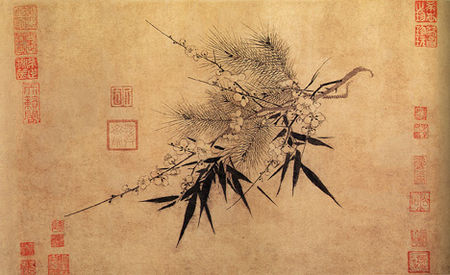
The Three Friends of Winter refer to the pine, plum, and bamboo. The origin of this term is found as early as “The Record of the Five-Cloud Plum Cottage” from The Clear Mountain Collection of literary writings by Lin Ching-hsi (1241-1310, a Sung dynasty loyalist): “For his residence, earth was piled to form a hill and a hundred plum trees, which along with lofty pines and tall bamboo comprise the friends of winter, were planted.”

Years ago, I saw a planting of the Three Friends of Winter in the Dr. Sun Yat-Sen Classical Chinese Garden in Vancouver. And I thought, what a lovely idea — a companion planting of things that thrive in winter! They symbolize steadfastness, perseverance, and resilience. A little like the novella? In honour of the Three Friends of Winter, I’d like to offer my three novellas — Inishbream, Patrin, and Winter Wren — for the winter-friendly price of $45. For the three of them. (See my Contact page for my email address.) And I will ship them for free. Think of them as hardy green trees (and doesn’t the scouring rush on Winter Wren look like bamboo?), flourishing in snow and wind, eager to find their way to you.

three-friends-of-winter

“I say, ‘Regicide.’ I say, Help!'”

From An Exaltation of Larks, by James Lipton:

An Herde of Wrennys, The Book of St. Albans. Hodgkin says, “The wren was probably allowed the term of ‘herd’…because it was the king of birds.” I say, “Regicide.” I say, “Help!”

It’s been slightly more than a month since the boxes of my novella Winter Wren arrived at my door. Readers of this blog might remember that my friend Anik See and I have begun a small literary imprint, Fish Gotta Swim Editions, to publish novellas for now and perhaps other innovative prose forms in the future. It’s been an interesting process so far. I wrote Winter Wren, Anik designed the cover and text, and the wonderful team at Printorium in Victoria printed the beautiful hand-sized books. People are sending the nicest notes or calling me to tell me their impressions. So far, so good!

winter wren.jpg

It’s a word-of-mouth endeavor at this point. We don’t have an advertising budget so we’re relying on email newsletters and the kindness of friends and strangers. Anik doesn’t even have copies yet but will receive hers when she’s in Canada next month. After then, she’ll fill orders for European customers and those from other parts of the world. (I’m filling orders for North, Central, and South America. And have mailed books to the UK and a few other places far afield.) But we both believe that readers will be interested in novellas and will somehow find us and our titles. (More are in the planning stages.)

Several reviews are forthcoming and I will post information and links on my News and Events page once I have them. I look forward to reading from Winter Wren when I participate in the Sunshine Coast Festival of the Written Arts on Friday, August 12th at 2:30 p.m. (I plan to talk about novellas in general and to also  read from my Patrin, which isn’t even a year old yet!) There will also be a proper launch for Winter Wren, probably in September. (If this sounds a bit vague,it’s because, well, life is busy right now! The Pender Harbour Chamber Music Festival, which I’m involved with, is coming up on the weekend of August 18-21 in Madeira Park; some of my children are coming for a couple of weeks later in summer; and there’s a third grandchild due in late August. But watch my News and Events page for a book launch date and if you’re in our area, come to help celebrate its regicide — without giving too much away, that word has a kind of eerie truth for this tale of wrens and the solstice and the passing of the old year.

pages.jpg

And if you want to support independent publishing not just in Canada but internationally (because Fish Gotta Swim Editions is located here on the west coast as well as in Amsterdam), please consider ordering a copy of Winter Wren. You can order from me. Or Anik. Several bookstores here on the Sechelt Peninsula carry the book and others can order it for you. If you are interested in a review copy, please let me know.

bookends

In 1977-78, I spent most of a year living in Ireland. I rented a cottage on a small island off the Connemara coast. It was a sweet time, though often lonely too. I walked. I gathered mussels and nettles to supplement the meager amount of food I could buy weekly in the nearby town when a boat was going that way and I could tag along with fishermen selling their catch or their wives doing errands. I say “meager” because I had so little money and also because everything I bought for the week had to be carried in my rucksack. Sometimes the boat would cross the narrow passage between the island and a strand several miles from the town and on those days I walked back and forth with my rucksack of provisions or else I borrowed a bike from a farmer who lived above the strand. A week’s worth of food could get heavy (and expensive) awfully quickly.

And I wrote. I wanted to discover if I was actually a writer and for some reason I thought I had to go far away to do that. I’d always loved Irish music and literature and somehow I imagined the west of Ireland would be a place I could lose my young damaged self in and find a better self. (I was 22. This is the way I thought then.)

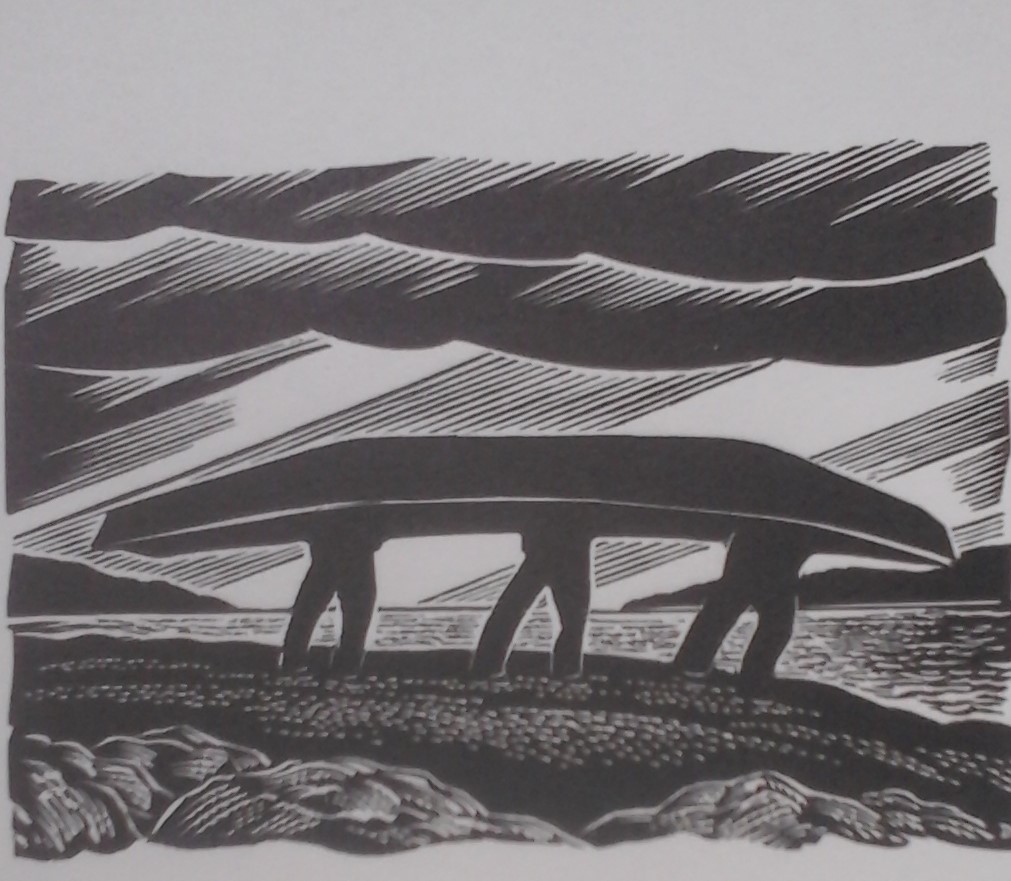
I have no regrets about that time. I loved the island, I loved the hedges of fuchsia and the sound of corncrakes in the field behind my cottage. I read voraciously and I wrote the beginning of a novella which I completed later, once I’d returned to Canada. That novella, Inishbream, was published first as a private press book by the Barbarian Press. It took them years to actually produce the book and all the reasons for the delays were entirely legitimate. The wait was worth it. And so was the process, the step-by-step process of making a book the old beautiful way. An American artist, John DePol, did a series of wood-engravings for the book.

currach

Some copies were quarter-bound with soft green Japanese silk; others with leather; and the very rare Design editions were quarter-bound with turbot leather. The printing is exquisite. And when I read the novella now, as I do from time to time, my heart goes out to that girl on a western island, her wild ecstatic heart. (I know now that some of the way she saw the world — a heightened rapturous vision — was in part due to hunger…)

There are pale beaches of coral sand, strung darkly with the dead weeds. I walk them endlessly, alert for news of the world: a bottle, an explosive, a book of the saint’s voyage enacted on the edge of the Atlantic, a waterlogged crate washed from the deck of a ship.

In those windy cottages, the stories age. Outside, a well runs dry. Pots rise empty on their bleach-bottle floats, the hay rots under the rain’s assault. And they stand, all of them, on the rim of the chopping sea, straining to the tide, pulling in the nets of the morning. World without end, amen.

My husband John remarked awhile back that my new novella, Winter Wren, is in some ways a bookend to Inishbream. The main character lives on a remote beach, on an island’s western edge, and although much older than the protagonist of Inishbream, she shares many of the same habits and aspirations. She wants to know where she is, wants to know the plants, the weather, the patterns on the rocks. (In Inishbream, the speaker of the book discovers what she thinks is a pattern of carvings on rock and wonders if they’re petroglyphs. In Winter Wren, Grace finds fossils from the Oligocene period in the sandstone below her house. Both of them are alert for whales. Both have unexpected lovers.) And although Winter Wren isn’t printed letterpress on fine papers with linen stitching, it is a very pretty production (thanks to Anik See and the great team at Printorium). In purely physical terms, it’s a bookend to the trade edition of Inishbream, published by Goose Lane Editions.

bookends.jpg

The older I get, the more I realize what a capacious form the novella can be. A small but surprisingly roomy vessel, for meanderings, meditations, for recording flora and fish species, for weather notes and snatches of poetry, for expanding the known world of a speaker who “came, wanting only the isolation of tides” but who found so much more at the doorstep of those tides. Birdsong, old stories, the vertebra of a whale, the far-off lights of Neah Bay.


Winter Wren arrived!

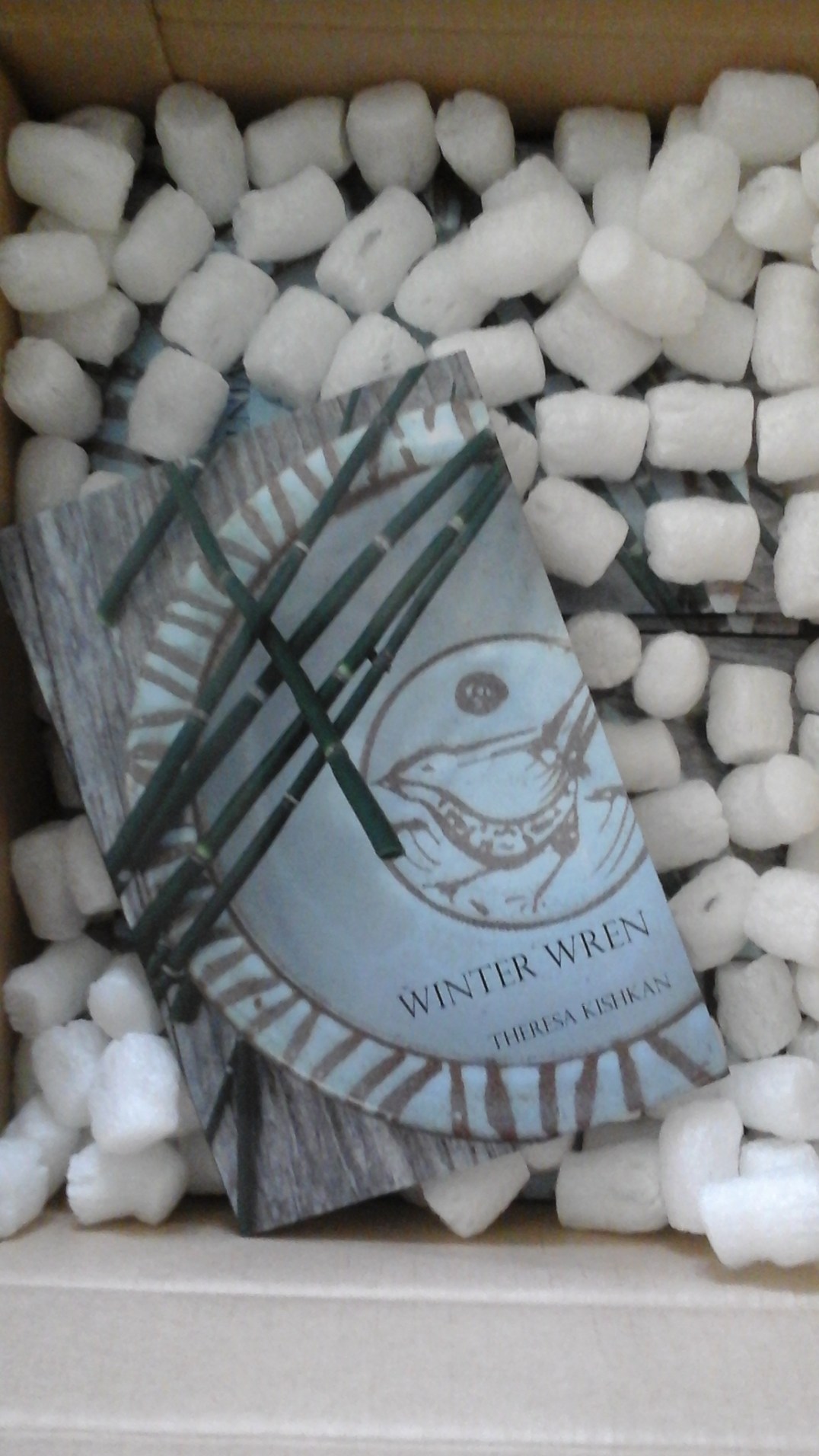
It’s official! Fish Gotta Swim Editions is truly in business! Our first title — my literary novella, Winter Wren — just arrived, by our postal worker’s own car, grinding its way up our long gravel driveway. Anik See designed the book and it’s beautiful. And a bargain — $18 (plus postage, at cost).

winter wren among packing peanuts.jpg

If you’re in Canada, the US, or Central and South America, you can order from me: https://theresakishkan.com/fish-gotta-swim-editions/

And for the UK, Europe, and the rest of the world, you can order from Anik See, who is in Amsterdam:

https://aniksee.squarespace.com/forthcoming-titles

Some bookstores will carry the book and there will be a launch here on the Sechelt peninsula, date to be announced.

My own printer-in-residence (and Friend of the Press), John Pass, printed a lovely keepsake on our 1890s Chandler and Price press. These will be tucked into orders until the keepsakes run out so get ’em while you can!

keepsake