the firewood palpitations

“All to gather the dead and the down.” (Gary Snyder)

firewood palpitations 2

We heat our house primarily with wood. We have an airtight, a Regency (painted blue), in our big kitchen. From about now until, oh, early June, the first person down in the morning makes the fire. We have a mat in front of the woodstove and 3 chairs (2 wicker armchairs and one rocker) near the stove. The part of the house we mostly live in is open, though of differing levels: living room up one stair, our (big) bedroom the entire second storey, with open stairs leading to it. No door. So the heat circulates, with the help of a ceiling fan. There are electric baseboard heaters but they’re an expensive way to heat so we just use them as a last resort. A few years ago we also had a mini split installed.

So firewood is often on our minds. Parts of our land–8.39 acres–had been logged some years before we bought it in 1980 and there was a fair bit of wood around to clean up. And in windstorms, trees would come down. We also had a pickup truck in those early years so when trees came down near the highway, we could take a chainsaw and fill the truck. But now we’re older, maybe even old, and we no longer have a pickup. You’d think it would be easy to just call someone to deliver a couple of cords of good seasoned wood but you’d be wrong. Some years a guy will park at the shopping area in the village near us, an old truck loaded with carefully stacked dry fir, maybe some maple. You talk to him and he follows you back, throwing the wood off the truck so you can stack it in the woodshed. You tell him it’s good wood and you’d like more. Oh sure, he says, holding up a hand with missing fingers. You never see him again.

Or someone knows someone who knows someone. His list is long but he’ll try to get to you. Sometimes he does. Often, not. This year John spent part of the early and late summer cutting up the rounds of cedar remaining from the standing dead (victims of climate change) in our woods. But cedar isn’t ideal. It became, well, a daily topic of conversation.

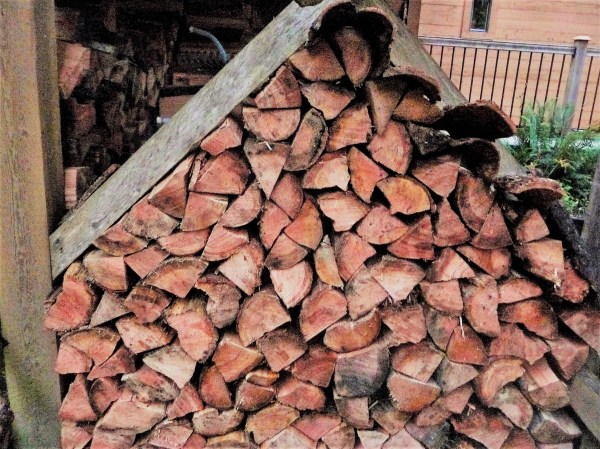
Then John learned about the Community Forest woodlot. Yes, they can deliver but wow, the price was so much better if you could pick it up yourself. A friend happened to drop by for coffee, someone we love but don’t see often enough because he fishes long seasons, and when we told him about the woodlot deal, he became visibly excited. He and his family are like us. They heat with wood too. And it turns out that they are rich (right now, not forever) in pickup trucks, including one we could borrow. He’d be away but John said we could help them if they needed help with wood. On Friday we went to the woodlot and filled the pickup with stacked seasoned fir (mostly; there was a little alder and cedar mixed in). We also filled the back of our Honda Element, the rear seats removed. The people there helped with the stacking. On our way back home, we stopped for coffee and John took a photograph of the wood and sent it to our friend’s partner; excited texts went back and forth. While we were having coffee, we unexpectedly met with other friends. When they saw we’d filled two vehicles with firewood, they immediately offered us whatever we wanted from a whole lot they had at their place, the result of trees coming down–a big grand fir, hemlock, and alder. They no longer burn wood and wanted to give away other seasoned wood they’d been storing. So this morning, when we were taking the truck back to our friend, we stopped on the way and filled it with wood for her.

firewood palpitations

When we dropped off the truck, we stood in the sunlight and talked about firewood. Two sources! Enough for all of us! Good wood! I could hear the relief in John’s voice, and in Amy’s too. I joked that we were all having firewood palpitations! This time of year, there are things you want. You want the pantry shelves lined with preserves, the bounty of your garden, and you want your woodshed filled. The talk was of hydro bills, the merits of one wood species over another, even the pleasure of splitting big rounds. John and Amy made arrangements to go to our friends’ to fill the truck again, soon, and then we headed home.

As John emptied the Element of its load of dry fir, stacking it in the woodshed in tidy rows, I picked the last of the beans, and removed the stakes from the tomatoes I decided wouldn’t ripen where they were, in the shade of an ancient fir. A big bucket of them came in to be laid out in a box. Returning to the house, I could smell the beautiful scent of fir as the last wood was stacked. Later in the week, if the weather is good and we can work out the truck, we’ll go get a load of big rounds for next year, grand fir and alder and a bit of hemlock. We never forget they were living trees and we are always grateful.

The pantry shelves hold their own bounty and there’s still more pesto to make for the freezer. In the greenhouse, eggplants, cucumbers, tiny olives beginning to swell. But it’s firewood that gives me palpitations, anticipating warm fires in January, a quilting basket by the rocking chair.

beans

“we’ll do the best we know…”

firewood gate2
An hour ago, while swimming, I caught a thread of autumn in the morning air. That slightly winey scent of leaves, a riffle of cool breeze unheard of a week ago when there was sun on the sand at 8:30. Maybe I noticed it because earlier I’d been reading the Autumn section of Bruce Hutchison’s A Life in the Country with my first cup of coffee. I’ve always loved his books and I found this copy at the Friends of the Sechelt Library book sale a few weeks ago. 2 bucks. It’s an elegant memoir of the author’s home-building in North Quadra near Victoria (the same neighbourhood my parents lived in), garden-making, renovations at the cabin he owned at Shawnigan Lake. He wrote so elegantly and beautifully of the dailiness of keeping a place intact, of welcoming visitors, of the strange and wonderful cast of characters who peopled his world. But back to Autumn. His meditations on the woodshed rang a familiar bell.
….If, occasionally, our politicians turned from rhetoric to reality and grasped an axe instead of a debating point or photo opportunity much social damage might be avoided.
   For those who can read its message, the woodshed rebukes such errors. Neatly piled (a high skill in itself), the contents, unlike all paper assets and printed money, are real wealth, an honest measure of value never diminished by the legal counterfeiting known as inflation. And when the chopper inspects the drying wood for next spring’s fire, he must be a little surprised by his own morality. His work, his sweat, his muscle and ache have created that wealth, or at least preserved it. He has asked no wages and he has toiled while his guests revelled in summer idleness.
   There is a darker side to the lesson of the woodshed. A moral chopper should ask himself what right he has to nature’s generosity when multitudes of human beings are cold in winter and hungry in all seasons. A nice question, especially for Canadians who, possessing a transcontinental treasure, grossly mismanage it by defying the woodshed principle.
   The moral question remains, and it has baffled philosophers of every faith since mankind left its caves—how much of nature’s yield does any nation or individual deserve? What volume of wealth are we entitled to hoard for our own use in woodshed or written contract?
We burn a lot of wood over the fall, winter, and spring. We buy some now that we’re past middle age and we cut what we can on our own land. We’re eyeing the dead young cedars, victims of two years of hot dry summers, and once it’s safe to take a saw into the woods, we’ll spend some time taking down what we can. When our older son visits in October, he may be conscripted for some woodcutting too. It’s good work, if hard on the muscles. But it also makes you grateful for a warm fire made with logs you’ve cut, split, and stacked yourself. Last year, in November, we had a load of dry pitchy fir delivered to supplement what we’d brought in ourselves. And the delivery coincided with two things: an emergency surgical procedure for John; and the visit of our Edmonton family. While he convalesced, I stacked wood in the shed; and Cristen, Kelly, and Henry filled the woodbox and kindling bucket in the porch as needed. Mostly John does these jobs and it was good for the rest of us to take them on, to know the luxury of a fire afterwards.
Yesterday was the first day of the Pender Harbour Chamber Music Festival. I’ve been involved since the beginning season, 14 years ago, with a break of a couple of years in the middle. It’s always a fabulous weekend of intimate chamber music in the most beautiful setting—a restored Forestry building on a little hill above the harbour, surrounded by big trees. The opening event was this year’s Rising Tide, our annual celebration of young performers; the concert is a gift to the community. We were treated to a programme ranging from John Dowland to Leonard Bernstein. It was during the duet “Make Our Garden Grow”, from Bernstein’s operetta Candide, that I reached for my husband’s hand and squeezed it. It was our life, in a way, in the way that music can reach into your heart, play it as deftly as any instrument, in the words of Richard Wilbur, the poet who wrote the lyric for this particular version of the libretto:
We’ll do the best we know.
We’ll build our house and chop our wood
And make our garden grow…
And make our garden grow.

finding my way into winter

November 1st. After morning chores, we’ll go over to Anderson Creek today to see if the chum salmon are running. These are good days to be outside. Leaves are falling, the last of the geese are heading south, and our woodshed is slowly filling. Slowly, because our division of labour has shifted slightly due to a rogue medical adventure of John’s last week so I’m the one stacking the fir chunks into rows in the woodshed, trying to keep my stacks as tidy as those behind them—the alder already cut and stacked earlier by John. It’s a kind of learned skill, how to choose pieces that will fit snugly against their neighbour, how to wedge and balance. Not unlike other things I do, not unlike the patterns I look for when I’m eyeing a stack of fabric and thinking about quilts, though I have to say that stacking firewood is a bit more physical.

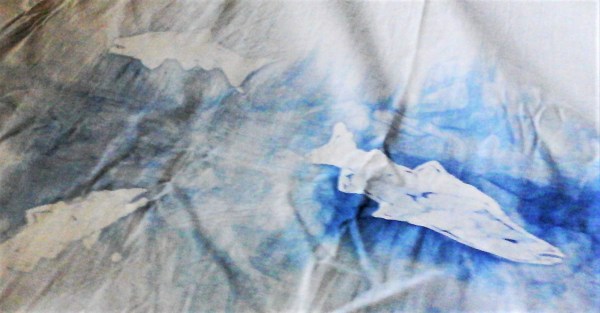
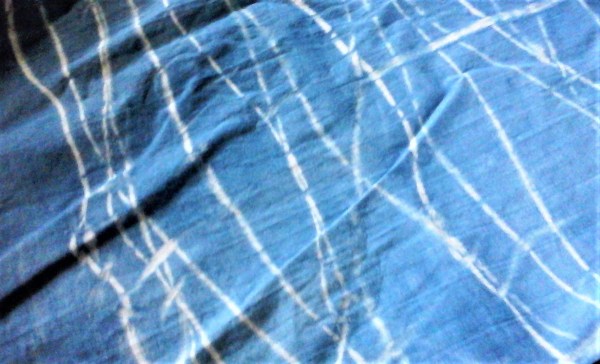
I took the wax out of the final length of indigo-dyed fabric the other day. I confessed in an earlier post that I realized before even unwrapping the length after its immersion in dye baths and long period of overnight oxidization that it wouldn’t look the way I’d hoped it would. And it doesn’t. But it has moments. This one, for example:

swimmers

And the eel-grass areas at the four corners of the fabric, because of the way I’d folded and wrapped and bound the sheet around a length of pvc pipe:

eel grass

I’m glad to have done it, to have learned things, and to have something now to work with. And there are pieces from this last dye lot that have surprised me with their beauty. This one will be a single-cloth quilt on its own, maybe backed with deep red cotton, and quilted with red sashiko stitching:

ready

Once the woodshed is filled and I know I can count on a winter of warm fires to work by, I’ll begin the process of turning this into a quilt. And all the other fabric I dyed? Well, it’s waiting too. Everything is gathering—the imagery, the ideas, the hours themselves, and my own need to spend time stitching and thinking, finding my way into winter.

the firewood gate

I went out to try to photograph the morning sky, pink suffusing the eastern and southern treelines, and everything so rich and autumnal. But the colour wouldn’t show up. But while I was outside, I could smell newly-split fir. (John spent the last few days splitting and stacking two cords of wood.)

firewood gate.JPG

Our woodshed was built with bits and pieces of cedar posts and beams more than 30 years ago. When you live where we live, you burn a lot of firewood and the woodshed was an essential structure. There’s a magnificent wisteria climbing up the right post, the one you don’t see, its trunk as thick as a good-sized tree.

The last week has been strangely stressful. A medical adventure for me, world events filling the airwaves — or at the radio airwaves; the ones outside are loud with wind and birds — and (maybe as a result of the medical issue) Time’s Winged Chariot whirring dangerously near. But the firewood is somehow comforting — its sweet smell, the quick winter wren that is busy investigating its new geometries for insects. So settle in, I tell myself, and remember where you are, who you are. Long conversations with my children have been a solace. News of Halloween: granddaughter dressed up as a garbage-truck driver (her current heroes, the guys who wave to her from the alley as they pick up the weekly garbage and recycling), clutching her plastic garbage truck as proof of her dedication; one grandson a pirate; the other (the youngest) a monster.

I think of Du Fu, that poet-sage of the Tang dynasty, who wrote of political corruption and the passing of time, and whose home had a firewood gate; he was nothing if not grounded in the particulars of home and hearth, all the while lamenting the injustices of the larger world. Time to do as he did, meditate on Autumn and its touchstones: the smoke and cold water, the song of a tiny bird among the logs, and the sound of the mountain.

I’ve heard them say that Chang’an seems like in a game of chess,
A hundred years of world events have caused unbearable pain.
The palaces of the noblemen all have their new masters,
Civil and military dress and caps are not like those before.
Straight north over mountain passes, gongs and drums ring out,
Conquering the west, carts and horses, feather-hurried dispatches.
The fish and dragons are still and silent, the autumn river cold,
A peaceful life in my homeland always in my thoughts.

(Autumn Meditation 4)