the gentle art

I was beginning to think I was jinxed because The Gentle Art of Swedish Death Cleaning was never available at the Sechelt Library; it was always checked out. For some months I’ve been thinking that I need to sort and winnow the overflowing rooms in this house I’ve lived in for 43 years. The books alone are, well, too many. We have a room with double-sided shelves, filled. I have a study with shelves built into one full wall and there’s no room to squeeze in another thin volume of poetry. Speaking of poetry, John has shelves upstairs with so many that he has also made piles on small tables and the floor. We never got rid of children’s books and good thing because now there are grandchildren. My mind is firmly analog, I guess, and although I use the internet (of course), I love to sit with books and look things up. There’s nothing like an atlas, for instance, or maybe 3 so you can cross-reference, sitting with them on your knee, tracing the distances from one city to another, tracing the river courses, figuring out borders. You need 3 because those borders are always shifting and it’s interesting to think about that historically, over time. And dictionaries: same.

But yesterday the library’s copy of The Gentle Art of Swedish Death Cleaning was on the shelf and I brought it home. I read most of it before sleep last night so is it any wonder I dreamed of filling boxes with…books? The author advises one room at a time. I’d like to try. I’d like to take in large bags and fill them with clothing, shoes I’ll never wear again, pots I haven’t cooked it for years, maybe even the fish-poacher Floyd St. Clair gave me when he was doing his own version of Swedish death cleaning. I remember I’d gone to have an early dinner with him and his partner David Watmough with my older son Forrest before heading down to Kits Point to see a performance at Bard on the Beach. We were using the bus and we were going to return to North Vancouver to sleep at the home of another friend after the play. So I had the fish-poacher in a large bag that I had to tuck under my seat in the tent and then carry back on the bus. That’s one item I could death clean but do I want to? Not yet. Floyd and David have been dead for years and I miss them still. (Everything in this house holds a memory.) Giving away the fish-poacher would seem so disloyal, unloving.

I could death clean the dresser holding table linens but then what happens when we need enough table cloths for all the tables put end to end for a really large gathering? (Will we have a large gathering again?) I could death clean the silver. The author recommends saving only enough plates and cutlery for the places you can set at your table. But what if? What if?

We don’t have a basement. Instead, we’ve filled our utility room with boxes of old boots, a tent, an inflatable dinghy, canning jars, two wine racks (filled, more or less, but you wouldn’t death clean wine, would you?), two vacuums, and, and, and. We’ve also filled our print shop, purpose-built to hold one printing press, then another, and cabinets of type, a table for laying out freshly printed pages, a cabinet for ink, etc. But as well as another vacuum, there’s also a wall of boxes of books, mostly copies of my own books, bought when they went out of print or else a publisher wrote to say they’re taking up too much warehouse space. Who could say no? Not me. No one wants to think of their books being shredded. But honestly, was it wise to think that somehow I could sell the books myself? I am no entrepreneur. (If you’re interested in any of them, just ask me. $5 a copy, plus postage.)

When I went to the library yesterday and found The Gentle Art of Swedish Death Cleaning on the shelf, I was thrilled. I looked at the first couple of pages and was filled with resolve. As I was leaving, I stopped at the trolley in the library lobby to see what books were being discarded, taken out of circulation. I’ve found treasures there, most recently some children’s books in French to have here for my Gatineau grandsons. Yesterday there were several copies of my book Euclid’s Orchard, the ones the library kept in their book club sets. I loved visiting a couple of book clubs who read that book, several members using library copies (while others had bought the book and asked me to sign it for them). Reader, I hesitated. I knew I had at least one box of Euclid’s Orchard in the print shop in the precarious stack against the east wall. Did I really need any more? I hesitated, as I said. But somehow The Gentle Art of Swedish Death Cleaning gave me to strength I needed to walk right past. And maybe I don’t want a copy (or two) of one of my own books with Discarded stamped on it. It’s a bit like finding one of my books listed on ABE, described as being “Unread, with fulsome personal inscription from author to fellow writer”.

One room at a time. That’s what the author advises. I don’t know where to start. But at least I haven’t added to the problem. Not since yesterday.
“you might catch a glimpse of the future too: driftwood windchimes turning in the air, a garden latch, a woodshed, a tiny dead saw-whet owl on a stack of dry fir.”

trio

This is the earliest spring equinox in 128 years. Yesterday I pruned the greenhouse olives and when I opened the door, the temperature was 24 inside. (Probably 16 outside.) It felt like early May, bees flying by in their purposeful way, the air clean and warm. Inspired by the shapely olive trees in Spain, I tried to give mine a little more form. And because I hate waste, I made 10 cuttings of the pruned branches, dipped them in rooting hormone, and put them into soil. What happens, happens.

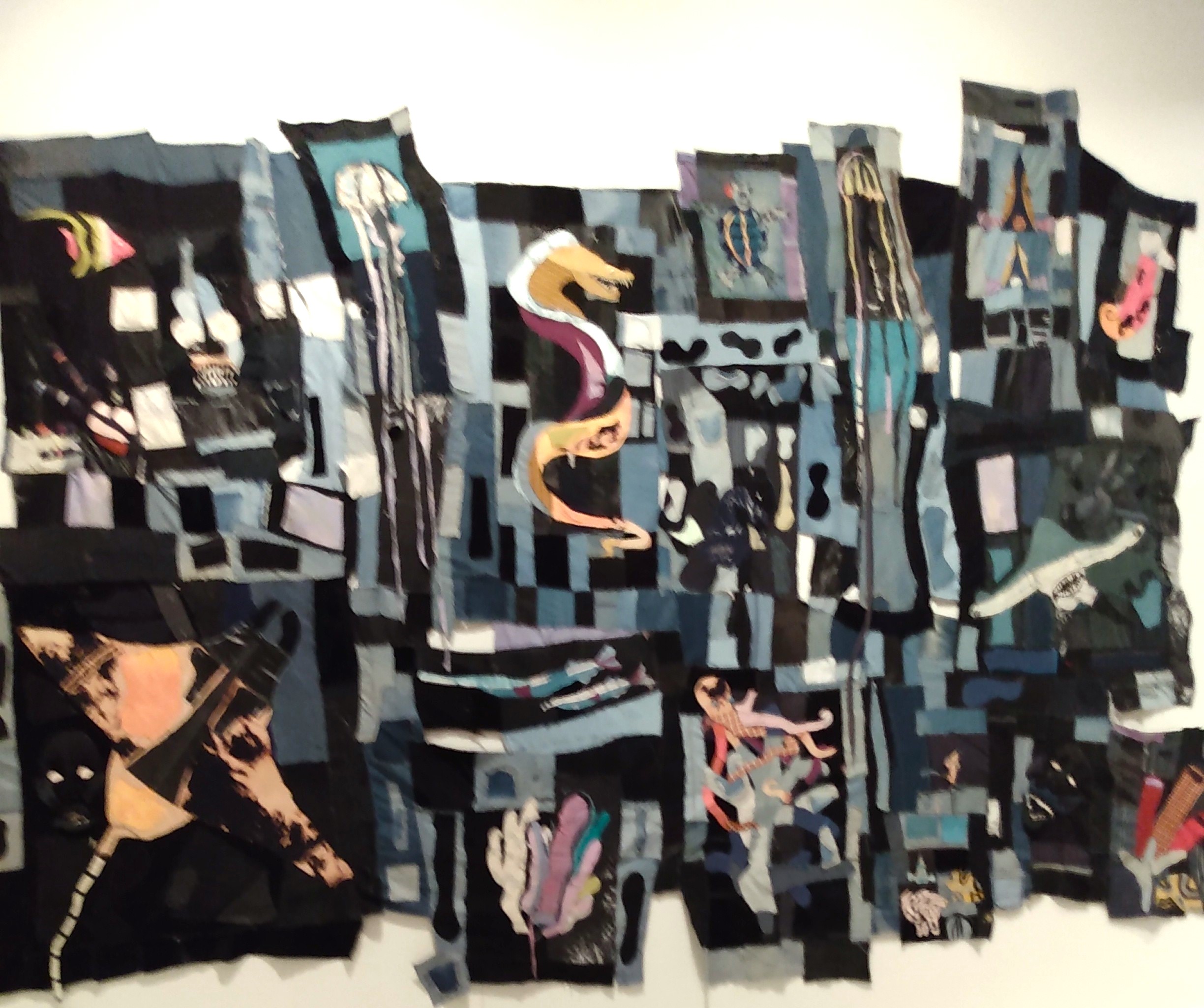
While I worked outside, I thought about something I want to make. In London, we went to Unravel: The Power and Politics of Textile Art at the Barbican Centre. I wrote about this briefly the day after and I remember I mentioned that I was inspired to do something I’ve thought about for years but had no visual or actual language for, not the whole experience of it. I was inspired by Tau Lewis’s The Coral Reef Preservation Society for a whole lot of reasons — the upcycling of denim, the embedded objects in the work — but it was really a tiny moment in the piece that has led me into the planning process for a project, half-textile, half-writing.

at the barbican

In the lower middle of this stunning work, just above a clump of coral, you can see the upended pocket from a pair of jeans. Well, the outer part of the pocket has been removed so you can see the contrast between the faded jeans and the brighter inner part of the pocket. When I looked at the textile, which is huge, my eye was immediately drawn to this small portal. I remember tears came to my eyes. But why? It was because I was remembering the months we lived in a blue tent here on the 8.39 acres we’d bought the year before, in 1980. We had the idea we’d build a small cabin where we’d spend time away from the city. But the more we thought about it, the more we realized we wanted to live here. We couldn’t afford to have someone build us a house so we decided to do it ourselves. And on the Easter weekend of 1981, with our two-week old baby and his diapers, his little sweaters and sleepers, a big tin bowl for both salad and bathing the baby, we came to our property and set up our tent on a plywood platform, stretched an orange tarp over it to keep us dry, and began the work of building a house. I’ve written about this in the context of essays and so on. But in the textile work I am planning, I’ll use tents made from old jeans pockets and fill them with emblems of the house-building years, the child-raising years, the years that have gathered themselves into baskets of saved blue fabrics, canning jars, scribbled notes about garden plans and recipes for desserts using the first rhubarb,

rhubarb

the apples from the orchard we lovingly tended and then abandoned (if you are interested in this particular subject, I wrote about it in the title essay of my book, Euclid’s Orchard and Other Essays), the storms, the windchimes, the dogs who barked at the elk and who are buried in the woods, the owls. I’m so excited to begin this. First things first: finding enough old jeans for their pockets and the usable portions of their legs. A trip to the Egmont Thrift Shop is in order.

I’ve had a strange year, re: my so-called literary life. I wrote something I thought was worth publishing and have encountered only silence when I’ve queried publishers. Oh, well, I thought: I guess I’ve aged out. Maybe I have. In a culture where identity is increasingly in the forefront, mine has felt irrelevant. But in Granada last week, John and I gave a presentation of our work to a room of students and faculty and the reception was so gratifying. Afterwards instructors came to tell me they’d like to include my books on course reading lists and one man cried and I realized that my quiet writing has a relevance to those who are willing to listen. And even if it doesn’t, I need to do it. Last night I was up for awhile, thinking about arrangements of pockets, of portals, of tent flaps open and closed, and what you might see if you untie the little strings holding them in place. You might see a sleeping baby in a yellow sleeper with a blue tuque on his soft head, you might see workclothes piled in a corner, a bag of worn cloth diapers, a woman dazed with miracles and worry, and if I can do this properly, you might catch a glimpse of the future too: driftwood windchimes turning in the air, a garden latch, a woodshed, a tiny dead saw-whet owl on a stack of dry fir.

“it lives in my spine” (Leonard Cohen)

core

Yesterday we went down to the old orchard, now overgrown and returning to forest, and John bucked up some of the cedar logs left after some we had some work there 3 or 4 years ago. Cedar’s not a great firewood. It doesn’t burn as hot or as long as fir, maple, or alder. But we have the logs and they’ll provide some heat. After John’s double hip surgery in October, 2020, he was left with a paralyzed foot after a nerve was compressed during the procedure. We hoped for a complete recovery but two years have passed and that’s unlikely now. But it’s much better than it was. Using a chainsaw is possible now, for example, because his balance is better. So that’s why we were down in the orchard, him bucking and splitting, and me carrying logs to the back of our Element. Two years ago, a friend came with his son and they cut up a couple of the logs. I wrote about it here. At the time, looking out the kitchen window as Joe and August stacked logs in our woodshed, I thought I was seeing angels. And maybe I was. Sometimes people offer exactly the thing you need and that day it was the offering of logs to warm our house.

the very core

I was lifting logs from the area by the chopping block when a long stick the width of a pencil dropped to the ground. It was the core of the log John had just bucked into stove lengths and then split. I must have seen the core of a cedar log before but this time I really looked at it. Hard, and smooth as skin, faintly pinkish–you can see it in the photo at the top of this post, though the pink is lost in that image. It is its own thing, its own strength. I put it aside and will keep it on my desk with all the other objects–the paperweight John brought me from Toronto years ago and which led me into an essay about my mother (“Paperweight”, in Phantom Limb); a large smooth rock from the Skeena River; a chunk of fossil-filled rock from a beach west of Sooke; two ikons, one from Greece, courtesy of Angelica, and one from Skagway; the pelvis of my beloved dog Lily; a tiny ceramic tree frog; a glass heart (a gift from John); and a bowl of shells and stones collected over the years.

We were in the old orchard, the one I wrote about in Euclid’s Orchard, and sunlight was bright on the house above us, the bigleaf maples on the edge of the orchard, and we were doing work we’ve done for decades, willingly, grateful to still have the strength to bring in the wood. There are things I’m having a hard time with these days and I’m trying to write my way through, hoping for clarity and peace. The core of the cedar reminds me of days past, days of kindness, which of course is the title of one of my favourite poems of Leonard Cohen. Reading it just now, I find lines to carry with me, to hold as strength and courage.

There was good light then
oil lamps and candles
and those little flames
that floated on a cork in olive oil
What I loved in my old life
I haven’t forgotten
it lives in my spine

It lives in my spine, what I haven’t forgotten. The fires we lit in the orchard to burn old brush, the ones when our children were still here, the ones when they returned with their own children. The days of apple blossom and pear blossom, rich as sandalwood. The good light of a few candles on the deck at the end of a dinner. The bees. The friends who have passed into memory, the ones who turned away, the dark nights driving home when elk crossed the highway in a long stream, the single snowy owl on the tree by our driveway. In my spine, what I loved in my old life, holding me true in the days since, the ones to come.

winter gifts at High Ground

I know Christmas is more than a month away but if you’re thinking about gifts, we can make it simpler for you by offering some of our own books, limited edition chapbooks, and broadsheets printed on our late 19th c. Chandler & Price platen press for sale during the season.

mud bottom

For example, John’s Mud Bottom (details here) is $35. If you buy a set of the Companions Series Broadsheets (also here), a folio of 12 letter press broadsheets including poems by Gillian Wigmore, Russell Thornton, and Maleea Acker written in reponse to other poems printed enface, priced at $150, then we will include a copy of Mud Bottom for free with your order.

winter books

For a selection of our books, including my Euclid’s Orchard, Winter Wren, The Age of Water Lilies, Inishbream, Patrin, A Man in a Distant Field, and Red Laredo Boots, and John’s crawlspace (winner of the 2012 Dorothy Livesay Poetry Prize), Forecast (Selected Early Poems: 1970-1990), and This Was the River. the deal is this: buy one at cover price and receive a second book of your choice for 50% off. We’ll happily inscribe the books. Postage will be charged at cost.

If there are other books you’re interested in or you see something on the High Ground page (including chapbooks, individual broadsheets, including Michael Ondaatje’s “Breeze”), please ask us. And if you think that background scarf on which the books recline is as ravishing as I think it is, visit Caroline Jonas’s website. (I recently ordered the scarf as an early Christmas gift from my husband because he won’t be able to shop this year!)

redux: “Who’s there?”

Note: this post is from February, 2019. I describe the process of writing “A Dark Path”, an essay subsequently published in Brick 104. Sometimes essays begin in thin air, a voice in the darkness calling out.

___________________________________________

pelvis

Something happened the other day and I want to write about it while it’s still fresh and lively in my thinking. I got up in the night (after midnight as Wednesday eased into Thursday) to sit at my desk and ponder the beginnings of an essay to accompany the dark path quilt I was sewing. I know this might not make sense to people who do one of these things or the other but not both. Each discipline requires a different set of skills, a different kind of focus. Still, working on the two things in tandem has become a way for me to explore the process of making something and thinking deeply about the way it connects to ideas, dreams, visual signals, metaphors. My essay “Euclid’s Orchard” traced the making of a quilt of the same name. It followed my attempts to learn something of mathematical language and pattern in order to understand my son Brendan and his life-long calling. (He is a professor of mathematics at the University of Alberta and when I look back at his childhood, I see that he was always pursuing patterns and numbers. Though when I asked him once if he always thought about numbers as a child, he said, “That’s the way you’d describe it but it was more about relationships, patterns, equations.” “Even then?” “Yes, even then.”) Another essay, “An Autobiography of Stars”, documents the making of a starry quilt for my daughter who was still a teenager. I wanted to give her the heavens and all they contained. Not all my essays have matching quilts but they almost have some sort of puzzle at their heart. Something I need to figure out.

So as Wednesday became Thursday, I was at my desk, the space lit by a small lamp, and I was looking at the beginning of the dark path essay. To the right of my computer is the pelvis of a long-dead dog. While I was sitting there, I remembered something that happened to me when I was 14, an accident with my horse. I heard (if you can believe me) the voices of the two soldiers in the opening scene of Hamlet:

Bernardo: Who’s there?
Francisco: Nay, answer me. Stand and unfold yourself.

I shivered a little in the night, in the small space of my study under its Giotto ceiling, and I began to write. An hour later, maybe two, I went back to bed. Then in the morning I returned to my desk and finished what turned out to be a complicated and (to me) fascinating nexus.

What I wrote wasn’t what I thought I’d write. When I began the essay to accompany the quilt, I imagined it would describe the process of choosing scraps of fabric and laying them out in a pleasing pattern. Yes, there’s some of that in the essay. I thought I’d describe how much John and I are enjoying reading the Inferno of Dante each evening by the fire. Yup, that too. But I also found myself drawing together pelvises, fractures, the fear of losing myself in the process of aging, various paths I’ve made and taken in my life so far, and oh, some other strands of loose thread into a crooked but interesting seam. It took me almost all of Thursday to finish the first draft and a good part of Friday (yesterday) to fix some weak areas and to tighten the structure. (Those seams! The connective tissue!)

Sometimes you just have to write. You can’t wait for the right moment because when exactly will that be? You need to pay attention to your own fears (Who’s there?) and walk into the night to meet them. You hope the path you’re following is not too broken and rough. You hope your footing is at least adequate, in the darkness, in the grass that has grown up over the path you made with rocks to lead you out to the outhouse when you first lived here, your baby (not the mathematician but the one who became a historian) sleeping in the unfinished house.

redux: what does a carrier bag hold?

Note: this was from December 1, 2014. Yet it’s still true, still ongoing. I did finish both the essay and the quilt. The essay was published first in Rooted: The Best New Arboreal Nonfiction, edited by Josh MacIvor-Andersen, and then it became the title essay of a collection of my work, published by Mother Tongue Publishing. The quilt went to Forrest and Manon for their March birthdays. And it’s all happening again—essays in progress, quilts inspired by them, and my bedrock belief that it’s part of a continuum.

__________________________________________________

For the past month or so, I’ve been trying to work on a long essay, “Euclid’s Orchard”, which is loosely about mathematics, wine, love, horticulture, and genetics. It’s a hodgepodge, yes, but I know that there’s also a coherence there, a pattern, and I’m a little at a loss right now to see it. (I’ve also begun a novella which is taking my attention, though not all of it.) The essay has a quilt to accompany it; the quilt is a textural meditation on the mathematics in the essay and the essay also details the making of the quilt. The individual parts of the quilt are all designed and made and now I need to piece it together, to find a pattern for the individual squares (though in fact they’re rectangles!) to echo the elements in the essay. This is where I’m puzzled and can’t see or think my way through it.

I don’t like being idle. And I think best when I have some sort of hand work to do. I am a terrible knitter but sometimes I knit just to feel the accumulation of yarn making itself into a scarf or a blanket, a kind of magic emerging from the needles. And my quilting skills are only a little better but I love to see the possibilities of colour, harmonies, even narratives in fabric and to find ways to work with those. My brain is not logical and I can’t follow directions so the quilts I’ve made over the years (more than 25 — years and quilts) are very much my own. And they’re explorations.

Maybe they’re also carrier bags. Years ago I visited a class of students studying my novel, Sisters of Grass, and when I met their instructor before the class, he told me that he thought of my work in the tradition of Ursula LeGuin’s “The Carrier Bag Theory of Fiction”, from her essay collection, Dancing at the Edge of the World. As it turned out, I’d brought along a basket of objects central to the novel — a sampler, some Ponderosa pine cones, photographs taken by the ethnographer James Teit — so I noticed the instructor (a very congenial man) smiling as I unpacked my basket, reading a little from my novel, and passing around objects for interested students to look at.

If it is a human thing to do to put something you want, because it’s useful, edible, or beautiful, into a bag, or a basket, or a bit of rolled bark or leaf, or a net woven of your own hair, or what have you, and then take it home with you, home being another, larger kind of pouch or bag, a container for people, and later on you take it out and eat it or share it or store it up for winter in a solider container or put it in the medicine bundle or the shrine or the museum, the holy place, the area that contains what is sacred, and then next day you probably do much the same again-if to do that is human, if that’s what it takes, then I am a human being after all.

A carrier bag holds more than food, of course. It holds anything you want it to and sometimes it holds ideas, simple ones and more adventurous ones. It holds scraps of fabric and pine needles for baskets and memories of campfires and the sweet scent of a baby sleeping.

This weekend I had such an urge to make something, my hands yearning for work. But I’m still weighing and pondering the final pattern of “Euclid’s Orchard” and wasn’t able to take that any further. I went into the trunk holding my stash of fabrics and pulled out a whole passle of scraps, bits and pieces left from other quilts but too pretty to throw away. There wasn’t enough to anything big or elaborate so I decided to cut what I had into five-inch squares and find a pleasing way to piece them together. It took two mornings to cut out all the squares — 168 of them — and then an afternoon and a morning to get to the point I’m at now: ten courses of the eventual fourteen pieced together. The cottons have no relationship other than the one I’ve imposed on them. Some of them are French prints, some scraps from intricate quilts I’ve made in the past, and some of the fabric comes from an unfinished dress begun by a friend and passed along to me because she thought I’d like the print and might want to cut up some of the usable areas.

This morning, as I sewed lengths of squares together, I found myself thinking about “Euclid’s Orchard” and I think I might be ready to work on the essay again.  Something about the quiet labour of fitting pieces together, aligning their edges, trying to make the seams even, looking for a way to highlight a colour — the punch of yellow in this simple patchwork quilt has me remembering the sunlight on the orchard that is central to the essay…

If you haven’t got something to put it in, food will escape you–even something as uncombative and unresourceful as an oat. You put as many as you can into your stomach while they are handy, that being the primary container; but what about tomorrow morning when you wake up and it’s cold and raining and wouldn’t it be good to have just a few handfuls of oats to chew on and give little Oom to make her shut up, but how do you get more than one stomachful and one handful home? So you get up and go to the damned soggy oat patch in the rain, and wouldn’t it be a good thing if you had something to put Baby Oo Oo in so that you could pick the oats with both hands? A leaf a gourd a shell a net a bag a sling a sack a bottle a pot a box a container. A holder. A recipient.

And wouldn’t it be wonderful to have a bright quilt to keep away winter’s chill? Blues, yellows, and a long diagonal of red, bright as berries and necessary as blood.

P1100972

redux: “I wish to be with you in any way I can.” — Ovid, Tristia 5 79-80

Two things: Autumn means (in part) the return of the coho here on the north end of the Sechelt Peninsula. And today I am feeling gratitude that the health issue of 2016 didn’t end up being what my specialist thought it was. Another thing: apparently the Google ad that pops up on my site is a scam so don’t click it. (WordPress says to click the report button and they’ll investigate…)

________________________________________________________

coho.jpg

On the weekend, friends came to dinner and after we’d eaten, just as they were preparing to leave, one friend asked me if I believed in an afterlife, a consciousness after this one. The way he looked at me, I knew that he knew what my answer would be. Not that I have a clear answer or a sense of an afterlife that corresponds with the Christian one I was raised to believe in — though I found myself quite firmly rejecting that Christian belief system when I was ten and spent an afternoon looking at photographs of the liberation of Belsen. I remember asking my parents how a just god could allow such things to happen — the Shoah as well as other events in human history — and they were at a loss to answer. And I knew that the god I had been raised to believe in didn’t — or couldn’t possibly — exist. (Not as I was taught he existed. And in those years, it was clear that god was male.) Because my friend is a poet as well as a commercial fisherman, I knew that he would understand me if I used the language of metaphor and the cycles of nature to try to explain what I thought happened after we die. Every year, about this time, we go to the salmon-bearing creek near us to watch the coho salmon excavate their redds and lay their eggs. They have come so far to do this and they find the creek — a small one, emptying into a long lake eventually draining into the ocean — they were born in. After the females have laid their eggs and the males have fertilized those eggs, the salmon die and eagles, coyotes, bears, wolves, and other animals feed on what’s left of the bodies. To see the live bodies hover in the water where generations of fish have undulated, expelled eggs or milt, died, and then emerged from the gravel to develop into an organism capable of swimming as far as Alaska, only to return again,purposefully and deliberately, is to think of life as everlasting. Not necessarily our own but what outlives us is part of us. We’re part of what goes forever. We’ve done our best to both damage these cycles (I’d like to think we haven’t done it willfully but that’s perhaps generous) and to ensure their vitality and endurance.

This is not a post about religion or dogma. It’s about how we live and how we accommodate death and rebirth. I’m just home from yet another test to determine how long I will continue on the earth in this state — sentient, lively, alert; and the news today was reasonably good — and when I open a file of the work I am currently revising, I see that my own preoccupations have been with consciousness and what it means for some time now. My whole life. And the lives that came before me and those that will continue after me. Fish, faithful dogs, beloved family members, the tiny remnants of birds who’ve hit the windows, friends who departed in joy or in pain…I told my friend I believed in ghosts and that I saw them regularly. I do. And I’m grateful for that.

(from “West of the 4th Meridian: A Libretto for Migrating Voices” (Euclid’s Orchard, 2017)

“I wish to be with you in any way I can.” — Ovid, Tristia 5 79-80

On my desk, folders and envelopes of papers, some of them in pieces – the remains of my grandmother’s life in Alberta, before she met my grandfather and after. She married him in 1920, a widow with 8 children and another buried in the cemetery where her first husband and her younger brother are also buried. It’s a sad process, in a way. I think of them in their bleak house in Drumheller with its legacy of death and illness — the Spanish flu, diphtheria. The graves in the nearby cemetery, the marked ones and the unmarked. In the photographs I’ve been studying, there are blurry moments when I suspect I’m seeing ghosts. A hat on a chair. A dog watching an empty road, as though in anticipation. But those ghosts are also my ghosts so it’s work I need to do. My grandmother is in my hands, my body, the way I peg sheets to the line on a summer morning, or chop garlic for my own version of česnečka. I am the mother of sons and a daughter who are her great-grandchildren, though they only know her through a couple of photographs, some stories, a long folk-song of food they hear when I sing her praises: her soup, her striky, her rich perogies, cabbage rolls tender as butter.


“What are years?” (cont.)

mum on gonzales beach

What are years, that they accumulate, that you hardly notice them, and then you do. I wrote about time yesterday and this morning I had the feeling that I was forgetting something. Something important. I looked in my datebook: no appointments. And then I remembered. 9 years ago today my mother died. 10 years ago yesterday my father died. (A sad synchronicity.) My father was difficult and I’ve written about him in “Herakleitos on the Yalakom”, an essay in Euclid’s Orchard. My mother wasn’t so difficult. I’ve written about her too, in “Tokens”. If you’ve read “Tokens”, you will know something of her story: that she was born to an unwed mother on Cape Breton Island in 1926, that she was given up at birth, raised in a foster home. She’d grown up knowing her biological father’s surname; it was the one she was given at birth. But she was kind of ambivalent about finding out about her biological parents. I think I understand that but I wanted to do some sleuthing after she died, and I did, and for years, I followed clues with no success. Then I did Ancestry’s DNA test and voila, I found her father. Well, I figured out who provided the sperm. He was in no way a father to her. In truth, I believe he was already engaged to the woman he married, a very accomplished doctor who became the chancellor of a large university. They had children who were my mother’s half-brothers, though she never knew this. I haven’t been able to figure out who my mother’s mother was. She is not even a footnote in the life of the man who impregnated her.

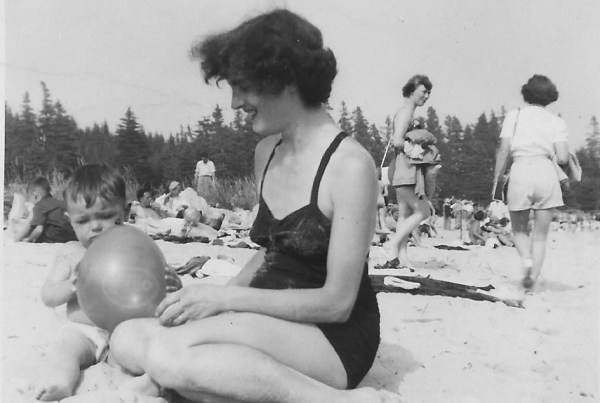
My favourite photograph of my mum shows her in all her beauty on Gonzales Beach with my older brother, her first-born. She and my father and my brother lived in a small cottage above the beach, now long-gone. She loved water, she loved the sun, and it must have been heaven in summer to walk down the stairs to the beach. In later years, when we lived on Eberts Street, she would walk with us to Gonzales Beach (because the whole waterfront along Dallas Road was contaminated with raw sewage; this would be the early 1960s), with a picnic, and we would swim and build sand castles. Did she remember the earlier house, the earlier walks to the shore, when she sat in the sand with her infant son, not knowing what the years would bring? Do any of us ever know?

Under Cape Breton’s rocky soil, under the parks in Halifax with their views of the sea, the sound of gulls, of commerce, of pianos and fiddles from open windows, under the earth the buried creeks hide their secrets. And you can hear something, a murmuring, a rill of original water, of origins, of fish in their lost habitats, eels, amphibians entering their dark waters,and in memory, birds at the vanished banks, their beaks poised, and secrets, secrets, my mother’s buried history in the damp ground where water longs for the sky.

I expected to find her parents, expected to solve the mystery of her birth, and instead I’m left with questions. Different ones than the ones I began with, and maybe unanswerable, but I understand some things more completely now. Her capacity for love, her generosity, her lack of self-regard, which made my own seem like vanity. I remember visiting the Foundling Museum in London and realizing how stories like hers still draw us to their mysteries.

At the Foundling Museum, a spyglass, a hairpin, the handle of a penknife. Padlocks, a tiny black hand pierced with a hole for a ribbon, a handful of coins, pierced, notched, worn thin by thumbs stroking, stroking, stored in the archives. I have My Sin, a tweed coat, a memory of Mrs.Nobody on her chair in the kitchen. I have a hole on my sleeve the shape of a heart but no scrap to match it with and the sound of a creek running underground on its way to the sea,with everything of my mother in it, and nothing. I have every regret for the way her life began, and ended, a motherless child, so far, so far from her home, no one looking for her in the listservs, among the dry records of Vital Statistics, no one, no one but me, my face against the glass case of all those unclaimed tokens, those stories begun perhaps in love and ending in sorrow.

the waning buck moon

girls and prosecco

I didn’t sleep much last night. I’d wake and realize my entire family was sleeping in this house where we raised our children and to which they’ve returned with their own children or (as with Aunty Angie) on her own, by small plane across Georgia Strait, and I felt so excited at the prospect of swimming today, watching the kids play elaborate games with a soccer ball and badminton racquets and frisbees. Would the huge prime rib roast be enough for all of us? Which Desert Hills red wine would pair with it? Would the kids like the dinosaur pinata we are going to hang from the clothesline later today? I could smell the smoke from our campfire (or firecamp, as Francophone Manon calls it) last evening where we roasted hotdogs wrapped in bannock and ate blueberry and peach galette. Smoky hair on the pillow reminds me of our summer camping trips across the province when my children were small, sleeping in the tent and hearing my family breathing like a single organism.

The waning buck moon was just passing our bedroom when suddenly the entire coyote family began to howl and yip just on the bank below the house. Were they hunting? And (oh!) where was Winter the cat? (Hidden, on the upper deck, listening too.) The sound was a tangle of harmonies, low voice, high voice, and (almost certainly the mother’s) middle vibrato. John and I held hands in the moonlight, while the song briefly followed the moon to the west. stopping as suddenly as it began.

And listen: the coyotes are singing, the deep voice of the father,the rather more shrill voice of the mother—anxious that all her offspring eat well and learn to hunt, to care for their safety in the forest beyond the orchard—and the lilting joyous youngsters unaware that a life is anything other than the moment in moonlight, fresh meat in their stomachs, the old trees with a few apples and pears too small and green for any living thing to be interested in this early in the season.

—From Euclid’s Orchard (Mother Tongue Publishing, 2017)

“But you must not pronounce its name.”

common pink moss

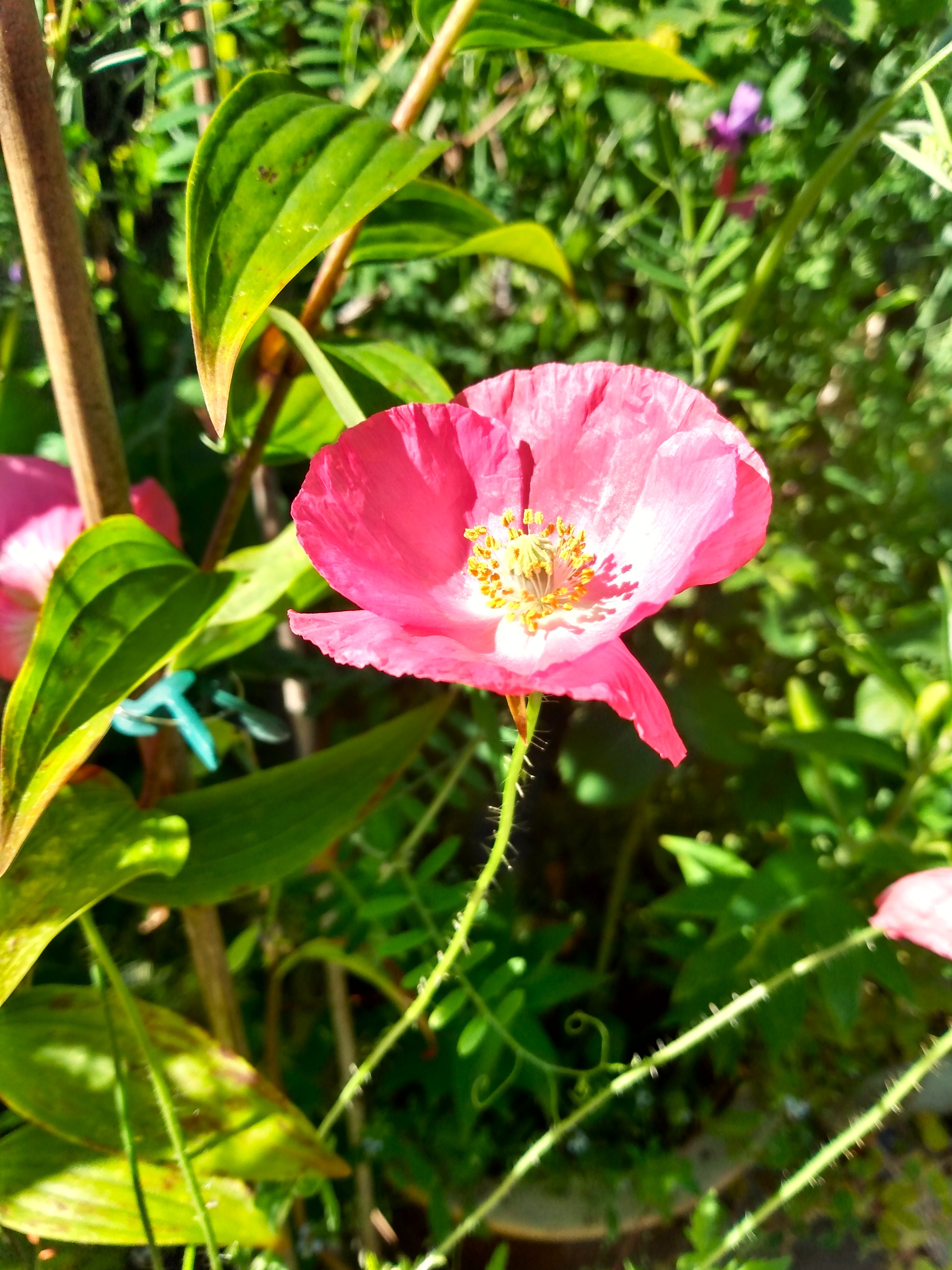
June is a month for roses and ours have been just glorious. Every few days I cut big bowls full and I can smell the nicest ones from a room away. This morning, the common pink mosses, from a huge sprawling bush given me years ago by an elderly woman in our community, now long-dead. She was odd. One year she walked in the local May Day parade, her head covered with a hood, carrying a papier-mâché head under her arm, with a sign on her back: Anne Boleyn is alive and well in the library. (She volunteered in the library and I guess she wanted to remind us that history was alive and all around us. Maybe.) Yet she lives in my garden and in many others, I know. That’s the way plants so often find us.

pillars

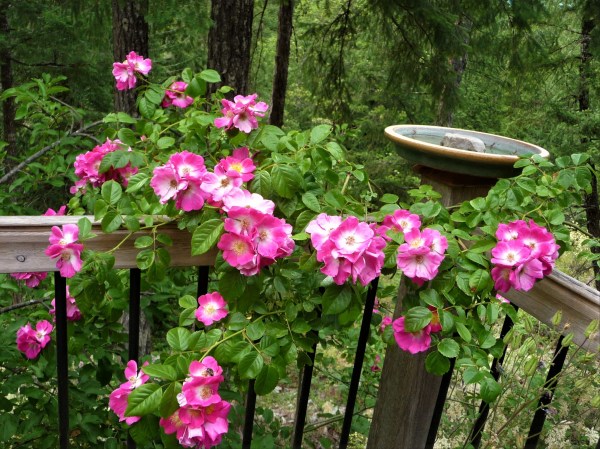
Another rose grows up the railings just beyond the kitchen. It came from a spring plant sale decades ago, unnamed, but when I was writing one of the essays in Euclid’s Orchard, I got out my big dictionary of roses and kept turning the pages until I found it. Did it matter? Would it be any less (more) beautiful named than unnamed?

The rose came from one of the annual spring plant sales at the Community Hall when we first lived here; you brought your box with you, and you got there early because everyone wanted the tomatoes or irises or Muriel Cameron’s dahlia tubers or bits of Vi Tyner’s roses. I’m not sure this one came from Vi Tyner, who did give me moss roses, a soft pink one and another one deeper pink in colour. But it grows everywhere—old homesteads, seaside gardens, along fences in semi-industrial areas as if remembering a former house, ancient care. It grows across from the Post Office in Madeira Park, for example, and I don’t know if it ever gets pruned or watered. And there’s a place on the highway, near Middlepoint, where one grew for years and years, until it was absorbed by the forest taking over the site of a cabin that I believed burned to the ground before we arrived in 1981.
I’d thought a little about trying to identify it but somehow never did. And somehow today was the day, so I took my rose encyclopedia and a cup of coffee out to the table and went through, page by page. Until I came to ‘American Pillar.’ Bred by Dr.Van Fleet in 1902. A very prolific and widespread rose,and yes, it will survive any kind of neglect, it seems.

June is about roses and water. It’s about birds, the ones I hear at dawn, the robins that follow me in the garden for the worms they know will turn up as I pull weeds, and even the stunned orange-crowned warbler that hit John’s study window a few hours ago. I picked her (it was a female, missing the orange crown) up in a tea-towel and carried her around in one hand as I filled the bird bath, watered some vines. She blinked, looked at me with a steady gaze, closed her beak, and after about half an hour, she flew off.

Some mornings when I go out to water, I watch the hummingbirds in the roses and it feels as though my life is passing too quickly. Do you feel this? That you want the days to pass as slow as honey, that you want the birdsong to go on forever, the roses too, and you want it all, the scent of common mosses, water cool from the hose, the tendrils of cucumbers, the taste of sharp mizuna and arugula, how the light goes on into the evening so that you look up from your book and it’s 10.00. I was reading poetry last night and these lines surprised me to tears for the way they spoke to the moment. (I tucked them away to use as an epigraph for my next collection of essays because this is exactly what I meant on every page):

Tell me a story.

In this century, and moment, of mania,
Tell me a story.

Make it a story of great distances, and starlight.

The name of the story will be Time,
But you must not pronounce its name.

Tell me a story of deep delight.

             --Robert Penn Warren, "Tell Me a Story"