redux: “I have walked behind the sky.” (Derek Jarman)

Note: 5 years ago this week, I finished a collection of essays that I called Blue Portugal. It was published by the University of Alberta Press in the spring of 2022. I loved writing the essays and was interested to find this post while looking for something else. So much of my life is cycles! Indigo dye (the first photo certainly has echoes of last week’s post), quilts, even the essays themselves. (I have another collection, Kingfisher, making the publishing rounds.) I didn’t end up using the Robert Penn Warren lines as an epigraph, I used a passage from the Odyssey instead, but I still love the lines. Make it a story of great distances, and starlight.

________________________________
clothesline

So. Yesterday I finished writing the final essay for Blue Portugal. Or at least I finished a full draft, with some parts a little rougher than others. There are ten essays in this collection, ranging from meditations on colour, investigations into ampelography, entoptic phenomenon, Bach’s Violin Partita No. 2 in D minor as a soundtrack for navigating grief, the relationship between the venous system and rivers, and using Dante’s Inferno as a means to recover from fractures. I know. It doesn’t sound like a manuscript that will be easy to place with a publisher, does it? In truth, I don’t think the essays themselves are difficult or chilly. But they’re not issue-based. They’re not life-style pieces. I read those and enjoy many of them but they’re not what I write. Or at least they’re not what I need to write right now.

There’s a lot of blue in this collection. The title piece for example begins with wine, Modry Portugal, a beautiful light red wine we drank in the Czech Republic. Modry means blue in Czech (and other Slavic languages) and I wondered about the Portugal. Where did the grape come from, and how, and why. I also wanted to look more deeply at family origin stories. There’s another essay, “The Blue Etymologies”, that I wrote to puzzle through what I experienced when I fell last November and damaged my retinas.  I have walked behind the sky, wrote Derek Jarman in Chroma, and yes, that was exactly where I went. “blueprints” revisits housebuilding and various kinds of fabric resist printing and the cyanotypes of Anna Atkins. Several of the essays use maps and land surveys in an attempt to locate the past and a couple of them might be too personal to interest anyone but members of my family. Who can say.

What I want to say is how much I’ve loved writing these essays. They are messy, imperfect, badly constructed in parts, and the craft is often careless; if you’ve read previous posts and seen images of the quilts I make, then you will recognize the parallel. But in an odd way they’ve kept me alive. Or they’ve kept my mind alive as I’ve navigated some health issues, have lain awake in the night thinking of my children and their children and how we’ve ended up living so far apart, have learned to do particular techniques with textiles, and have tried to keep what’s beautiful close to hand in the face of climate change, dangerous political systems, and an aging body.

hooped

The epigraph for this collection is a passage from a poem by the American poet Robert Penn Warren.

Tell me a story.

In this century, and moment, of mania,
Tell me a story.

Make it a story of great distances, and starlight.

The name of the story will be Time,
But you must not pronounce its name.

Tell me a story of deep delight.

–Robert Penn Warren

Deep delight, in a moment of mania. That was me, in the night, writing by starlight, telling the story over and over again.

“On hair falling down in curls.”

This morning, coming into my study, I stopped by the door to look at the drawing hanging on the wall. How many times do I come into this room and never notice it? Hundreds of times. Thousands. But this morning I noticed. Last year, over the Christmas holiday, I was writing a long essay in which this drawing has a little cameo. I was writing an essay about the artist who drew it–me–and how his life and my life entwined for a few years. By the time he drew this, we were “friends”, or at least that’s what I thought. But writing the essay had me re-reading a stack of old letters he’d written to me and I realized he never gave up his obsessive hope that I would realize I should make my life with him.

“On hair falling down in curls.”

Section 389 of Leonardo Da Vinci’s Notebook.

On hair falling down in curls:
Observe the motion of the surface of the water which resembles that of hair, and has two motions, of which one goes on with the flow of the surface, the other forms the lines of the eddies; thus the water forms eddying whirlpools one part of which are due to the impetus of the principal current and the other to the incidental motion and return flow.

He drew me once with my third child. He drew on rough paper that began to deteriorate almost at once. He made a copy and brought it when he came for a visit. It’s on the wall outside my study and I see it every time I come in to work at my desk. When he brought it I almost forgot the difficult weeks, the letters, the pressure, the insistent pronouncements of love. Look at my strong arms, the drapery of my clothes, the soft curl of my hair down my back, like water in motion. Look at my hands.

drawing3

I almost forgot.

Hundreds of time a year I pass the drawing. Hundreds of times I come down the stairs from my bedroom to encounter a portrait of myself hanging in the stairwell, myself at 23. The essay began as a conversation with that younger self. I finished it last March and it sits in various forms–paper, pdf, etc.–in my study. It would be difficult to publish it, for some legal reasons, for reasons of length (34,000 words) and subject matter (the male gaze, how it insinuates itself into a life, and how difficult it is to look away), and maybe most of all for personal reasons that involve my own sense of trespass. (It’s complicated.) Writing the essay was troubling and also cathartic.

As the old year fades away in grey light, I am sitting at my desk and thinking, taking stock of the past 12 months: what was accomplished, what was lost, what gave me joy, what didn’t. I wrote this essay, I worked on a novel, Easthope, set near me on the Sechelt Peninsula, I spent time with my family, with a few good friends. I swam in the Pacific Ocean in January on a trip to Baja and I swam daily, from the first of May until mid-October, in the lake near my home. As the old year fades, the lines of the drawing fade a little too. It’s behind glass. When I swim, my hair is water in motion and the years flow around me like water. There was so much I forgot until I wrote it down.

‘Some folk say time is a spiral…’ (Kathleen Jamie)

sunday morning, quilting

I’d forgotten I hadn’t finished Surfacing by Kathleen Jamie until I was looking for something else and found it on John’s side of the bed. Sometimes when I read at night, I fall asleep and when he comes up to bed, he puts whatever book I’ve left on top of the covers on his bedside table rather than walk around the bed to mine. This must have happened. So I opened the book, realized I’d read about half, including the incredible “In Quinhagak” in which Jamie joins a group of archaeologists in the remote Yup’ik community situated where the Kanektok River empties into the Bering Sea. It’s a place of light and wetlands where the thawing permafrost is reshaping the land and eroding a 500 year old settlement site. I remember reading that essay and thinking how beautifully Jamie wrote about it but also how she somehow let the place and the artefacts and the Yup’ik people and their culture take their place in her words, her descriptions. She wasn’t pushing herself to the fore, wasn’t asking the reader (me) to recognize her sensitivity or courage or intelligence. It’s a quality, inherent in her work, I’ve noted before: her essay collections Findings and Sightlines are treasures of quiet beauty. I remember her extraordinary collaboration with visual artist Brigid Collins, Frissure, in which she examined the scar left on her body after a mastectomy:

Whatever it was, it was a line, drawn on my body. A line, in poetry, opens up possibilities within the language, and brings forth voice out of silence.

What is the first thing an artist does, beginning a new work? He or she draws a line. And now I had a line – quite a line! – inscribed on my body. It looked like a landscape. Because it was changing colour as it healed, it seemed to me as if it had its own weather.

So over the past few nights, it’s been my unexpected pleasure to read what remained of Surfacing. And to recognize again, because I certainly felt this when I read Jamie’s earlier essays, how skillful a writer she is, how elegant, and how so much of what she writes about and notices echo my own interests. On Westray, one of the Orkney Islands in Scotland, she (again) joins an archaeology crew as they excavate a Neolithic and Bronze Age settlement. Detail after detail, meditations on time and continuity, on what changes and doesn’t: I read farther into the night than I meant to just to follow her mind and her account of the work of the crew working against time (again), weather, funding sources drying up. She marvels at the little Westray Wife, or Orkney Venus (you can read about this tiny carved sandstone piece here), and I marvelled too because I am fascinated (as so many are) by the early representations of women found in various sites in Europe. (Mostly recently I’ve been looking at a Gravettian engraved Venus found in Předmostí in the Czech Republic, unusual for the geometrical elements used in the carving. The Westray Wife has interesting incisions in the decorative patterning too.)

On Westray, Jamie is intrigued by the spirals carved into rock, found on pottery fragments. After she meets a young couple who’ve come to the island to raise dairy cattle and to make artisanal cheese they call Westray Wife, she stands with them on their land for a few minutes:

     Amid the cows, we were looking inland at the island’s shallow valley. Their view was of a gloomy castle, and, beyond it, the small loch, then farms on the hills, sheep on the peaty summits, the climbing road, the chambered cairn, two or three small whirring turbines under the huge island sky.
     I said, ‘When the Neolithic people brought their cows ashore here, the first ones, all this land would have been wild. Can you imagine? I wonder what grew here then?’
     ‘I love this valley,’ said Nina. ‘Its different colours. Brown in the spring, then green. The cattle. Quiet, then noisy with tractors.’
     ‘I see it differently through your eyes.’
     ‘They were like us,’ Jason insisted. ‘Caring about their animals.’
     Some folk say time is a spiral, that what goes around comes around, that events remote to one another can wheel back into proximity. Leaving Nina and Jason I walked down to the shore, feeling like a child again, glad of heart to know there is still room in the world for a summer’s day and a cow called Daisy.

When I was putting aside the book the other night, the night I returned to it after an absence of perhaps 3 months, I found the card inside that had come with it when it arrived from the Netherlands as a gift from my friend Anik. I’d made her a quilt, mostly as a thank you for a kindness on her part, and also as a housewarming gift for the house she had recently moved to with her husband and son. The quilt was log cabins, 4 of them, arranged around green pathways quilted with spirals. I wanted her to be reminded of the log cabin she was living in when we met and how we have stayed friends, our green paths perhaps metaphorical rather than actual, though on a quilt they can be both. In the centre of each cabin block, a red square for the hearth. Everything is connected, isn’t it? The hearths uncovered on Orkney, their spiral pots broken. While helping with the excavation at Quinhagak, there’s a wonderful moment when Jamie is screening some soil with a Yup’ik man:

     A smell was rising from the earth in the screen. It was familiar, domestic, not unpleasant. I worked on, wondering if I was imagining it, because it was the smell of cooking. Specifically, the smell of mince and tatties, staple dish of my childhood
     ‘Mike–I’m hallucinating. Can you smell that?’
     ‘The meaty smell? It’s because we’re down at the floor level now, where they did the processing. Seals, walrus meat, skinning, all that.’
     The air is so clean and sharp, you can smell seal-meat from five hundred years ago.

On a cool morning, I’ll make a fire and sit by it stitching spirals. And in those inscriptions, time curls in on itself, holding stories and history and love. Sometimes they spool out across the ocean and sometimes they are the blanket that keeps me warm at night, keeps others in my care.

i

“the Leech and Jordan, the Nitinat and Koksilah, the Oyster and Nimpkish, the Po and Arno”

fraser below lillooet
The Fraser River, below Lillooet

At 2 a.m., I was awake and thinking about the essay I thought I’d finished last night. I’d worked on it yesterday morning, then had to go down the coast to do errands, but as soon as I got home, I was back at my desk. I thought I had it and I went to bed with that deep satisfaction that comes when you complete something. Until I woke in the wee hours with the sense that there was still more to do. So I came downstairs, feeling my way in the dark, and switched on my small desk lamp that always makes me feel that I am in the best place in the world: my own room with its deep rose walls and Giotto ceiling, my books and papers all around me (some would say in disarray but mostly I know where everything is). I heard owls. The cat was delighted to find me awake.

Sometimes I feel constrained by form. I think of the essay in a particular way and I think I am writing that kind of essay. An argument, an anecdote, a piece of non-fiction (a term I dislike, esp. when paired with “creative”), a reflective narrative (on occasion), a memoir-ish construction, a series of questions and answers. A beginning, an ending. I’ve written versions of this essay and I know I will write other versions in the future. But the essay I’ve been working on is something else. It’s both objective and subjective. The passages based on memory or history are reconstructed and might not be objectively true. The passages based on human physiology are imaginary voyages into my own body. Its geography is dependent upon maps that might not be accurate in the Cartesian sense but I think the heart would approve. (Mine does. At least it does this morning.)

In the small hours, I realized that I had to push the actual physical structure more than I had by simply deciding to move some of the sections to a right-handed margin. Yes, I was pleased with how this worked but I wanted less reliance on river banks and dams and more flooding. So that’s what I did. I sat with my paper draft and tried to see how I could use the space to make my language advance its imagery and its innuendos. The final draft (or final until this morning) is nearly 7000 words and there is a structure, yes, but it’s not the kind I usually employ. There are connections across time and space. You’ll notice them if you give up the expectation that one thing leads to another in a straightforward pattern. Here’s a short passage from section 14.

the Deadman and Bonaparte, Upper Hat Creek,

Coldwater, and the Kispiox where my children waded on a hot day in July, the Leech and Jordan, the Nitinat and Koksilah, the Oyster and Nimpkish, the Po and Arno and the sweet Hoh and Queets and Ozette where I camped as a young woman, the Snake, the Escalante and Kanab, the Lost and the Warm and the Coeur d’Alene,

the Kern, the Mad, Klamath and Rowdy Creek,

the Lost, the Elk,

and the one I walk to season after season, near my home, where coho salmon swim in by starlight

and mergansers wait to feed on their eggs.

And if I sound excited, it’s because I am. Every time I finish something, I wonder if I’ve written everything I have to write. Maybe that’s it. And then I write something else. I’m kind of looking at my clutter (it’s an organized clutter. Maybe.) and wondering what I might find if I move things around.

Oh, and I still don’t have a title.


“creeks in the darkness”

bridge over Rosebud River
bridge over the Rosebud River, April, 2016

I am currently at work on an essay about rivers and blood clots. An odd combination, I know, but I seem to have a clotting disorder (I’m waiting to see a hematologist for further tests) and it’s made me think a little more seriously about how our venous system works. How everything flows normally and then doesn’t. And of course that led me to think about rivers, the ones I love and return to, and how they change too for reasons that have some similarities to what happens with our veins. So it’s very absorbing, this essay, and I woke this morning with that kind of excitement I’ve always felt as I enter the deep waters of writing. It’s leading me to the north, to the MacKenzie River, where we were lucky enough to spend a few days in Fort Simpson at break-up, and to Englishman River, where I camped as a child and then as a young woman in desperate straits, and this morning to the Rosebud River as we drove it two springs ago very early and stopped at the aqua bridge between Wayne and Rosedale to listen to magpies. And in my mind is how to keep the various strands winding around each other, as the channels of braided rivers split and rejoin, as banks erode and are changed over years or centuries.

A deep cramping pain. Some swelling. In the Emergency room, my history is taken. Pulmonary embolism a year ago. Suspected deep vein thrombosis. 6 months of blood thinners. Many scans and tests.

A lab technician is called from his bed to take my blood for a d-dimer test to determine if there is active clot activity. An ultrasound is set for the next morning, though it is well into that morning when the technician draws blood from the pool of my right arm. I do not wait for the results because I want some sleep and the person in the other bed is on a powerful narcotic that makes her itchy, causes her to moan on her side of the screen that separates us. The medical staff is not happy I’m leaving.

We drive home on a dark highway. It’s a 45 minute journey and after 30 minutes the Emergency room physician phones me on my husband’s cell phone. In the car, the loud opening chords of “Sultans of Swing”, a moment when I regret he didn’t set his ring tone to something sweet—the Brahms lullaby or “That Sheep May Safely Graze”—as I struggle to stab in the right place to answer it. The physician tells me that my d-dimer test is positive for blood clotting, that I may have a DVT, and that I must return immediately to begin a course of anticoagulants.

As I’ll be coming in later in the morning for an ultrasound, I can’t just wait until then?”

No, I must insist you come back now.”

So we turn around and head back, my husband silent with weariness. He won’t let me drive. About halfway to the hospital, we see a large animal on the side of the highway. Not large like elk, which we see quite often. And not a coyote. Bigger than that. It takes a moment or two, and the glare of the animal’s golden eyes, for us to realize we’re seeing a cougar. I’ve lived on this peninsula for 35 years and I’ve seen just two cougars in that time. I’ve heard two more, I think, but sightings are rare.

All down the coast, we passed creeks in the darkness, Homesite, Meyer, Anderson, Maple, Haskins, scribbling down the mountains. And I would do it all again, sit at the desk with a nurse taking my pulse, my blood pressure, arranging for bloodwork, ultrasound, medication to prevent a blood clot moving up into my lungs, for the glow of the cougar’s eyes in our headlights, and the knowledge of water finding its way to the sea.


pale fish on a pale ground

When I woke this morning, I wanted to go outside right away to unwrap the last shibori piece. But it wasn’t yet light! So I made the fire, fed the cat, ground coffee beans—a more seemly order to the day’s beginning?

And as I was doing those things, I realized that the piece would not look as I envisioned it would. I think the arashi technique is best suited to either a smaller length of fabric (I used a linen sheet, single-bed sized…) or else a long pole or pipe so that the most surface area possible is exposed to both the indigo dye and the process of oxidization. A further thing, I realized, is that the area where I’d drawn and then waxed salmon (a form of resist pattern) would be the area receiving the least exposure to the dye. So pale fish on a pale ground (or water). Maybe I was preparing myself for disappointment. But I also knew, know, that mistakes and errors and (let’s face it) lack of artistic skill and experience often make for beautiful results.

pale fish

And yes, I think the result is beautiful. Or will be, once the sheet is dry and I can remove the wax and then wash the piece. I’d intended to detail the fish with fabric paints in any case and then to embellish them with shell buttons.

shell buttons

I think of these projects like essays, in a way. When I begin an essay, I have ideas in mind, images, even particular sentence rhythms, but I don’t have an outcome that I’m working towards. I want to find things out, I want to try, to attempt, to weigh, all those old notions associated with the essay form. There are variables, stray plants encountered along the way, passages of poetry that somehow seem relevant, maybe a memory of a meal, someone singing, a rise of hill punctuated by umbrella pines seen from a train going between Avignon and Arles, and whoosh, there’s the essay. Or the first draft anyway. And these essays in blue cotton and linen? First drafts too, because now the work of finding out how to improve them, to make use of them in a practical way (as quilts, as clothing even), now that work begins.

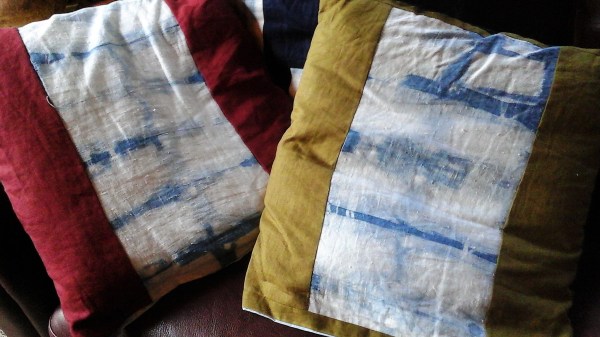
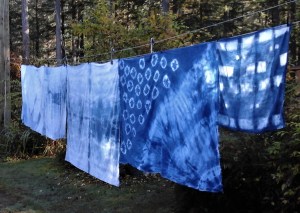
All weekend I’ve spent my time immersing my (rubber-gloved) hands in pans of indigo dye while around me the bigleaf maples filled the woods with the most limpid yellow light. I remembered doing a batch of dyeing last summer and how the morning that I came out to cut the threads and roll out the lengths of fabric was the same morning a family of pileated woodpeckers was loud in the trees just beyond my bench. The parents were teaching the young ones to feed and the offspring kept flopping clumsily on the trunks of the big firs and squawking piteously. As I snipped and unwrapped, I wondered if they’d notice me and fly away but no. So the memory of that morning is in the cushion covers I made with the itajime fabric, the sound of woodpeckers imprinted in the process.

itajime pillows