the thing with feathers

It’s been a long grey week. The rain, the news of the British referendum, the aftermath of the murders in various parts of the world (that ask us again and again to think how we are implicated, whether our silence serves or distracts or ignores), our radio and television airwaves filled with the noise of that awful man south of the border, a more personal sorrow, and the images of fires in California, flooding in many places: you wonder where to place your hope, if you have any left.
This morning, around 6, I woke to light. Not just morning light but a sky without clouds. Blue as a book of hours. In the trees, a pair of western tanagers, so brilliantly coloured that I wondered (as I do every time I see them), why they chose our green landscape for a summer home. They spend their winters in Central America and find their way here, to the bigleaf maples below the house (I think that’s where they nest; they always come from, and head back, to those trees). And listening to a recording just now of their call, I realize that’s what I’ve been hearing the last few mornings. So maybe their young have fledged and they are teaching them about territory, food sources (elderberries, salmonberries, huckleberries…), and dangers.
And when I got up and came down to my desk, I watched the robins gliding in and out of the nest just beyond my vision, around the corner of the house, tucked into an elbow of grapevine. I’ve been thinking that the young must be about ready to fly but I’ve stayed away from the nest out of superstition. (The last robin nest we were watching with hope was raided by a weasel…) But I did go this morning, just to see, and yes, there are at least two young’uns. When they saw me coming, they quickly hid. But I waited and was rewarded with the sight of two eager beaks poking over the side of the nest, while the parents watched from the arbutus. Here they are, just barely visible. Like hope.
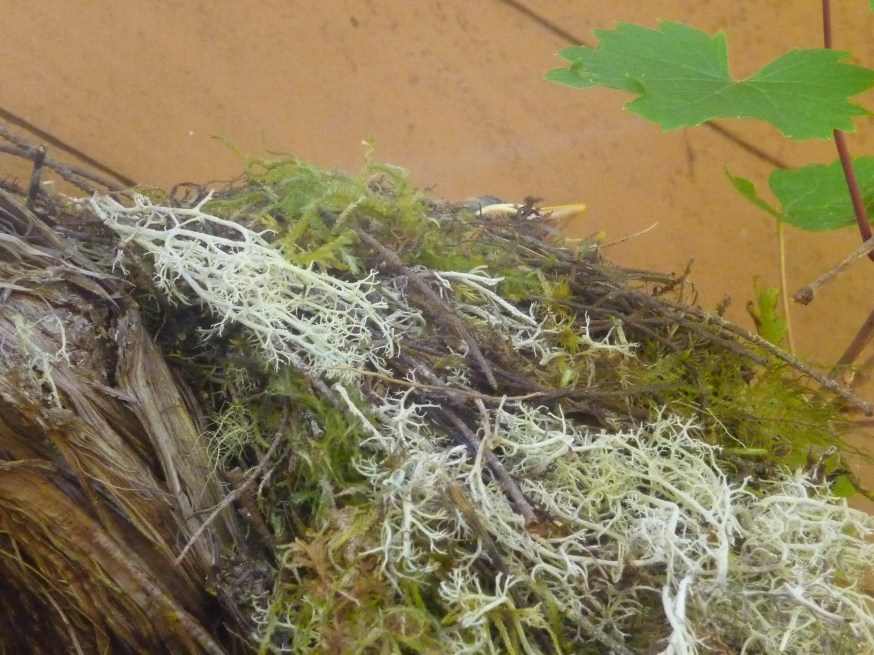
 P1120714.JPG
“Hope” is the thing with feathers –
That perches in the soul –
And sings the tune without the words –
And never stops – at all –
                           –Emily Dickinson

a mutation of thrushes

I looked in An Exaltation of Larks for the collective noun for robins. There are so many of them this year, singing, playing chicken on the side of the highway (and these must be males, flying up at the last minute…), and following me in the garden, ready to plunge their beaks into the newly-dug soil for worms. And there’s isn’t one. The closest is “a Mutacyon of threstyllys” from the Porkington MS, a mid-15th century miscellany of poetry and prose now held in the National Library of Wales.  The term appears to come from the belief that thrushes grow new legs at ten years of age and cast their old ones aside.

Last year, in July, I wrote a series of posts about the robins nesting on the cedar beam across our patio. It was the first time they’d nested in that particular spot, though we’ve watched robins build on an elbow of drainpipe on our printshop, in an angle of grapevine climbing our southern wall, and — three times! — in a willow now completely claimed by clematis above the west-facing deck. One year we watched three robins learn to fly and it echoed the passage of our own children away from home. It was very sweet to see the parents and two of the young all in a fir tree calling to the remaining nestling until, whoosh, it flew clumsily from the nest to join them. Every time I see this, I wish for wings myself. Imagine just…well, flying. Gliding away from the nest on wings you never knew you had, the whole world opening.

We were away for four days last week and when we returned, there was a nest in exactly the same place on the beam. No sign of robins but a nest, newly made. And by yesterday, there was a female robin tucked into it — so I’m assuming she’s incubating eggs. The literature talks about “nest fidelity” — the willingness of robins to return to locations and even reuse the same nests. Ours have never reused a nest but maybe that’s because we occasionally remove them (the one on the beam last year) or else the clematis smothered the opening where a bird might enter the cool interior of the willow.

This year, the female is not as skittish as last July. She remains on the nest while I’m watering. I put a saucer of worms on the ground below the nest and went off to do something else. When I passed that way again, I noticed that all the worms had been eaten. So I bet she remembers that I fed her last year too.

I think of Emily Dickinson:

“Hope” is the thing with feathers –
That perches in the soul –
And sings the tune without the words –
And never stops — at all –

And sweetest — in the Gale — is heard –
And sore must be the storm –
That could abash the little Bird
That kept so many warm –

I’ve heard it in the chillest land –
And on the strangest Sea –
Yet, never, in Extremity,
It asked a crumb — of Me.

Every year the same things happen. I begin the tomato seeds. I wait for the first ripe fruit. Baskets of sun-warmed tomatoes give me such pleasure that I forget I’ve done this for nearly 30 years. And the robins, with their echo of our own life, the tune without the words : a nest,  patience, the helpless young growing to maturity in the time it takes to close my eyes, then open them.

P1100288