autumn thinking: wolves and bears

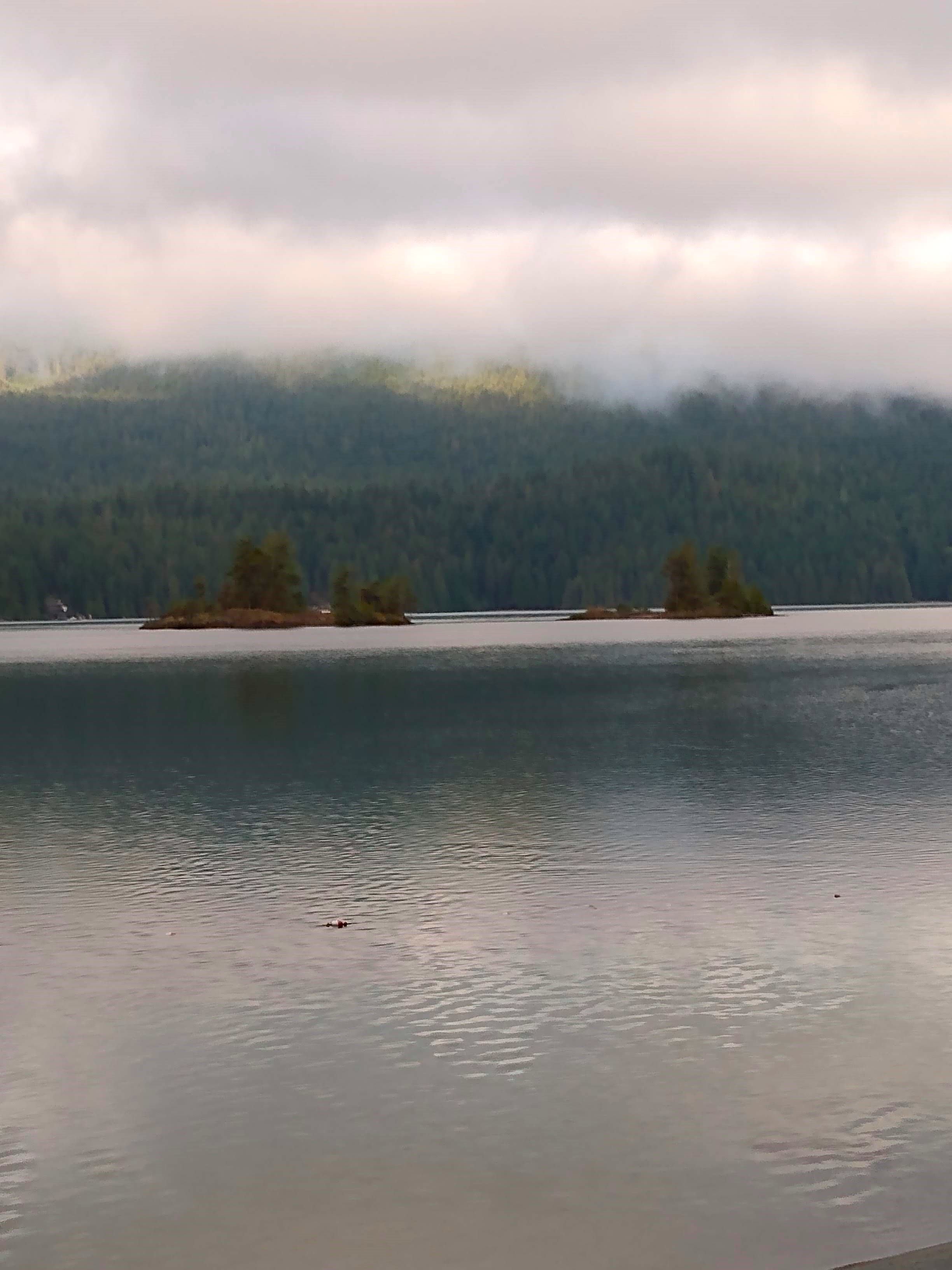
autumn lake

Yesterday, swimming, I wondered how many days I could continue. John has begun to swim in the local pool and soon I’ll join him but I’m not ready to give the lake up just yet. Just yet. Though the water is very cool, I have to say, and there are moments when I can’t feel my toes. What I don’t want to give up: the kingfishers, the quiet, the muffled cloud over the other shore, the trout jumping for insects, how it feels to glide through the green water, eyes closed. I don’t think I’ve ever felt so alive as I do on these mornings. But one day, not this one, I will wake and think, No, it’s just too cold. As it is, John sits in a folding chair under the big fir in three layers, with gloves on. When I get out of the water, he holds my big towel so I can wrap up. I’ve been in the lake each day since May 19th, with a little break to go to the Island for Angelica and Karna’s wedding.

Last night I was awake for hours, thinking about the chaos of the world right now. How far we are from the civility I believe we are capable of. In the night the situation(s) felt perilous–and I don’t think that’s an exaggeration. I’d been reading a book before sleep, by flashlight because the power had gone out in our first autumn storm, and I didn’t want it to end. Gumboot Girls, a gathering of stories and recollections of women who’d arrived at Prince Rupert and Haida Gwaii in the 1970s to make new lives for themselves. They built houses, learned midwifery, grew food, towed logs to beaches to cut into firewood, canned salmon and clams, learned to dress venison, to smoke fish, make cheese from goats milk. One of them, Chloe Beam, wrote about going up the Skeena River in her skiff to pick up a box of tiny chicks in Terrace. She was also the woman who wrote so beautifully of wolves, a song I’ve heard in the early morning once or twice:

I stepped outside on the dock this particular night. I was astounded by the brightness. I looked up and behind undulating dripping curtains of aurora borealis filling the entire sky. I had just seated myself on the rocks of the point to enjoy the electromagnetic spectacle, when from the next point over, a pack of wolves started to howl. At first it was intermittent. Then the wolves got into full swing. They bayed and chorused, sometimes in unison, sometimes in solo arias, calling down the northern lights to dance and snap in rhythm.

So one world, the one that feels upended and troubling, and the other world, where women cut wood with a swede saw, tend babies next to tin stoves, make quilts together, held in a kind of uneasy balance. Part of the uneasy balance is closer to home. Yesterday I was shopping in Sechelt when a woman asked me if I’d heard about the grizzly seen on the beach that morning. The beach where I gather the stones to tie into linen for indigo dye work, where my grandchildren love to swim in the summers and explore the tidepools at low tide. The beach right in front of the condominiums, one hotel,the walkway usually lively with bikes, dogs, little kids on scooters, leading to the play park. This beach:

where the grizzly was seen

No, I said, I hadn’t heard. She said the RCMP and the conservation officers were at Chapman Creek where the bear had walked to along the beach (Chapman Creek is a salmon stream). And later I learned that the bear had been trapped and relocated. But grizzly bears are so rare in our area, almost always young ones who’ve somehow arrived by water –one swam Jervis Inlet to terrorize pigs in Egmont about 8 years ago– or across the ridge from Salmon Inlet to explore Gibsons. I’ve only seen one, and not here; in April, at the head of Bute Inlet, watching guys unload a tanker truck full of 70,000 Chinook salmon smolts to be released in the Southgate River, we were alerted to a grizzly bear at the Homathko River estuary, just on the other side of the inlet. It was leisurely grazing seaweed (it looked like), raising its huge head occasionally to look our way. We don’t often get to see something so completely wild and beautiful. Though three days ago I was at my desk when I saw the grape vines moving around a corner of the house just beyond my window and when I went upstairs to see what was going on, I saw two black bear cubs, this year’s, scrambling across the upper deck to the stairs leading down. No doubt their mum had alerted them to the possibility of grapes–bears have very sophisticated memory maps of food sources– though ours had been picked and they were out of luck.

When I swim later this morning, after John returns from the pool, I’ll be thinking about bears and our planet, and the shifts and dangers of being alive at this time in history. I want to believe we can do the right thing, as a species, as citizens, and that our precarious arrangements, social, political, ethical, and ecological, can somehow be brought into a healthier balance. I hope the bears can find a balance too that doesn’t require them to graze on seaweed on the beach of a small town on the Sechelt Peninsula because these stories seldom end well for them. When I swim, I’ll remember the bear prints I sometimes find in the sand at the edge of the lake and Gary Snyder’s lines for bears.

A bear down under the cliff.
She is eating huckleberries.
They are ripe now 
Soon it will snow, and she 
Or maybe he, will crawl into a hole
And sleep.


Cougar companions

cougar

I was late coming to Cougar Companions: Bute Inlet Country and the Legendary Schnarrs, by Judith Williams, published as Raincoast Chronicles 24 by Harbour Publishing last spring. I knew about the Schnarrs, a homesteading family, with daughters who kept cougars as pets in the 1930s. And when we spent a day on Nelson Island in July, courtesy of our friend Howard White (who, with his wife Mary, founded Harbour Publishing in the last century), we talked about the book while sitting at Cape Cockburn, caught in one of those curves of time, the old cabin built by Harry Roberts behind us as we ate our lunch on the pebbled beach.

chimney

I remember saying how much I’d admired Two Wolves at the Dawn of Time, Judith Williams’s extraordinary documentation of Dzawada’enuxw artist Marianne Nicholson’s creation of a pictograph to acknowledge her village’s continuing strength at Kingcome Inlet as well as a meditation on the colonial legacy in the form of the Halliday homestead in the same area. I remember how we agreed that it was complicated to want to demonize all those homesteaders, one of whom had built the cabin we’d just explored. Complicated is the word I remember.

Friends came for dinner a few weeks ago and brought a bag of books as a gift. One of them was Cougar Companions. I’ve spent the last few nights enthralled, propped on 4 pillows, reading by the small light of my reading lamp.

On a winter day in 1934, August Schnarr, a handlogger, trapper, and homesteader, shot a cougar his dogs had treed on Sonora Island. When he began to skin it, he realized that it had recently given birth and had been nursing young. He found the den and brought home 4 tiny kits, their eyes not yet open, for his daughters to care for. He was a widower, charged with the responsibility of raising 3 young girls, aged 12, 10, and 7. Two of the kits died quite soon after but the other two, Leo and Cleo (soon to be called Girlie), grew to maturity. I was fascinated by the photographs of Pansy, Pearl, and Marion with their cougars. The cats only cared for them and could be menacing to others. With the girls, they were affectionate and reasonably biddable.

Judith Williams studies albums of photographs (August Schnarr was a avid photographer), store records, a journal kept by Pansy in 1934, and a miscellany of archival materials to piece together the lives of this family. But she does it not exactly as a historian. She is interested in how different “readings” of the material record and indeed the memories of those who knew the girls and their lives might result in different histories. “Conflicting stories can send me running in circles,” she admits. “Memory is not a science. A “reading” is not necessarily conventional history.” She also looks at, and for, the complicated (that word again) history of Bute Inlet, an 80 km. fjord with its origins at the head of the Homathko and Southgate Rivers, emptying into the ocean by Stuart Island. It’s a place Williams has explored by boat and she also wrote High Slack: Waddington’s Gold Road and the Bute Inlet Massacre of 1864, a book worth reading for its excellent balancing of oral and written histories of what became known as the Tsilhqot’in War.

The Schnarrs lived a hard life. The girls lost their mother the year before the cougar kits came and they did the work of men. They logged, they built and maintained boats, they set log rafts under their house so it could be moved up to their father’s Bute Inlet camp in summers, they preserved food for the coming year, smoking fish and meat, canning quarts and quarts of berries and other fruits, growing acres of vegetables, raising and killing pigs, and they tried to avoid the attentions of the old men who were always eager to pursue them. It seems Marion was not as lucky as the other girls and gave birth at least once in her adolescence.

This is book-as-memory-theatre. The backdrops, real and imagined, are constructed of old floathouses, dugout canoes, pictograph galleries in remote areas on the inlet, deep forests, abandoned camps. The soundtrack: wind, turbulent water, the keening of seabirds, a father’s voice shouting the orders his daughters knew they had to obey: “You jumped when he spoke and did it. You didn’t talk back. You’d get a backhander if you did. He had to be that way to survive. He was a gruff person.” Each daughter had a slightly different version of their lives.

What captured me most in the book are the photographs of the young girls with the cougars. The images were familiar somehow. The strength of the girls, the beauty of their companions. And yes, we’ve seen these pairings before. I think of some of the early images of Artemis, goddess of hunting, wild nature, young animals. The ravishing François Vase, a black-figure vessel dating from around 570 BCE, has several depictions of Artemis, one of her standing with a lioness and a stag. Look at her arms, her strength,

artemis

her steady gaze. There is something of this in the Schnarr sisters.

cougar-companions

So yes, I was late coming to this book but I’ll never forget it. Last night I dreamed of a cougar on its chain and a fierce young woman guiding it. In the Homeric Hymn to Artemis, the rhapsode sings:

The tops of the high mountains tremble and the tangled wood echoes awesomely with the outcry of beasts: earth quakes and the sea also where fishes shoal.

It’s complicated, yes, but so important to how we continue to read and understand the multiple histories of this place.