I walked out

crab

A cool morning, after the gift of 3 beautiful ones in a row. I walked out to stand under the crabapple tree, the one given us at least 38 years ago by John’s mum as a sucker cut from the base of her own tree, ours filled now with blossoms and bees. Standing under it is to be immersed in bee sound. (Standing under it in fall is to be in the presence of bears. Another story.)

A cold winter has resulted in spectacular lilacs. The purple ones all came from my parents’ house in Royal Oak, the one with the paddock for my horse behind, the little shoots poking up around the base of the tree they kept pruned within an inch of its life. Is it still there? I don’t know. But we have at least ten offspring here and yesterday I noticed a bunch of suckers at the base of the big one by the compost boxes. I’ll dig them up and plant them somewhere else.

I’ve been saying everything is a month late this year and yes, many things are, but when I looked back to see when I put the pots of tomatoes on the upper deck last year, I found this entry: https://theresakishkan.com/2021/05/23/le-matin/  And here are the pots I took up over the past few days (there are more around the corner and many more in the greenhouse still):

a month late

No roses yet, though they’re in bud. The wisteria is definitely behind its usual flowering time but the light feathery leaves are unfolding and the buds are filling out.

This year I thought I’d grow some orach. I seeded some in pots in the greenhouse and a few spindly threads germinated and then sort of disappeared. I was disappointed–last year, with the heat dome in June, many of the greens bolted early, so this year I’ve been adding plants that tolerate heat: New Zealand spinach, sturdier lettuces, and (I thought) orach, of which my old friend Pliny the Elder has this to say:

They say, too, that there are two species of it, the wild and the cultivated, and that, mixed with bread, they are good, both of them, for dysentery, even if uiceration should have supervened, and are useful for stomachic affections, in combination with vinegar. They state, also, that this plant is applied raw to ulcers of long standing, and that it modifies the inflammation of recent wounds, and the pain attendant upon sprains of the feet and affections of the bladder. The wild halimon, they tell us, has thinner leaves than the other, but is more effectual as a medicament in all the above cases, as also for the cure of itch, whether in man or beast. The root, too, according to them, employed as a friction, renders the skin more clear, and the teeth whiter; and they assert that if the seed of it is put beneath the tongue, no thirst will be experienced. They state, also, that this kind is eaten as well as the other, and that they are, both of them, preserved.

Given that recommendation, how could I not plant orach? So those threads, not much growth, but then this morning as I moved some flats of beans around on the shelves in the greenhouse, I kept seeing orach seedlings growing among them. Also in the little pots of cucumber plants and even in some of the tomatoes I haven’t yet planted in their big pots. There was a mouse in the greenhouse about 3 weeks ago, or 2 mice, because we had to put out traps and that was the bounty. Maybe in their foraging in the newly-sprouted beans, they somehow distributed orach seeds from their pot to the flats of beans. Anyway, I was so happy to see the little seedlings because given Pliny’s list of cures effected by orach, who wouldn’t grow it?

I walked around, thinking how lovely the sound of robins in the woods, the low and high pitched bee music in the crabapple tree, and how my parents’ lilacs remind me every year of them, Walt Whitman’s lines, “When lilacs last in the dooryard bloom’d,/And the great star early droop’d in the western sky in the night”, the good and the bad, how I’d return late on a spring night to stand for a few minutes in the driveway of their house, the one I couldn’t wait to leave, the scent of lilacs in the darkness almost too much to bear.

lilacs

instead of Greece

instead of greece

This morning I’ve been thinking about Greece, a place I will probably never travel to again, and I am remembering how I took for granted the long warm days, swimming in a warm ocean, eating ripe tomatoes and cucumbers and salty cheese with glasses of golden retsina at lunch, and lying down in fragrant grass with Agamemnon. I’ve written about this in my book, Mnemonic: A Book of Trees, and mostly it’s very much in the past, but this morning, a very welcome sun and 3 new leaves on a small fig tree, a rosemary in a Krinos olive oil tin,  have reminded me of that time.

crete

As the weekend approaches, I am content, mostly, to be moving tomato plants up to their summer home on the second-storey deck. I say “mostly” because we were anticipating a flight to Ottawa to see our family there, to walk at Mere Bleu, maybe swim in the quarry pond near their home, and spend time with them on the deck we helped them to build 7 or 8 years ago. I had tiny tomatillo seedlings to wrap in damp paper to deliver to them and some beeswax for a project with older grandson. But a phone call reporting household-wide COVID had us cancel our flight.

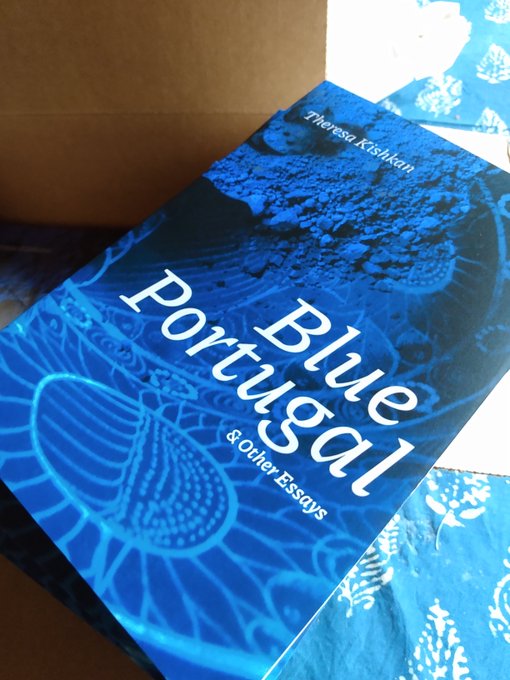
Content, mostly, to wash the oldest quilts and hang them to dry, to plant out chard seedlings, to think about my morning swim and how the front crawl isn’t nearly as difficult as it was last week, and to keep an eye out for western tanagers which should be arriving soon. This was the week when my Blue Portugal and Other Essays was officially published (though I’ve had copies for about 10 days) and it was welcomed in the most generous way, here, and here, and here. (And an earlier book, The Weight of the Heart, was reviewed here by a dream reviewer, someone who knows the writers it pays homage to and the landscapes it celebrates.) Friends write to tell me they’re reading it and I realize how that was always my hope. To know that the essays have found readers and what I’ve recorded over the years it took to write Blue Portugal hasn’t been lost.

Instead of Ottawa, instead of Greece, I am here, right here, in a red chair with a cup of strong coffee, a greenhouse full of seedlings that need to be potted into big tubs or else given away (and if you need tomatoes, let me know), an olive tree about to bloom, actual warmth in the sun after weeks of chilly rain, and a book about decoding the Rosetta stone that reads like a mystery novel. And after that, I’m going to re-read Lawrence Durrell who will take me to Greece, or at least the Greece I am longing for: before computers, before the 21st century, when I was still young, and the anemones were blooming, and everything seemed possible.

“Other countries may offer you discoveries in manners or lore or landscape; Greece offers you something harder—the discovery of yourself.”

In the meantime, if you’re looking, here’s where you’ll find me.

corner

“In the forest, upon the oak, I was spinning the thread for a shirt.”

in the honeysuckle

In Ukraine, in 2019, I bought two vyshyvanky, the embroidered shirts that encode so much of traditional life and culture. The one on the right uses rhombus forms that I believe symbolize the unity of male and female principles, sown fields, prosperity.

geometric

The other vyshyvanka has poppies embroidered on the yoke and sleeves. The poppy is a protection against the evil eye.

on my sleeve

I remember the difficulty in choosing a vyshyvanka among the thousands available in the Kosiv market, each one more beautiful than the last. Some were so heavy with embroidery that I couldn’t imagine actually wearing them — and I wanted to wear mine. I still think of the one that got away, not in Kosiv but in Lviv, at the end of my trip, when my suitcase was full and I thought I’d spent enough money. That one? It was black, with appliqued yoke and sleeves in deep rose, sage green, a rich soft blue. Of course I should have bought it. And will I ever return to Ukraine? I hope so but who knows.

What I think of when I see my vyshyvanky in my closet is ghosts. I think of the mornings when I woke in Ukraine thinking of those my grandfather left behind. This woman, for example:

single woman

I have no idea who she was and why my grandfather kept her photograph, one of two, all his life. I showed her to the relations I met from his village and no one recognized her. She has inspired my work-in-progress and in the way that things work, maybe one day my novel will lead me to her name, who she was to my grandfather. A sister? A sweetheart? A section of my novel is set in Lviv and one of the characters is a curator of a small textiles museum. It’s serving as an impetus to learn more about Ukrainian textiles, the black and red threads that represent the generations and carry their stories forward. My stories are so sparse, so threadbare but I hope that one day I’ll know more of their shape and meaning, the poppies on my sleeve, the sown fields.

A few days ago, a short piece I wrote about Ukraine went up on the Canadian Writers Abroad site. Writing it filled me with the urgency to put things down, to record the stories, the silences, the names, and it also made me wonder if it’s too late to learn embroidery.  In “Museum of the Multitude Village” in Blue Portugal and Other Essays, there are lines of Ukrainian folk poetry threaded through. I loved this little song (though didn’t use it in my book); it’s a spring song, one of a group sung by girls as part of spring rituals.


O LADY VESNIANKA,
Where didst thou spend the winter?

“In the forest, upon the oak,
I was spinning the thread for a shirt.”

I thought of ghosts this morning as I hung my vyshyvanka in the honeysuckle by my garden gate. A very light breeze filled their sleeves, let them dance briefly in the new green leaves. Today is Vyshyvanka Day in Ukraine. That amazing man President Volodymyr Zelensky said, “This is our sacred amulet in this war. Happy Vyshyvanka Day, Ukraine!” I echo his words and hope that the power of thread and sacred stories serve as weapons against the terrible violence they are enduring. Slava Ukraini!

“You think that you have time. And then, all at once, you don’t.” (Jessie Greengrass)

bouquet

It’s the middle of May and it’s hardly stopped raining for weeks. The winter was colder than I remember it, apart from 2008 when there was so much snow everything sort of stopped. We couldn’t drive out. We couldn’t pick up Forrest who was returning from Ontario for Christmas by train (a story in itself, with frozen waterlines and delays) and had to wait for him at the bottom of the driveway, holding up a lantern so the Malaspina bus driver would know where to stop because all the usual familiar landmarks were whited out. Someone said the other day that the rain was better than last June’s heat dome but has it come to this, that one extreme is preferable to another?

At the library, I keep reaching for the books that offer not solace but a sense of doom. Last night when John came to bed, I was reading Carys Bray’s When the Lights Go Out, and I told him a little about it. A couple who are facing the climate emergency in different ways, one of them by standing in the town with placards, food stockpiling, and acquiring a breeding pair of rabbits for meat, the other knitting (to supplement the lost income of her husband whose landscaping job has gone sideways because of the sempiternal rain), collecting plastic on beaches, counting bees, and even planning a quilt:

A fabric map made of time and geography: nine blocks, beginning with this land as it was eighteen thousand years ago when a vast ice sheet receded, and water filled a depression in the glacial drift. She has started work on the central piece: the Moss, as it looks in present-day aerial photographs. An appliqued Tetris jumble of triangles and rectangles, parallelograms and squares, in a variety of earthy colours and corrugations.

At first I felt a kind of optimism, reading about the purposefulness of Emma, even as her husband stood with his signs in the town, his jacket forgotten as the rain poured down, but then I kept hearing their dehumidifier whirring non-stop, thought of the former lake, now a wetlands, that their land bordered on, reclaiming its old identity, and I had to put the book aside. I don’t sleep well anyway and I knew the night ahead would be difficult.

But maybe not as hard as the nights following my reading of The High House, by Jessie Greengrass, a really extraordinary novel of the coming of the end of the world as we know it. There’s water, yes, and preparations have been made, and a house high above the sea and the rivers emptying into it. There’s a man who remembers the last great flood and has knowledge of weather, tides. One of the characters remembers,

the beginning of things, when we were still uncertain, and it was still possible to believe that nothing whatever was wrong, barring an unusual run of hot Julys and January storms.”

The characters in this novel are prepared, because one of them, a climate scientist, knows what’s coming. But being prepared and surviving — well, those might be two very different things. We’re not sure in this novel if they are. Because the things the characters are dependent on are the things we’re all dependent on: reliable pollinators, birds, clean water, each other. What do you survive for, if everything has changed, the things you’ve loved have disappeared? You eat the precious but lumpy bread in the years you miraculously have wheat to grind. Is that worth it?

It was a book I wanted to talk about so I recommended it to my older son. He signed a copy out of the library and when we next talked on the phone, he told me he’d begun to read it, agreed it was very good, but he couldn’t continue with it. Too bleak. I felt such remorse for recommending it to someone with small children, having just survived a pandemic, having transitioned to working at home, sporadically home-schooling an older child (when the school closed because of high infection rates), and who needs to hope that the world is still a good place to be. Of course it is. I know that. (My fingers are crossed as I type this.) But when I lie awake in the night, hearing rain on the metal roof, remembering the heat of last summer, the atmospheric rivers that caused catastrophic flooding in November, the wildfires that tore through huge swathes of North America (and which rage still in New Mexico) and which burned an entire town in the blink of an eye, I am searching for a map through it for myself and for those I love. A map detailing routes through a treacherous world, threaded with rising rivers but some with safe crossings, crowded cities, mountain passes with uncertain weather, forests dense with smoke, and oceans marked with hic sunt dracones, potential dangers to be avoided, and perhaps even a terra incognita, a place which none of us have yet damaged with our machines and our greed. In the night I would be grateful for a map, one I could fold under my pillow, and sleep, knowing I could find a safe place if this one sinks or burns.

atmospheric

first spiral

A Saturday, raining, Bob Dylan singing of Key West and happiness:

People tell me that I’m truly blessed ‬
Bougainvillea blooming in the summer, in the spring
Winter here is an unknown thing
Down in the flat lands, way down in Key West

My bougainvillea died over the winter, a winter colder than usual here on the western edge. I loved its magenta bracts, the way it filled one corner of my greenhouse with tropical beauty. I’ll buy another if I see one in one of the local garden centres and will let it overwinter in my sunroom next winter. But while it was blooming? I did feel blessed.

I’ve been quilting. I backed the panel I pieced together last month and it’s been in my basket waiting for me to pick it up. I was busy with last minute work on Blue Portugal, busy in a little cluster of fine days planting beans in pots in the greenhouse and transplanting tomato seedlings, peppers, and eggplants. I thought these would be in their summer places by now, garden teepees (beans, including a new one to me, Doukhobor poles) and along the south wall of the sunroom (tomatoes, etc.), but it’s still too cold. Yesterday morning there was new snow on the mountain, quite a lot of it on the peak and easing down one shoulder. We’re still making fires in the woodstove and the day before yesterday I was drawn by its warmth to sit and thread the beautiful Japanese needles with sashiko thread. I didn’t know how I would quilt this piece. Maybe waves, I thought. Maybe just outlining the strips that mimic the 2x4s we used to frame our kitchen walls. But I found myself beginning a spiral and I thought my hands knew something my thinking mind didn’t.

When I sew my spirals, I am finding my way into darkness, hopeful that I will find my way back. I am walking a path worn to the bare earth. It’s one way I know to hear myself think. I sew small shell buttons to the ends of each trail, a place-marker, shining as the light shone by my face in an Edmonton room where I lay in intense pain, but also in joy as I heard my grandchildren singing: Two little dicky birds sitting on a wall, one named Peter, the other named Paul.
        –from “The Blue Etymologies” in Blue Portugal and Other Essays, just released

Dylan sings of Key West, a complicated story, and I listen, taken away by the lyrics. I am in my little cold cottage on an island on the edge of the Atlantic, hearing him sing “Just Like A Woman” and I am back, back in my room, studying for my university exams, listening to “Sad Eyed Lady of the Lowlands”, and he never gets old. On that island I was preparing to leave. I would spend a few days in Dublin where an acquaintance had arranged some readings to celebrate the arrival (at the Clifden Post Office) of my second book of poems, Ikons of the Hunt, one at the Brazen Head on the Liffey, one of the oldest pubs in Ireland, and one a reading and interview on a pirate radio station, ARD. In Dublin I wondered why I’d ever left that western island but it was the beginning of something else, a key, the life I live now, and Dylan somehow knows that and offers his own strange consolation.

I’m searching for love, for inspiration ‬
On that pirate radio station
‪Coming out of Luxembourg and Budapest

‪Radio signal, clear as can be
‪I’m so deep in love that I can hardly see ‬
Down on the flatlands, way down in Key West

My hands knew something. They know something, where a mind can travel as it stitches a spiral, as the fire warms my bare feet, the cat who is crouched between the two rockers of the chair I am sitting in, and the room dense with a voice I have known for decades, atmospheric, listened to in every season, not least this season that will surely become warm enough for tomatoes by a southern wall, a tumble of bougainvillea in the corner.

spiral one

who wouldn’t want to return?

market in kosiv

Last night I dreamed I was back in Ukraine. I could hear air raid sirens and smell cordite but somehow life was going on around me in a steady purposeful way. I woke up after midnight with such yearning for the time I spent in my grandfather’s country. I’d thought I’d return, but will I?

I think of the people I met, The woman showing us how she wove a lizhynk, a thick wool blanket, using fleeces she’d spun herself, and how she had a ladder leading to a place under her house where the Rybnysya River had been channelled through big wooden tubs where the blankets were tumbled in the river’s currents, their threads shrinking and tightening. The woman in the market who tucked extra apples into my bag when I told her my grandfather was from Bukovyna. The man who stopped on the road down the mountain near Tiudiv and let me stroke his horse’s face.

tiudiv

Last night I dreamed. And when I woke, I felt helpless. Day 78 of an unnecessary and cruel war. I remember the fields of sunflowers, the horse-drawn wagons, like the one in the photograph, carrying lumber and potted trees, the things that wouldn’t fit in a small practical car (and there were lots of those too), the vans pulling up at the market and unloaded the bags of nuts, jars of milk, homemade mouse traps, tiny thong underwear. It was a world both beautiful and functional, the old wooden houses in orchards with grazing sheep, the new houses nearby, fleeces draped on railings to dry after their rinse in the river, a tractor crossing a field with Nirvana playing loudly over the noise of the engine. I remember coming down to a hotel breakfast room with tables spread with homemade cheeses, butter, smetana, warm rye bread, bowls of peaches and red currant jam, and a smiling woman telling me that everything came from the farm owned by the same person who owned the hotel. Who wouldn’t want to return?


spring is late

corner

1.
This was May 10 last year, the lilacs, wisteria, the dense green leaves. This morning, a few tight buds broken by the rain.

flava

2.
The long-throated daylilies, bright mint, tree frogs hidden in the leaves.

peony 1

3.
Another year, tree peonies by the fence, poppies, roses opening their petals to the bees.

pink perfection

4.
There is nothing to tie up. No blooms, no long strands. Hummingbirds return again and again to the same flowering currant, the same tired tulips.

you of whom I had heard
with my own ears since the beginning
for whom more than once
I have opened the door
believing you were not far
   –W.S. Merwin, from “Late Spring”

learning to crawl

WadiSuraSwimmers

About ten thousand years ago, someone painted these swimming figures on the wall of a cave in southwestern Egypt. I love their buoyancy, their weightlessness. It’s how I feel when I’m swimming my slow kilometer in the local pool 3 mornings a week. I feel like part of the water, a current, a slight turbulence in its stilly blue.

A kilometer is 50 lengths of the 20 meter pool. I do five sets of 5 laps: sidestroke, backstroke, breaststroke, backstroke, finishing each set with a combination of breaststroke and backstroke. In the summer I swim every morning, probably about 3/4 of a kilometer–there’s no way of measuring apart from the time I take and anyway the summer swims feel more qualitative than quantitative. I have fairly broad shoulders and good lungs and I’m strong. I swim, and then I come home to do whatever else I need to do that day. I don’t usually feel tired, in muscle or in spirit.

Last summer I thought I’d try to swim to the island we’ve always called White Pine. I’d see the island from the little beach and I’d remember all the family picnics, in every season, the ones where we’d cook hotdogs over a small fire up in the grove of pines at the highest part of the island, pines now fallen in storms, or the picnics on the flank of smooth dry grass and sharp-scented yarrow.

postcard 1

I thought about swimming to the island but I never managed to do it. I wondered if I’d be better off learning to swim the front crawl first. Somehow I thought it would be easier to accomplish the distance by stroking strongly in front of myself in the way I saw others at the pool swimming. But how? I figured it was too late to learn something new. A new stroke. But when I wondered aloud to the lifeguard a few weeks ago if I was too old to learn the front crawl, she said, Absolutely not. She was just anticipating a small class of adult swimmers and she invited me to join them when they would be learning the crawl. You’ll probably only need a couple of lessons, she told me.

This morning I had my first lesson. I borrowed John’s goggles (that he never wears) and we timed our own regular swim to end just before the half hour lesson. It turned out the two other adult learners were good swimmers already but were working on stroke improvement. The lifeguard set them up with their laps and she made me duck my head to my eyebrows. I was surprised at how I felt. I’ve never liked having my face underwater but with the goggles I liked seeing the blue distances, the lines painted on the bottom of the pool. She wanted me to begin by simply doing windmills with my arms as I swam, face in the water, breathing as I needed to. Two lengths doing that. Some adjustments. Then she suggested a couple of refinements and told me to make sure I expelled the air underwater (I think I was waiting to come up to breathe and trying to both breathe out and then in at the same time), to count to myself so I’d remember to turn my head to the side to come up for air, and sent me off. I did 3 more laps, 120 meters, crawling. It was hard. I felt it in my sternum. I won’t win any awards for style or speed but I found myself figuring out the rhythm, figuring out the form. I have another lesson next Friday morning and then I’ll try to juggle my usual sets around to make sure I include the crawl.

In another month, we’ll be lake swimming. Our children will be coming at various points and I’m hoping one or more of them will join me in swimming to the island. Maybe we’ll try to ferry people over in our little aluminum boat, the one that hasn’t been in the lake for a couple of years, though we had the engine rebuilt and it should be sound.

In Blue Portugal (newly released! My copies arrived yesterday!), there’s an essay called “Love Song”, drawing together all the summers of our lives here into a single day. The island and the picnics have pride of place.

Out in the boat with a picnic to eat on the island in the lake, the island we call White Pine for the little grove on its high point, or else “Going to Greece” for the scent of yarrow and dry grass. I spread out a bamboo mat on the spine of hill and brush ants from my legs while one child dives from the rocks and another swims underwater. The third is learning to start the boat motor, pulling the cord and adjusting the choke. One son brings his wife and baby—but wait, it’s too early for this: the picnic first, and the last years of high school, the long years of university, a wedding still a decade to come. Two weddings. Far out in the lake, a merganser leads her ducklings to the mouths of small trout-haunted creeks where insects are plentiful. The boat makes two trips or three to take all the people who have come with the years, the old picnic basket filled to the brim. A black dog with the hips of a wolf hangs over the prow, eager for land.

This summer, I’ll be the woman in the black bathing suit, face in the lake, arms stroking one after another, swimming to the island.

morning lake 1

how many generations of bears

blue eddy

I don’t think I’ve ever been a linear thinker. Instead my thoughts tend to spiral, not in an anxious way (though sometimes this happens of course) but in a way that can be exhilarating, creative, intuitive. Something enters my thinking and it turns and spirals, sometimes outwardly and sometimes towards an inner centre. I’m used to it and I depend on certain patterns as a way to find my own way through puzzles or new territory. And old territory too. Last night I was reading in my bed when I heard clattering outside. At first I thought maybe John had gone out to do something but no, it wasn’t him, because he was watching television. Maybe it was the cat? Or wait. Maybe it was a bear on the upper deck. I’d fertilized the potted roses with Salish soil, a kind of fishy compost. When I looked out the windows in the sunroom, I saw two bears, a sow and this year’s cub.

At the foot of the stairs, John was saying, I think there’s something outside, and yes, I said, it’s bears. He came upstairs to take a look and I went downstairs to shoo them away. Opening the door to the little deck where our hot-tub is, I saw the mum looking into the greenhouse and the cub right by her heels, both of them so beautiful, their coats dark and glossy. She paused for a moment and we made eye contact. Go, I said to her. I had a camera but the light wasn’t good and she wasn’t hanging around. She must have made some indication to the cub who skooted up the pretty fir just beyond the greenhouse while she headed down the lane leading to the vegetable garden and the woods beyond.

the bear's tree

I could hear the cub squealing a little as it held onto the trunk for dear life and the mum growling to it to get down and come with her. I guess she realized I wasn’t going to follow her.

So that was the evening’s drama. They’d been in the woodshed and had upset a bucket, investigated the barbecue on which steelhead fillets had been grilled last week. John always burns off the bits of skin afterwards but maybe there was still a little scent of fish. The cat was terrified and hid behind the washing machine.

When I returned to bed, I began to think about bears. If their average life span is 18-20 years (though they can live longer than that), and we’ve been here for 40 years, then how many generations have we known? The earliest bears who were just passing through, the ones that came later for the orchard fruit, the one that broke into the garden to eat cabbages, the ones who broke the garden gate not once but twice, the ones that drag out the empty cans we used to keep garbage in (and last night’s bear did that so she’s obviously a return visitor), the mother with twins who lingered just beyond my study window and sent both cubs up a tree where they climbed very high and squealed like babies,the one that topples the compost boxes just because it can, the one who climbed the pergola over the sundeck in search of grapes that had already been picked (so it had been here before), the ones that come for crabapples in autumn and eat themselves silly, the whole spiral of their visits and departures, the heart of the spiral curled in like the conclusion of a story.

They have very sophisticated memory maps of food sources, can remember food sourced at least 10 years in the past, and given the number of years we’ve lived here, that the crabapple tree with its sour scabby fruits has been productive, that there was once the possibility of garbage though not for decades, I suspect we are part of the map shared among them, information passed down like family stories. Our histories turn and spiral like the routes to ancient shrines where the bear mother was worshipped, kept alive in the night sky for guidance in her incarnation as Ursa Major, light for the cosmic hunt. A couple of years ago, in December, I focused my binoculars on Ursa Minor, hoping to see the Great Conjunction. Did I? Maybe. But I remember how beautiful the tail of the young bear was in that dark sky, pulled longer by the force of the swing of the god who threw it to the sky.

Yesterday at a garden centre in Sechelt, I found a plant I’d never seen before, Allium senescens “Blue Eddy”, a spiral ornamental onion. In its pot, the foliage swirls like the rapids in the Thompson River, the Jaws of Death, the Cauldron, where I remember our inflated raft turning in the eddies, the blue eddies, water swirling, dry air, fish under us on their way to Adams River, to the Deadman River, bears along the route, the sky at night dense with stars, and when I plant the allium, this will also be part of its leafy spirals, a mother bear pausing to sniff it, a cub at her heels.

ursa major and minor