posts

redux: “five suns from a flying heaven”: Thanksgivings 1991 and 2020

Note: I posted this five years ago, remembering a Thanksgiving weekend nearly 30 years before that. Yesterday as I shopped for groceries, I realized that another Thanksgiving has come around. We were away last week and in two weeks, we’ll fly to London, then Portugal, so a quiet weekend at home is in order. I did buy duck(legs) to roast and we have lots of vegetables. And I still have some copies of Red Laredo Boots (it’s out of print) if you’re interested. $5, plus postage, whenever that might be possible again.
the last plate

1.

“I found the yellow plates on the day before Thanksgiving, 1991. We’d gone by boat down the length of Sakinaw Lake, tying up to some logs at the western end. From there, a boggy path leads through wild mint and arums to a small estuary. High cliffs on either side of the bay give the place a protected hidden feeling; you could be at a creek mouth at the edge of the world.”

2.

“Wading across the rising creek, I suddenly spotted an unusually large shell on the bottom, partly obscured by eelgrass. Curious, I lifted it out and put it in my bucket among the frilly oysters; it rang against the side of the galvanized bucket like a bell.

[…]

Remembering my strange disc, I took it out of the bucket and showed the others. Holding it up to the light, turning it this way and that, we could tell it was a plate.”

3.

“A rough shelf hung partly off one wall and on the shelf were four dusty yellow plates, the only things in the shack that were unbroken. They were waiting, as the first plate waited, in a dark corner, not underwater, but fallen the same, five suns from a flying heaven.”

4.

“Thanksgiving, 1991. We ate the oysters broiled in their own juices with lemon over top, clams stewed with garlic and garden tomatoes, turkey and all the classical trimmings, served on the yellow plates. We each said a grace before eating, something to be thankful for–food, family, the peace of the big trees around us, and the weather bringing rain, wind, the brilliance of sunlight in October, sometimes streaming from the great sun overhead and sometimes hidden in creekbeds, shacks, flawed under dust and barnacles, waiting to be found and praised.”

5.

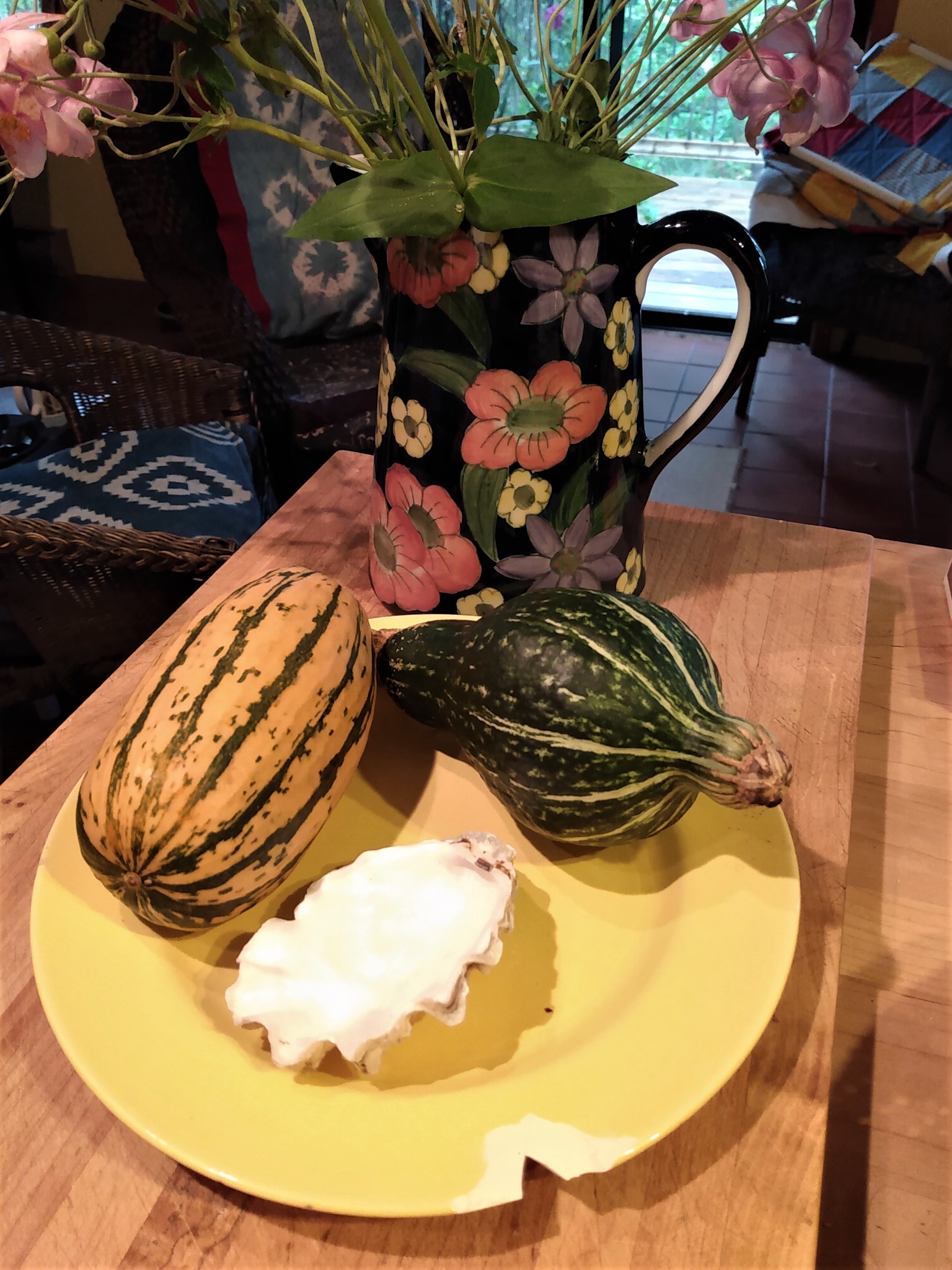
A small chicken defrosts in the kitchen. Squash, a savoy cabbage, blue potatoes grown from a couple brought home from Ottawa last year, apple and blackberry compotes topped with pastry fish. I am thankful for what I have but I am also wistful for feasts at the pine table, every chair filled, the silver polished and gleaming, the glasses at every place. 4 of the yellow plates broke and were thrown out but I bring the last one, chipped and cracked, down from the sunroom where it serves as a plant saucer. Let it hold an empty oyster shell, two squashes, the memory of that day 19 years ago when we went to a beach on the edge of the world, a family intact, “oysters blanketed with seaweed, the clams opening and closing in the cold water.”

empty

Note: the first four passages are taken from “Yellow Plates”, publishing in Red Laredo Boots, New Star Books, 1996. It’s out of print but if you are interested in a copy–it’s a collection of essays–I have a few copies available for sale.
“Where the years went I can’t say” (Kate Wolf)

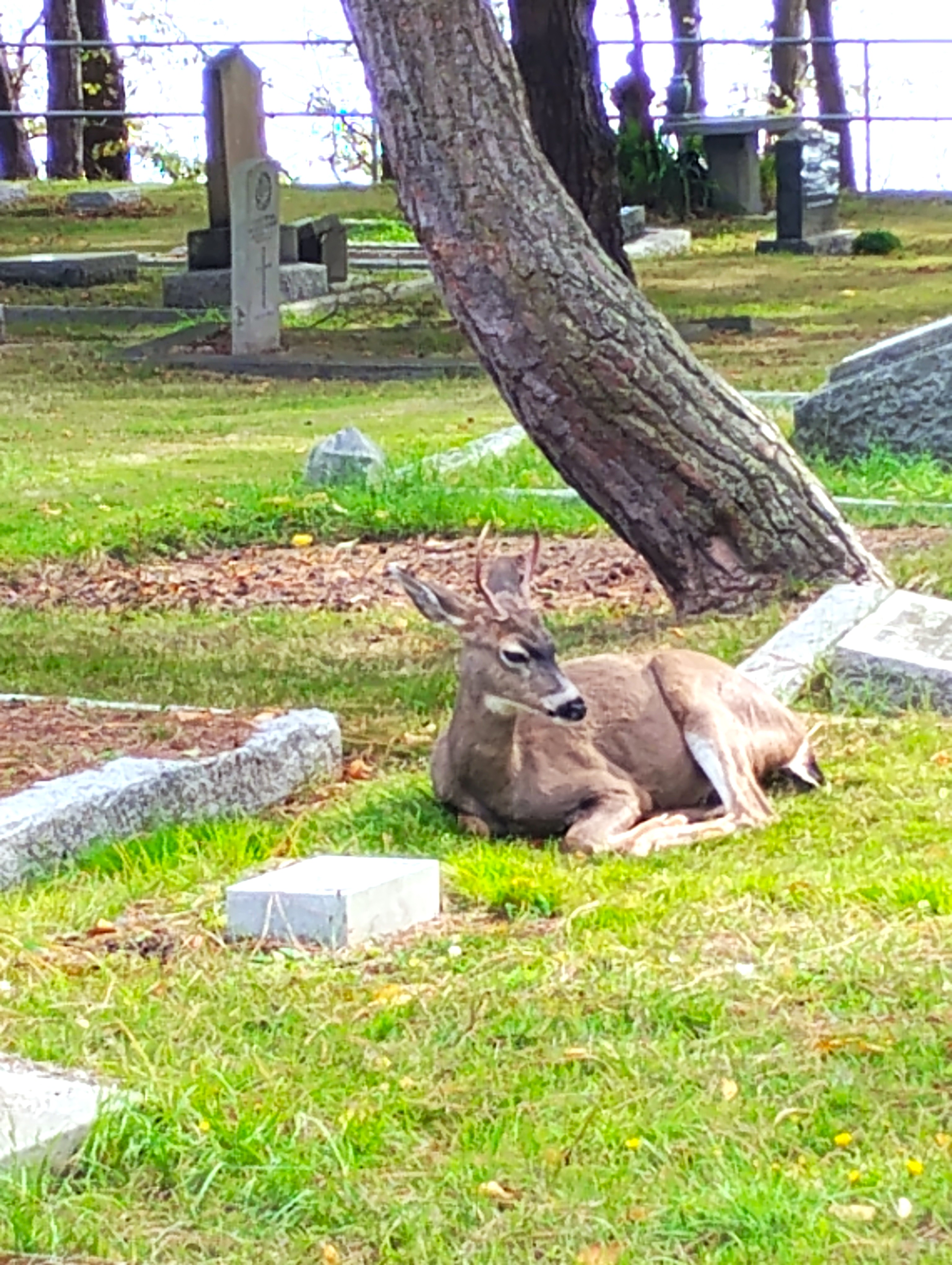
When I was a child living near the Ross Bay Cemetery in Victoria, I never saw deer lying on the graves. Never saw peacocks, or peahens, away from the lawns of Beacon Hill Park. Later, when my family lived at Royal Oak, we sometimes watched deer on the trail by our house, maybe heading for the apple orchards still productive in the area, the ones now turned into subdivisions. Never bears. Sometimes pheasants.

But it’s different now. I pulled off Cook Street onto one of the quiet side-streets to park while I did some errands and there was a peahen with her half-grown chicks. There was a peacock on a fence on Menzies Street, some distance from the Park. And deer? They are everywhere. John and I did our ritual walk in the Cemetery while I told the same stories of riding my bike as a six-year old on the quiet lanes, of listening for the buried creeks under the soft grass and graves, of hovering over the men working on gravestones at Stewart Monumental Works at the top of our street, watching them carve the names of the dead into pink stone or grey. Once my brothers buried me in the sand hoardings under the building–I imagined that it was dust from the stones themselves but learned later that it was sand used to make cement for installations — and how I had to lie there for hours until they remembered me and dug me out. The elderly woman walking with her husband in the Cemetery was telling these stories for at least the tenth time and somehow she was still the girl waiting for her brothers to return. Smelling the iodine sting of the ocean, she remembered Saturday mornings when her mother would give each child a bag and ask them to walk the shore at Ross Bay and collect bark for the wood burner in the kitchen. And she remembered leaving her teddy bear Georgie on Moss Rocks after an afternoon lying among the shooting stars and camas and her father going out in the dark to find him.

I’ve been walkin’ in my sleep
Countin’ troubles ‘stead of countin’ sheep
Where the years went I can’t say;
I just turned around and they’ve gone away

I know I’ve linked to this song before but I was the woman humming it as she walked the Odgen Point breakwater, I was the one so filled with memories of childhood, and later, as we drove past Faithful Street, down Memorial Crescent to find a place a park, I was the one quiet, briefly, in my seat as we passed the old familiar houses. And this song knows about memories. It knows about worn stuffed bears lying in a crevice in the rocks, patient, while a father searched with a flashlight, the family dog to keep him company.

The finest hour that I have seen
Is the one that comes between
The edge of night and the break of day
It’s when the darkness rolls away

it is a wonderful thing to make a mark

Yesterday I was working on this quilt, two lengths of hand-dyed linen sandwiched with organic cotton batting. I know I keep writing about this but every day I find out something new. Or old. Maybe I just wasn’t paying enough attention. But in-between stitching, I’m studying several books about Paleolithic cave art — the text-heavy theoretical ones and the more visual ones. Through the wonders of interlibrary loan (thank you, Sechelt Library!), I have Cave Art, a magnificent guided tour of rock art sites, by Jean Clottes. He tells us in his introduction that he has tried to create an imaginary museum and if you’ve read my essay “Museum of the Multitude Village”, in Blue Portugal and Other Essays, you will know that I am already in line, ready for the tour.

So I sit with the book on my lap, studying the wonderful plates. There are some images I remember. This horse, for example, called the Chinese horse, maybe for its resemblance to Przewalski’s horse, the Central Asian animal that was almost extinct and has been brought back from the brink. They share similarities in conformation and colour.

I took this photograph at Lascaux IV, the astonishing centre of parietal art in the shadow of Lascaux cave. (The cave itself is off-limits to anyone other than a handful of researchers but the replica is really glorious.) I love this horse. In fact I love every horse I saw, at Lascaux, at Rouffignac, at Font de Gaume. But what also caught my attention here is the line below the horse — a free-drawn exuberant trail across the cave wall. Is the horse following a trail? Does the artist want us to know something about him or herself? Is it an inventory? Will anyone ever know for sure?

When I sew, I follow a line. My needle finds it in the fabric. It meanders, it spirals, it stretches out like a road on a map, like a river in a landscape. When I see some of the brush work in these paintings, I feel a kinship, across thousands of years. It is a wonderful thing to make a mark, to leave a trace — of thinking, of ceremony, of an encounter with mystery.

One of the plates in Cave Art is this black stag, also at Lascaux.

The paintings at Lascaux date to something like 17,000 years ago, possibly as old as 22,000 years. The artists made use of a full polychrome palette: deep blacks, warm browns, reds, yellows, even a kind of mauve. What I love about this stag is the wildly original depiction of its antlers. Imagine the artist, tilting the stag’s head upward, as though bellowing, then–I am imagining the body first, then the antlers–following the line up and up to create those antlers. With joy, I am certain.

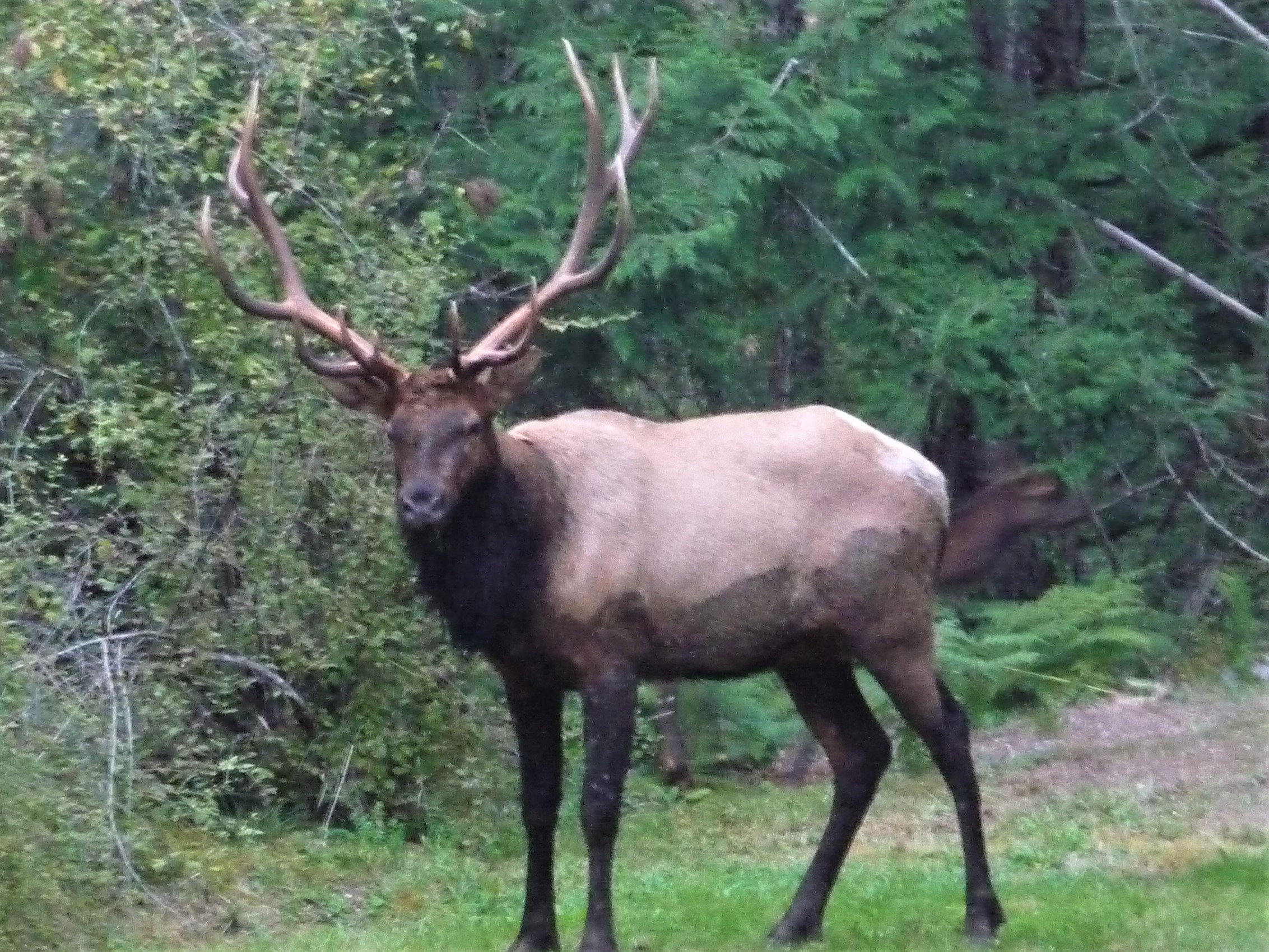
I think of Barrie Cooke and his Megaceros hibernicus (also called Megaloceros giganteus, the Giant Irish elk, though it’s not actually an elk, nor Irish), showcasing in a not dissimilar way, the otherworldly antlers. I think of him and these animals every time I see a bull elk in autumn, ready to gather and defend his harem. I’ve heard the elk bellowing in the woods, two at the same time, challenging one another.

So I read, I study the images, and I run my needle through the stretched linen, a skyscape, a waterscape, dyed with indigo on a late summer morning. A quilt is growing under my hands. What will it remember of the weight of the book on my lap, the distance my imagination is travelling, the distance between blue stitches, hoping a horse will find the trail.

“to fly toward a secret sky” (Rumi)

Yesterday I swam in the local pool for the first time since early May. I’d been in the lake the day before and knew that it would be my last day. It’s not so much that the water is cold, though it’s certainly chilly. It’s more that the air is cool and I can’t get warm afterwards. Even wrapped in a big towel as soon as I get out of the water and even after a hot bath. Someone suggested a wetsuit but somehow that’s not how I want to swim, though I know it works for others. I want the water to polish my skin. And the pool is a good compromise, even if it’s loud (or was yesterday as the children from several families shrieked and whooped, a good sound for the most part) and crowded enough that John and I had to share the one lane roped off from the rest of the pool. You can’t enter that meditative state if you’re trying not to bash your partner with your arms as you back-stroke down the pool. The lane was not quite wide enough for two.

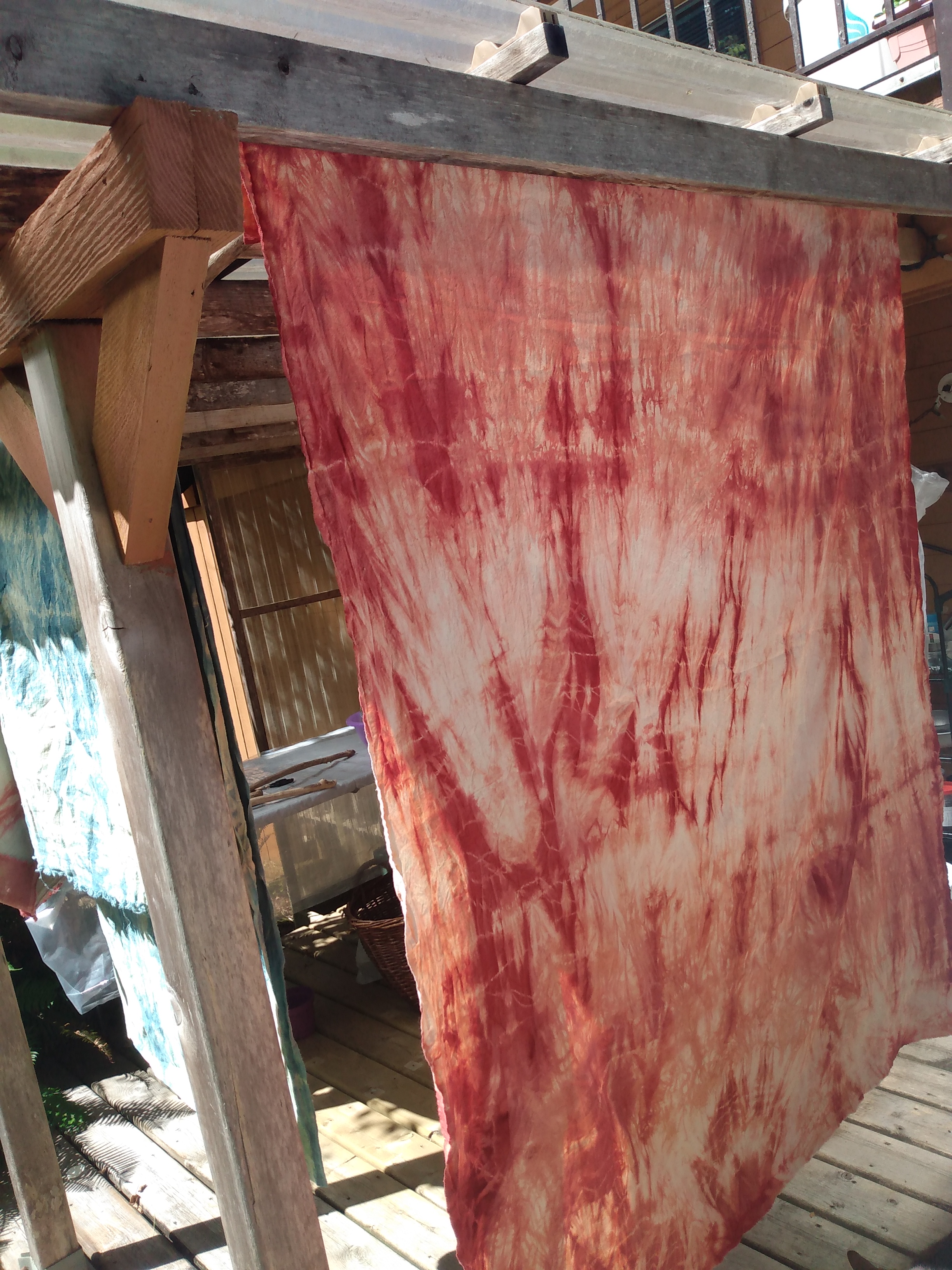
But luckily I’ve begun a new single-cloth quilt, some of the ecru linen I twisted and tied with hemp string and then dyed with indigo and rose madder. (You can see both of the lengths at the top of this page.) I threaded 3 sharp Japanese needles with blue sashiko thread and fitted the fabric into a frame. Then what. I looked at the watery pattern of the dye and began to sew a spiral. It will morph into something else and I’ll probably do what I’ve begun to think of as form of punctuation: ending a long line with a small akoya shell button.

Behind the frame is another single-cloth quilt made of white linen dyed with indigo. The colour is quite different. The process is always interesting because I think I’m being honest when I say that I don’t really care about results; it’s what happens as I twist and tie scoured fabric, as I prepare the dye vat set up on a long cedar bench out by my vegetable garden, as I dip the lengths into the vat and then remove them to oxidize, watching the swampy colour turn the most beautiful blue.

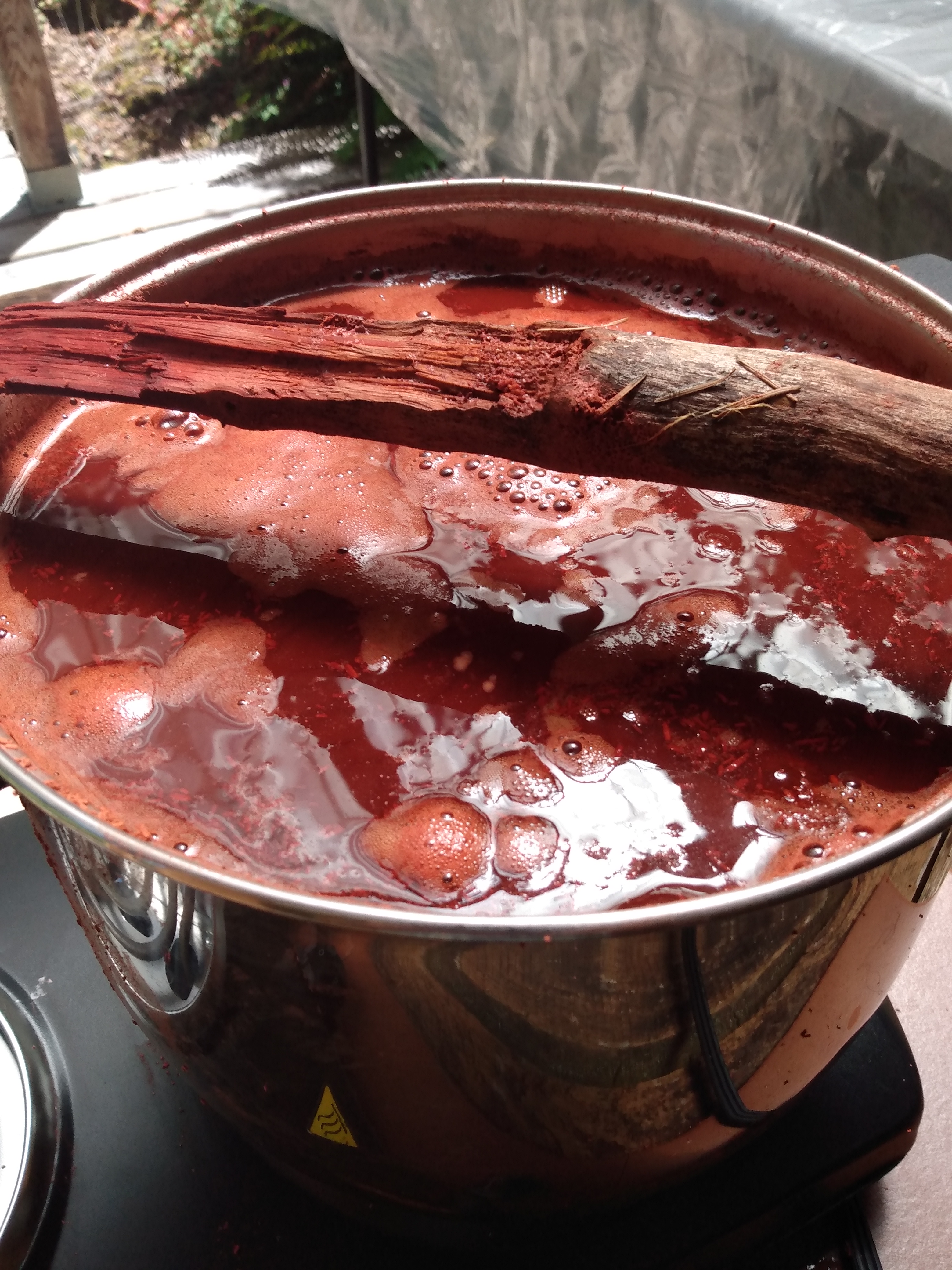
With the rose madder, it’s not quite the same. The fabric has to simmer in a mordant, then soak in a big pot of prepared dye on the little hotplate I have set up in my outdoor dye workshop.

But when the dye has done its work and I unwrap the fabric, it’s like a gift. A birth. And as I sew, I’m thinking about a show I’ve learned about in London, which we will go to when we’re there in late October. Yto Barrada’s work sounds so congenial. (And what’s so interesting is learning that she has a property with arts residencies in Tangier, the Mothership, with a dye garden and workshops, and oh, of course I’ve been dreaming as I sew.)

There is a relationship between what happens when I swim and when I stitch. The two of them locate me in my body as well as elsewhere, a spirit realm, a cloudscape. When I swam all summer under blue skies, scraps of clouds drifting overhead, I was part of what was happening. And when I run my sharp needles through the dyed linen, I am making a veil, I am drawing together a seam of water, of sky, of self.

This is love: to fly toward a secret sky,
to cause a hundred veils to fall each moment.
–Rumi

quotidian: making stock

Note: this template comes from Kerry Clare at picklemethis.com, though I’ve adapted it.

1.

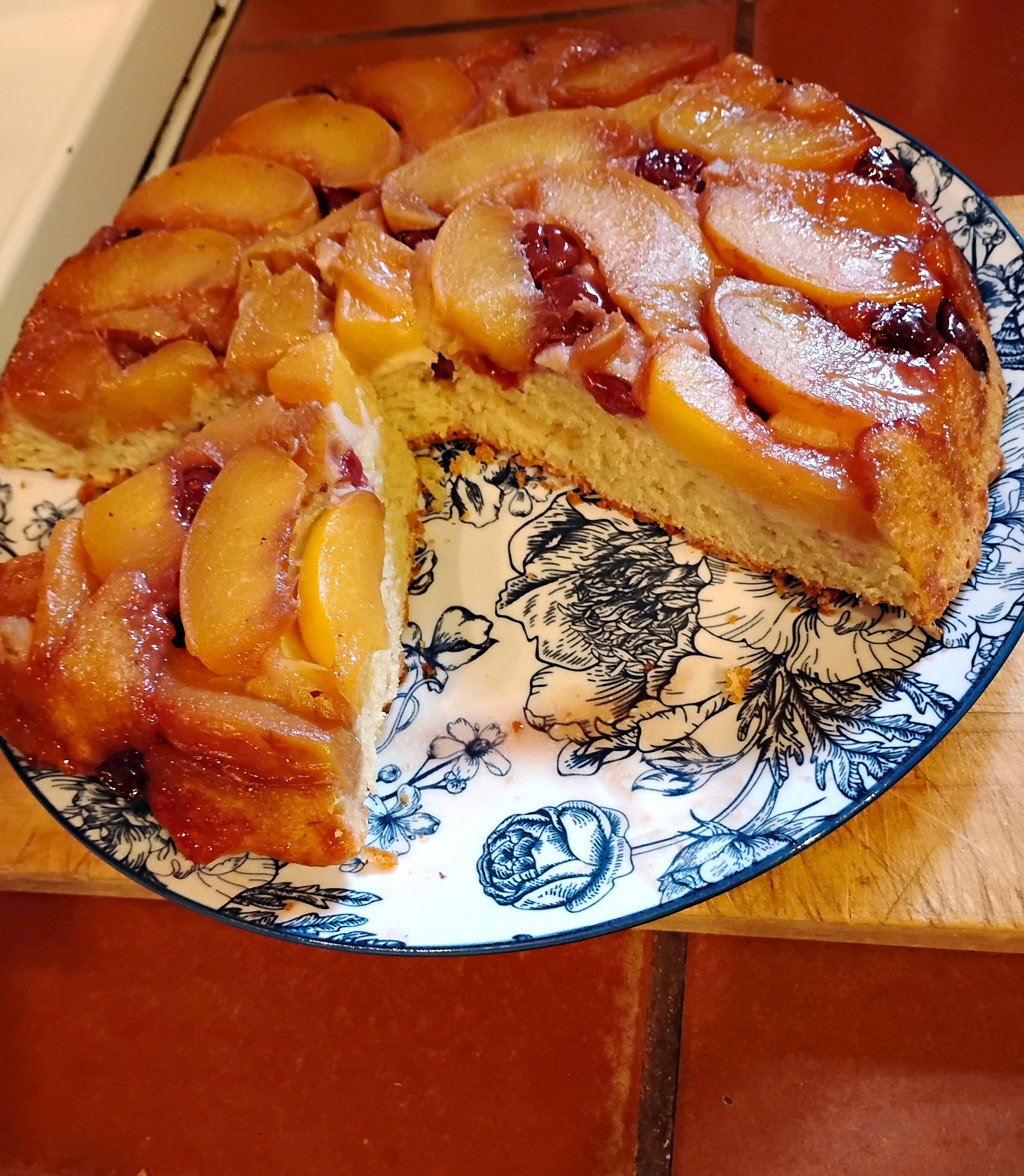
Making: It’s the time of season for taking and making stock, for putting food away (as in preserving), for using up the garden’s bounty. And what does “stock” mean? From the Etymology online site, the mostly 15th c meanings: “stump, wooden post, stake; trunk of a living tree; log”; “block from which a bell is hung”; “gun carriage” (and as a gunsmith’s daughter, I remember my father making stocks of walnut and cherry, shaping, polishing and oiling); “supply for future use; collective wealth”; “lay up in store” (17th c); “broth made by boiling meat” (18th c); and many more, so many more that stock itself, taking it, making it, could result in a book. Or an apple cake, using Merton Beauties and some bottled tart cherries in a skillet, covered with browned butter batter. Reader, it was delicious.

2.

Listening: I’ve written about this song before but how can September pass without “September Song” (composed by Kurt Weill, lyrics by Maxwell Anderson), without its sweetness, its yearning:

But it’s a long, long while from May to December
And the days grow short when you reach September
And the autumn weather turns the leaves to flame
And I haven’t got time for waiting game

And if you don’t believe me, listen to Willie Nelson, listen as you’re making dinner, the kitchen facing west as the clouds come in to mark the end of weeks of sunlight, maples beginning to turn, dogwoods already pink.

And the days turn to gold as they grow few
September, November
And these few golden days I’d spend with you
These golden days I’d spend with you

3.

Remembering: As I anticipate a trip in late October to look at Paleolithic art, I am remembering last year’s visit to the Dordogne and how we were led to this opening and what came after.

4.

Thinking: When I lie awake at night, I’ve been thinking about the difficulty of how to begin a new book. I have some ideas but so far they haven’t led me into something meaningful. Maybe this is the meaning. Maybe I need to pay attention. Add something to the pot.

5.

Eating: Apple cake; black beans simmered all day in the slow cooker with butternut squash, tomatoes, chilies, and eaten on little corn tortillas cooked on my old cast iron griddle; sourdough bread; Scottish flapjacks (which aren’t pancakes); salmon chowder (speaking of taking stock, because I thawed broth made from spot prawn shells); and dried mushroom risotto on the day that we walked down to see if there were any chanterelles yet and there was only one so I used dried ones instead.

6.

Loving: Photographs of my grandchildren standing in front of their houses on the first day of school, swimming, riding their bikes, eating ice-cream.

7.

Reading: The Last Whaler, by Cynthia Reeves; What is Paleolithic Art, by Jean Clottes; Being Jewish After the Destruction of Gaza: A Reckoning, by Peter Beinart; Curve! Women Carvers on the Northwest Coast, curated by Dana Claxton and Curtis Collins.

8.

Hoping: I’m keeping these close.

9.

Sipping: Last night I asked John to bring me a half-measure of single malt as I read in bed and I don’t know if it was Bowmore or Laphroaig (the two we currently have in our cupboard*) and it was like sitting on a beach with the sting of salt wind and seaweed, a smoky fire warming my hands.

10.

Appreciating: That I can still swim in the lake, even though it’s cold, even though I have a hard time getting warm afterwards, that I can still propel myself on my back while I look up at the changing sky, that I can watch an osprey, that I can actually swim into the arriving rain, soft on my face.

*I just discovered the Bowmore bottle on the counter so it was that one. I love them both.

“Winter clothes everywhere” (Du Fu)

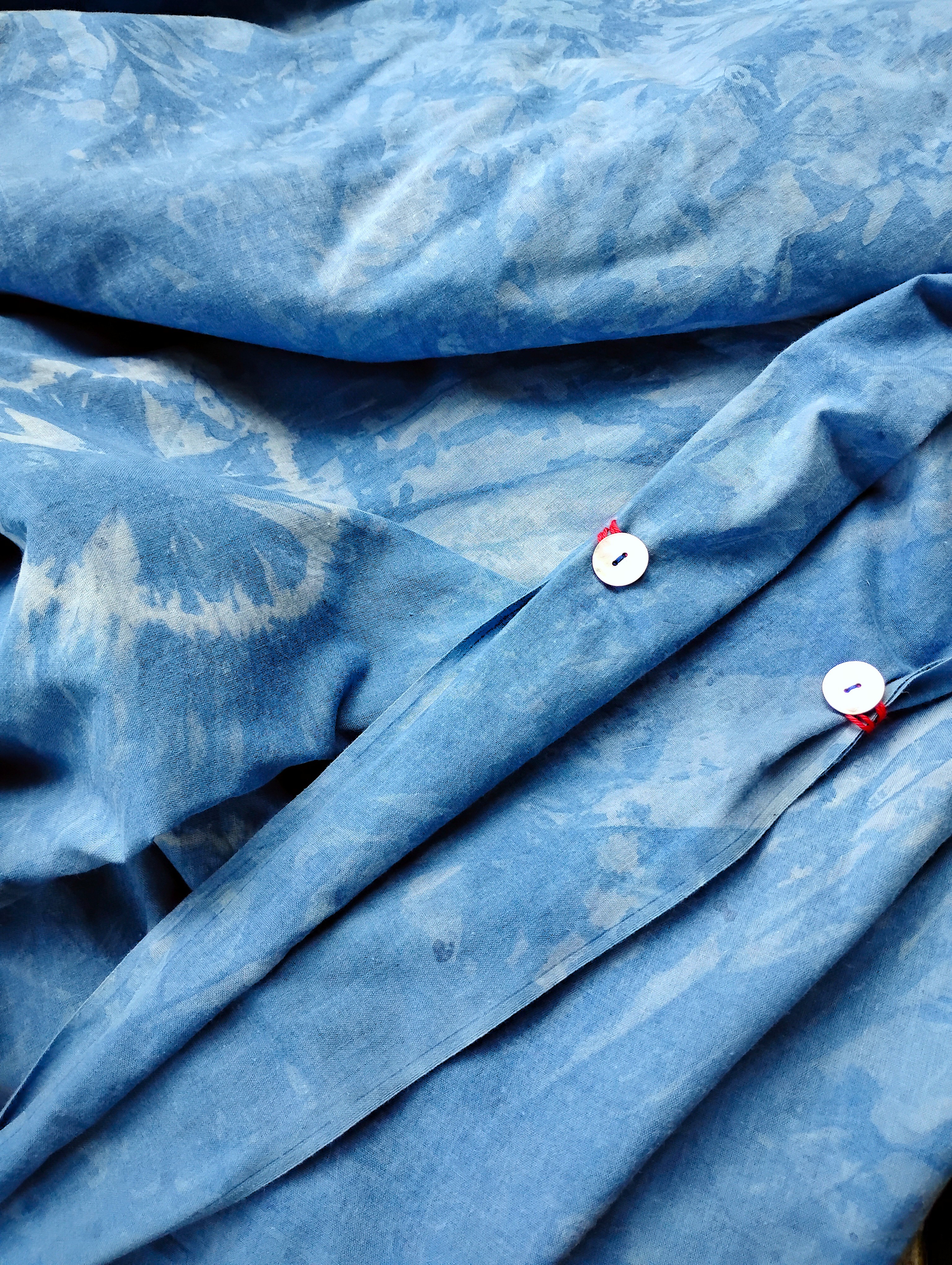
This morning, one of my last fall swims, the sky so blue overhead, a few contrails, one cloud. One of my last fall swims. At home, a new quilt in progress, the layers basted together. Two weeks ago, for my daughter’s birthday, I sent a duvet cover I’d dyed, sewn, finished with shell buttons fastened with red thread. Time to pull out the winter blankets, the warm coats, though the sun is shining. How cold the water was as I swam my lengths, arms reaching forward, then back, my torso not quite straight. One of my last.

A lonely boat, a single line, my heart is full of home.
Winter clothes everywhere are urgently cut and measured

I look up

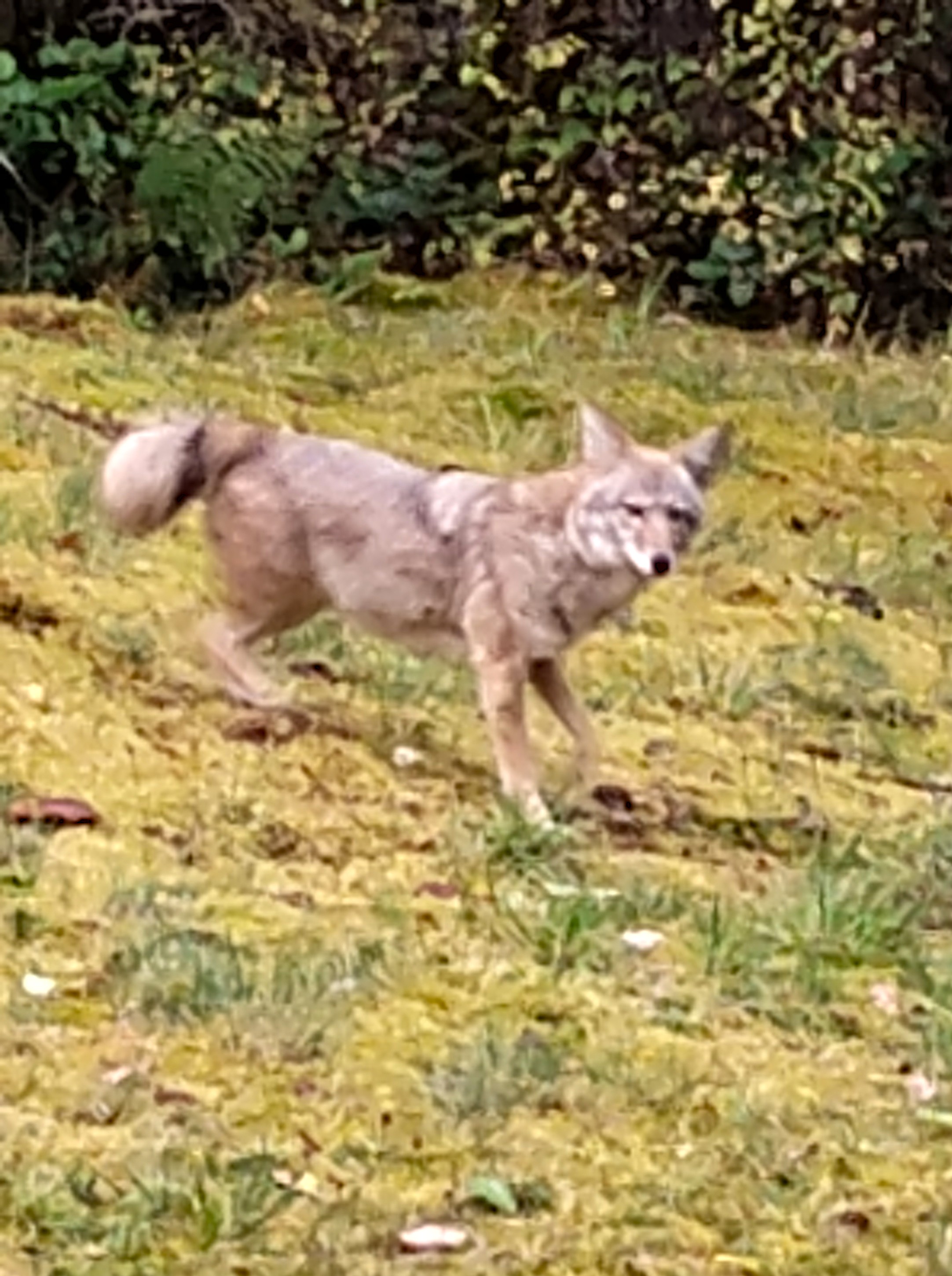
I look up and she’s looking back. I know this is a female because I just watched her pee, squatting, then kicking up moss when she was finished.

This is not the coyote who came the day before yesterday, the one with the really big ears and a grey-ish coat, a slight limp.

I don’t know if they’re this year’s pups, now grown, the ones sent away to fend for themselves. But they like the moss, sniffing around for mouse remains we sweep off the upper deck after a good night’s hunting for the cat. (He leaves us morsels: stomachs, kidneys, sometimes a perfect whole mouse.) And the cat is wary, stirring from his sleep to listen.

I look up. Last week it was a bear at the top of the steps, peering in the sliding doors.

I could see the white blaze on its chest and wondered if it was somehow related to a bear that visited years ago, maybe 15, or even if it might be that bear (they can live for 20-30 years). That one came for crabapples, as this one did (I saw it swaying in high branches the other evening), sitting like a dog by the little pool under the tree after feasting.

I think of Gary Snyder’s “this poem is for bear”:

honey-eater
forest apple
light-foot
Old man in the fur coat, Bear! come out!

I think of this bear in its heavy coat, the coyotes shaggy and wild, the deer we surprised on the drive the other day, the one ambling up as if she had all the time in the world, the grouse in the salal, the otter swimming towards me in the lake the other morning, the single merganser fishing along the shore, the chickadees waiting at the door for seeds, so eager they perch on my outstretched palm. I look up, I think of them, and I look at Gary’s poem again.

“As for me I am a child of the god of the mountains.”


redux: heaven’s door

Note: this was written two years ago and I was already back at the pool. This morning’s lake swim was cool but I’m not ready to give it up just yet. Green clear water, ravens squabbling in the cedars, a cloud that looked to much like a salmon that I kept looking, looking, until it dissolved into wisps. I’m reminded that my cell phone ring tone is Bob Dylan singing “Knocking on Heaven’s Door” so if I’m late to answering, it’s because I want to hear it as long as I can.

_______________

pine

My first lap was in a quiet pool. The man who does the wild butterfly was in the hot-tub and no one else was swimming. A quiet pool, and I could hear myself breathe. So I asked for music. The first song that came on was Bob Dylan, “Knocking on Heaven’s Door”. In the light-filled space, the water blue, a Japanese maple turning scarlet beside the big window, I thought of what heaven might be. I’m not a Christian. I swam and thought, keeping track of my laps. I listened, swam, thought. A samara fell from the maple. Crows bickered in the trees beyond the parking area.

When I got home, the house was quiet, John gone to Vancouver for the day, and the cat sleeping. On my phone, images of this day last year. On this day last year we were driving to Alberta. We got an early ferry and stopped at Nicola Lake for a swim. The water was cold, I remember, but as I swam I remembered so many family camping trips by the lake, my children plunging into the water over and over, morning, noon, and evening. In the evenings they’d have a last swim and then we’d roast marshmallows over a fire of sweet pine. There were the days of the blue tent and the days of the tent trailer and then it was over, they were grown, gone into the world to live the lives that include jobs, partners, children of their own. And us, still, on this day last year, driving to Alberta to spend time with one family.

On this day last year, we dried off, changed out of our bathing suits and continued up Highway 5A to Kamloops. Stop, I kept saying, stop, so I can take a photograph. The light was extraordinary.

5a

Past Stump Lake, the road to Glimpse Lake, past Trapp Lake, Napier Lake, Shumway Lake, the old homestead at Separation Lake, we drove, stopping to take more photographs.

5A

As I swam this morning, I thought of what heaven might be. I think it’s in the dailiness of our lives, what we notice, and love. What we carry as memory, the memory of warm air, the scent of Ponderosa pines and golden grass, what we carry home, a pine-cone, a stray feather that might have come from a bird or an angel, smoke from a fire surrounded by children. We could just as easily have driven another highway that day, not meandered along 5A, stopping to swim at Nicola Lake, almost the only ones there. A woman, just packing up her blanket. A man with a dog on the path leading up from the water. Across the lake, Quilchena, closed, the golf course returned to reeds. The sprig of sage I cut for the mirror filled our car with summer. We were driving to Alberta, damp bathing suits on the floor, damp towels. I closed my eyes for a moment and it was as though the years had never passed.

“Through linked mountains, evening shines red” (Du Fu)

The sun is heading southward. On Monday, late morning, the equinox. It’s in the air, isn’t it? Last night I went out to wish on the first star and it was pretty chilly. I’m still swimming in the lake but John said the other day that he was going to switch to the pool. There were bear prints on the sand the day before yesterday, deep heels, long claws. And yesterday I was swimming towards my favourite overhang of cedars when I realized the branch in the water wasn’t a branch at all but an otter! I quickly got out of its way. On his way to the pool, John saw a coyote on the side of the highway, sniffing the tarmac, wearing its winter coat.

What will fall and winter bring? Travel, for us: we’re going to northeastern Portugal to the Côa Valley. I am thinking of this as a field trip for my ongoing project which is “instead of returning to university to study paleoanthropology”. On my bedside table, a teetering stack of books about paleolithic art, about sites. I go to sleep with images of horses in my head, of bison and aurox. Last fall we went to the Vézère Valley to visit several caves and to learn what we could about them. And for the past year I’ve been thinking about where I’d like to go next. The Côa Valley sites aren’t caves; they’re most engravings, many panels of them along the river, sheltered by rock overhangs. I can’t wait.

This morning I read the most generous review of my novella, The Weight of the Heart. The protagonist of the book travels through the Interior of B.C., in search of locations of inspiration for the subjects of her academic research: most Ethel Wilson and Sheila Watson, though Margaret Peterson makes a small cameo too. Sometimes I’ve thought of that protagonist as a younger version of myself, doing the work I might have done if I’d chosen scholarship rather than writing. And who is this, the older version of myself, immersing herself in monographs about the archaeological context of Côa rock art, distribution patterns, etc.

At our house, the crack of a splitting maul in a big round of fir, flickers in the mountain ash, and not yet, but longed for, farewell song of the geese against the mountain. And pages turning, turning.

On distant shores, autumn sands white
Through linked mountains, evening shines red

Diving scales escape frightful waves
Homing wings encounter high winds

Mallets’ echo – ringing from each house
Axes’ sound – in rhythm, every stroke

Hoarfrost welcomes Qingnu
Gifting me a quilt, far from South Palace

Note: the lines are Du Fu’s, translated by TIEN TRAN