
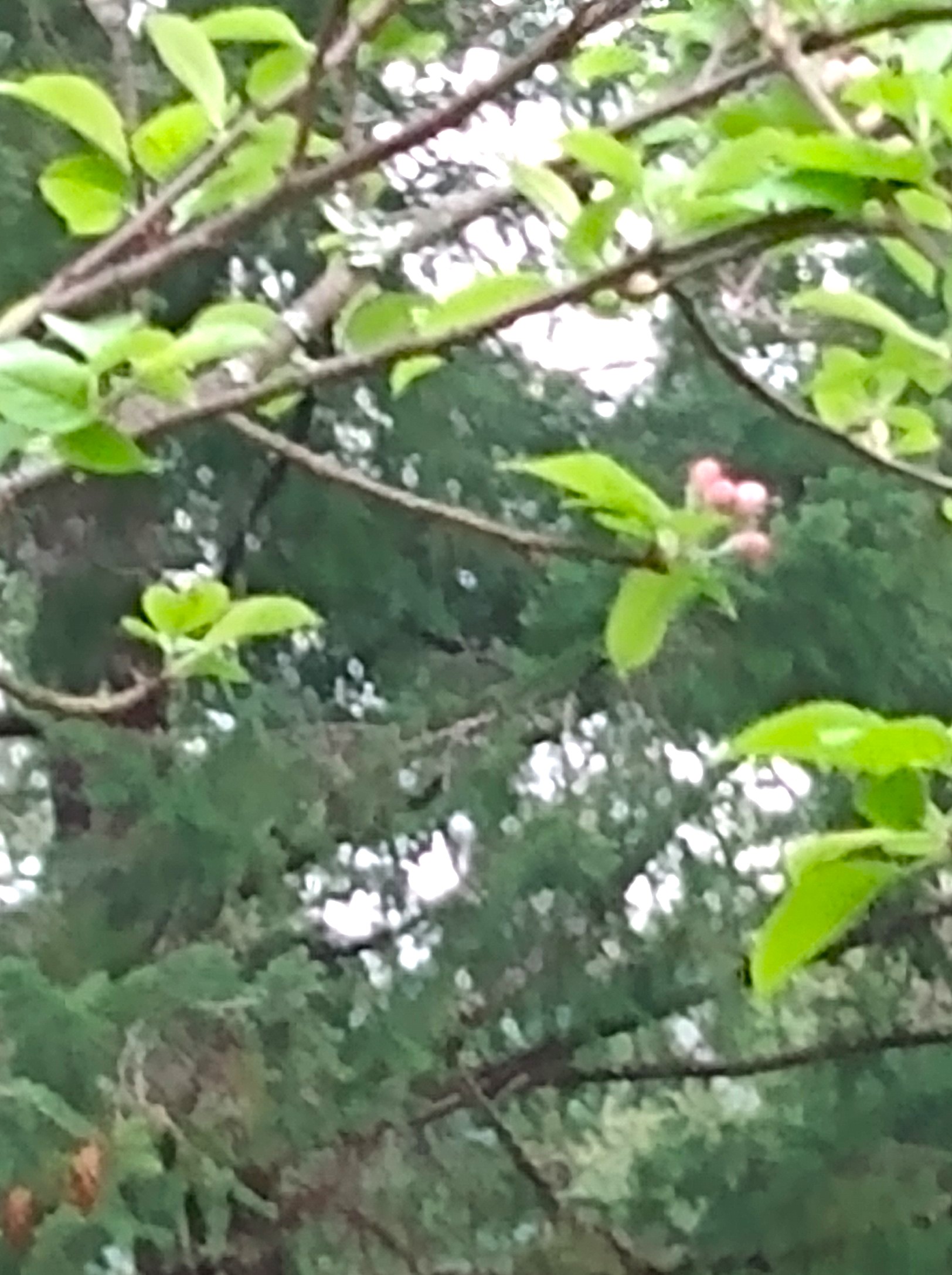
There’s a saskatoon bush growing by the printshop porch and I’ve been watching for bloom. Hummingbirds perch on a long strand of it, what I thought was a long strand of it — until this morning. Yesterday I’d noticed, in passing, that there were pink clusters, just a few of them, and I kind of tucked the noticing away. Until this morning. That’s apple, I said. Just in front of the the saskatoon, an apple tree has grown. I went out in my flipflops to try to scramble under it to take a picture of the blooms.
Not a native crab apple but, well, I don’t know what yet. Some years ago, a scrappy little tree growing in rock in front of our west-facing deck suddenly bloomed. And it was an apple tree. I wrote about it in Euclid’s Orchard:
The question of course is how the tree got there. I know that apples don’t come true from seed. Blossom from a Merton Beauty, say, is pollinated by an insect bearing reciprocal pollen from another apple–here, it would be a crabapple–and although the resulting apples would be true to their tree, their seeds would be the children of the Merton Beauty and the crabapple. One in ten thousand of those seeds might produce something worth eating. Who are the parents of this stray apple tree? It started growing before the Merton Beauty began its small production of fruit. Did this tree sprout from a seed spit over the side of the deck or excreted by birds or even seeds from the compost into which I regularly deposited cores and peelings from apples given us by friends in autumn. Belle of Boskoops from Joe and Solveigh, for instance, which make delectable fall desserts and cook up into beautiful chutney. Or else a seed from the few rotten apples from the bottom of a box bought from the Hilltop Farm in Spences Bridge, their flavour so intense you could taste dry air, the Thompson River, the minerals drawn up from the soil, faintly redolent of Artemisa frigida. This stray is all the more wonderful for its mysterious provenance, its unknown parents, and its uncertain future, for it grows out of a rock cleft on a dry western slope.
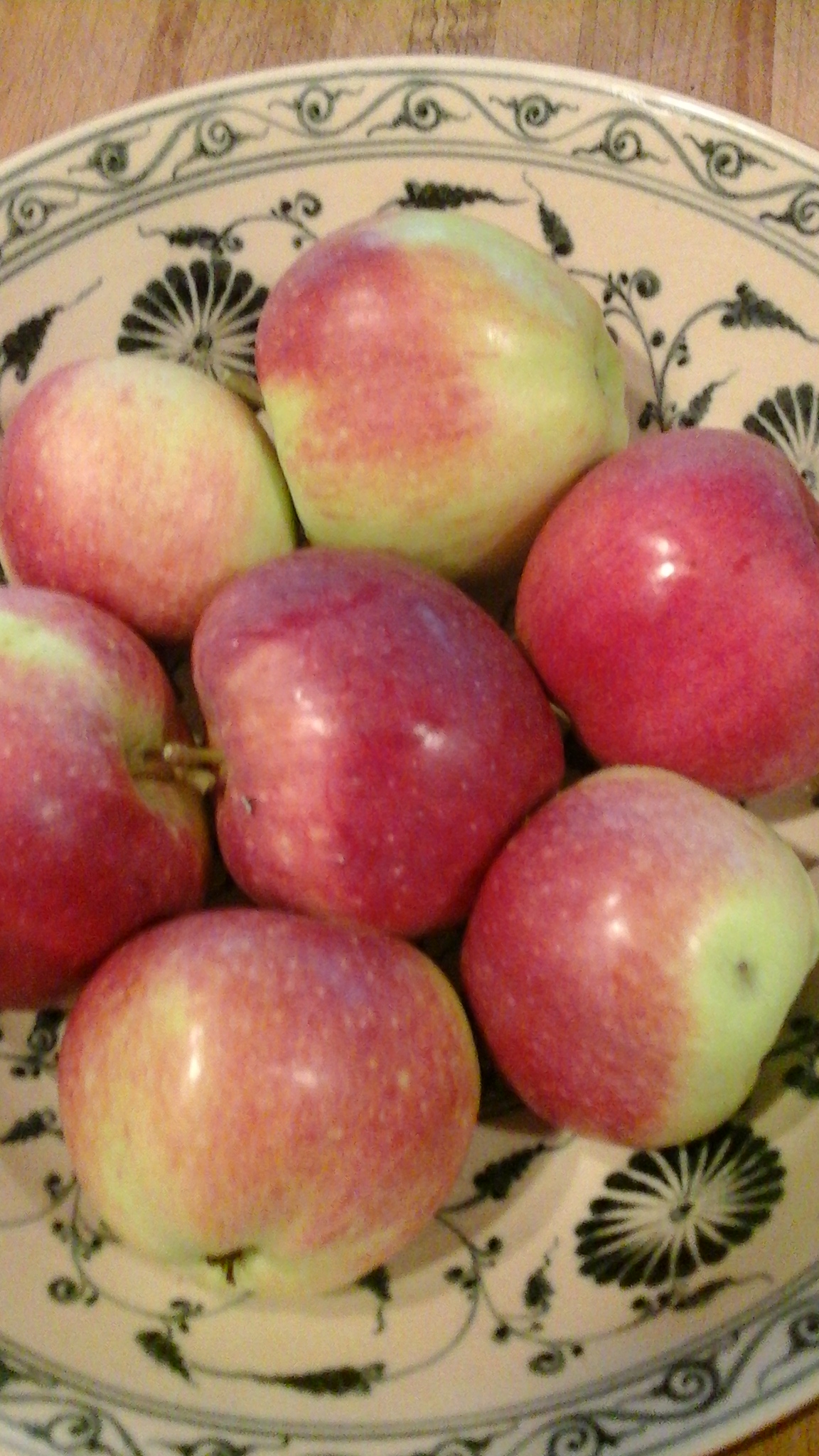
I love these mysteries, almost miracles. The tree I wrote about in Euclid’s Orchard produced apples that were beautiful to look at, heart-shaped, with rosy shoulders, but too mealy to eat, not the one in ten thousand worth cultivating. Late last summer a bear dragged the little tree down the slope, though its roots still clung to the rock. I righted it, pruned back the broken wood, and tucked manure in its root hole, anchoring it with rocks. (And that was the day I saw cyclamen blooming a little lower on the bank, also kind of miraculous, because they’re not a native plant and must have been seeded there by birds from the one or two plants Edith Iglauer gave me decades ago. I lifted a few of them and planted them closer to the greenhouse so I can see them.)
So now this, now another stray, also growing in rock. I think there are 4 blossom clusters so who knows, there might be apples on it if it gets pollinated by bees or hummingbirds. It’s a favourite perch of the hummingbirds, partly why I noticed it in the first place, because I see them settled there between the skirmishes by the feeder, Anna’s and Rufous battling it out for sugar water.

 ...Theresa Kishkan
Flipflops? That seems impossible. hehe The last pile of snow in the yard just melted a week ago, and there is a single little crocus valiantly insistance under one edge of the juniper bush. It’s still around zero at night. But today was jacket-weather. I love it when plants take root among rocks, reminding us that tenacity makes so many things possible. And even if the apples are mealy, are they good for other creatures’ tastes, I wonder?
I wear flipflops year round for quick stuff– driving to pool, etc. (Even in snow ..) We have 8.5 acres, mostly woods, so letting strays grow is never a problem. And certainly the best who broke the tree last fall to get to the fruit wasn’t worried about them being mealy. My friend Harold Rhenisch suggested years ago that they might be good in cider. Maybe they would, though there aren’t enough of them. Yet.
(You knew I meant “bear” and not “best”.)