

Go and play in the cemetery, my mother used to say–this was the early 1960s–on summer mornings, the sun not yet hot, the day waiting. We lived a block away and she had work to do: laundry for a family of 6, in a washing machine with an old-fashioned mangle; baking bread, 8 loaves at a time; cleaning our house with its windows looking out on leafy yards, little views of the sea. Go and play. I had a blue bike with a plastic basket fastened to the handlebars and I’d pedal along the cemetery’s narrow lanes, stopping to examine the cone of an exotic pine–the cemetery was planted as an arboretum and is graced by Atlas cedars, interesting firs, cork-bark elms and others–or lean my bike against a bench so I could try to wriggle into a mausoleum. I had my favourite graves: Isabella Mainville Ross’s, for example, because its marker was wooden and because I knew the cemetery was built on the site of her farm; and one summer the local newspaper reported that my friend and I had kept Sir James Douglas’s grave tidy and swept of branches and pine needles. Our school was named for him and it seemed respectful somehow. I could make myself cry by reading the dates on the stones of infants who’d died at birth or shortly after and I’d touch the lambs or angels on their graves. There were names I recognized from city streets or social studies: Helmcken, Dunsmuir, Rithet, Finlayson. And there was Emily Carr, not as iconic in those years as she became.
Go play in the cemetery, my mother would say, and I’d stop sometimes on my way to watch the men at Stewart Monumental Works working on tombstones. There were days I took a book and stretched out in the grass in the southern part of the cemetery to read. One day I heard water as I pressed my head to the ground and later my dad told me there were buried streams coursing under the ground, emptying out into Ross Bay below. I remember I wondered about the streams and the farm, if cows had grazed on their banks under Garry oaks, and if hens had foraged for the corms of blue camas.
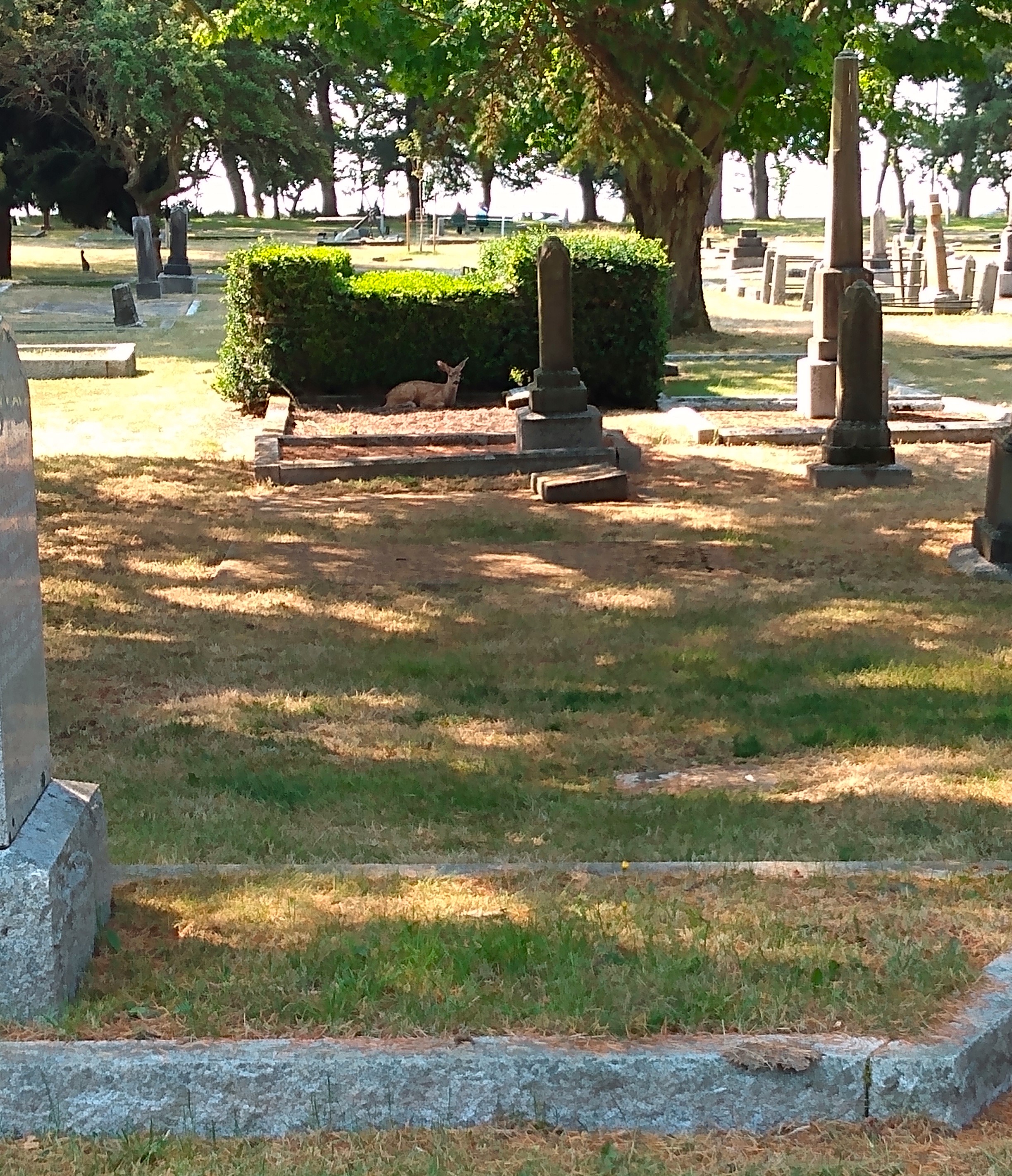
Today we walked the narrow lanes and I remembered how cool the hours could be in the shade of the trees, how soft the grass, how sad the catalogue of old deaths and histories. Twice on stones I read “A native of Victoria” and I surprised myself by saying to John, I am too. These were my first forays into the larger world, one that held families together, and apart, one that remembered the war dead and the victims of shipwrecks and disease. In those years there were never deer in the cemetery. I never saw deer in the city but years later I occasionally startled one above Rithets Bog as I rode my horse on weekend mornings when the oaks were leafing out and shooting stars bloomed in the dry grass. Rithet was a name I recognized in the cemetery, and David Spencer, from the store where we bought school clothes and the warm sweaters my father liked. Today, two fawns, just losing their spots, one grazing, one lying in the shade of a privet hedge. They gazed at us, unconcerned. A tiny wall lizard, not native (unlike me), skittered along a grave edge. It was so quiet among the dead, just the sound of a worker raking dry leaves, and a few gulls over Ross Bay keening. In the days I am remembering, I was so small I could wriggle between the gate of the mausoleum closest to Memorial Crescent to sit on a stone bench, the scent of privet almost unbearably sweet.

 ...Theresa Kishkan
[…] Theresa Kishkan’s reflection of childhood summers immediately had me in love with the subject so I’m writing mine in the […]