
I have been thinking about my writing lately, the difficulty I’m having in placing a manuscript, and because the manuscript is so personal, that makes the difficulty personal, if that makes sense. Yesterday I spent some time looking at the central essay in the manuscript, one I’ve called “Let A Body Venture At Last Out of its Shelter”. It looks back on an experience I had as a young woman and it tries to follow how the experience shaped my life afterwards. The harm it did and what I learned from it, because it wasn’t entirely a negative experience. The essay inverts the male gaze to some degree. I thought I’d post a section here today, along with one of the images central to the essay.
___________________
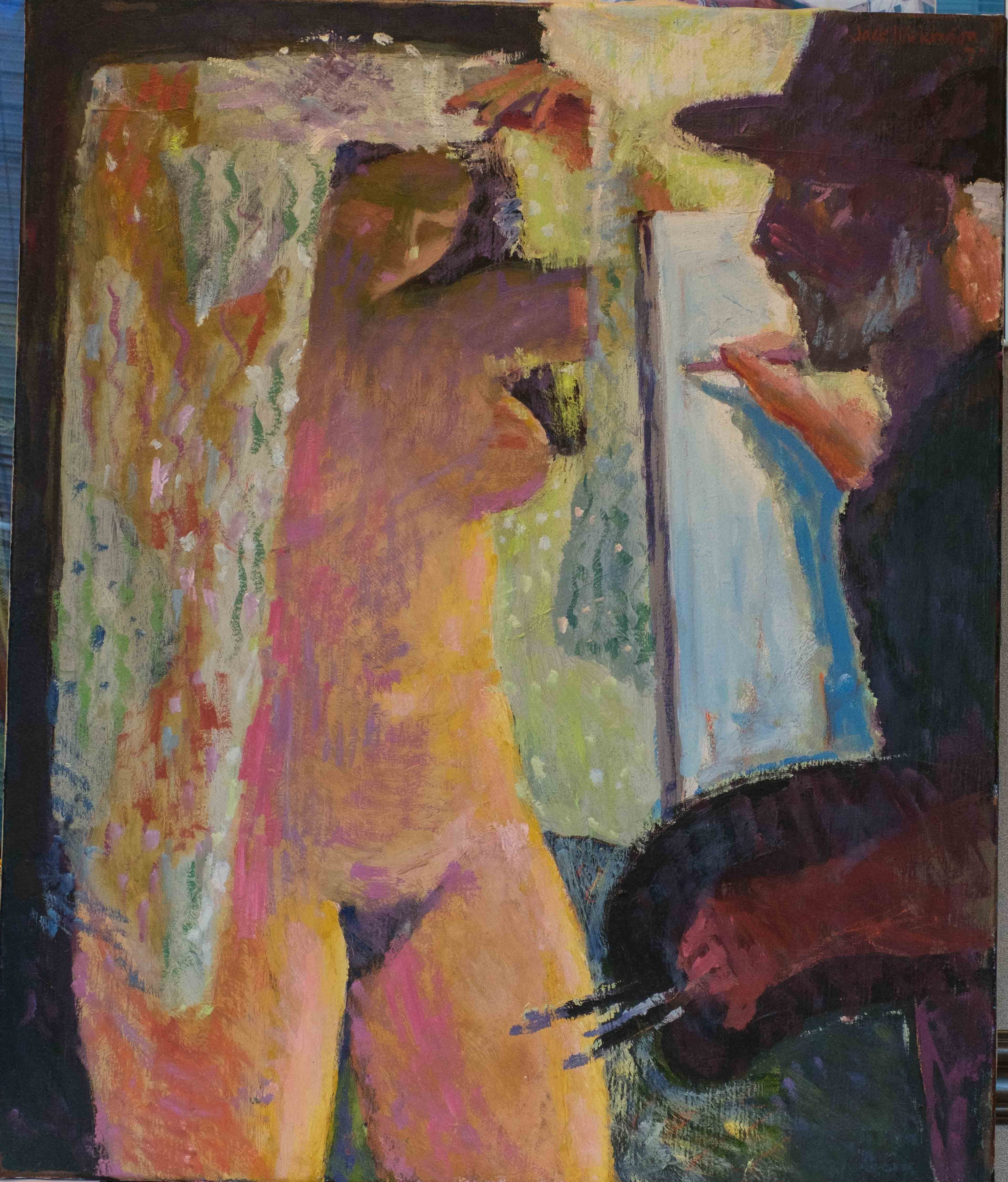
What is less commonly known is that a woman is not completely defenseless against that glance. If it turns her into an object, then she looks back at the man with the eyes of an object. (Milan Kundera)
She looks back. It takes time. Years, decades even: you have been an object, you stand draped in a pale gauzy shawl in someone’s house in Victoria, B.C., in a red kimono in your own house, on a flowered divan in private and public collections, in charcoal and ink in folios, and what is seen is the clear skin of a young woman with dark hair and large breasts. An object of beauty, of painterly attention, unnamed, unprotected in a cold studio (no sign of goose bumps though you remember them on your arms the time you took off your clothing).
To be naked is to be without disguise.
To be on display is to have the surface of one’s own skin, the hairs of one’s own body, turned into a disguise which, in that situation, can never be discarded. (John Berger, Ways of Seeing, 54)
This painting hangs in a room in Victoria, owned by someone I’ve never met. I was naked and I became a nude. I stood without my clothing, draping a Japanese cloth over my head, while colours were mixed, brushes chosen, and my disguise was my hair, the dark triangle of my pubis, and the fall of black hair over my shoulder.
Let a body venture at last out of its shelter, take a chance with meaning under a veil of words. (Julia Kristeva, “Stabat Mater”, 162)
You were the object—and now? You are looking back. Stand as close as you can to the image of your younger self, the one in the blue vest. What does she have to tell you? She looks beyond you, eyes averted. But you need to talk to her, to listen to her story. Her story takes decades to tell and it leads right to your door, to your stairs, to the room where you sit on a couch with a cup of coffee or a glass of wine, ready to listen. And ready to take the necessary step to your whole self.
It is a most painful procedure to tear off those veils, but each step forward in psychological development means just that, the tearing off of a new veil. We are like onions with many skins, and we have to peel ourselves again and again in order to get at the real core. (Carl Jung, Visions: Notes of the Seminar Given in 1930-1934, edited Claire Douglas)
To peel away the outer skin, to tear away the veil, is to find the creamy-skinned body of a 23 year old young woman, impulsive, dreamy, occasionally thoughtless. Her face is lit from within, candle-lit, soft and glowing. She looks out under a fall of hair, not really meeting my eyes. Or the painter’s eyes. Clothed or unclothed, she is holding something back. Keeping something near. She is hoping her parents don’t find out she has taken off her clothing for someone whose intentions are not entirely honourable, though for years after he insisted on his deep love, his care for her well-being, before she entered a marriage with someone else, and after.
To be naked is to be oneself.
To be nude is to be seen naked by others and yet not recognised for oneself. (John Berger, Ways of Seeing, 54)
Which was it?

 ...Theresa Kishkan
I struggle with this idea of when it is and when it isn’t personal because it all can feel personal even when none of it is, so in a situation like this, where the line shifts because the narrative erupts FROM personal experiences directly, how does one adjust the balance of how personally to take the rejection. And, here you are approaching a situation with nuance, and with a querying tone, which doesn’t fit with the current either/or zeitgeist, which complicates things further. Maybe this is the place from which zine culture emerged? A place where women had to photocopy and staple, in order to tell their own stories, on their own terms? Or, is this your zine.
That’s a very interesting thing to say — maybe this is my ‘zine. It’s a long essay, 35,000 words, and there are a number of images (and could be more). I think it’s kind of a demographic issue, too. Personal is maybe more acceptable if the protagonist isn’t, oh, nearly 70, with the assumption of privilege. But we all have our stories, our traumas, and some of come to the realization of what they meant, or continue to mean, later than others.
The preponderance of images, the current zeitgeist, I can see both adding substantially to your challenge. For all that there have been improvements in recent decades, people insisting that the Single Story trope be dissolved (to quote Adichie, but many have worked to correct such imbalances while using different terms/language), ageism remains relatively undiscussed.
I wonder if you’ve entertained the possibility of collaborating with other artists/writers who are exploring similar or complementary themes (not an anthology but maybe 4-5 pieces), maybe at a similar stage in life (or a diametrically different stage), and marketing the collaboration as much as the actual work. But there’s something to be said for simply sticking with your own story and getting there on your own of course! (Which you have successfully done many many times. Obvsly.)
I like the idea of collaborating — I have a long essay in the Sharp Notions anthology that sits in really wonderful company–but this particular essay seems to want to be on its own, or with others written by me. It’s out now to several publishers and we’ll see what happens. Either it will find an interested place or it won’t. I can live with either possibility, though would obviously prefer the former!
Oh, yes, I do know what you mean, and I hope to hear (eventually, whenever) news of its success, whatever form that takes!