
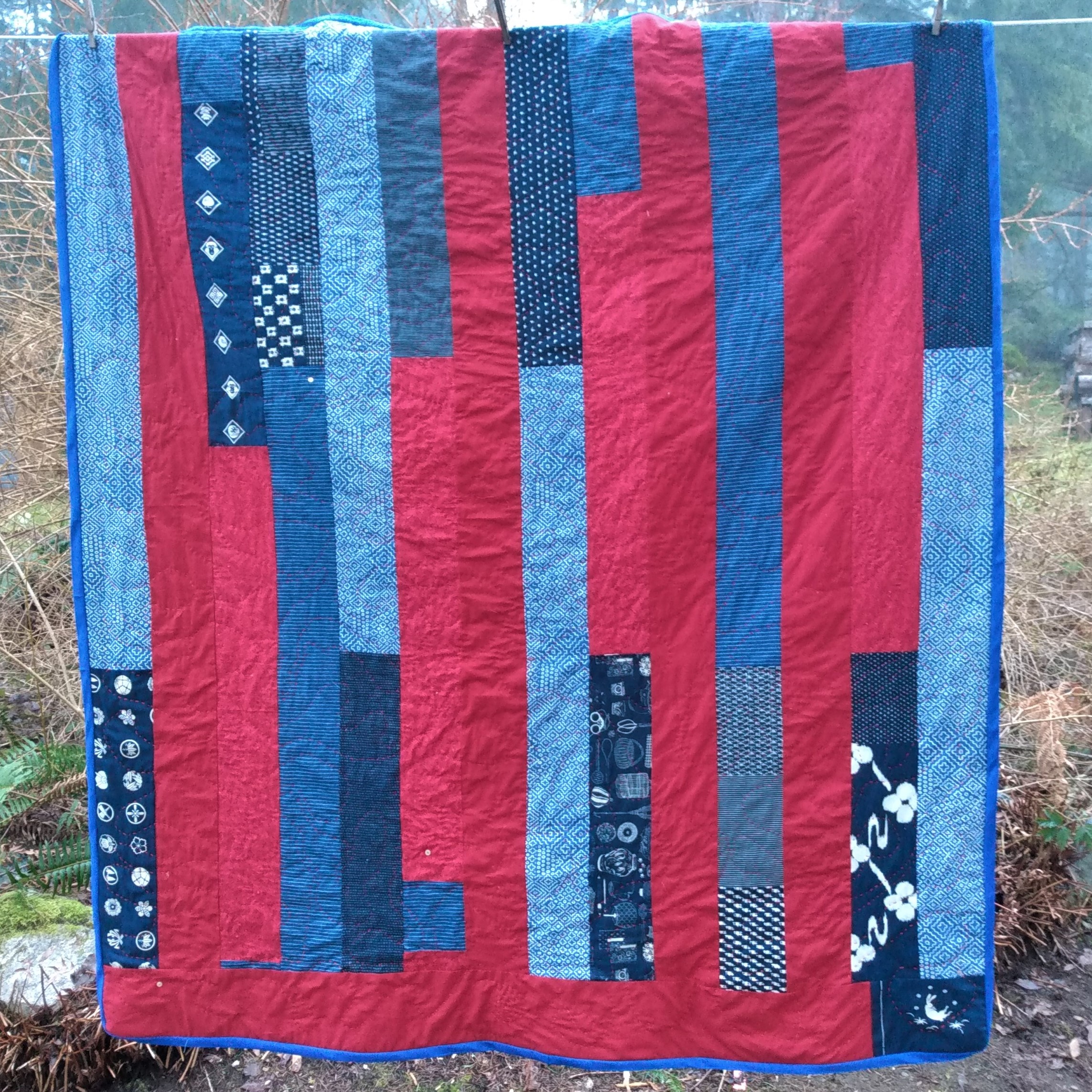
Apparently we are entering a polar vortex. For the last few days we were promised snow, high winds, extreme winter temperatures, and although none of those transpired for us (apart from hard frost), other places received them. Because of the climate emergency and the new weather patterns, it seems that the news is filled with warnings, predictions, and so another layer of anxiety accumulates. My solution these days has been to put another quilt on our bed. We have a heat pump that works very well for the lower level of our house and we have an airtight woodstove that provides lovely warmth as well as the beauty of flame but our bedroom–the entire top floor of the house– is cool. Luckily I make quilts and there are lots of them to choose from.
Increasingly the quilts are a response to the shifting nature of the world as I know it. The one in the photo at the beginning of this post was begun as a way to think about a health occurrence in the fall and winter of 2016/7. I wanted to remember to remember and record how it felt to know that my venous and arterial systems had been under threat and how I had experienced difficulty walking for a time and how I turned to swimming to regain my strength and good health. The quilt references the red and blue of my veins and arteries, it references the blue lanes of the pool where I swim in winter (maybe one day I’ll figure out how to quilt summer’s lake), and it’s also a tribute to the rivers I love: the Thompson, the Fraser, the Nicola, among others. I pieced the top and then began to figure out a backing for the quilt. I had a cotton sheet I’d dyed and it was the right size. It wasn’t until I began to baste the backing and the top with the batting layer inbetween that I noticed the salmon I’d waxed and forgotten.

I basted and as I was wondering how I’d quilt the layers, meaning what motif or pattern I’d use to closely stitch the layers together for strength (and beauty), the news was full of the atmospheric river system–this was November, 2021–and I realized that I needed to think about that. To think about what happens to rivers when they flood, change course, when the newly-laid salmon eggs are washed from their redds, when human enterprises are damaged, entire highways tumbled into water. I began in the middle of the quilt, as one does, and I stitched the rivers as they oxbowed and meandered, as they changed course. The entire quilting process took me months and it was a way to keep myself from drowning in the anxiety and sorrow of what we’d done to our planet.
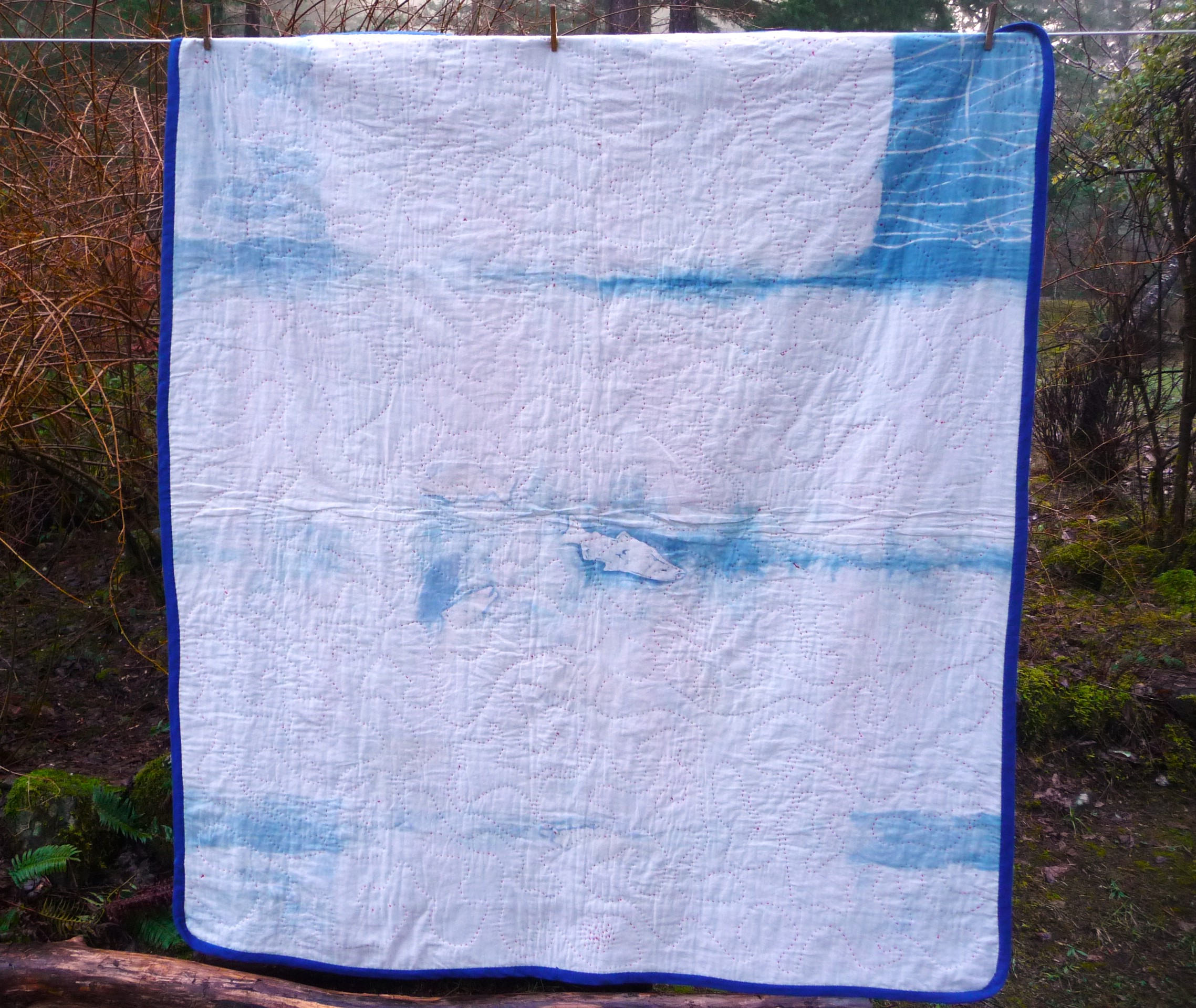
There are only three lines of stitching in the entire process. I simply followed the thread, red sashiko thread, until it seemed like a good time to end that line and begin another. On the other side of the quilt, I marked the conclusion of the line with a small akoya shell button. (You can see one in the bottom left corner of the quilt in the photo at the top of this post.)
It’s not the quilt we’re sleeping under now but maybe it should be. I’m thinking again about that time because I began an essay over the weekend, “On Swimming and the Origins of String”, and it takes me to January of 2017 when I began swimming for my life. That sounds dramatic but I believe it’s true. This morning I wrote a passage and I went to look at the quilt folded neatly on the back of a couch. I ran my fingers over the texture of the stitching, the texture of the cottons I used to piece the top, and I traced the two ghost salmon as they found a place in the new water. In one corner, a patch of eelgrass.
Polar vortex, flooding, snow warnings all over the country. This morning I am writing about rivers, about my own veins and arteries, about the salmon I have loved all my life, and how I dream of these things in the long dark nights of January. An essay comes in its own time, washed down the river, tumbled over rocks, the carcasses of spawned out salmon, the sturgeon keeping their dark counsel under bridges, comes on freshets and meanders and oxbows, comes tossed by currents and lost highways, ready to be stitched into cotton, held in words.
You and I can turn and look
at the silent river and wait. We know
the current is there, hidden; and there
are comings and goings from miles away
that hold the stillness exactly before us.
What the river says, that is what I say.
–William Stafford

 ...Theresa Kishkan
Beautiful. That William Stafford verse is wonderful.
He was a fabulous poet.
That’s a practical solution indeed! We have added more layers to ourselves rather than to the bed.
You remind me that I haven’t added a hands-on crafting element to my 2024 plans. Not that writing isn’t hands-on, but you know what I mean.
This morning I’m wearing leggings under my jeans, a long-sleeved merino undershirt under my heavy sweater, and sheepskin slippers. And I’ll spend the morning piecing squares together for a French patchwork! (I have in mind a more complicated quilt but I haven’t figured out how to do it yet. And I like to have two in the works at once so I can move from one to the other…) The quilting is another way to think deeply, strange as that sounds, and it works well with writing.
Hah. Same. Well, nearly. We are literally piecing ourselves together!
That’s just the kind of phenomenon I’ve noted, when it comes to crafting, but I’m not putting it to work and really must try harder to do so.
The other day I began an essay, partly about the origins of string, and right now I’m writing about the thread I use for quilting these days (sashiko). So the two disciplines are nicely cooperative right now…