
Note: this was written in November, 2019, before the pandemic, before the (current) wars. The world felt different, though probably that was my illusion.
__________________________________
If you read this blog now and then, you know that time is something I think about a fair bit. How we are shaped by it, how we conceive it, where it comes from, where it goes. We say it passes but it doesn’t. We are always in its flow, carried with it, through it. It doesn’t always feel like a continuum but it is. I think.
One of our sons is in Paris with his family for part of the autumn. He is working in what I think of as deep math. It’s a world that has held him since he was a small boy, walking down our driveway with his grandfather, telling him that numbers exist below zero. He was 3 or 4. I’ve tried to take the measure of that world—if you’ve read the title essay of Euclid’s Orchard, you will recognize my effort and where it took me—and I learned enough to know that I will never understand that part of my son’s life. But we do have things in common, beyond the obvious (I am his mother after all), and he is wonderful company.
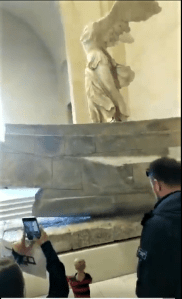
Some mornings I wake to photos and short videos from Paris. It is evening there when I look at what my grandchildren did that morning. I am in the moment and they are asleep. I watch them ride carousels in the shadow of the Eiffel Tower and time stands as still as it can while children laugh and fly through the air in a small metal plane. I watch them race through the Louvre, eager to see everything. In the halls of great art, they are children from the new world. The winged Nike of Samothrace was a particular pleasure for them. Created circa 190 BCE, possibly to commemorate a sea battle, she stands on the prow of a ship of Lartos marble, her clothing of translucent Parian marble so airy that you half-expect to hear it swish. My grandchildren rush to the winged Nike and I watch them, 8000 kms away, earlier on the same day that they went to the Louvre with their mum, a life-time away, the sound of my granddaughter’s voice so clear. “That statue is like a lot of years old,” she says, as her brother stands at the base, his shirt on backwards.
I think of Guy Davenport’s beautiful poem for Marianne Moore, “At Marathon”, and its stunning conclusion:
Two thousand, four hundred and fifty-five
years ago. There are things one must not
leave undone, such as coming from Brooklyn
in one’s old age to salute the army
at Marathon. What are years?
Such as coming from Edmonton as children to race down to the Winged Victory of Samothrace. What is time?

 ...Theresa Kishkan
I agree with you that the world felt different before the pandemic. It is not an illusion. We now have two major wars with no obvious conclusion, escalating impacts of climate change, abandonment of some nuclear arms agreements, heightened tensions with China and Russia, major migration crises, increased homelessness and hunger, and increasing population. Put another way – its not an illusion when a Mack truck hits you! But perhaps our best alternative, as in WW2, is to “keep calm and carry on.” I hope you can manage to do that.
The keeping calm part is fairly easy for me, John. I am so far away from everything, it seems. But it’s hard to think of the future with anything like a positive heart and mind. I fear the world is turning away from Ukraine. The daily news from the Middle East is horrifying. And yes, the impacts of climate change, political shifts, increasing numbers of homeless people…But yesterday, on a walk, I watched a little group of cutthroat trout making their way to spawning beds in a nearby creek and it was just so beautiful and powerful to see them in the cold water, darting under branches, hovering in a quiet pool.
Yes, very hard to reconcile and balance the beauty with all the horror. A story I read lately illustrated our amazing ability to still take pleasure in small personal things, even when we’re conscious of the larger world falling apart.
The blurry photograph for this post is a screenshot from a video. I confess to watching it often for the joy of a little boy in pyjama bottoms and a shirt on backwards racing to the winged Victory of Samothrace with his arms wide-spread, a guard ready to stop him from hugging it.
I love that description; my schooldays friend’s husband works in what I will now always refer to (at least in my own mind) as deep math.
It adds to our loneliness too, doesn’t it, when we feel as though the world is turning away from a situation that we feel is vitally important to witness. Not a personal loneliness, especially when you share your immediate present with someone who shares (or several someones who share) your awareness, but a cultural loneliness. That’s something I feel about the climate crisis too. But, then, in other moments, all these sorrowful situations feel all-of-a-piece.
“Deep math” — it does feel like the right term, esp as I learned how shallow my own grasp of even simple geometry is. (Read “Euclid’s Orchard” for proof…!)
In the title essay of Blue Portugal, there’s an extract from a guide to an exhibition of shipwrecks at the National Museum of Archaeology in Portugal. I remember standing by a case and reading a passage about ship populations being a microcosm, the various decks representing the stratas of society: “…opposite poles of a small world saturated with divisions between social classes and geographical loneliness.” I think this extends to so many aspects of culture — our divides, our lack of common language or sensibility — in ways that are proving to be the undoing of our species.