
The night before last, John heard coyotes yipping. During the day 3 vultures had hovered all day over the old orchard, one or two at a time settling briefly in the tall Douglas firs below the house, then hovering, gliding, the shadow of their wings darkening the deck. We wondered about the source of their interest. A stillborn fawn in the bush? We walked down, pushing our way through dense salal, but we couldn’t see anything. I don’t like to go down there. It reminds me of all the hope we invested in the work of making an orchard and then my sadness at our decision (completely reasonable) to abandon it after 20 or more years. We planted the trees, we fenced the area, maybe half an acre, we kept the grass mowed, we tried another kind of fence when deer jumped the wire, when bears pushed down the wire, even the electric wire, and when the elk arrived, en masse, we gave up. The orchard had its moments: grass strewn with wild strawberries and violets; the apples–Melba, Transparent, Cox’s Orange Pippin, Golden Nugget– were delicious to eat under the boughs and winter gold in pies, sauces, a basket in the garden shed where the Golden Nuggets lasted quite well with their russeted cheeks. It had its moments and sometimes I still dream of it in those years.
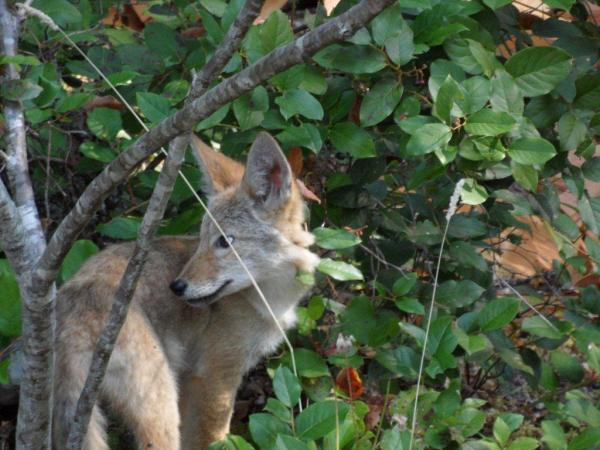
One or two sightings of the vultures yesterday but not their heavy presence in the sky and in the firs. Last night we had just turned off our reading lights when we heard the most beautiful coyote song, quite near, probably to the south of our house, the area where coyotes have denned and raised families for a couple of decades now. The one in the photograph was from one of the early families, when coyotes made their way as far as our area, after they’d been spotted in Gibsons, Sechelt, Halfmoon Bay, moving north little by little. They are opportunist and find niches wherever they can. The young coyote in the photograph was one of that year’s young and over a period of several weeks, we’d see it in the mornings, tentatively exploring near the house. It would push down salal branches and hold them in place with one paw while delicately plucking the berries off. One morning it entered the doghouse, the one we built for Lily, who’d been dead for several years by then. It turned around a few times and sat in the opening. Forrest was home from Ontario for a visit and we were having coffee on the upper deck. The pup knew we were watching but didn’t seem nervous. You could almost train that guy, said Forrest, and seeing it in the doorway of the doghouse, I was almost tempted.
Last night’s song held in it the beauty of the our lives here. There were many voices, their harmonies rising and falling and spreading out into the night. It was so sweet to lie in the dark with my husband of nearly 44 years and to hear the coyotes sing as they have for decades. In 2017 I published a book of essays, Euclid’s Orchard, and one of the essays, the title one, pays attention to this haunting music.
Braid groups, harmonic analysis: The whole is greater than the part. (Euclid’s 5th Axiom)
A mid-summer evening, clear moonlight. Down in the orchard, the coyotes have gone under the fence with their young. How many? I’ve seen one, heard several others. I’ve imagined them on the soft grass, tumbling like my children used to play, rolling down the slope over tiny sweet wild strawberries, over the heart-shaped violet leaves, the deep pockets of moss, while around them snakes hid under the lupines. But now in the quiet, I am shaken out of my dreaming because a coyote is singing a long, low passage. A lump forms in my throat as I look out into the night, the sky dusty with stars, a three-quarter moon hanging so perfect over the hidden lake that I think of a stage-set, an arranged scene created by strings and wishful thinking. A jagged line of dark horizon and the vertical trees, the line of them rising, then descending as the bar changes, a page of music, the arpeggiated chords, the implied bassline. A pause, a comma of silence. Another coyote joins in, then at least two more. It’s a part-song, a madrigal. Each voice is on pitch but one is low, another high, and several braid themselves in and around the melody line.
See, see, mine own sweet jewel,
See what I have here for my darling:
A robin-redbreast and a starling.
These I give both, in hope to move thee—
And yet thou say’st I do not love thee.What feast have the parents provided—a flying squirrel, a clutch of frogs, robin nestlings fallen from a tree, a cat from the summer neighbors sound asleep in their beds? See what I have here for my darling—I hear the riso in the father’s line, his extravagant vibrato; and then the sospiro—in hope to move thee, as the mother nudges the twitching body towards her eager pups. For she knows, oh, she knows, that by summer’s end, her young will have gone their own way, far from the natal den in the woods just south of the orchard, forgetting the braided perfection of the family body and its unravelling, the strands unplucked and loose, and yet thou say’st I do not love thee.

 ...Theresa Kishkan
Lovely
Thank you, Susan