The Next Big Thing

My friend Barbara Lambert has “tagged” me in “The Next Best Thing”, a lively literary relay making the rounds of Canadian writers. The idea is that we answer a series of set questions about our current work-in-progress and then tag (ideally) five other writers, providing links to their websites or blogs. Barbara’s own answers can be found here (and if this also leads you to her recent novel, The Whirling Girl, you won’t be disappointed!): http://barbaralambert.com/writer/author/books/177-Blog+Tour+That+Ran+Itself

Ten Interview Questions for the Next Big Thing:

— What is your working title of your book?


I am half-way through a novella – working title is Patrin (a Romani word for “leaf” or to indicate a trail marked by sticks, leaves, etc.). It will be a companion-piece to a recently-completed novella, Winter Wren.

— Where did the idea come from for the book?


Patrin grew out of research I am doing for an extended non-fiction work based on the life of my grandmother, born in what is now the Czech Republic in 1881. She was poor and it turns out poor people don’t leave a huge material record. I said to someone, “I might just have to imagine her early life as a work of fiction.” About a week later, I began to write a novella based on the life of a woman who turns out NOT to be my grandmother but who has allowed me to imagine another world, a woman who is as far away from my own life as my grandmother was, who came to Canada under similar circumstances but with a very different background. I am also interested in how material objects  can hold family history, often undecoded, so when I saw Patrin opening a box containing a tattered quilt with a curious pattern of loden leaves, connected by trails of grey wool, I knew it was a map directing me to the heart of the story.

— What genre does your book fall under?

Literary fiction.

— Which actors would you choose to play your characters in a movie rendition?

Someone dark and willowy for Patrin, the 20-something woman at the heart of the novella-in-progress. The young Juliette Binoche from The Unbearable Lightness of Being? A young Adrien Brody for Petr, her guide in Prague and further afield. And if anyone has a suggestion for Patrin’s grandmother, a woman in her late eighties, heavy-set, rugged, and with dark-ish skin (she is a Kalderash woman from eastern Moravia), do let me know so I can tell the studios when they come calling.

— What is the one-sentence synopsis of your book?


Victoria, British Columbia and the forests of the Beskydy Mountains in the Czech Republic form the backdrop for a brief lyrical narrative about a young woman in search of her family’s mysterious past.

— Will your book be self-published or represented by an agency?

I have never been able to interest agents in my writing, alas. But I’ve been lucky enough to have placed my books with lively small(ish) presses over the years and have nothing but praise for the presence of these presses on the literary landscape. They keep the cultural conversation diverse and authentic.

— How long did it take you to write the first draft of your manuscript?


I haven’t yet finished Patrin. Winter Wren took me a year. I anticipate that Patrin will take about the same time.

— What other books would you compare this story to within your genre?

I’m not finished yet and don’t want to suggest relationships that might not survive the writing. But I admire the novels of John Berger for their fiercely idiosyncratic structure, the consummate story-telling of Louise Erdrich, the intelligent trajectory of anything by John Banville…


– Who or what inspired you to write this book?

I partly answered this in the second question but of course who ever knows where, exactly, the inspiration for a book truly comes from? As well as family history, I’ve also been immersing myself in Czech cultural history and look daily at the photographs of Josef Sudek who has given me entrance to the Beskydy Mountains where my grandmother lived as a child. And I’ve been listening to Roma music, both the styles of Central Europe as well as Macedonia.

— What else about your book might pique the reader’s interest?


Joe Fassler wrote a wonderful piece on the novella, published last April in The Atlantic. (http://www.theatlantic.com/entertainment/archive/2012/04/the-return-of-the-novella-the-original-longread/256290/) He mentions Dennis Loy Johnson, co-founder of Melville House Publishing and its “Art of the Novella” series: “He was daunted by the genre’s limited viability—and yet the idealistic prospect of novella-writing pleased him. ‘It always struck me very romantically,’ he said. ‘A pure writerly exercise that was only for the love of writing. We had no expectations our novellas would ever circulate.”

Maybe this is part of the pleasure of the novella. Years ago I wrote Inishbream, a brief narrative set on an island off the west coast of Ireland. It was published by the Barbarian Press in a beautiful edition, illustrated by the American wood-engraver John DePol; and then given a second life a few years later by Goose Lane Editions. Yet when I wrote it, I had no expectation that anyone would ever want to publish it at all. The thing about getting older is that you come to terms with what’s possible and what’s unlikely. I’m probably never going to write a block-buster, a best-seller which will be sold to Hollywood (I hate to disappoint Juliette Binoche and Adrien Brody), but every morning I can come into my study, turn on my desk-light, and write for the sake of the language and the story. What a privilege.

I’ve tagged five writers and so far can tell you that Anik See, Catherine Owen, and Don Gayton will carry the baton forward in the near future. I can’t wait to see what they write!
www.aniksee.com

http://blackcrow2.wordpress.com/

www.dongayton.ca

openings

I’ve wanted to write about the winter wren I see almost every morning when I first come to my study. My desk looks out to a small covered porch where a birdhouse hangs, a gift from Brendan a few Christmases ago. No bird has nested in it though every spring a few chickadees examine it and find it wanting in some way. On these cold mornings, the winter wren darts in and out, no doubt in search of insects or spiders. The wren also comes right to the window and hops along the frame. If it sees me, it doesn’t seem to mind. I know that the wrens have been reclassified, that what was formerly known as the winter wren has now been split into an eastern species (winter wren) and a western species (Pacific wren). But I will always think of this small bird as a winter wren. And their song is part of our winter soundscape in these coastal forests, a long complex song full of sequences of notes that repeat fairly regularly. A few winters ago, I was writing a novella I’d titled Winter Wren and was listening to bird song recordings, some of which were slowed down so one could hear these sequences.  And I was listening to Bach too. There are several bars in the fourth movement of  the Partita in A minor for solo flute which have almost exactly the same run of 16th notes that I hear in the song of the winter wren. I’m listening to Jean-Pierre Rampal play this Partita right now and it’s full of winter — the chilly clear air, the rich polyphony of water and birds. I don’t know much about music but moments like this are openings, windows into worlds just beyond our usual understanding.

Here’s a little bit of the novella in which the main character hears the winter wren for the first time:

“She was on the porch, wringing the mop over the edge when her favourite movement of the Bach partita in A minor, the last, the Bourée Anglaise, began. Leaning on the railing, she loved how the passage floated out in the wintery air, a counterpoint to waves and wind. She hummed a little of it from memory. She’d heard Jean-Pierre Rampal play this in Paris, the amazing backward rhythm of the bourée balancing the rapid run of 16th notes, and ever after thought of it as music she would choose before all else.

It wasn’t until the movement was almost complete that she realized she was hearing another sound, another melody answering the bourée, ascending as the flute descended. Startled, she looked around, fearful. Was it someone whistling on her property? No, it was a bird. It must be a bird because there wasn’t anyone or anything else in sight. And it came from within the salal on the trail down to the waterfall. Peering into the undergrowth, she came face to face with a tiny dark bird, very pert, bobbing and bending on the stem it had claimed. From its open beak came a long undulating series of notes as melodic as anything Bach had put to paper.”

Thown (back)

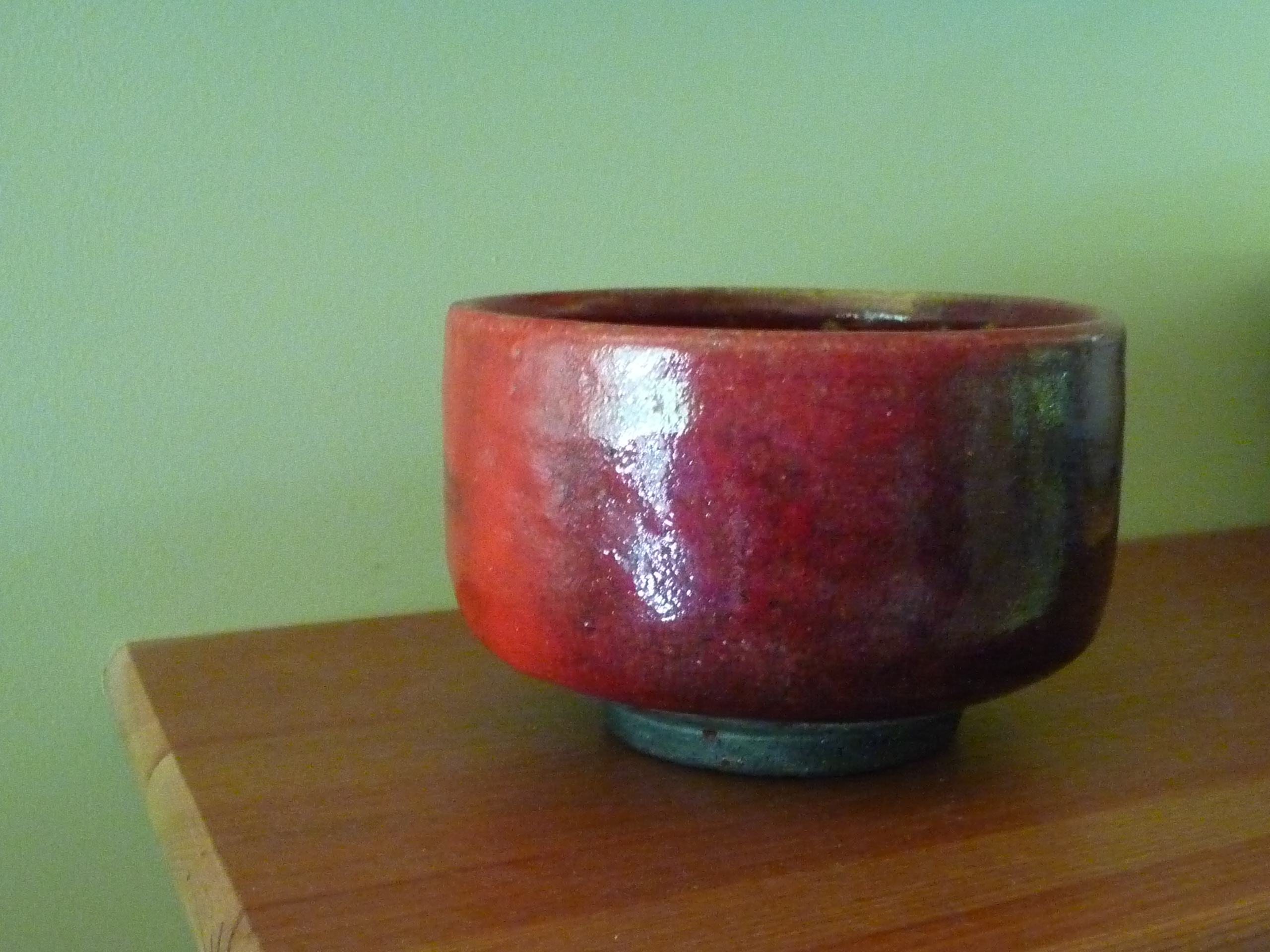
This week I’ve been reading Thrown: British Columbia’s Apprentices of Bernard Leach and  Their Contemporaries, published this spring by the Morris and Helen Belkin Art Gallery at the University of British Columbia. It’s a collection of essays, interviews, and letters by or about a group of potters who were closely (or loosely) connected to the Leach Pottery in St. Ives, Cornwall. These potters – Michael Henry, Tam Irving, Charmian Johnson, Glenn Lewis, Wayne Ngan, John Reeve and Ian Steele – were part of an exhibition at the Morris and Helen Belkin Gallery in 2004. The book  (“Far more than an accompaniment to an exhibition,” the editors write in the Acknowledgements) is a wonderful pairing of texts and images. For those of us who lived in B.C. in the 1970s, the potters and their work will be familiar.  I look around my house and see pots that several of them made. This tea bowl by Wayne Ngan for example. I received it as a gift in 1976. I’ve never used it for tea but keep it on a shelf where I see it every day. The colour never ceases to amaze me.


I’m reading Thrown after the fact. After the fact of the exhibition, which I never even knew about, but also after the fact of writing a novella last summer and fall in which one of the characters is a potter living near Sooke in 1974. He even spent two years working at the Leach Pottery. I read Leach’s books to try to understand the impulse to make things with clay and I was intrigued by one of his colleagues, Katherine Pleydell-Bouvier, who used the ash from rushes and sedges for her pots. When my character returns to British Columbia, he works to develop glazes made from native plants, experimenting with scouring rush and nettles.

In this novella, Winter Wren, I wanted to revisit and re-occupy a time and a place still intensely important to me. I was 19 years old in 1974. I was a university student and I was finding my voice as a writer. I was often lonely and I felt like no one would ever love me. I spent a lot of time on Sandcut Beach, west of Sooke, almost at Jordan River, and in some ways I’m still there. I learned to keep my own company on that length of the coast, bedding down for a day or two at a time above the high tide line and making endless pages of notes in the journal that never left my side. I swam in the breakers and showered under the sandstone cliff where Sandcut Creek tumbles over the edge to meet the sea. The sandstone contains shell fossils from the Oligocene period and I loved running my hand over them for the sense of mystery they contained.

After John and I met in February of 1979, we took a tent and camped on the beach in March. The stars were extraordinary, and the sound of the surf just a couple of yards away was as familiar as breathing. We’ve returned many times and I have a chunk of sandstone on my desk, dense with fossils, to remind me. As if I ever need reminding — of both the early days of our relationship or Sandcut Beach…

The essays and interviews in Thrown are illuminating, shedding light on artistic practice and process, on materials, on friendships and relationships. I love Mick Henry’s letters to Glenn Lewis in which he describes the quotidian details of his life at St. Ives and then later at Roberts Creek – walking, baking bread, making pots. I wish I’d seen that exhibition but in some ways it’s all here, in this book:  tables laid with jugs and platters, tea pots and wine cups ready.