“Where the years went I can’t say” (Kate Wolf)

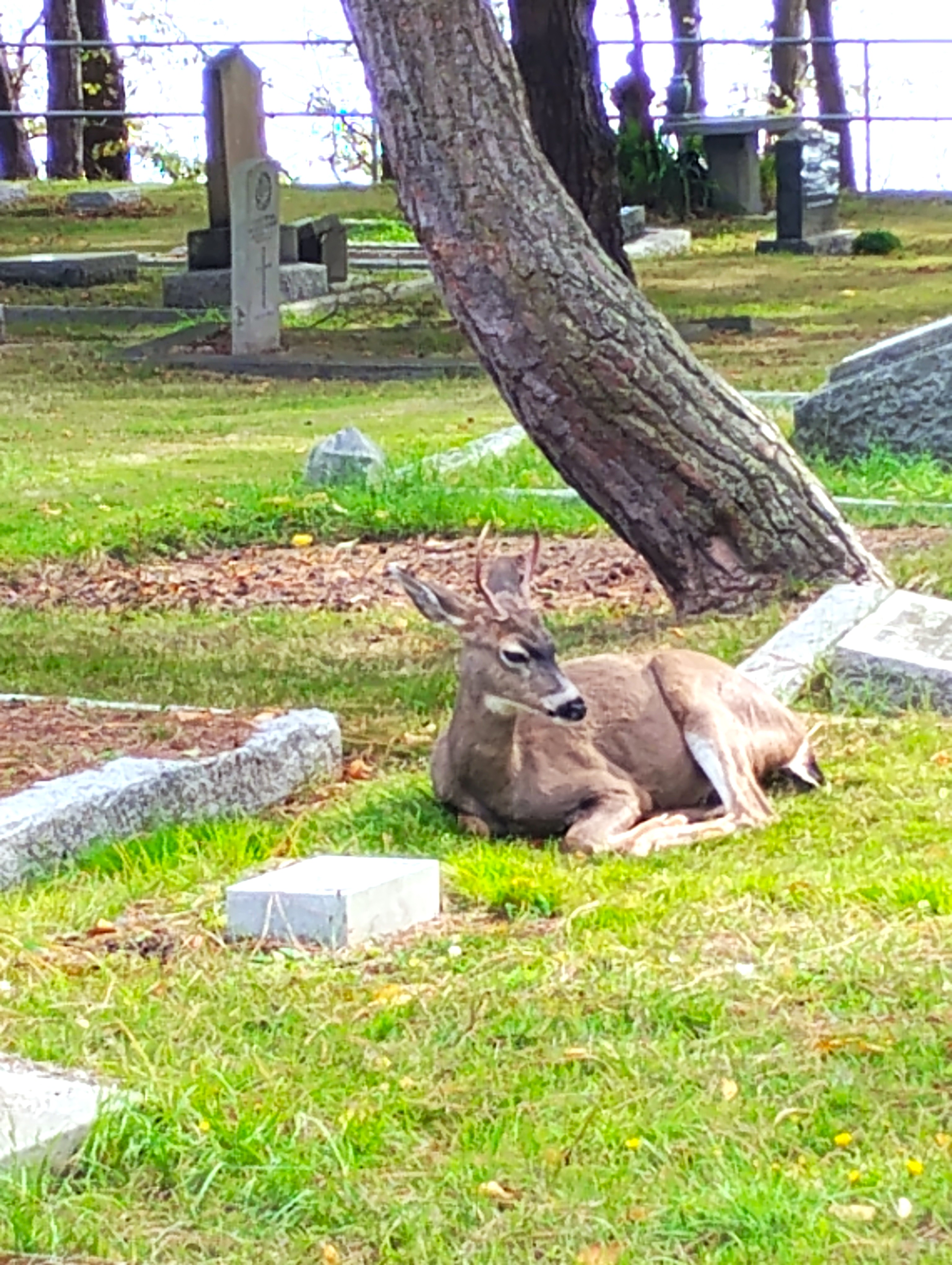
When I was a child living near the Ross Bay Cemetery in Victoria, I never saw deer lying on the graves. Never saw peacocks, or peahens, away from the lawns of Beacon Hill Park. Later, when my family lived at Royal Oak, we sometimes watched deer on the trail by our house, maybe heading for the apple orchards still productive in the area, the ones now turned into subdivisions. Never bears. Sometimes pheasants.

But it’s different now. I pulled off Cook Street onto one of the quiet side-streets to park while I did some errands and there was a peahen with her half-grown chicks. There was a peacock on a fence on Menzies Street, some distance from the Park. And deer? They are everywhere. John and I did our ritual walk in the Cemetery while I told the same stories of riding my bike as a six-year old on the quiet lanes, of listening for the buried creeks under the soft grass and graves, of hovering over the men working on gravestones at Stewart Monumental Works at the top of our street, watching them carve the names of the dead into pink stone or grey. Once my brothers buried me in the sand hoardings under the building–I imagined that it was dust from the stones themselves but learned later that it was sand used to make cement for installations — and how I had to lie there for hours until they remembered me and dug me out. The elderly woman walking with her husband in the Cemetery was telling these stories for at least the tenth time and somehow she was still the girl waiting for her brothers to return. Smelling the iodine sting of the ocean, she remembered Saturday mornings when her mother would give each child a bag and ask them to walk the shore at Ross Bay and collect bark for the wood burner in the kitchen. And she remembered leaving her teddy bear Georgie on Moss Rocks after an afternoon lying among the shooting stars and camas and her father going out in the dark to find him.

I’ve been walkin’ in my sleep
Countin’ troubles ‘stead of countin’ sheep
Where the years went I can’t say;
I just turned around and they’ve gone away

I know I’ve linked to this song before but I was the woman humming it as she walked the Odgen Point breakwater, I was the one so filled with memories of childhood, and later, as we drove past Faithful Street, down Memorial Crescent to find a place a park, I was the one quiet, briefly, in my seat as we passed the old familiar houses. And this song knows about memories. It knows about worn stuffed bears lying in a crevice in the rocks, patient, while a father searched with a flashlight, the family dog to keep him company.

The finest hour that I have seen
Is the one that comes between
The edge of night and the break of day
It’s when the darkness rolls away
“A map of houses and days, of secrets and details noticed by a child fiercely in love with the pattern trees make with their shadows…”


We spent a few days in Victoria, visiting Angelica and Sahand, and it was (as usual) a time of great pleasure and wistful nostalgia. They live in the neighbourhood where I spent part of my childhood; in fact, they are a block away from my elementary school, the one in which I sat near a window and gazed out at Moss Rocks, thinking of the wildflowers on its sunny slopes, and wondering how many more hours I had to sit in the classroom before I could take the path over the rocks and home. We lived near the Ross Bay Cemetery. My mother would say to us on summer mornings, “Go play in the cemetery. I don’t want to see you until lunch.” I rode my bike down its quiet lanes and I had my favourite graves. Some of them were the graves of children; I cried by a small stone armchair with an empty pair of shoes, the grave of D.B. Campbell, who died in 1913 at 17 months of age, “a little hero”. I used to lie on the warm grass and listen to water. Impossible, my father said. But I knew I heard water. It wasn’t until about 2005 that I found out about the buried streams under the cemetery and in fact throughout Fairfield. I gave the experience of listening to water to Tessa, one of the main characters in my novel, The Age of Water Lilies. And like Tessa, I also played in the yard of Stewart Monumental Works where men engraved tombstones while children darted among the slabs of granite and marble and buried each other in the sand beneath a crawlspace under the building. “A map of houses and days, of secerets and details noticed by a child fiercely in love with the pattern trees make with their shadows in sunlight, of the softening touch of moss on an inscription set in motion in a box canyon where lovers lay in dry grass and dreamed of a future now collapsed by violence. Off the edges of the map, the world settles its story and what can anyone do but remember the route water takes through the decades on its singular journey to the sea.” And much earlier than any of this, the Lekwungen people used the creeks as transportation corridors through their territory. A place contains so many layers of history, so many occupations, so many stories. Sometimes, if the light is right and we are attentive enough, we can apprehend something of this richness. A house, a grave, a creek, a case of masks in the Royal British Columbia Museum with information about the Winter Ceremonials to remind us that our own experience is recent, that the ravens we hear in the yews at the cemetery are the descendents of those who inspired the Crooked Beak of Heaven.

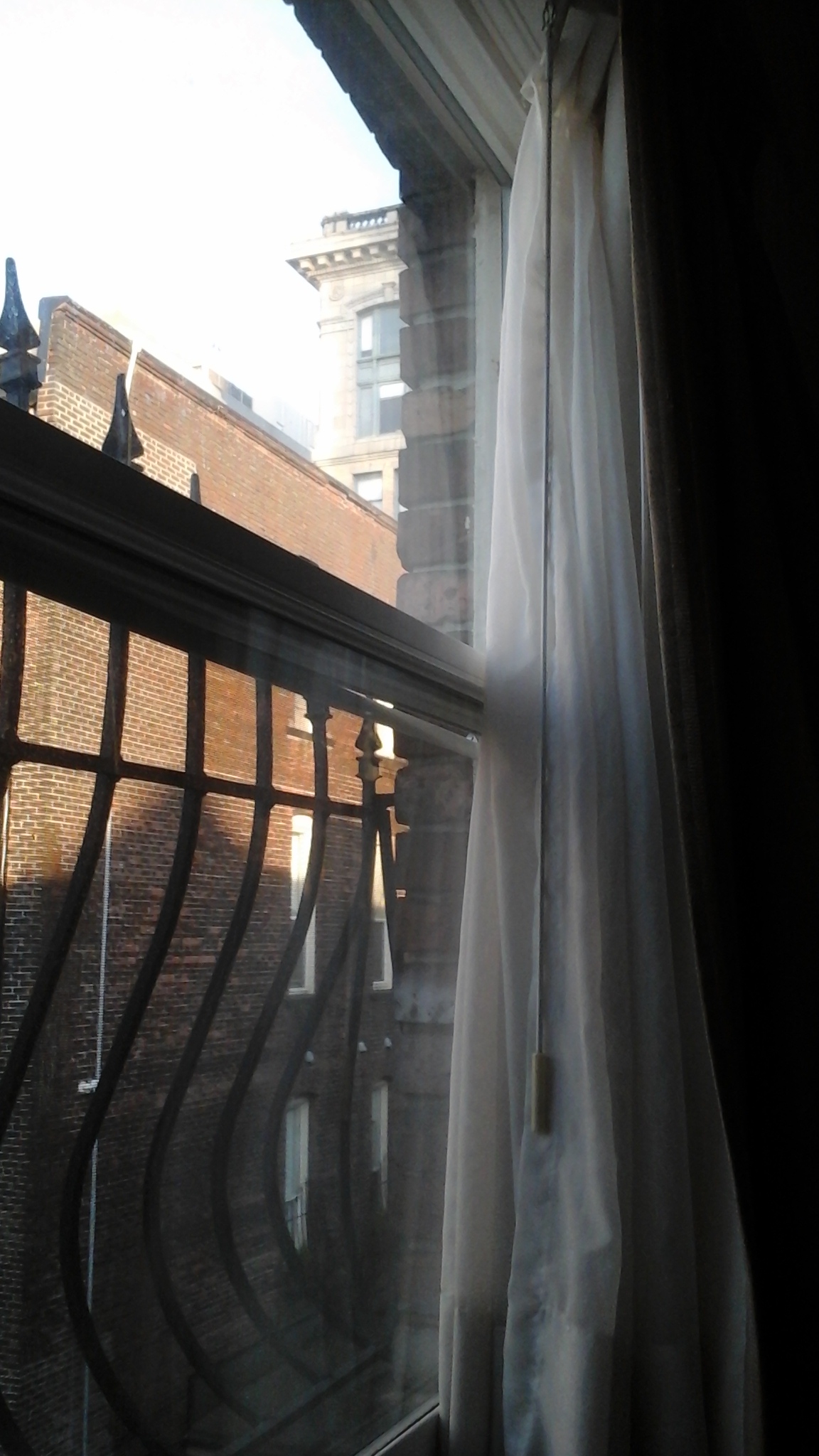
And then a night in Vancouver — John was reading at the Vancouver Public Library as part of the Vancouver Writers Festival Incite Series — where we stayed in our favourite hotel   (speaking of history): http://victorianhotel.ca/   It’s kind of quirky and the breakfast room is always in yet another stage of renovation but the rooms are comfortable and the rates are so reasonable, particularly for Vancouver. (And imagine, you get breakfast too: wonderful croissants and baguettes with fruit and coffee.) When you sit at the table in the window of your room in the morning, you have the sense that you are truly somewhere. Not just anywhere, but a place, a location, a building with echoes of its making in the brickwork around the windows, the little glimpses of other buildings around the corner:

from the Victorian Hotel

The hotel was built as a guesthouse in 1898 and occupies a corner in what might be termed a “transistional” neighbourhood. But on the other corner, Finch’s — the best sandwiches in the city: we had fresh baguette stuffed with sliced free-range eggs, butter lettuce, dijon and mayo, and thick slices of tomato. Nearby, Sikora’s, for cds (some of us will probably never learn to download music. I still don’t know what an ITune is). And around the corner, The Paper Hound, a marvellous independent bookstore.

Driving away from the Victorian, along Hastings yesterday, I saw the Marine Building ahead of us, cradled by a curved glass tower in morning sun. The new, the old. The Marine Building is one of the most beautiful structures in Vancouver. It was built in 1929-1930, with Art Deco carvings and plasterwork and a Mayan effect in its upper stories; at 21 floors, it was the signature skyscraper of its time. You might not notice it if you’re walking along Hastings or Pender, listening to your ITunes, but if you look up, there it is. Unforgettable.

marine building