
I’m reading The Lost Landscape, the new memoir by Joyce Carol Oates. I’m not particularly drawn to her fiction and in truth this book is uneven — a whole chapter told from the perspective of Happy Chicken??? But the chapter I’m reading now is one in which she parses the hidden stories of her mother and father. A murder, an attempted murder, a child (her mother) given away to people who might have been relatives. Or maybe not. And I recognize something deeply familiar. She writes of the “childhood mysteries”, and how she wonders if they are at the root of her fiction: “I find myself imagining that what I am inventing is in some way “real”; if I can solve the mystery of the fiction, I will have solved a mystery of my life. That the mystery is never solved would seem to be the reason for the writer’s continuous effort to solve it — each story, each poem, each novel is a restatement of the quest to penetrate the mystery, tirelessly restated. The writer is the decipherer of clues — if by “clues” is meant a broken and discontinuous subterranean narrative.”
As I grow older, I increasingly want to know the mystery of my mother’s birth. I’ve written of that in these (virtual) pages and it’s the subject of a section of the memoir I’m currently working on. Who was she? Some things are known. Shirley MacDonald, born in Sydney, Cape Breton Island, in 1926 to an unwed mother whose surname was McDougall. My mother was put into foster care at a few days of age and she lived with her foster mother and sister and brother until she was old enough to move out on her own. That foster mother was Emma Morton Watson, widow of Dr. David T.C. Watson, a physician and medical missionary who died in 1917. I’ve been to Sydney. I’ve asked questions. I’ve written letters. I’ve applied for my mother’s birth certificate because she was told that the names of her birth parents were recorded on her birth certificate but the Vital Statistics office in Halifax tells me I have no right to that information until 100 years after my mother’s birth. Let’s hope I’m still alive in 2026.
My mother had little bits of information about her possible birth father. She was told — I don’t know if it was her foster mother or her foster sister (Helen Maude Watson) who told her this — that he was the brother of a prominent Halifax physician. She told me this. I’m sure of it, or at least as sure as anything that she told me. But apparently she didn’t tell my brothers this. So I am aware there’s the possibility that I’ve misremembered. But I don’t think so. I ‘ve known this — or believe I’ve known it — my entire adult life.
I’ve looked at lists of doctors in Halifax from the period of her childhood and there’s something that stands out. Her foster mother’s brother, Dr. Angus MacDonald Morton, was a physician in Bedford, a suburban community of Halifax. He had five sons, one of whom died in infancy. One of them, Allan Reid Morton, followed his father into medicine. Here are some notes about him from the CPHA website:
He graduated in medicine from Dalhousie University, Halifax, in 1925 and went into general practice in Wolfville until his appointment in 1927 as Assistant Medical Superintendent of the Nova Scotia Hospital. From 1934 to 1939 he again practiced medicine in Halifax and in 1938, became part-time Medical Officer of Health of the City of Halifax. From 1937 to 1939 he was also Superintendent of the Halifax Tuberculosis Hospital and received a Rockefeller scholarship and graduated in 1940 from Johns Hopkins University in Baltimore with a Master of Public Health degree. He returned to Halifax and became the first full-time Medical Officer of Health for that City and in 1941 he assumed the dual responsibility of Commissioner of Health and Welfare for the City of Halifax. At this time, he also accepted an appointment as Associate Professor of Preventive Medicine at Dalhousie University.
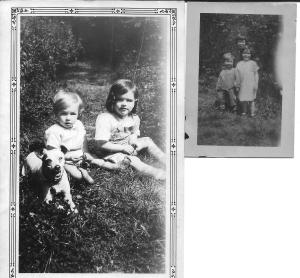
The other brothers were also quite successful, or at least two of them were. One became a chemistry professor at Carlton University and one became a journalist, eventually buying the Dartmouth Free Press and teaching journalism. There was also a sister. There’s a photograph of her in my mother’s foster sister’s photo album in which that sister looks a lot like my mum. In fact, in a photo of the whole family, I see my mum in many of them. Is this just because I want to? I’m willing to believe that. But I’m also willing to believe this might be part of the secret my mum grew up within, perhaps a part of, but shamed from being included in.
If a child is born out of wedlock and there’s a widowed sister who needs money and she is a nurse, thus reliable as a carer of children, then it makes sense to hide the illegitimate child in plain view. Doesn’t it? I wonder if I’ll ever know. I have all these photographs, these suggestions of a trail, but no certificate to prove my mother’s provenance. Her name, hidden in theirs. Her dark hair. The fact that she was told (though I’ve never found any evidence of it) by her foster mother that there were possiblities of adoption during her childhood but her foster mother didn’t want to give her up. Love wasn’t mentioned. But perhaps there were family expectations that the foster arrangement would continue.
Increasingly, that “subterranean narrative” has taken its place in my writing, asking to be brought to light, the way buried streams are daylighted. In fact a small section of the piece I am currently working on is titled “Daylighting”:
“Daylighting—the practice of restoring a stream that had been routed through a culvert back to its natural state—is becoming a more common stormwater trend.”
Let me bring you back to life, to light. Let me trace the route of all those undercurrents, the dark waters idling their way to the sea, find the bed and the riffles of oxygen, the small tributaries that lead away from a source but which might, with effort, allow me to find the spring of your origin.


 ...Theresa Kishkan