

I was beginning to think I was jinxed because The Gentle Art of Swedish Death Cleaning was never available at the Sechelt Library; it was always checked out. For some months I’ve been thinking that I need to sort and winnow the overflowing rooms in this house I’ve lived in for 43 years. The books alone are, well, too many. We have a room with double-sided shelves, filled. I have a study with shelves built into one full wall and there’s no room to squeeze in another thin volume of poetry. Speaking of poetry, John has shelves upstairs with so many that he has also made piles on small tables and the floor. We never got rid of children’s books and good thing because now there are grandchildren. My mind is firmly analog, I guess, and although I use the internet (of course), I love to sit with books and look things up. There’s nothing like an atlas, for instance, or maybe 3 so you can cross-reference, sitting with them on your knee, tracing the distances from one city to another, tracing the river courses, figuring out borders. You need 3 because those borders are always shifting and it’s interesting to think about that historically, over time. And dictionaries: same.
But yesterday the library’s copy of The Gentle Art of Swedish Death Cleaning was on the shelf and I brought it home. I read most of it before sleep last night so is it any wonder I dreamed of filling boxes with…books? The author advises one room at a time. I’d like to try. I’d like to take in large bags and fill them with clothing, shoes I’ll never wear again, pots I haven’t cooked it for years, maybe even the fish-poacher Floyd St. Clair gave me when he was doing his own version of Swedish death cleaning. I remember I’d gone to have an early dinner with him and his partner David Watmough with my older son Forrest before heading down to Kits Point to see a performance at Bard on the Beach. We were using the bus and we were going to return to North Vancouver to sleep at the home of another friend after the play. So I had the fish-poacher in a large bag that I had to tuck under my seat in the tent and then carry back on the bus. That’s one item I could death clean but do I want to? Not yet. Floyd and David have been dead for years and I miss them still. (Everything in this house holds a memory.) Giving away the fish-poacher would seem so disloyal, unloving.
I could death clean the dresser holding table linens but then what happens when we need enough table cloths for all the tables put end to end for a really large gathering? (Will we have a large gathering again?) I could death clean the silver. The author recommends saving only enough plates and cutlery for the places you can set at your table. But what if? What if?
We don’t have a basement. Instead, we’ve filled our utility room with boxes of old boots, a tent, an inflatable dinghy, canning jars, two wine racks (filled, more or less, but you wouldn’t death clean wine, would you?), two vacuums, and, and, and. We’ve also filled our print shop, purpose-built to hold one printing press, then another, and cabinets of type, a table for laying out freshly printed pages, a cabinet for ink, etc. But as well as another vacuum, there’s also a wall of boxes of books, mostly copies of my own books, bought when they went out of print or else a publisher wrote to say they’re taking up too much warehouse space. Who could say no? Not me. No one wants to think of their books being shredded. But honestly, was it wise to think that somehow I could sell the books myself? I am no entrepreneur. (If you’re interested in any of them, just ask me. $5 a copy, plus postage.)
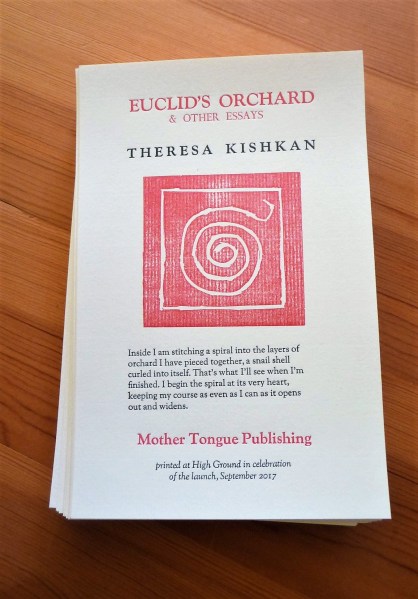
When I went to the library yesterday and found The Gentle Art of Swedish Death Cleaning on the shelf, I was thrilled. I looked at the first couple of pages and was filled with resolve. As I was leaving, I stopped at the trolley in the library lobby to see what books were being discarded, taken out of circulation. I’ve found treasures there, most recently some children’s books in French to have here for my Gatineau grandsons. Yesterday there were several copies of my book Euclid’s Orchard, the ones the library kept in their book club sets. I loved visiting a couple of book clubs who read that book, several members using library copies (while others had bought the book and asked me to sign it for them). Reader, I hesitated. I knew I had at least one box of Euclid’s Orchard in the print shop in the precarious stack against the east wall. Did I really need any more? I hesitated, as I said. But somehow The Gentle Art of Swedish Death Cleaning gave me to strength I needed to walk right past. And maybe I don’t want a copy (or two) of one of my own books with Discarded stamped on it. It’s a bit like finding one of my books listed on ABE, described as being “Unread, with fulsome personal inscription from author to fellow writer”.
One room at a time. That’s what the author advises. I don’t know where to start. But at least I haven’t added to the problem. Not since yesterday.



 ...Theresa Kishkan