“Can a bridge be an anchor?”

On Sunday evening, we had the pleasure of hearing Diego El Cigala fill the Chan Centre with Spanish flamenco, from slow beautiful ballads to salsa that had everyone in the building on their feet, stamping and clapping. His band was sensational. He was sensational, with a rich voice and an extraordinary energy. Before the concert, we attended a discussion, “Opre Roma: Rise up Roma”, between Gina Csanyi-Robah of the Canadian Romani Alliance and Dr. Shayna Plaut of the Global Reporting Centre on contemporary Roma resistance and empowerment. It was interesting to see video clips of Roma children in Europe, in places we’ve traveled (and that I wrote about in Patrin), overcoming the systemic discrimination that has marginalized them for centuries, and then to hear Diego demonstrate, with passion and elegance, that rising.

diego.jpg

And now I’m back to work on the collection of essays tentatively scheduled for publication in September, 2017. In our discussions about the essays, the publisher suggested some specific areas needing work. This kind of clear editorial attention almost always sends me directly out into the field of the material at hand and I begin to see how to reframe the work. I spent most of Saturday revising one essay and what I loved was discovering that a fragment in my “Current Work” file actually fills the gap the publisher had identified. The fragment was a series of questions asked of applications for homesteads, circa 1910, and I found myself answering those questions from my particular point in history.

11. What is the size of your house, of what material, and what is its present value?

In the list of structures on the SE quarter of Section 10 Township 29 Range 20 Meridian 4, Joseph Yopek has a shack 20 x25, partly on the street between blocks 51 and 52. It is valued at $150. Other houses described? Holes in the ground with sod for roofs. A dugout in the riverbank (my grandmother’s brother). I try to imagine these dwellings, how 11 people could sleep in such a small house. How they could study their school lessons (of which English would have been an important one), how laundry was done (several children in diapers at any one time), clothing sewed and mended and how much light there was during the long cold winters. In a town history of Drumheller, I find a description of a house that sounds almost like it could have been theirs, though the woman remembering is called Bond.

World War 1 started in August, 1914, and on October 2 my second baby was born. We called him Tom. He was only a few weeks old when my husband was laid off, so we had to leave our home because it was a Company house. My husband got lumber and built a small place on the School Section nearer the town, similar to those being built by a number of other people. The houses were longer one way than the other, and could be converted into two rooms. They had a caravan roof, had tar-paper on the outside walls and roof and, as at the Sterling, had no water or toilet inside. Those homes with children had bunk beds put along the back wall. As soon as our house was livable we moved in. Gumbo was very bad on the roads here when it rained and we always struck across the field to the railroad track during wet weather, otherwise you could lose your footwear in the gumbo.

Meanwhile, there is concern that a local man can’t get grazing rights to the land and a mayor complaining that the squatters paid no taxes for services.

I am excited about this work and the prospect of making the essays better. This photograph is one of the anchors I keep at hand because it’s central to one of the pieces I’ll be revising this week. (I know the metaphor is a little unruly. Can a bridge be an anchor? I hope so.)

bridge over Rosebud River.jpg


September song

But the days grow short when you reach September
And the autumn weather turns the leaves to flame
And I haven’t got time for the waiting game

And the days dwindle down to a precious few
September, November
And these few precious days I’ll spend with you

                         (Kurt Weill, Maxwell Anderson)
A sweet time at our house with a visiting grandson (and his parents), a visiting daughter (minus her cats this time around), and a scattering of bright days among the rainy ones. The other morning I noticed that the bigleaf maples are turning and the air has that cool tang of autumn. Apples, stardust, the knowledge that chanterelles are out there if we just hunt carefully enough.
A perfect time to offer a sale! So I am. Three novellas — Inishbream, Patrin, and Winter Wren — for $45, shipping included. Here’s what reviewers have said about the books:
Inishbream is a story imbued with the rhythms of speech and of the natural world, of dying and living, of flight and change. It holds the same fundamental truths as a sung air, as the hanging notes of a tin whistle, of the resonance of pipes.” — Quill and Quire
“In Patrin, Kishkan skilfully weaves together several complementary threads, each one illustrating a different aspect of longing. One thread expresses the nostalgia for a personal past (Patrin’s first loves, and her early days of independence as a young woman just coming into her own); another illustrates Patrin’s desire to connect to an ancestral past, to feel part of something larger than herself.” — Vancouver Sun
“Kishkan’s new novella, Winter Wren, is a phenomenal read, and the latest evidence that there’s no accounting for which artists are the ones who get famous.” — Book Addiction
Each of them is the ideal length for an afternoon’s read by the fire (or the memory of one), each one of them will take you to unexpected places — an island off the west coast of Ireland, Czechoslovakia before the Velvet Revolution, a wild beach on Vancouver Island. And they make beautiful gifts. (Is it too early to think about Christmas? No.)
Here’s my grandson Arthur enjoying novellas on a rocking chair by the fire.
novellas!.jpg
And the days dwindle down to a precious few
September, November
And these few precious days I’ll spend with you

“I say, ‘Regicide.’ I say, Help!'”

From An Exaltation of Larks, by James Lipton:

An Herde of Wrennys, The Book of St. Albans. Hodgkin says, “The wren was probably allowed the term of ‘herd’…because it was the king of birds.” I say, “Regicide.” I say, “Help!”

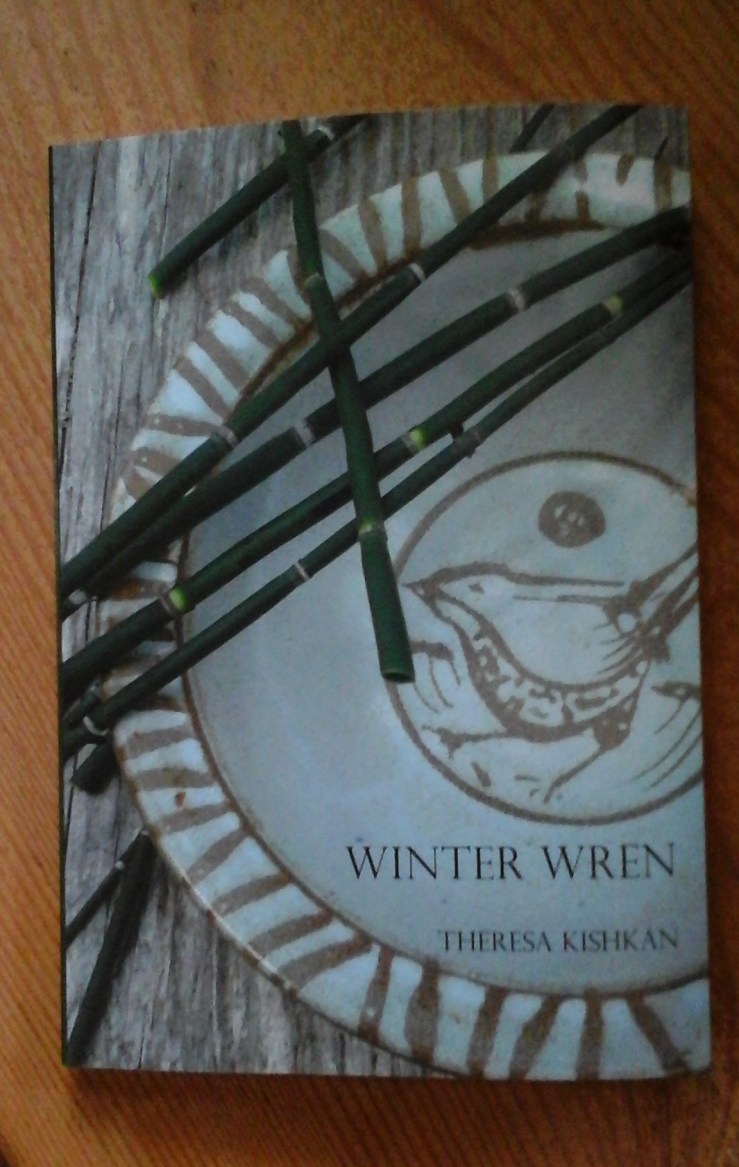
It’s been slightly more than a month since the boxes of my novella Winter Wren arrived at my door. Readers of this blog might remember that my friend Anik See and I have begun a small literary imprint, Fish Gotta Swim Editions, to publish novellas for now and perhaps other innovative prose forms in the future. It’s been an interesting process so far. I wrote Winter Wren, Anik designed the cover and text, and the wonderful team at Printorium in Victoria printed the beautiful hand-sized books. People are sending the nicest notes or calling me to tell me their impressions. So far, so good!

winter wren.jpg

It’s a word-of-mouth endeavor at this point. We don’t have an advertising budget so we’re relying on email newsletters and the kindness of friends and strangers. Anik doesn’t even have copies yet but will receive hers when she’s in Canada next month. After then, she’ll fill orders for European customers and those from other parts of the world. (I’m filling orders for North, Central, and South America. And have mailed books to the UK and a few other places far afield.) But we both believe that readers will be interested in novellas and will somehow find us and our titles. (More are in the planning stages.)

Several reviews are forthcoming and I will post information and links on my News and Events page once I have them. I look forward to reading from Winter Wren when I participate in the Sunshine Coast Festival of the Written Arts on Friday, August 12th at 2:30 p.m. (I plan to talk about novellas in general and to also  read from my Patrin, which isn’t even a year old yet!) There will also be a proper launch for Winter Wren, probably in September. (If this sounds a bit vague,it’s because, well, life is busy right now! The Pender Harbour Chamber Music Festival, which I’m involved with, is coming up on the weekend of August 18-21 in Madeira Park; some of my children are coming for a couple of weeks later in summer; and there’s a third grandchild due in late August. But watch my News and Events page for a book launch date and if you’re in our area, come to help celebrate its regicide — without giving too much away, that word has a kind of eerie truth for this tale of wrens and the solstice and the passing of the old year.

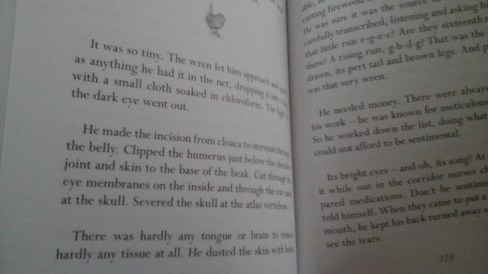
pages.jpg

And if you want to support independent publishing not just in Canada but internationally (because Fish Gotta Swim Editions is located here on the west coast as well as in Amsterdam), please consider ordering a copy of Winter Wren. You can order from me. Or Anik. Several bookstores here on the Sechelt Peninsula carry the book and others can order it for you. If you are interested in a review copy, please let me know.

voices from west of the 4th meridian

I keep hearing them, voices from a hundred years ago, on the banks of the Red Deer River. I’m working on something I think of as an antiphonal essay, a series of calls and responses. Sometimes the calls are my own, back through the decades, to ask questions of my grandmother and her first husband, the other members of that early incarnation of my family who lived in a settlement of squatters in Drumheller from 1913 – 1917; and sometimes the calls are theirs — to the institutions and individuals who were part of the world they lived in. And the responses? They are often choruses of voices, or occasionally a single voice. The voice of Frank Collins, Superintendent of School Lands, Department of the Interior, Winnipeg, who wrote “I do not consider that we should force the squatters to vacate this land as it might seriously affect the operation of the mines…” He knew, as others knew, that the reason people had built shacks illegally on a quarter section of property known as School Lands was mostly because they were poor, there was nowhere else for them to live in the tiny community of Drumheller, and their labour was needed in the nearby coal mines. The voices of representatives from the Canadian Northern Railway who responded to Frank Collins: “The squatter situation has developed to our disadvantage.” The voices of the surveyors, the mayor of Drumheller (in a terse telegram): “Conditions are a menace to towns health and finances as we are practically debarred from any revenue from people on this land.” Later voices from people remembering what it was like to live in the settlement:”There were many coyotes running in packs. When they howled there were very noisy and would wake up the children. Each house had its scrap heap where you put out ashes, etc. The coyotes would come across the river in search of food from these scrap heaps. At night you could see them run from these heaps when you went outside…The houses were longer one way than the other, and could be converted into two rooms. They had a caravan roof, had tar-paper on the outside walls and roof and had no water or toilet inside. Those homes with children had bunk beds put along the back wall.” There were nine children in the home of my grandmother and her first husband so I am trying to listen to the voices inside their house (20×25 feet) and outside, as my grandmother chased her chickens and hoed potatoes in the big garden (its dimensions, 80×125 feet, found their way onto the list detailing the worth of the buildings in the settlement once a decision was made to allow the squatters to buy their lots). I hear them, I hear them across the decades, and it’s like a plain-spoken opera, an oratorio, the voices beautiful in their insistence on being heard. Even the questions on the patent application for homesteads:

When did you build your house thereon? And when did you begin actual residence thereon?

How much breaking have you done upon your homestead in each year since you obtained entry, and how many acres have you cultivated each year?

How many horned cattle, horses, sheep, and pigs, of which you are owner have you had on your homestead each year since date of obtaining entry? Give number of each year.

So I listen and notate and try to find a shape for this material and all the while I have these photographs on my desk, a little gallery of lost time.


the fish are swimming!

fish

Readers of this blog will know that my friend Anik See and I are both passionate about the literary novella. We love to read them and we write them. Although I’ve been very lucky with publishers in the past — both the Barbarian Press and Goose Lane Editions issued beautiful editions of my novella Inishbream and more recently Mother Tongue Publishing released my Patrin — I’m also aware that current publishing models aren’t exactly embracing the novella any longer. A few stalwarts persist. But when Anik visited here on her way back to her home in Amsterdam after a three-month residency at the Berton House in Dawson City a year or two ago, we were both lamenting that we had novellas that we couldn’t find publishers for. At one point in the conversation, we began to laugh and one of us said to the other, “Well, you know what this means.” And we did know. It meant we had to create a place for novellas so that this wonderful, well, is it a genre? A hybrid? A special variant? Anyway, a place for it to flourish. Anik has a lot of experience as a book designer — have a look at her Saudade, which she both wrote and designed…(She is also an amazing journalist: listen to her recent documentary, “The Illusion of Money”,  for the CBC’s Ideas:http://www.cbc.ca/radio/ideas/the-illusion-of-money-part-1-1.3460225 )

We’ve been working back and forth on the first title of our Fish Gotta Swim Editions, which just happens to be my novella Winter Wren. Anik edited it, then my husband John (a poet and long-time college English instructor) copy-edited it (with a few disagreements of the “Can This Marriage Be Saved” variety, mostly to do with how to present dialogue on the page: as a writer, I want to believe that a text can accomodate dialogue as part of a narrative without setting it off with quotation marks; John is less convinced…), and now Anik has designed the book block which will be sent to the printer in Victoria when we have all the details right. The pdf arrived this morning so I could see and approve and make suggestions. And reader, I have to say it’s absolutely beautiful. I can’t wait for it to be a book in hand. Soon!

We are sorting out details to make it easy to buy this book. Copies will be available for shipping from both Amsterdam and here (the west coast of B.C.). And I think I’ll make a webpage for our Fish Gotta Swim in the next while too. Watch for more information on this. (For now, Anik has a page for it on her website, www.aniksee.com)

We don’t intend for Fish Gotta Swim to be a vanity press. We’re starting with one of our own books simply because Winter Wren is ready. We hope to make a small but relevant contribution to our literary culture over the next few years by finding and publishing novellas.

a copper briki

“A tiny copper briki in which coffee had been boiled three times.” That phrase occurs in my novella, Patrin. I wrote it, remembering how much I’d loved coffee the months I spent in Greece in the last century when I was in my early 20s. I had a sweetheart on Crete — I’ve written about him in my memoir, Mnemonic: A Book of Trees, in the chapter “Olea europaea: Young Woman with Eros on her Shoulder”: “A very old man, a fisherman with a bright blue boat, used to bring me slices of melon when I sat at the dock and read my book. One day he brought his son, whom I will call Agamemnon. He was older, had served in the army, and spoke English only marginally better than my Greek.” I had many cups of coffee with Agamemnon and his father. They made it by spooning coffee into water in a little briki, along with sugar. The briki was placed on a gas burner (Agamemnon and his family owned a small taverna) and brought to the boil, removed, placed back on the burner, removed, and then placed on the burner one more time. It took some time for me to convince them that I wanted mine without sugar — sketos. But that’s how I liked it best. They didn’t drink their coffee quickly, the way people drink an espresso in Italy, but they sat at a table or on a bench, with a tall glass of water, and they sipped the coffee slowly and appreciatively. I learned to do the same. The first few times I had coffee with them,  I drank mine right down to the last drop — which was grounds. And I was told not to do that. I soon figured out when to consider my coffee finished. All this is so long ago now but the other day, on Commercial Drive in Vancouver, I was shopping for Christmas presents and as I was about to pay for all the things I’d chosen at the Mediterranean Market (this will be an edible Christmas!), I saw some brikis hanging behind the counter. I asked to see one and as I held in my hands, a whole world came back to me, filled with the rustling of olive leaves, the flavours of retsina and salty cheese, the feel of my body alive in the ocean, and then the company of two men under shade trees in front of Agamemnon’s taverna. Of course I bought the briki and will keep it in my kitchen for the memories it conjures on winter mornings, the taste of strong coffee — sketos — and the warmth of sunlight, almost forty years later.

briki

“we are nothing if not impulse to direction”

When John and I met and fell in love in 1979, we spent a fair amount of time arguing about poetry. Not our own but what we imagined the important contemporary writing to be. I remember running out into the night, in tears, wondering what on earth I’d done by marrying someone whose ideas were so different from my own. I’d barely heard of Robert Duncan, Charles Olson. What on earth was “projective verse” and how could it possible matter. We did have many favourite writers in common; we were both reading Wendell Berry and Gary Snyder, for instance. And in truth, our work was far more congenial than we knew during those first months, that first year. We used different language to talk about writing and in time our vocabularies became as acquainted and then as familiar as everything else.

I’ve been remembering all this for the past month or so as I sit in audiences listening to my husband read from his new book, which isn’t really new. It’s Forecast: Selected Early Poems, 1970-1990 (Harbour Publishing). The poems come from out-of-print chapbooks and books and some of my favourites are there, including “The Crossing”:

here the star, the far shore

or this tree. we enter with attention


what passes and must pass

to bring us closer


the ocean heals behind the ship

the trodden brush springs back


and we are nothing if not impulse to direction

This poem concludes with the line, “we cannot hold our coming through the world”, which has always seemed to me a deeply powerful mantra. Our mantra, in a way.

So. “Projective Verse”. This morning I remembered the phrase and asked John about it and he immediately opened his copy of Donald Allen’s The New American Poetry to Charles Olson’s essay.

projective verseJohn’s notes on the pages are as interesting to me as the essay itself. What he noticed, what he underlined, what spoke to him. This passage, for example:

It would do no harm, as an act of correction to both prose and verse as now written, if both rime and meter, and, in the quantity of words, both sense and sound, were less in the forefront of the mind than the syllable, if the syllable, that fine creature, were more allowed to lead the harmony on.

And later, this:

The objects which occur at every given moment of composition (of recognition, we can call it) are, can be, must be treated exactly as they do occur therein and not by any ideas or preconceptions from outside the poem, must be handled as a series of objects in field in such a way that a series of tensions (which they also are) are made to hold, and to hold exactly inside the content and the context of the poem which has forced itself through the poet and them, into being.

And this:

Let me just throw in this. It is my impression that all parts of speech suddenly, in composition by field, are fresh for both sound and percussive use, spring up like unknown, unnamed vegetables in the patch, when you work it, come spring.

In those years, I was trying to find a way to integrate all the elements of my life — my love of place, of plants, of textiles, of food (the making of it, the history of it, the science of it); I was hoping to find a form which would allow all those parts of daily life to take their place in my artistic practice, to find the right tension (like knitting!) to hold them in a way that enhanced their textures and relationships. I remember making paper one summer, using a kit brought by a friend for our children, and we were experimenting with adding flowers to the pulp, which we’d made with various kinds of newspaper and other paper, chopping and blending them all together. In those years we were the grateful recipients of passed-on copies of the Times Literary Supplement and that particular light newsprint was perfect for the pulp. When I’d pressed the pulp into the screen and then removed it and let it dry, I was astonished to see that words and phrases from the TLS had survived the process of blending and had emerged at various points in the finished sheet of paper, along with flowers and stems. (Somewhere I still have this piece of paper, I think.) I realized I could manipulate the contents of the pulp with a bit more experience and effort — imagine positioning lines of poetry so they could be seen within the paper from certain perspectives. Paper as palimpsest, as repository… I felt both exhilaration and anguish. Yes, here was another process which would allow so many elements of what I loved to conspire and create something new but did I really have time to take on another practice?

The older I get, the more I realize that the writing of a book is a composition both as crafty as the making of paper and as artful as the positioning of objects in a field, a projective field, the syllables sounding their way across it in a lively and unexpected way. When I look at my drafts and notes for Patrin, I see how they resemble, in a way, the notes I make for quilts. There were other possible arrangements for the individual blocks which make up the narrative(s) and it took me some time to find the pattern which allowed the visible or external story to both hold and reveal the coded history. And are these things ever completely known to us as we work and then as we read? As we sew, as we press pulp through a screen to make sheets of new paper? I suspect not.  I remember reading a wonderful book years ago about the quilts women made as they travelled the Oregon Trail. In Treasures in the Trunk, Mary Bywater Cross provides an alternate history of that movement west by decoding the quilts which were created during , or after, the migration. They were commodoties, death shrouds, memorial texts, dreamscapes, echoes of everything seen and experienced. Even their titles have the resonance of poetry: “Stars with Wild Geese Strips”, “Wandering Foot”, “Pieced Star”, “Wheel of Fortune”, “Birds in Flight”, “Delectable Mountains”. Did those women consciously embed their hopes and fears in the patterns they chose for the bedcovers they composed during the long days of their journey west? Maybe not entirely consciously. But for women who perhaps had no other outlet for such expression, the domestic becomes the artistic.

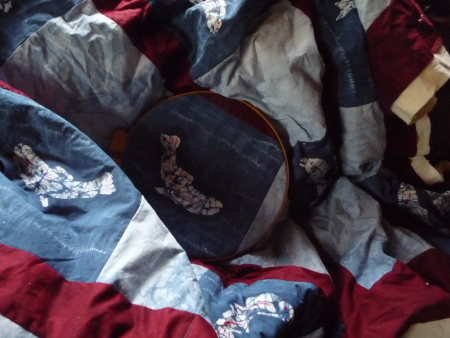
My friend Barbara Lambert sent me something she’d posted about Patrin on Facebook. It made me so happy that she’d detected the pattern at its heart and that she also provided a visual example (in her photograph, the book is resting on a potholder I made for her years ago and the potholder is layered on a beautiful piece of shibori cotton):

When is a novella even more than a novella?

When its form takes on the shape of its subject matter, in a most intriguing way —
as Theresa Kishkan’s “PATRIN” leads you on a young woman’s quest for her Romany origins, along a sensuous trail inspired by the inheritance of an antique quilt.

patrin at home


On Salt Spring Island…

When John and I first met in 1979, I moved to his house in North Vancouver. I was 24, beginning my life as a writer, and at first I felt a little bereft. In Victoria, the city I’d left, there was a lively literary culture and if I wasn’t exactly at the centre of it, I did attend readings (John and I met at one of those, a grand benefit for bill bisset at Open Space), and I belonged to a small writing group.

Not long after i’d moved to North Vancouver, we went to something — I forget what, exactly — at the Literary Storefront on Cordova Street, a wonderful centre or nexus for readings, workshops, launches, parties, and any other kind of literary activity imaginable. I wonder if i’m remembering correctly when I recall hearing Stephen Spender there? Anyway, the Literary Storefront was founded by Mona Fertig and in the way circles complete themselves, she is now my publisher. And on November 7th, I will be launching my new novella on Salt Spring Island, home of Mona’s Mother Tongue Publishing, alongside Trevor Carolan, who has just published a history of the Literary Storefront. I think it will be a fabulous evening! If you’re on Salt Spring, come help us celebrate!

Patrin_Storefront_evite

“Where on the map”

One book released to the world and another finding its way into my daily life, another novella, The Marriage of Rivers. I began it some time ago but put it aside because I had the work of editing Patrin and then I also wrote a long essay. I’m never sure why some work agitates its way to the front of the line but it does and other writing goes quiet. But on a fall morning, this morning in fact, I woke excited about this novella again and there it was, waiting. I’ve finished the first half. And I like where it’s going, in actual terms and in narrative terms. In actual terms, here’s a glimpse of the main character (who doesn’t have a name. I don’t know why that is but maybe she’ll find one…) in country I’m thinking of these days, with that kind of longing you feel as keenly as anything.

across the Fraser River


“Ever since I could remember, it was my joy and the joy of all of us to stand on this strong iron bridge and look down at the line where the expanse of emerald and sapphire dancing water joins and is quite lost in the sullen Fraser. It is a marriage, where, as often in marriage, one overcomes the other and one is lost in the other. The Fraser receives all the startling colour of the Thompson River and overcomes it, and flows on unchanged to look upon, but greater in size and quality than before.”

I had the map I’d drawn for my thesis, rough but fairly accurate, and I was marking it with the places I’d identified in Hetty Dorval. I’d left my car at the Totem Motel and walked to the bridge. An osprey nest was unoccupied, though birds fished over both rivers, dipping and plunging. On the far side, the Lillooet side, a man was walking towards town with a dog beside him. I could hear the ospreys whistling as they fished, a surprisingly thin sound for such a big bird. There was such power in their wings which formed a kind of sail for the birds to ride the currents of air and watch for fish. Emissaries, beacons, gods of the sky. I wondered if they saw you, James, as you fell from your kayak and tried to fight the wild water, tumbling against rocks, your head thrust up, and up, their impersonal gaze casting over you as you drowned.

I made my mark on the map. Then I walked out the Lillooet Road, along its narrow shoulder, grass and pines above my shoulders, and everywhere the scent of southernwood, its blossoms just finishing. Dry air, a dry wind as I walked. Where was it Frankie Burnaby first met Hetty Dorval on the dusty highway, Frankie riding back from her home ranch in Lillooet to where she boarded during the week when she attended school in Lytton, and Hetty, recently arrived in Lytton from some mysterious past, out exploring on her mare. Ethel Wilson wrote of hairpin turns and the hills dotted with sage and it could have been anywhere along the road where the two met and witnessed the long arrow of migrating geese in the autumn sky. As I walked, I looked up, hoping for the same arrow. But saw only the blue vault and a few high clouds.

From a letter you wrote to me: Sometimes we head up to Keatley Creek to see what they’re doing. Man, what a place. Huge village – probably around 1500. When the creek meets the Fraser, the fishing would have been amazing. In a kind of funnel which would have dried the fish in no time. I love that place. And you can drive by and never know that it exists.

A I walked out the road, I thought how our maps are so cursory. We know that the big cities matter because they have stars to prove it. And the big rivers – thick blue lines across the landscape. Mountain ranges, the borders between provinces delineated in a kind of morse code – dash, dot, long dash — countries. Huge expanses of blue sea. Great lakes. The colours of empire. But what do they tell us about happened, or happens, in grassy kettle depression where the flakes of old tools litter the earth and salmon leap in the river against the current. Where on the map’s contours is the place where a woman paused to consider the beauty of the morning? Where a tree noted for its long cones was cherished by a family dependent on seeds. A map carries nothing of the smell of autumn, what it feels like now to walk over and into the remnants of pithouses, right into the body of the memory. Where on the map is the site where two boys found a body and were changed forever by it.

afterglow

On Saturday, my publisher Mona Fertig from Mother Tongue Publishing and her husband Peter Haase travelled from Salt Spring Island to help me launch my new novella, Patrin. We met at a local restaurant and they gave me an unexpected gift: a bottle of sparkling Italian wine with a sweet card. (The plum gin was presented later, at our house, by the fire…) But why should I have been surprised? Everything about the process of publishing this particular book has been note-perfect. Mother Tongue may be a small company but Mona is also generous and thoughtful.

So the launch was wonderful. I’m still glowing. The beautiful Arts Centre in Sechelt filled with friends and well-wishers, the long tables laid out with food and drink, books, flowers, and of course a scattering of leaves in honour of Patrin Szkandery (whose name means “leaf” and who is told by a Roma woman in rural Moravia, “your name is your best prayer”).

Some lovely surprises at the launch: Jeffrey Renn, our actor friend, who came in the door with a huge smile. And Kathy Munro and Bill Mann from Whitehorse! (They should get a prize for coming the longest distance…) I’d love to post some photographs but John’s are blurry. I think Mona will send some photos later — the cake in particular was spectacular! But luckily my young friend Isabelle drew my portrait while I was reading and so I can show you what an author looks like, dressed for the celebration of her novella. (Isabelle must have thought my reliable black dress was too dull so she gave me some colour.)

me

P.S. Here’s Mona’s photo of the cake!

the cake!