
“I am no philosopher, he thought, fumbling for a cigarette, but if continuity is anything, it is in this. Bright pictures in the dark of the mind, each an echo of something, but still unique.”
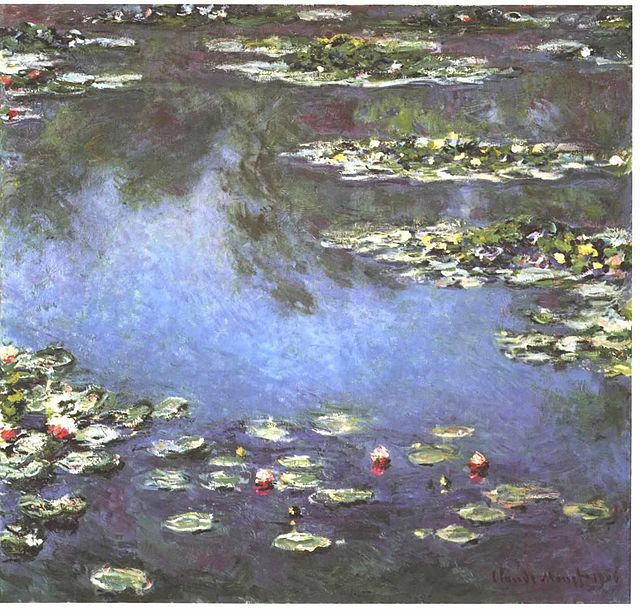
The “he” in this passage is Claude Monet and it is nearly half-way through the day described so wonderfully in Light, a novella by the late Eva Figes. Monet has been up for hours, before dawn, “the dark just beginning to fade slightly, midnight blueblack growing grey and misty, through which he could make out the last light of a dying star.” He is in pursuit of light and the reader follows him, his extended family, the servants, and a lunch guest, as the light shifts and changes, highlights at one moment a willow, at another the opening bowls of water lilies in the pond he created for them.
The relationships in the novella are complicated. Monet and his wife Alice have children from previous marriages. Suzanne, one of Alice’s daughters, recently died and the two grandchildren are staying at Giverny, cared for by Marthe, an unmarried daughter. Another daughter has fallen in love with someone who Monet dismisses: “It’s absurd,” he said, “since the boy has neighter money nor prospects.” The widowed husband of Suzanne is contemplating marriage with Marthe. Monet’s son and step-son have their own agendas. The servants keep the house running during the intense heat of the day and the mercurial nature of the painter who must be placated and obeyed. All of this is both subordinate to the light but also illuminated momentarily by its changing qualities.
I’m so glad I found this novel (thanks to Sarah at Edge of Evening — http://edgeofevening.wordpress.com/2014/06/20/midsummers-eve/
So many things conspire in these pages to make a perfect narrative. The language, the canvas (Sarah calls it “circadian” and I think that’s perfect), the sense of a world about to change (it’s 1900; and even the Abbé Toussaint who arrives at the end of lunch says, “I believe the Church must come to terms with science, if it is to survive. To me the theory of evolution is the greatest miracle of all.”), a gardener kneeling on the path to plant out new seedlings and deadhead the old, and the stately passage of the sun across the sky from dawn to dusk make for an elegant and beautifully controlled story.
 ...Theresa Kishkan