it is a wonderful thing to make a mark

Yesterday I was working on this quilt, two lengths of hand-dyed linen sandwiched with organic cotton batting. I know I keep writing about this but every day I find out something new. Or old. Maybe I just wasn’t paying enough attention. But in-between stitching, I’m studying several books about Paleolithic cave art — the text-heavy theoretical ones and the more visual ones. Through the wonders of interlibrary loan (thank you, Sechelt Library!), I have Cave Art, a magnificent guided tour of rock art sites, by Jean Clottes. He tells us in his introduction that he has tried to create an imaginary museum and if you’ve read my essay “Museum of the Multitude Village”, in Blue Portugal and Other Essays, you will know that I am already in line, ready for the tour.

So I sit with the book on my lap, studying the wonderful plates. There are some images I remember. This horse, for example, called the Chinese horse, maybe for its resemblance to Przewalski’s horse, the Central Asian animal that was almost extinct and has been brought back from the brink. They share similarities in conformation and colour.

I took this photograph at Lascaux IV, the astonishing centre of parietal art in the shadow of Lascaux cave. (The cave itself is off-limits to anyone other than a handful of researchers but the replica is really glorious.) I love this horse. In fact I love every horse I saw, at Lascaux, at Rouffignac, at Font de Gaume. But what also caught my attention here is the line below the horse — a free-drawn exuberant trail across the cave wall. Is the horse following a trail? Does the artist want us to know something about him or herself? Is it an inventory? Will anyone ever know for sure?

When I sew, I follow a line. My needle finds it in the fabric. It meanders, it spirals, it stretches out like a road on a map, like a river in a landscape. When I see some of the brush work in these paintings, I feel a kinship, across thousands of years. It is a wonderful thing to make a mark, to leave a trace — of thinking, of ceremony, of an encounter with mystery.

One of the plates in Cave Art is this black stag, also at Lascaux.

The paintings at Lascaux date to something like 17,000 years ago, possibly as old as 22,000 years. The artists made use of a full polychrome palette: deep blacks, warm browns, reds, yellows, even a kind of mauve. What I love about this stag is the wildly original depiction of its antlers. Imagine the artist, tilting the stag’s head upward, as though bellowing, then–I am imagining the body first, then the antlers–following the line up and up to create those antlers. With joy, I am certain.

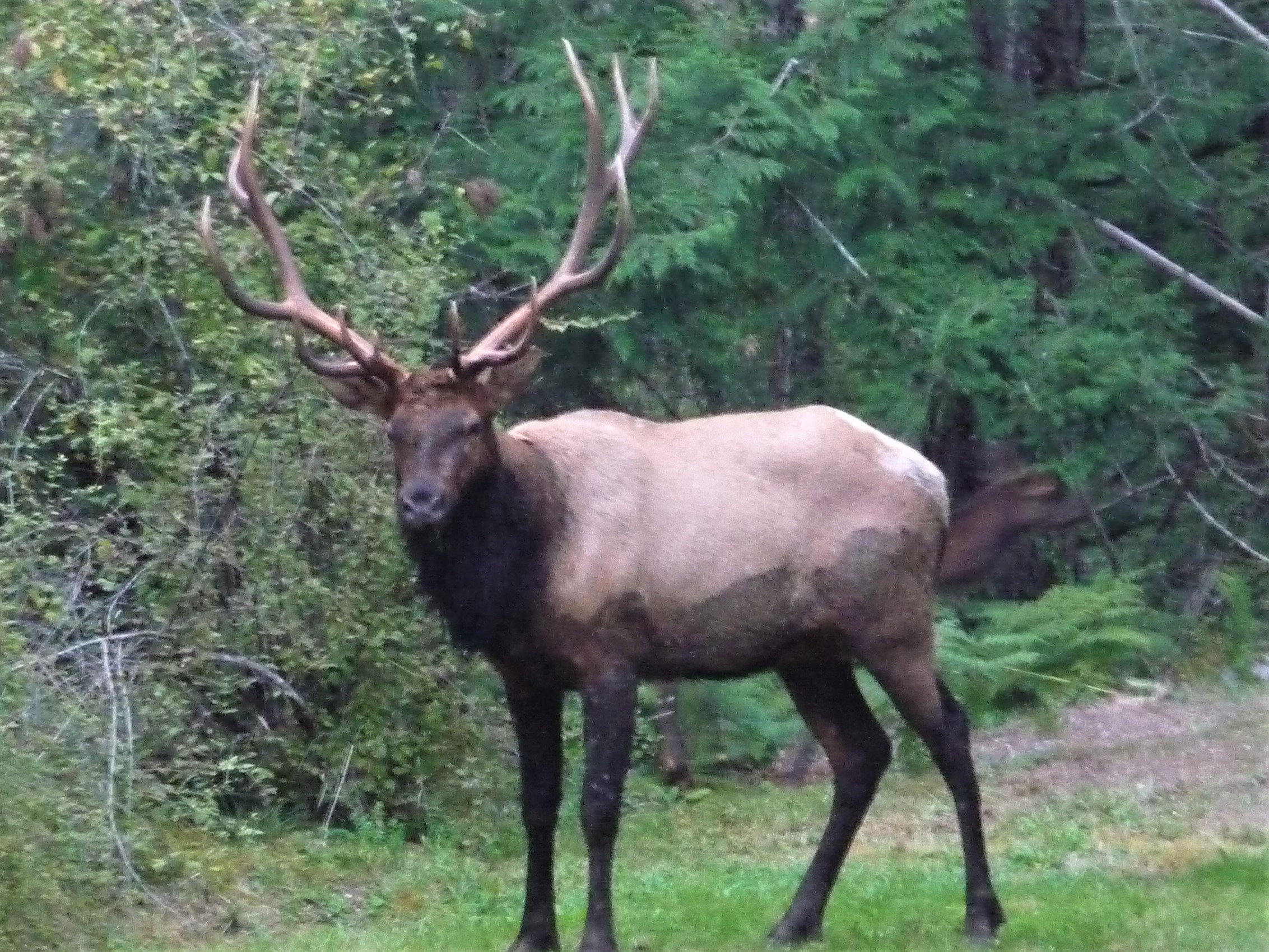
I think of Barrie Cooke and his Megaceros hibernicus (also called Megaloceros giganteus, the Giant Irish elk, though it’s not actually an elk, nor Irish), showcasing in a not dissimilar way, the otherworldly antlers. I think of him and these animals every time I see a bull elk in autumn, ready to gather and defend his harem. I’ve heard the elk bellowing in the woods, two at the same time, challenging one another.
So I read, I study the images, and I run my needle through the stretched linen, a skyscape, a waterscape, dyed with indigo on a late summer morning. A quilt is growing under my hands. What will it remember of the weight of the book on my lap, the distance my imagination is travelling, the distance between blue stitches, hoping a horse will find the trail.

blue solstice

detail

I was asleep at the moment of the winter solstice, 1:20 a.m. Pacific time. Yesterday was a long day. We went to Vancouver for a medical procedure for John, to the same facility where I went every few weeks for 5 months last year to have my threadbare retinas stabilized and repaired. On our way down the coast, we stopped to pick up our mail from the previous day. Finally things I ordered in early to mid November are beginning to arrive so I was happy to open a package containing a copy of Christine Desdemaines-Hugon’s Stepping Stones: A Journey Though the Ice Age Caves of the Dordogne, recommended to me by Clara Aussel who took John and I to Rouffignac and Font de Gaume in late October.

I was 19 when I first read about the caves in the Dordogne Valley. I wrote a poem about them, tucked away the memory of seeing photographs of animals alive on limestone cave walls, and finally we went to France this fall in order to actually visit the caves. It was wondrous. I felt I’d found my people, the ones who’d given us the gift of reindeer, bison, horses, mammoths. We were only able to visit two caves as well as the Lascaux reproductions but I knew then, and know now, that we’ll go back.

On the ferry from Langdale to Horseshoe Bay and in the medical facility waiting area, I read about the Vézère Valley where Clara took us and where I’ve actually found a little house I want to buy (but probably won’t). I was thinking of how humans make their mark. I was thinking about the night before when friends came for John’s birthday dinner. Amy and I were talking about indigo and I took her to the back of the house to show her the pieces I dyed in September. She was most taken by a 5 m. length of linen I’d twisted and tied. I remember that John held one end of the fabric on the patio while I twisted it as tightly as I could and then tied it with coarse hemp string, hoping it wouldn’t slip or loosen. I was curious to see what would happen when I immersed the length in the indigo vat, 7 or 8 dips, with long oxidation periods between. The linen was wheat-coloured so I didn’t think I’d get a clear blue. And I didn’t. It had sort of greeny underlights, or at least the parts of the fabric kept away from the dye from string were greeny. Here it is, recently removed from the last dip, rinsed, and hanging on the clothes line. (It’s the fabric on the right, with an untwisted middle section, because I didn’t want it to drag on the ground.)

hanging out

Amy loved this piece. What will you do with it, she wondered. And I wondered too. 5 m. is a lot of cloth. I don’t really want to cut it, though it would make a beautiful quilt, I think. We spread it out in the back room and looked at it closely. You could see water in its movements, shot with light. You could see the inside of an abalone shell. You’ve obviously figured out this stuff, Amy said, and I replied that I absolutely haven’t. I have no idea when I begin what the results will be. And in a way I don’t care. I am committed to the process, though. Each twist, each stone I tie into a piece of fabric (the length second from the left is the result of beach stones tied into coarse cotton), each piece of string I cut and wrap: I am interested to see where they take me. In a way it’s a cave of my own making. Surrounded by blank linen and cotton, remnants of old damask tablecloths (the two small pieces at the far left), sheets, I begin to make a mark without knowing what it will be.

We each held the end of long length of linen across the bed in the back room and brought our ends to meet the other. Women have been doing this for centuries. Millennia. They’ve been immersing cloth in dyes made from roots and leaves, hoping for beauty, for light, smoothing out the wrinkles, folding the cloth afterwards. It’s been a dark year for a whole lot of reasons. I haven’t known how to find the light. though as of 1:20 this morning, it’s coming back. The other night, light shone through the linen we held and folded, it rippled like ocean water, the water I swam in off a little bay in Bute Inlet in April, the water I swam in almost every morning from the beginning of May until the beginning of October, entering Ruby Lake’s green depths, the linen held those moments, and others, and now folded, it waits for me to know what to do next.