a publishing history, with asides (third instalment)

21st century, second decade

Sandcut Beach

My parents died at the beginning of the second decade of the new century, a year apart to the day. Several close friends died. My sons married their sweethearts. (My daughter married hers a few weeks ago!) Every day held sorrow and joy. And also a sense of possibilities for my long-held interest in my family’s history. After my father’s death, I took home the small hoard of papers and photographs he’d kept to himself. I don’t know exactly why he was reluctant to share the materials, or to pursue answers to questions–the ones I had and surely ones he had too? And a year later, after my mother’s death, I felt the uneasy sense that I was now the family matriarch, the one responsible for keeping the lines of kinship clear. They were not clear. There were half-stories, careless genealogies. In retrospect, I see that much of the research and writing I did during this decade was in service to these histories.

I’ve always loved the literary novella. Without ever really intending to, I’ve built up a nice collection and have read many more, via library or generous friends. Inishbream was a sort of accidental novella, beginning as it did as a linked group of prose poems, eventually drawn out and given a structure. I loved the possibilities of the form, how it could hold so much in such a hermetic shape. A year or two after The Age of Water Lilies was published, I was invited to a book club to talk with members who’d just read it. I always enjoy these occasions. During our time together, one woman asked what happened to Grace after the novel ended. Good question. Grace was born to a single mother in the spring of 1915. She is sort of tangential to the narrative. But the more I thought about her, the more I wondered too. I began to write Winter Wren to find out. I think I knew from the beginning that the book would be a novella. I put Grace in a cabin I’d always thought I’d like to live in, a cabin I first saw as a teenager, on a beach west of Sooke, B.C. (It’s the one above the waterfall in the photograph at the beginning of this post.) She was in her late 50s, an artist trying to paint the view at dusk. I wanted to write about the 1970s—the novella takes place in 1974, an interesting time for ceramics in B.C. (Grace’s love interest is a potter in the tradition of those who studied with Bernard Leach in Cornwall and then returned to Canada), for museums where the salvage paradigm was part of the ethos, and perhaps the last possible time for Grace to meet one of the late 19th c-early 20th c artifact collectors.

winter wren

But you know already what I’m going to say: I sent Winter Wren to dozens of publishers and all of them rejected it. To make a long story short, my dear friend Anik See was visiting enroute from Dawson City to the Netherlands and we shared similar stories about novellas we’d written. We decided to begin a micropress to showcase the form and we decided to begin with mine. Our rationale was this: if our endeavour didn’t work, then I would be disappointed, sure, but at least it would only be me and not someone else. I could shake it off, poof, and move on. (Ha!) Anik designed the book, I photographed a pottery dish with a length of scouring rush (it figures in the book), and we found a really good printer in Victoria. And you know, we sold our first print run of 250 copies within weeks and we reprinted. I still get orders for it. We went on to publish 4 more novellas and we are very proud of Fish Gotta Swim Editions. Our latest is Anik’s Cabin Fever.

I’ve been to the small Vancouver Island beach near Jordan River where Theresa Kishkan’s novella Winter Wren (Fish Gotta Swim Editions) is set; I’ve seen the waterfall that tumbles over sandstone onto the shingle just below, and the solitary cabin facing south and west, surrounded by salal. Winter Wren tells one possible story from the many that cabin could tell. (Michael Hayward, Geist)

After I finished writing Winter Wren, I wrote another novella, Patrin, and it was published (beautifully) by Mona Fertig’s Mother Tongue Publishing in 2015 and then in French by Marchand de Feuilles in 2018. I also wrote a long essay, “Euclid’s Orchard”, about quilting, mathematics, coyote music, apple trees, and love; and when Mona showed interest in publishing a collection of my essays, I gathered together a group. Eulid’s Orchard & Other Essays was published in 2017 and was shortlisted for the Hubert Evans Award.

Each image is a perfect crystallization of a detail, gesturing toward a truth much larger than the tiny pinpoint of its composition. Near Victoria, she recounts an exquisite memory of “an abandoned house completely knitted into place by honeysuckle and roses” (p. 101). Near Drumheller, she sings the prairie: “turn, turn, bend the song to the roadside plants … free verse composed of craneflies, dragonflies, bluebottles, broad-bodies leaf beetles, greasewood and cocklebur” (p. 61). And near her home, she concludes with the cries of coyotes: “lilting joyous youngsters unaware that a life is anything other than the moment in the moonlight, fresh meat in their stomachs, the old trees with a few apples and pears too small and green for any living things to be interested in this early in the season” (p. 155). (Catriona Sandilands, The British Columbia Review)

An aside: Mona Fertig and her Mother Tongue Publishing enterprise deserve gratitude from writers everywhere for the beauty of the books and the huge effort Mona put into designing them, editing them, bringing them into the world with sparkling wine and flowers, arranging public events for the writers, and being the kind of publisher writers dream of. I’d have published with her forever and was sad when she announced her retirement but also glad for her because she’s been able to return to her own writing projects. She did everything that bigger publishers did and she did it with joy. (She’s the one on the left, with the big smile.)

at-the-book-prizes

Novellas, novellas. I wrote The Weight of the Heart as a way to lament the gaps in my own education in the 1970s when the instructor of my Canadian literature course told me not to bother writing about Sheila Watson and Ethel Wilson, saying they were minor, and the former was barely coherent. I wanted to celebrate these two literary cartographers of our province and to highlight the importance of their work. I also wanted to spend time, real time and imaginatively, in the Thompson Canyon and the dry Interior of B.C. Palimpsest Press published The Weight of the Heart in the spring of 2020, just as most publishers and some writers were required to pivot to a virtual presence because of the pandemic. I wish I’d been better at this, though we still had such a slow internet connection—we live in a rural area– that even if I had been able to Zoom more effectively, our bandwidth wouldn’t have allowed me to participate much. (We were able to upgrade a bit later.)

The Weight of the Heart also finds in Wilson’s and Watson’s writing an experimental style and a mode of consolation. Like Wilson’s independent protagonists, the narrator discovers her autonomy and grit in the landscape she travels. Watson’s spectral figures and interest in sacred rituals resound in the symbolic scenes of almost drowning in which the narrator is saved by her brother’s mysterious presence and in Kishkan’s invocation of Egyptian burial rites as a refrain throughout. Most obviously, the double hook of Watson’s title recurs in the dualities throughout the novel—in the two rivers, in twin foals (the colt unfortunately lost in birth) by a mare named Angel, and most clearly in the two siblings who are bound together in a landscape where life and death regularly meet. So, Kishkan and her narrator know where to look in Canadian fiction for a view of the British Columbian landscape that reveals these striking oppositions and their consoling unions. A unique and compelling creation in its own right, Kishkan’s poetic exploration of grief lives up to its literary precursors. (Kait Pinder, the Malahat Review)

I wrote another novella in this decade, begun perhaps in the middle, put aside, but finished in 2020, during the long lonely weeks of the pandemic when I was missing my family and wondering if we would ever get together again for our summer meals, swims, and talks late into the night by a campfire. I used Virginia Woolf’s Mrs. Dalloway as a template, following the main character through a day of preparations for a party. There are shadows and owl voices in the woods and an unexpected guest coming up the driveway at dusk, carrying a knife. I tried to find ways to present the material innovatively, with sections of call and response, lists, and the music of an oud. I called it The Occasions. I don’t know if it will ever be published.

Another aside: I am lucky in life and love if not in publishing. And I wonder how many writers have a husband who is also a letterpress printer and who offers to make keepsakes to celebrate new books? For the past ten years or so, John has printed beautiful objects, some of them embellished by me, to give away at book launches and to provide local book stores with so they can tuck a keepsake into the books of mine that they sell. I have a few remaining of some of these and if you want to order a book from me, I can include one for you.

keepsakes remaining

At the beginning of this instalment, I wrote that I was trying to untangle the knots of family history and genealogy. Some of this work resulted in essays in Euclid’s Orchard but I wasn’t finished and kept on writing. I’d also had a health issue in 2016 that resulted in many tests, half-diagnoses, fearful assessments (though it all worked out well), and I also wrote about those things against the backdrop of all I loved: my family, the rivers of this province, textile work (which is always a way of meditating for me, sewing myself in and out of mysteries, riddles), the countries my grandparents left for new lives in Canada, and more. These became Blue Portugal & Other Essays, published with care and generosity by the University of Alberta Press in 2022. It received SUCH good reviews.

In Blue Portugal the essays’ themes are allowed to slip their boundaries; a topic addressed in one essay recurs in later essays, a recognition, perhaps, that thoughts and interests develop over time, shifting slightly as they are put in the company of other thoughts, are seen from different perspectives. The essays in Blue Portugal seem to talk to each other; they interlace in interesting and thought-provoking ways. The book is a fine example of the personal essay at its best. (Michael Hayward, The British Columbia Review)

It was a book that others noticed, gifted to friends, and reading it now, I am sort of surprised that I was led into some of the essays so mysteriously. A voice in the night, murmuring, The river door. Whose voice? I only know I took it to heart.

To those of us who’ve been following Theresa Kishkan on her blog for many years, the preoccupations of her latest book, the collection Blue Portugal & Other Essays, will be familiar, the quilts, the homesteads, the memories, the blue. But it’s the stunning craftsmanship of the book, the fascinating threads that weave the pieces together and also recur throughout the text, that make this book such a pleasure to discover. How quilting squares are analogous to the rectangles from which, one by one, Kishkan and her husband literally constructed their home on BC’s Sechelt Peninsula, and the blueprints, and the blues of dye, and of veins, and of rivers, and of how one thing turns into another—how? How does a body get old? How do children grow? How does a family tree sprout so many new branches? And from where did it all begin, Kishkan going back to seek her parents’ nebulous roots in the Czech Republic and Ukraine, in a 1917 map of lots in Drumheller, AB, in everything that was lost in the Spanish Flu, and how we’re connected to everything our ancestors lived through. (Kerry Clare, picklemethis.com)

And now? Now? 4 years into the 3rd decade of the century, I’ve completed another collection of essays. The centrepiece is a long postmortem and reassessment of a relationship I had with a painter when I was 23 years old. My walls are hung with some of his paintings, portraits of me among them, and I attempt to reclaim the gaze by entering into a daily conversation with one particular portrait hung in a stairwell; she is one of the first things I see each morning as I come down to the kitchen. There are other essays in the collection that meditate on war, climate change, injury and recovery, swimming and Herakleitos, and the nature of love. I’ve begun the long process of trying to find a publisher (my last publisher wasn’t interested, feeling perhaps that the collection is too personal and potentially risky in terms of sexual politics). As I write, it’s been rejected by 4 publishers and is currently awaiting decisions by 6 more. I’m also about halfway through writing a novel set in a small fishing village called Easthope and in the city of Lviv, in western Ukraine. I began the novel 4 years ago, just home from a trip to Ukraine, and set it aside to complete editorial work on Blue Portugal. And then the Russians invaded Ukraine and I couldn’t imagine ever writing about Lviv. But I decided that I’d stay with my original intention and setting— 2015—and write to set down what I love about both places.

And now in a hurry just
pack, always, each day,
and go breathless, go to Lvov,
after all it exists, quiet and pure as
as a peach. It is everywhere.

–Adam Zagajewski, trans. Renata Gorezynski. The poet used a variant for his native city which has known many administrations since it was first established in the 5th century and is currently known as Lviv

It may seem that I am a bit cranky about publishing in the 21st century but I have to say that it’s always the end point in writing for me. I began to write with the sense that the process was complete when the piece found a place in the larger world. I don’t begin a work with any idea of what might happen when I’ve finished, though. Not yet. I live in the language, the world of the writing, and when I come up for air, it’s then that I realize that I have no idea if the work will ever find a readership. I am too many things that are not what the current world wants or needs. Who wants to read about a fishing village or a party under fairy lights in a garden on the edge of the world or eye injury or indigo dye or the musings of an aging grandmother? A woman married for 45 years. I know some people do but maybe not enough of them. Enough of you, I mean. But I have some years left and those will find me at my desk, finding a way to map out the terrain I dream about, yearn for, to find ways to knit together strands of music, roots of family trees, and real trees too, embellished with salmon bones, the beautiful holdfasts of bull kelp and bladderwrack (the tired images scorned by A.F. Moritz all those years ago). There’s a little quote from the writing of the early naturalist and advocate for wilderness, John Muir: “When we try to pick out anything by itself, we find it hitched to everything else in the Universe.” I keep this in my mind and heart as a mantra. I don’t know how this might be worked into a synopsis or query letter or proposal but it keeps me anchored, heldfast, to what I want to do in my life. Everything else is a bonus.

holdfast

a year of Blue Portugal

book and fish

A year ago this week, the courier left a box of Blue Portugal & Other Essays down by the gate that leads to our neighbours. It was raining that day and when our neighbour Ted drove up our long driveway and said he had something for us, I suspected it was books but I also hoped they hadn’t been sitting in the rain for too long because our neighbours are back and forth to another home on the mainland. Would the books be ruined? By process of deduction we figured out they’d only been there for a hour or two and the courier had put the box in a big plastic bag.

Blue Portugal is my 16th book. Or maybe 17th. (Each time I count I get a different number.) But the actual moment of opening a box and seeing something I’ve worked hard on, first the writing, then the editing, then copyediting, proof-reading, some of this entirely on my own (the writing), and some with excellent people such as the whole team at the University of Alberta Press, anyway, that moment is extraordinary. In the box, nestled in white packing paper, were the blue books filled with my meditations of this life of mine. A life that is shaped and shadowed by a wide network of family members in the present and in the past. My parents are in the book. My father’s parents, and what I know of the long line of Kishkans and Klusovas stretched along the spine of the Carpathian Mountains as they extend west to the Beskydy Mountains in the Czech Republic. As they travelled by boat from Europe to North America. As they made rough homes and planted gardens and grew potatoes. (My mother’s parents are mostly unknown to me, though I tried to trace them in an earlier book, Euclid’s Orchard.) My children are in the book, and theirs. There are rivers, brushes with serious illness, memories of fractures and sorrow, a fall on ice resulting in damaged retinas, an overnight train ride from Kyiv to Chernivtsi before Covid, before the Russian invasion. And there’s a lot of blue: the cyan of Steller’s jays; the indigo I dye cotton and linen with to make quilts inscribed with eelgrass, clouds, snow-angels, migrating salmon; the namesake wine of the title, Modry Portugal, that I first drank in my grandmother’s country; the hallucinatory blue of entoptic phenonema.

In the past year, Blue Portugal has made friends. In the British Columbia Review, Michael Hayward said this:

The essays in Blue Portugal seem to talk to each other; they interlace in interesting and thought-provoking ways. The book is a fine example of the personal essay at its best.

Michael Greenstein, in the Miramichi Reader, concludes his review with this:

Her elegiac rhapsody in blue recurs in “Blueprint” where we follow the construction of her house in British Columbia. Her web of essays are palimpsests covering and uncovering hidden roots and rhizomes. From Dante to duende, and the melancholic saudade of fado, Blue Portugal cultivates grapes and vintages. Follow Kishkan closely along many paths of anatomy and destiny.

On her literary blog, Pickle Me This, Kerry Clare is generous:

But it’s the stunning craftsmanship of the book, the fascinating threads that weave the pieces together and also recur throughout the text, that make this book such a pleasure to discover

Friends and readers I’ve never met took the time to write beautiful letters. A few sent little gifts. And in return, we made some small gifts. My husband John is a letterpress printer and he printed keepsakes on our 19th century Chandler & Price platen press which I embellished with fragments of indigo-dyed cotton, shell buttons, and red silk thread: a number of bookmarks were given out when the book was first published (local bookstores tucked the keepsakes into copies of Blue Portugal they sold and I mailed bookmarks to people who told me they’d bought the book); and a second keepsake was given to well-wishers at a book launch at the Arts Centre in Sechelt last September.

finishing

There were some readings, online and in person, some interviews (including this wonderful conversation with Joe Planta: https://thecommentary.ca/ontheline/2044-theresa-kishkan/ ), some talks given to interested groups via Zoom, and there are more events in the future, including a brief reading and two workshops on the personal essay at Word on the Lake Writers Festival in Salmon Arm later this month, and an event at the Sunshine Coast Festival of the Written Arts in August. (Talewind Books always sells books at this Festival and John will print a 3rd keepsake to be given away with copies of Blue Portugal sold at this time.)

A year ago this week, the courier left a book of books at the neighbour’s gate. I remember sitting by the fire with a copy, reading my words on Alan Brownoff’s elegantly designed pages, actual pages after the many hours of working on a screen with Kimmy Beach and others, and thinking that maybe the pieces in this book get closer to what I hope to do when I begin to write an essay. I’m learning all the time. This is what I wrote in the Preface:

Some essay collections are unified thematically or chronologically around a writer’s life so that a reader understands the book to be a form of memoir. Blue Portugal does not aspire to memoir exactly. There are connections between the individual essays, yes, there are times when they talk among themselves, refer the reader to others in the group, but my intention was not to create a unified set of texts, with a logical flow. What the essays share is a sensibility—mine, of course, but also I know that I am interested in ideas and terrain which often share something in common. The rivers of my home province echo the venous system of my body. The indigo powder I turn into dye in turn shares a palette with entoptic phenomena. The title essay remembers a wine I first drank in my grandmother’s homeland. These are personal essays after all, not rhetorical or expository ones, so I’m at the heart of each one. Mine is the voice that invites the reader in, welcomes you at the door. My heart is on the sleeve of each essay. I’m the woman on the raft in the Thompson River and in the restaurant in Prague, in the PET tunnel in the B.C. Cancer Centre, portioning out her parents’ ashes on a beach on Vancouver Island, in a kitchen on the Sechelt Peninsula sewing a quilt from indigo linen she’s dyed on a cedar bench by her garden while pileated woodpeckers teach their young to fly nearby. Her (my) own children have flown but she remembers them on the trail down to the school bus, shadowed by the dog whose pelvic bone sits on her desk, a reminder of injury, recovery, and the precarious nature of our lives.

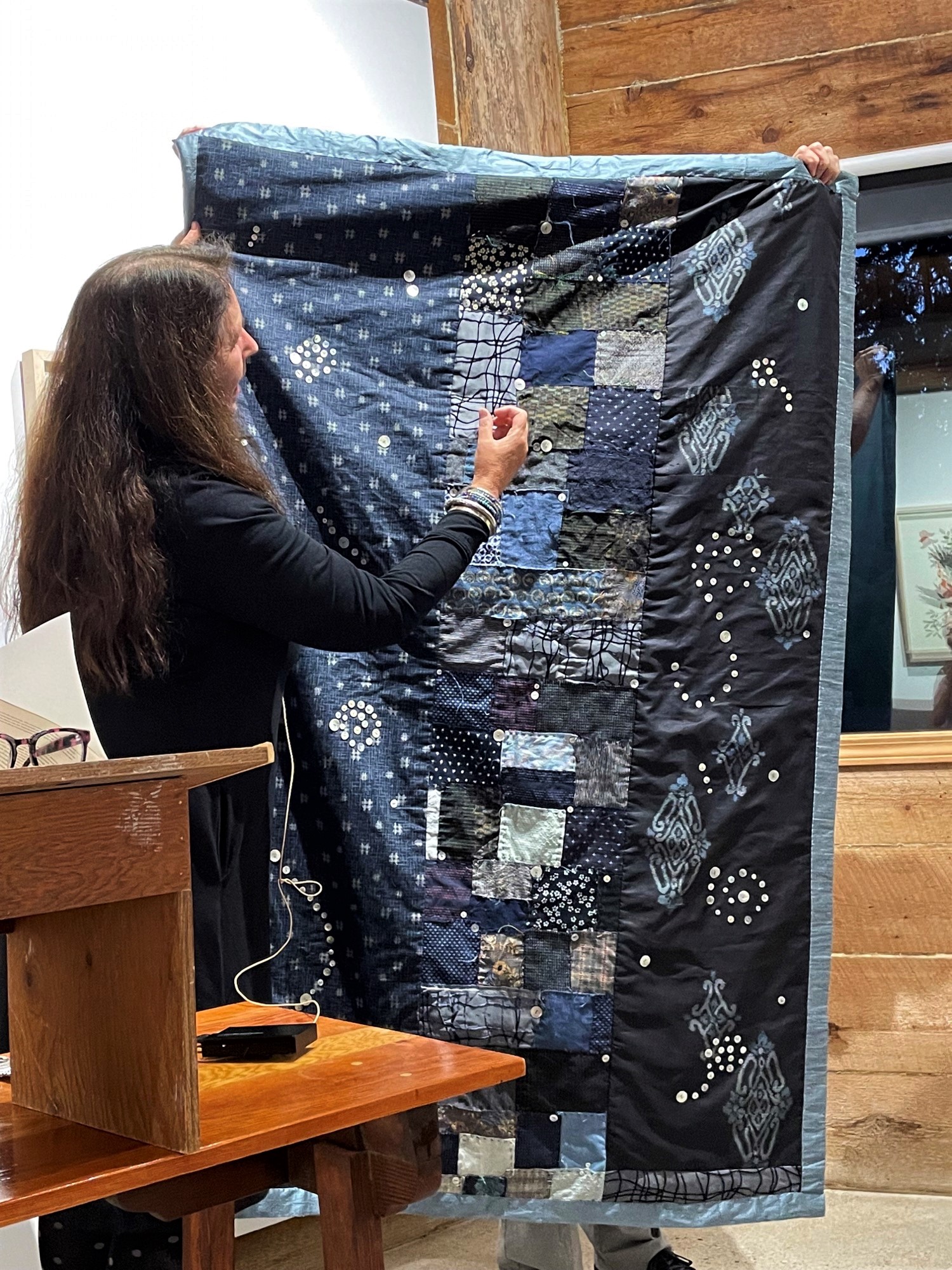
Here I am at the launch, showing the quilt that accompanies “A Dark Path”, the path that leads back, way back, to the year I was 14 and was injured in a riding accident and found myself on a path through bitter privet at the Gorge Road Rehabilitation Centre, learning to walk again, walking into a future I could never have dreamed. Blue Portugal & Other Essays is a book I’ve been writing all my life, through all the years that have led to this one, stitched from scraps of beauty and difficulty and love.

a dark path at Blue Portugal launch

PS–two things. For some reason, not all the links are working. I keep adding them and they disappear. Sorry! And the second thing is that I should explain that couriers in their wisdom seldom follow instructions on how to find our house for deliveries. Once they left a car-seat, arriving for a visiting grandchild, down a neighbour’s driveway (the neighbours keep their gate locked when they’re not here so there was a small window of opportunity and the courier took it boldly) and it was only when the company sent a screenshot to prove they’d “delivered” the item that we recognized a particular element about half a mile away and went to collect our parcel from under someone else’s sign. Books by the gate are a common issue and they won’t listen when I tell them, If you reach the gate, you’ve gone too far. The only company that ever gets it right is the one that delivers cases of wine from to time. Thank goodness.

redux: “Once I told them, You look like goddesses, all of you, there in the water, so graceful as you raise your arms.”

Note: this was 4 years ago and this morning, re-reading, I was surprised to realize I was revising “How Rivers Break Away and Meet Again”,  an essay that is central to my Blue Portugal & Other Essays. I didn’t know then that the collection would be finished, would be published, and that a copy would sit on my desk to remind me of how the thinking and writing I do gradually accumulates until, voila, a book….

morning swim

Kerry Clare at Pickle Me This has a wonderful post this morning, a review of Swell: A Waterbiography, by Jenny Landreth. It’s a book I’d like to read, and will. I’ve been reading books about water lately, about swimming, about various kinds of immersion. Jessica Lee’s Turning: A Swimming Memoir was so beautiful and so brave that I began to plot ways of swimming in winter. Wait, I do swim in winter, though in a pool, not the lakes Jessica has found near Berlin, where she lives. I swim daily in Ruby Lake from June to late September and then it’s the Pender Harbour Aquatic Centre, where my children learned to swim more than 30 years ago, and where the lifeguards do their best to save my lane for me, the one closest to the big windows and on the side of the pool because otherwise I can’t keep straight.

I’ve been revising a long essay on rivers and the venous system, mostly because it keeps getting rejected and I return to it with a nervous eye, wondering what to do to make it something more attractive to readers. I loved writing the early drafts. I wanted to do something I hadn’t done before, not in prose, so I used both margins to justify different parts of the text. I wanted the typography to echo the text. I wanted the text to meander on the page as a river meanders through a landscape and our veins and arteries carry our blood through our bodies. (Writing this description, or justification, I realize how this might be the reason no one wants to publish it. It looks odd. It uses space in an unexpected way. But who wants to keep doing the same old, same old?)

Here’s a little of the essay, a section justified to the right margin (though some sections move back and forth between margins, as a swimmer moves through water):

8. Deep Venous drainage system

The fibular vein. Anterior tibial vein. Posterior tibial vein. The three become the popliteal vein at the knee; and then that vein enters the thigh, via a passageway called the adductor canal, as the femoral vein. These are the veins where the thrombosis formed, a clot poised like a temporary island, breaking free, travelling into my pulmonary system where it lodged as an embolism, threatening my heart.

My heart never knew it was threatened. My heart grew large with love that time, in anticipation of a third grandchild, surrounded by other family members, hearing their voices, sitting with them at the long table we’d eaten at for more than three decades. My heart, unaware, as I tried to catch my breath. It never knew it was threatened. It was filled with love, it was heavy with love.

And other minor veins drain into the femoral vein, like small creeks. The femoral vein graciously receives its tributaries as rivers receive theirs, the threads of mountain courses, of run-off, of bog-dark sweet creekwater, limestone, gritty, clear as mirror glass, dense with salmon, lively with mayflies and dragonflies catching fire, of rivulets, right-bank, left-bank, forked, streamlet, greater saphenous vein, which usually receives the external pudendal vein as well as the superficial epigastric vein, and the superficial circumflex iliac vein.

When I go for my swim at the local pool, I see the older women whose class is finishing just as I enter the water for my laps. They are thin, large, stooped, high-stepping, and lame. On their legs, the story of their lives thus far. Varicose veins, spider veins, venous insufficiency, superficial phlebitis, swellings and dark bruisings, lymphedema: some of them use walkers or canes to help them into and out of the water, to the hot-tub where they are helped down the stairs. But in the pool—sometimes I arrive early enough to see this—they raise their arms, they float, they are light as birds in the clear water while gentle music plays and the instructor leads their movements from the walkway at the edge. In the hot-tub after, their heads above the warm froth, they are beautiful, talking among themselves as the music continues and I swim my laps, listening to them.

…listen to your suppliants voice, come, and benignant in these rites rejoice;
Give plenteous Seasons, and sufficient wealth, and pour; in lasting streams, continued Health.

Once I told them, You look like goddesses, all of you, there in the water, so graceful as you raise your arms. Join us, one of them says, smiling, using her cane to walk unsteadily to the change room. My own legs are uncertain rivers, uncertain streams, their courses changing, islands forming of my own blood, its platelets and fibrins turned semi-solid.

“Once I told them, You look like goddesses, all of you, there in the water, so graceful as you raise your arms.”

morning swim

Kerry Clare at Pickle Me This has a wonderful post this morning, a review of Swell: A Waterbiography, by Jenny Landreth. It’s a book I’d like to read, and will. I’ve been reading books about water lately, about swimming, about various kinds of immersion. Jessica Lee’s Turning: A Swimming Memoir was so beautiful and so brave that I began to plot ways of swimming in winter. Wait, I do swim in winter, though in a pool, not the lakes Jessica has found near Berlin, where she lives. I swim daily in Ruby Lake from June to late September and then it’s the Pender Harbour Aquatic Centre, where my children learned to swim more than 30 years ago, and where the lifeguards do their best to save my lane for me, the one closest to the big windows and on the side of the pool because otherwise I can’t keep straight.

I’ve been revising a long essay on rivers and the venous system, mostly because it keeps getting rejected and I return to it with a nervous eye, wondering what to do to make it something more attractive to readers. I loved writing the early drafts. I wanted to do something I hadn’t done before, not in prose, so I used both margins to justify different parts of the text. I wanted the typography to echo the text. I wanted the text to meander on the page as a river meanders through a landscape and our veins and arteries carry our blood through our bodies. (Writing this description, or justification, I realize how this might be the reason no one wants to publish it. It looks odd. It uses space in an unexpected way. But who wants to keep doing the same old, same old?)

Here’s a little of the essay, a section justified to the right margin (though some sections move back and forth between margins, as a swimmer moves through water):

8. Deep Venous drainage system

The fibular vein. Anterior tibial vein. Posterior tibial vein. The three become the popliteal vein at the knee; and then that vein enters the thigh, via a passageway called the adductor canal, as the femoral vein. These are the veins where the thrombosis formed, a clot poised like a temporary island, breaking free, travelling into my pulmonary system where it lodged as an embolism, threatening my heart.

My heart never knew it was threatened. My heart grew large with love that time, in anticipation of a third grandchild, surrounded by other family members, hearing their voices, sitting with them at the long table we’d eaten at for more than three decades. My heart, unaware, as I tried to catch my breath. It never knew it was threatened. It was filled with love, it was heavy with love.

And other minor veins drain into the femoral vein, like small creeks. The femoral vein graciously receives its tributaries as rivers receive theirs, the threads of mountain courses, of run-off, of bog-dark sweet creekwater, limestone, gritty, clear as mirror glass, dense with salmon, lively with mayflies and dragonflies catching fire, of rivulets, right-bank, left-bank, forked, streamlet, greater saphenous vein, which usually receives the external pudendal vein as well as the superficial epigastric vein, and the superficial circumflex iliac vein.

When I go for my swim at the local pool, I see the older women whose class is finishing just as I enter the water for my laps. They are thin, large, stooped, high-stepping, and lame. On their legs, the story of their lives thus far. Varicose veins, spider veins, venous insufficiency, superficial phlebitis, swellings and dark bruisings, lymphedema: some of them use walkers or canes to help them into and out of the water, to the hot-tub where they are helped down the stairs. But in the pool—sometimes I arrive early enough to see this—they raise their arms, they float, they are light as birds in the clear water while gentle music plays and the instructor leads their movements from the walkway at the edge. In the hot-tub after, their heads above the warm froth, they are beautiful, talking among themselves as the music continues and I swim my laps, listening to them.

…listen to your suppliants voice, come, and benignant in these rites rejoice;
Give plenteous Seasons, and sufficient wealth, and pour; in lasting streams, continued Health.

Once I told them, You look like goddesses, all of you, there in the water, so graceful as you raise your arms. Join us, one of them says, smiling, using her cane to walk unsteadily to the change room. My own legs are uncertain rivers, uncertain streams, their courses changing, islands forming of my own blood, its platelets and fibrins turned semi-solid.


a summer book shelf

morning visitor.jpg

A summer book shelf. Doesn’t that sound lovely? The truth is, well, messier. I’ve been trying to organize the shelves in our book room (or library, as we grandly call it). Yes, we have one. It used to be a playroom (and before that, a bedroom for the one child we had when we first built our house; by the time we moved in, another was due in two weeks….). The rooms we needed to accommodate the three children who eventually formed our family elbowed their way off that original bedroom/playroom and it seemed like a good idea to set up banks of shelves for the books that accumulated in the way books do. You think you have a few. You realize you have twice that many. Then three times that many. And so on. It’s like one of those math puzzles that hurt your brain. And if you’re like us, or at least like me in particular, you like to look things up in books rather than depending on the Internet exclusively. There’s something about taking one of the volumes of The Complete Gardener’s Collection to sit with as you drink your morning coffee, looking up one thing but then finding yourself reading something else with great interest.

So as I tried to find shelf room for some of the books in the piles that have grown against each wall in my bedroom, the surfaces in my study, some of those in the teetering columns against the bookcases themselves, I found myself thinking, Did I read that? Putting it aside to take upstairs to join the others on my bedside table. And there were others that I’ve bought and put on the lower stairs, waiting until I’d read my library books or the books I was using to research a particular thing in the novella I’m currently writing. I’ve also been gathering books about music for an essay I’ve been asked to write.

This morning, I realized the stairs were clear. The library shelves are as jammed full as they can possible be, several boxes are packed up for the thrift store or the book sale at the local library, and I’ve been thinking about what I’ve read in the last week. For some reason, the selection felt memorable. One title talked to another. A long gorgeous novel set in Ireland actually entered my dreams and I watched the two main characters diving off rocks into glittering water. Another made me laugh and cringe and worry about how the story would end. One or two were unsatisfying in ways that made me wonder why I seem to be outside the tide of current thinking.

Barbara Gowdy’s Little Sister, for instance: very well-plotted, well-written, but I found the whole thing kind of preposterous. I respect this author but can’t warm to her work. And I’m perfectly willing to take the blame for this. I never finish one of her books and think, Oh, I’ll need to read that again one day because I’ll want the story to unfold again, taking me along. I wasn’t taken along.

A book that was the antithesis of Little Sister was At Swim, Two Boys by Jamie O’Neill. Not a new book – it was published in 2001 – but rich and timeless. O’Neill uses language like his shadow-brother, James Joyce; and it’s no coincidence that the novel takes place mostly around Sandycove, with its Martello tower haunted by that earlier James. There’s so much in this book. The life of a community with its rich and its poor, swimming, fatherhood and its gaps and tenderness, young men learning what their bodies are capable of, in the ocean as they swim towards the Muglins, and in the awkwardness of love. The complicated politics of Ireland in 1915-16 and its heroes and martyrs. The Church. I can easily imagine finding this novel in a stack waiting to find a place on the shelves and thinking, Oh, I’ll put it by my bed because I want to read it again.

The two books that spoke to one another were an unlikely pair at first. Virginia Woolf: An Inner Life by Julia Briggs is a wonderful guide to Woolf’s writing process. Briggs studies the material evidence of this and provides a fascinating exploration of the context of each of Woolf’s books. What she was reading, what she was thinking, her health, her friendships, what she hoped to do as she found her way into the deep work. An Aftermath section follows each chapter, detailing the critical responses to the books and– this is so interesting!– the sales information, the reprinting schedules, and how Woolf responded to the reviews and both the successes and failures of her books. Her schemata for To the Lighthouse is particularly enlightening. “She found herself with that ‘quick decisive stroke’ writing the words ‘To the Lighthouse’ at the top of a fresh page of her notebook, and following it with a diagram rather like a letter ‘H’– the ‘two blocks joined by a corridor’, which would make up the structure of the novel – the longer ‘Window’ and ‘Lighthouse’ sequences joined by ‘Time Passes’”. It made me want to pick up To the Lighthouse again, a novel I re-read every four or five years, always with a sense of rediscovery and pleasure. Of all Woolf’s novels, this one drew its author back into the idyllic days of her childhood summers and the beauty of that, the resonance, is palpable.

I loved finding To the Lighthouse at the heart of Kerry Clare’s delightful Mitzi Bytes. Sarah Lundy’s book club meets to eat good food (even a cake decorated with a lighthouse), drink some wine, and engage in a spirited discussion about the novel. Which becomes a discussion about much more, some of it coded and allusive. As Sarah’s life is coded and (in some ways) allusive. And elusive. How many of us don’t live multiple lives? Those of us who are parents know this. Those of us in relationships (of any kind, really). I read this book in two afternoons, on a long wicker lounge in our sunroom, not wanting to finish but hoping for a happy ending. At some points, that didn’t seem possible. The book is described as “a grown-up Harriet the Spy for the digital age”. I confess I never read Harriet the Spy. (Nancy Drew was the girl detective of my childhood though I suspect she wouldn’t work in the digital age. Her roadster? Her reluctance to kiss her boyfriend on the porch for fear the neighbours would see. Her sleek outfits and perfect diet, made possible by a kindly housekeeper?) But in some ways, To the Lighthouse is the shadowy H haunting these pages, bridging the before and the after, time passing, even as the computer crashes and the digital files are lost (but not the photos on her phone!):

The kids were changing all the time, so fast so often that from one morning to the next, they seemed like entirely different people. Sarah needed the pictures as proof of where the time went, but all the rest of it, everything else that mattered, were stories she kept filed away on her brain. It was an unreliable filing system, nothing ever turning up at the right moment and so much at the wrong time, but it worked. And it was possible that she didn’t need an archive, that she could go forward now.