“Where the years went I can’t say” (Kate Wolf)

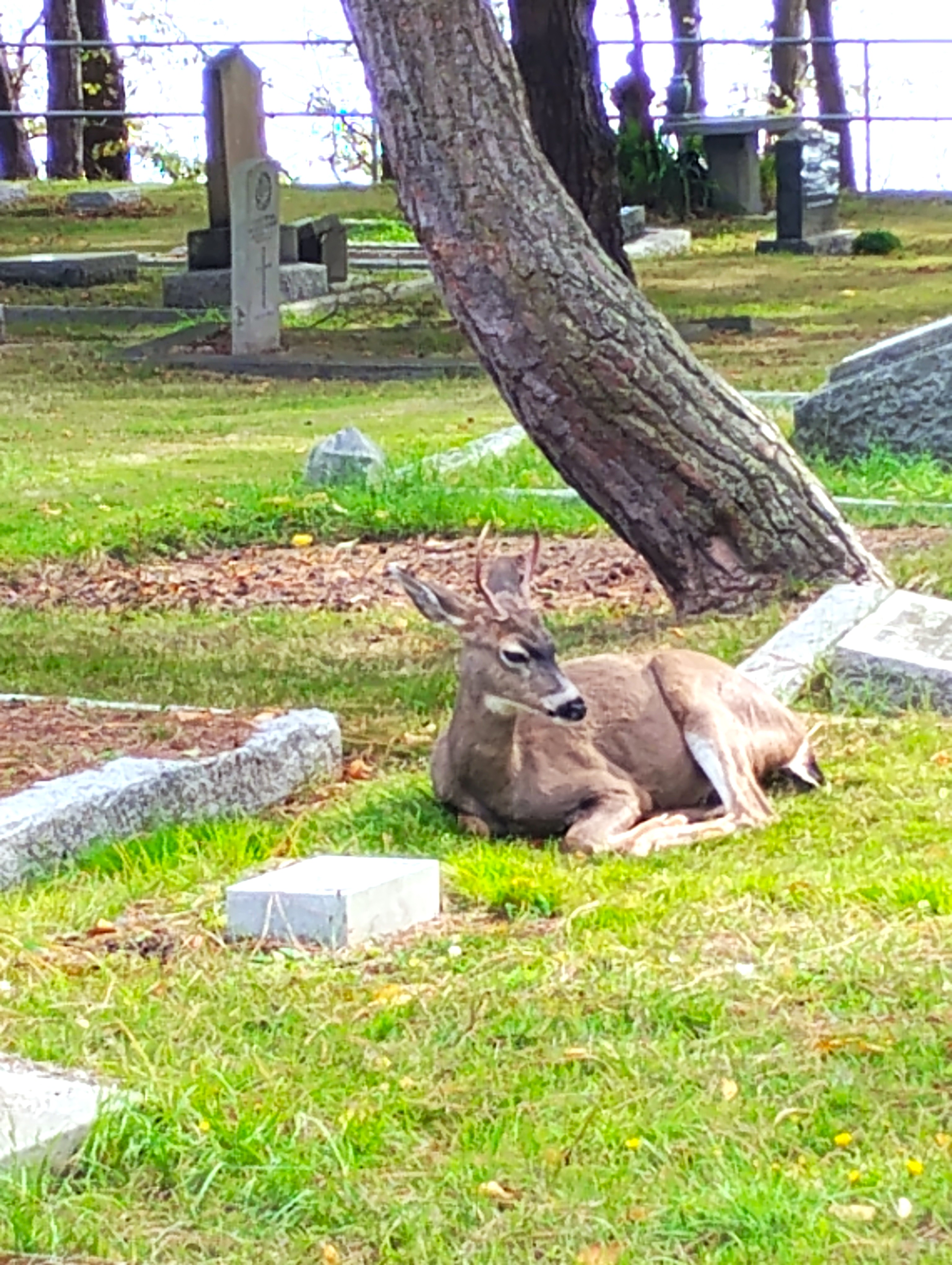
When I was a child living near the Ross Bay Cemetery in Victoria, I never saw deer lying on the graves. Never saw peacocks, or peahens, away from the lawns of Beacon Hill Park. Later, when my family lived at Royal Oak, we sometimes watched deer on the trail by our house, maybe heading for the apple orchards still productive in the area, the ones now turned into subdivisions. Never bears. Sometimes pheasants.

But it’s different now. I pulled off Cook Street onto one of the quiet side-streets to park while I did some errands and there was a peahen with her half-grown chicks. There was a peacock on a fence on Menzies Street, some distance from the Park. And deer? They are everywhere. John and I did our ritual walk in the Cemetery while I told the same stories of riding my bike as a six-year old on the quiet lanes, of listening for the buried creeks under the soft grass and graves, of hovering over the men working on gravestones at Stewart Monumental Works at the top of our street, watching them carve the names of the dead into pink stone or grey. Once my brothers buried me in the sand hoardings under the building–I imagined that it was dust from the stones themselves but learned later that it was sand used to make cement for installations — and how I had to lie there for hours until they remembered me and dug me out. The elderly woman walking with her husband in the Cemetery was telling these stories for at least the tenth time and somehow she was still the girl waiting for her brothers to return. Smelling the iodine sting of the ocean, she remembered Saturday mornings when her mother would give each child a bag and ask them to walk the shore at Ross Bay and collect bark for the wood burner in the kitchen. And she remembered leaving her teddy bear Georgie on Moss Rocks after an afternoon lying among the shooting stars and camas and her father going out in the dark to find him.

I’ve been walkin’ in my sleep
Countin’ troubles ‘stead of countin’ sheep
Where the years went I can’t say;
I just turned around and they’ve gone away

I know I’ve linked to this song before but I was the woman humming it as she walked the Odgen Point breakwater, I was the one so filled with memories of childhood, and later, as we drove past Faithful Street, down Memorial Crescent to find a place a park, I was the one quiet, briefly, in my seat as we passed the old familiar houses. And this song knows about memories. It knows about worn stuffed bears lying in a crevice in the rocks, patient, while a father searched with a flashlight, the family dog to keep him company.

The finest hour that I have seen
Is the one that comes between
The edge of night and the break of day
It’s when the darkness rolls away

“The finest hour that I have seen/Is the one that comes between”

from underground

One of those mornings, the sky soft and promising after a few days of chilly rain and snow creeping down the mountain behind our house, one of those mornings when you turn to each other in bed, saying, Where did they go, the years? Because in another month, you’ll be listening for Swainson’s thrushes just beyond your window, the robins, the long whistles of the varied thrushes, you’ll be planting out the peas you’ve started by the woodstove, looking for the first wild violets, the bleeding hearts.

Where the years went I can’t say;
I just turned around and they’ve gone away.

Which year was it you saw the wolf lope across the grass, the sow bear with her twins in the old orchard, which year was it when you stood with some of the grandchildren around a bonfire, in March, burning decades of windfall?

I’ve been siftin’ through the layers
Of dusty books and faded papers.
They tell a story I used to know
And it was one that happened so long ago.

Was it only last year the snowshoe hare hid under daylilies when you discovered it trying to wriggle under the new fence, was it four years ago, or six, when you dug up a clump of crocus, blooming underground, buried during the reconstruction of the septic field, was it ten years ago, or twenty, when the dogs curled up in the woodshed while deer pillaged the irises in the small pond?

The finest hour that I have seen
Is the one that comes between
The edge of night and the break of day.
It’s when the darkness rolls away.

So you listen again to Kate Wolf, her radiant voice gathering all the years together, where they begin, where they end.

redux: “The blues were annual…”

Note: In Ottawa a few days ago, I was conscious of all our earlier visits, the one where we helped to build a deck for Forrest and Manon, then the next year a pergola. The year we ate prime rib at their table with the rest of our family, all tucked into rooms in the house in Vanier, and how each year there was a new baby, a new paragraph in the family story. Sometimes a new chapter entire. Three years ago on this day we were building that pergola and hoping that the wisteria I’d brought (from John’s grandmother’s garden in Suffolk) would thrive there. (It didn’t. But grapes have!)

reading

Sometimes memory plays its own strange tricks, so that a moment like this brings back all the times I read books to my children, all the books (even this book, Curious George) , all the weight of their bodies on my knees, in my heart. How can the years have gone so quickly, how is it that I hardly noticed them passing? I think of that beautiful Kate Wolf song, “Across the Great Divide”, appropriate to where I am now (Ottawa, far from home):

I’ve been walking in my sleep
counting troubles instead of counting sheep,
where the years went, I can’t say.
I just turned, and they’ve gone away.

I’ve been sifting through the layers
of dusty books and faded papers.
They tell a story I used to know
and it was one that happened so long ago.


And yesterday, hiking the Eagle Nest Trail above Calabogie Lake, the scent of pines (though not Ponderosas), the sound of chipmunks, and I was back in the Nicola Valley with my children, my husband, on one of our family camping trips, the dry air and pollen making our skin mysterious to the touch. Passing the little graveyard in Burnstown, I thought of the Murray churchyard in the old Nicola townsite, the stories I could almost understand as I wrote down the inscriptions, the epitaphs. They were tangled up with my own family stories, the houses we’d lived in, my mother’s attempts to make each one a home as quickly as possible.

In my notebook, “Morning glory” and the date, July 10, 1989. In later gardens, my mother planted a cultivar of morning glory called Heavenly Blue, perhaps forgetting what the white form had done to the roses and peonies. The blues were annual and I don’t remember if they were invasive. Seeds of wild flowers come in the droppings of birds and mammals, hair and fur, the clothing of those passing through. In one corner of the graveyard at Nicola, a tendril of pink field bindweed among the small stinging cacti. In an enclosure of while pickets, a woman who died in childbirth and the daughter who survived her for nineteen days, dying on her mother’s birthday, October 31, 1881, wild iris spreading over their little field of sadness. A young boy nearby, sleeping under the gentle cover of traveller’s joy. God speed them all.

–from “Morning Glory”, in Red Laredo Boots (New Star Books, 1996)